Foucault News

News and resources on French thinker Michel Foucault (1926-1984)

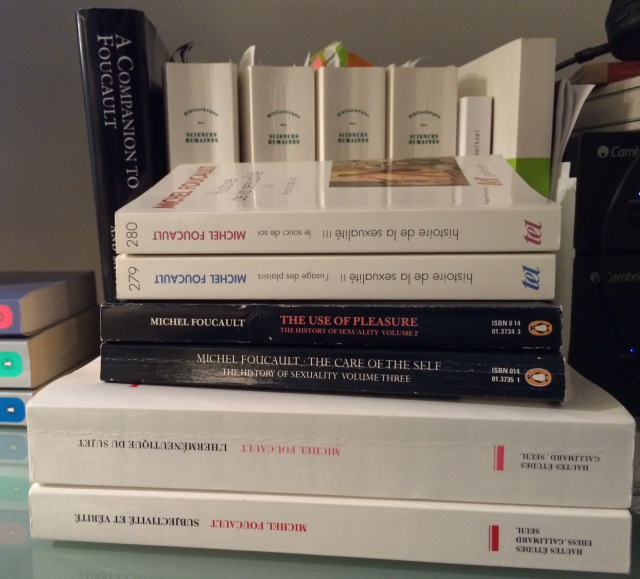
The limit experience blog has posted a collection of what they consider to be bad cover photos of books on Foucault. You may wish to differ or add your own examples!

chevallierPhilippe Chevallier, Michel Foucault. Le pouvoir et la bataille, Presses Universitaires de France, 2014

Further info

L’ouvrage
Le pouvoir n’est pas ce dont certains se saisissent un beau matin, pour ensuite le perdre ou le céder au gré des événements. À la lisière de nos vies, le pouvoir s’exerce et se risque sans cesse. Telle fut la grande leçon de Michel Foucault, marquant la fin des rêves – ceux de la révolution, de la transgression, de la prophétie – et le retour du sérieux en philosophie.
Le pouvoir réserve bien des surprises à celui qui se risque à en faire l’analyse. À la fois fort et faible, sûr de sa fin et équivoque, tenace mais réversible, le pouvoir semble perpétuellement menacé par autre chose que l’opposition réfléchie à son exercice. Comment rendre compte de ce paradoxe du pouvoir sans s’interroger sur son lieu d’émergence, ou – si l’on veut conjurer les chimères de l’origine – sur sa limite ? Quel est cet autre du pouvoir, qui à la fois le sous-tend et le met en péril, et hante l’écriture du philosophe ? Cet autre, nous l’appellerons : la bataille. C’est de cette région obscure autour du pouvoir, peu explicitée par Foucault et pourtant présente dans son œuvre, que nous tenterons d’approcher.

Table des matières

1. La question du pouvoir comme vigilance première du philosophe
1.1. L’éclipse du pouvoir dans le « dernier » Foucault : évaluation critique
1.2. L’ontologie critique de nous-mêmes
1.2.1. Le présent
1.2.2. L’ontologie
1.2.3. La critique
1.3. Le pouvoir sans dehors

2. Le pouvoir ou la bataille ?
2.1. Un indice : l’étude historique des formes judiciaires de la vérité
2.2. Un changement d’hypothèse
2.2.1. Il faut défendre la société (1976)
2.2.2. « Le sujet et le pouvoir » (1982)
2.3. Comment lire un événement ?
2.3.1. L’écriture de l’histoire : enjeu et méthode
2.3.2. L’événement entre régularité et irrégularité
2.3.3. L’archive de l’infamie

3. De deux manières de dire la vérité
3.1. La vérité politique de l’histoire
3.2. La vérité des batailles
3.3. De la patience entendue comme une certaine forme de l’urgence

Épilogue : On a raison de se soulever

A propos de l’auteur
Philippe Chevallier est docteur en philosophie. Il est notamment l’auteur de Michel Foucault et le christianisme (ENS éditions, 2011) et a dirigé avec Antoine de Baecque le Dictionnaire de la pensée du cinéma (Puf, 2012). Il travaille à la Bibliothèque nationale de France.

Michel Foucault: After 1984

Friday, October 17, 2014 9:00 AM – Saturday, October 18, 2014 9:00 AM
Yale University
Whitney Humanities Center (WALL53),
Auditorium
53 Wall St., New Haven, CT 06511
(Location is wheelchair accessible)

Further info

Speakers: Etienne Balibar, Columbia University; Jean-François Braunstein, University of Paris; Wendy Brown, University of California, Berkeley; Judith Butler, University of California, Berkeley; Partha Chatterjee, Columbia University; Arnold Davidson, University of Chicago; Frédéric Gros, University of Paris; Daniele Lorenzini, Université Paris-Est Créteil; Judith Revel, University of Paris

(Department of English and Whitney Humanities Center)

Thirty years after Foucault’s death, this conference undertakes a reassessment of his career and legacy. As the College de France lectures and other works have become available, how do we understand him differently? With the interval of time, what more do we see about his intellectual milieu, his engagement with the times, the prescience of his analysis, or the divergence of our own moment from his?

Open To: General Public
Admission: Free

With thanks to Daniele Lorenzini for this news

geoffroydelagasnerie's avatarLe site de Geoffroy de Lagasnerie

Je participerai, le samedi 20 septembre 2014, à une rencontre sur le thème “Le savoir/Le pouvoir” avec Didier Eribon et Edouard Louis dans le cadre des Rendez-vous philosophiques de la Fondation Deutsch de la Meurthe

Samedi 20/09/2014, Fondation Deutsch de la Meurthe, salle des Fresques, 37 Boulevard Jourdan, 75014 Paris, 15h-17h.

 Logo fondation

View original post

mf-jardin

JOURNÉES EUROPÉENNES DU PATRIMOINE
20 & 21 Septembre 2014

Hommage à Michel Foucault
Exposition~Promenade
Vendeuvre-du-Poitou
« Le jardin du Philosophe »

Vendeuvre du Poitou est situé dans le Haut Poitou, au nord de Poitiers, au milieu des vignes et des terres maraichères, « creusé dans les collines, entre les vallées de la Pallu et de l’Envigne ».

C’est ici, au coeur du village, dans la maison familiale au vaste jardin, loin de l’agitation de la capitale, du bruit et de la fureur des villes que Michel Foucault est venu en vacances, en villégiature, pour se reposer, pour réfléchir et méditer, pour écrire et lire. C’est à Vendeuvre du Poitou que Michel Foucault est enterré, dans le cimetière de son village, non loin de la maison de son enfance.

« Le jardin du philosophe » est un modeste hommage qui a pour double objectif de célébrer l’homme et le philosophe, et de le faire redécouvrir au public poitevin. A l’occasion de la trentième année de sa disparition, Vendeuvre du Poitou souhaite lui rendre hommage pendant les manifestations des Journées du Patrimoine les 20 et 21 septembre 2014, afin de découvrir ou redécouvrir l’homme qui a incarné le chercheur, le professeur, le penseur, le philosophe, l’écrivain, le militant, l’homme engagé ; qui a laissé une oeuvre considérable dont l’importance est toujours d’actualité et qui est célébré dans le monde entier. Ce rendez-vous exceptionnel présentera le philosophe dans le contexte de la maison familiale en visitant son jardin avec l’aimable autorisation de ses propriétaires actuels.

Contact :
Dominique Moullé,
Coordinatrice de la manifestation
06 52 96 55 39

Ouverture Samedi 20 et dimanche 21 septembre / 14h00 18h00 – Accès Libre

Lieu d’exposition : 17, route de Poitiers 86380 Vendeuvre-du-Poitou

Visite de l’exposition et du jardin exclusivement.

Les accès à la maison et aux dépendances ne sont pas autorisés

With thanks to Daniele Lorenzini for this news

Mauricio (see comments) explains that this is one of a series of buildings named after philosophers. So there are also a Nietzsche building and a Durkheim building.
With thanks to Dyogo Leão for this news.


Edifício Michel Foucault

Further info

mf-apartments

01 – Introdução

• Como todo imóvel Ágata, o padrão de acabamento do Edifício Michel Focault é de primeira linha, sendo totalmente revestido com cerâmica. Cada unidade terá direito a 02 (duas) vagas na garagem, e as coberturas, a 03 (três) vagas, sendo todas previamente demarcadas e numeradas. Todo o piso externo e descoberto dos terraços (coberturas, áreas privativas, acesso ao edifício e lazer), será em cerâmica; o da garagem, em concreto “nível zero”; e o da caixa de escadas, em cimento liso, com cantoneiras em alumínio anodizado ou em pedra ardósia. As pingadeiras dos muros/jardineiras e os peitoris das janelas/guarda-corpos serão em mármore polido. O edifício contará com sistema de interfone, proteção contra descargas atmosféricas (pára-raios), prevenção/combate a incêndio, tubulação para tv a cabo ou outras, previsão para medição individualizada do gás de cozinha, 01 elevador, além de se encontrar em ótima localização, o que proporcionará maior conforto e comodidade a você e sua família.

02 – Localização:

• Rua Chapecó, 610 – Prado – Belo Horizonte- MG- CEP: 30410-070

03 – Número de pavimentos

• Total: 13 pavimentos, sendo:

stuartelden's avatarProgressive Geographies

FLD 13I spent some more time on the collaborative projects part of Chapter Six – especially on the report Généalogie des équipements de normalisation: Les équipements sanitaires which has some very interesting material. I say a bit more about this here. I also drew together all the information I know about the collaborative projects from this era here – a resource I hope is helpful and for which I’d welcome additions or corrections.

The last thing, at this stage of drafting, I wanted to complete in Chapter Six was the material on Iran. I reread all the material, and ended up feeling I had little to say. The treatment in Afary and Anderson’s Foucault and the Iranian Revolution is very partial, but they do provide a useful appendix of texts by Foucault and some of his critics, including one that was not published in Dits et écrits. Marcelo Hoffmann’s

View original post 787 more words

New Series: Continental Philosophy in Austral-Asia. Rowman & Littlefield International

Further info

Continental philosophy left home in the second half of the twentieth century, to migrate to the US, Australia, New Zealand, and Asia. It has established itself in the Anglophone world as a minor tradition in philosophy programmes, but also in cultural studies, literature, film, gender studies, sociology and politics programmes. Continental philosophy has been particularly well adapted to attempts to interrogate the socio-historical situation of European colonisation of the new worlds. From Foucault to Deleuze and Guattari to Derrida, Spivak, Agamben, Butler and beyond, continental approaches to philosophy have been able to explore, with apparently less cultural chauvinism, the specificity of the habitats in which thought finds itself. Through this adaptation, continental thought has also been taken up in novel and distinct ways. Not only has geographical displacement enabled continental philosophy to shed new light on antipodal modes of cultural and political life, it has also subjected continental philosophy itself to various kinds of critical pressure.

By responding to environmental, social, cultural and political contexts specific to the countries of Austral-Asia, and by virtue of their distance from the traditions, priorities and hierarchies of the North Atlantic world, philosophers in this region have become known for their original and surprising interpretations and articulations of the ‘continental’ tradition. Taking seriously the commitment to historicity and place found in that tradition, authors in this series challenge the centrality of European culture and shapes of life. They ask how continental philosophy comes to terms with the places that were rendered according to — but that also and in every case exceed and confound — the constraints of European imagination. They ask how the various social and political impasses in which Austral-Asian countries have become entrenched owe their provenance to European modes of thought and of life. They ask how continental philosophy may help to think beyond such impasses, for example: How does continental philosophy assist thinking about the relationship between colonising and indigenous peoples? Or about mutual responsibilities in a multicultural society? Or about our responsibilities to non-human others? How does continental philosophy respond to the challenges to imagination posed by the fragile ecologies of Australia, New Zealand and island nations in Asia that will be most affected by global warming? How does the world conceived according to European traditions of thought and language compare with the non-European worlds of Asia and the Pacific?

This series will seek to show the vicissitudes of European thought in the dreams it had for itself, once it left home to seek its fortune… and to become, perhaps, wiser, or at least more circumspect about its own purity. Far from an exercise in parochialism, then, “Continental Philosophy in Austral-Asia” presents new critical perspectives on philosophical methodologies practiced globally, thereby opening continental philosophy to novel imperatives and trajectories.

The series is developed in collaboration with members of the Australasian Society for Continental Philosophy (ASCP), which was established in 1995 to recognise and support the burgeoning interest in Continental Philosophy in Australian Universities. The ASCP came to include philosophers working in New Zealand, and continues to attract international members and to develop networks with scholars in the broader Asian region. The Society also traverses disciplinary boundaries, serving scholars working with continental philosophy in the fields of English, Cultural Studies, Sociology, Political Theory, and Fine Art. Like the Society, the book series aims to represent the multifaceted and interdisciplinary ways in which continental philosophy is used in Australasia. And also like the Society, the book series will support and promote high quality work of early-career and established scholars alike.

Simone Bignall, P. Diego Bubbio, Joanne Faulkner and Paul Patton

If you would like to submit a proposal, please follow this link to use the RLI proposal form, and send the completed proposal to Joanne Faulkner at j.faulkner@unsw.edu.au.

Mark Kelly

DATE/TIME: Wednesday, 17 September, 3.30pm-5.00pm

PLACE: University of Western Sydney, Bankstown Campus, Building 3, Room 3.G.27  [How to get to Bankstown Campus] http://www.uws.edu.au/campuses_structure/cas/campuses/bankstown

All welcome

ABSTRACT: In this paper, I critically assess Gilles Deleuze’s ‘societies of control’ thesis, in relation to both the work of Michel Foucault which inspired it, and the work of which it inspired in turn, including that of Hardt and Negri, and Lazzaratto. I argue, contra Deleuze and his reading of Foucault, that contemporary society continues to be a form of the disciplinary–biopolitical society identified by Foucault as existing already in the nineteenth century. The argument for this is dual. On the one hand, I point to claims by Deleuze that have not been born out by subsequent development, particularly the claim that disciplinary institutions are breaking down: while some institutions have declined, others (particularly the prison) have massively expanded, leaving no clear pattern of decline. On the other hand, I argue that characteristics specifically assigned to societies of control by Deleuze are already part of disciplinary power as conceived by Foucault, noting indeed that Foucault uses the word ‘control’ as a synonym for discipline.

While acknowledging changes, I thus argue that any transition from Fordism to post-Fordism is at most a modification of disciplinary power, rather than a matter of a new technology of power in a Foucauldian sense. I hence seek to downplay the political importance of this change in favour of a reading of our society as exhibiting continuous tendencies. I conclude by agreeing with commentators who argue that neoliberalism is more accurately characterised as a return to nineteenth century conditions.

Biography
Mark Kelly was appointed Senior Lecturer in the School of Humanities and Communication Arts and ARC Future Fellow at the University of Western Sydney in 2014. His ARC project, ‘The invention of norms: how ethics, law, and the life sciences shape our social selves’ aims to show how the concept of the norm has shaped our understanding of the world, changed our society, and become part of our personal lives. He has authored three books on the thought of Michel Foucault – The Political Philosophy of Michel Foucault (Routledge, 2009), Foucault’s History of Sexuality Vol. I (Edinburgh, 2013), and Foucault and Politics (Edinburgh, 2014) – and published on topics in political philosophy, including a forthcoming book, Biopolitical Imperialism (Zero).


Visit Philosophy @ UWS on Facebook
https://www.facebook.com/philosophyuws
For future research seminars on Philosophy, please visit: http://www.uws.edu.au/philosophy/seminars2014
For further information in Philosophy@UWS, please visit: http://www.uws.edu.au/philosophy

Postponed until later this year

Cartography of Exhaustion

Venue: Morven Brown 310 (map ref C20)University of NSW, Sydney
Who: Peter Pál Pelbart
Peter pal Pelbart.jpg

School of Humanities and Languages and the Biopolitical Research Network

Drawing on Nietzsche’s problematic of nihilism and the question of exhaustion that Deleuze finds in Beckett, this talk will attempt to trace some of the lines required for a cartography of exhaustion. This cartography will be developed in relation to conceptual pairs such as subjectivation/ desubjectivation, bare life/ a life, biopolitics/ biopower. It will touch on the perspectives of Deleuze, Foucault and Agamben, in each case in relation to our contemporary context.

Peter Pál Pelbart is a professor of philosophy at the Catholic University of Sao Paulo and a member, with Suely Rolnik, of the Centre for the Study of Subjectivity. He is also coordinator of the Ueinzz Theater Company and translator of Deleuze and Guattari into Portugese. He has worked especially with the concepts of time, biopolitics, subjectivity, madness, community and with thinkers such as Guattari, Deleuze, Foucault, Nancy, Blanchot, Agamben. He has published in Chiméres and Multitudes and his recent books include O tempo não-reconcilado (Perspectiva, 1998), A vertigem por um fio: Políticas da subjetividade contemporânea (Iluminuras, 2000), Vida Capital, (Iluminuras, 2003), Filosofia de la Desercion: Niilismo, Locura y Comunidad (Tinta Limon, 2009): Cartography of Exhaustion: Nihilism Inside Out, (São Paulo and Helsinki, n-1 Edições, 2013).

For further information contact Paul Patton prp@unsw.edu.au