Foucault News

News and resources on French thinker Michel Foucault (1926-1984)

See also pdf for full program

Print

When
NOV 18, 2014 | 7PM
Where
Albertine Books
972 Fifth Avenue
New York, NY 10075

Further info
Livestream link

On the occasion of the 30th anniversary of the death of Michel Foucault, the Cultural Services of the French Embassy and the Collège International de Philosophie present Minds in Migration: a series of lively debates on contemporary issues.

Non-fiction books, recently translated from French, will serve as a starting point to explore crucial issues such as conflicts and reconciliations, untranslatables, whistleblowing and self-censorship, environmental threats, capitalism and dialogue between religions. Philosophers, novelists, artists, social and political scientists, translators, journalists and movie directors alike will join the conversation and shed light on questions raised by these works.

The debates should not only prove to be great food-for-thought, but hopefully also efficient tools of empowerment.


A discussion about Michel Foucault’s The Courage of Truth (transl. Graham Burchell, Palgrave Macmillan, 2011)

In his last course at the Collège de France, Michel Foucault investigated the function of ‘truth telling’ in politics. In view of sobering revelations such as the Snowden affair, panelists will delve into the subject of self-restraint as contrasted with the risks taken by whistleblowers.

With DIDIER FASSIN (Professor of Social Science, Institute for Advanced Study, Princeton) ANN STOLER (Professor of Anthropology and Historical Studies, New School for Social Research) DIOGO SARDINHA (Chair, Collège International de Philosophie)

Moderated by ERIC BANKS (Director of the New York Institute for the Humanities)

In partnership with the Institute for Public Knowledge and the New York Institute for the Humanities.

WATCH THIS EVENT LIVE ONLINE 7PM EST


Eric Banks is a writer and editor based in New York. A former senior editor of Artforum, Banks relaunched Bookforum in 2003 and was editor in chief until 2008. Banks’s writing has appeared in Bookforum, the New York Times Book Review, the Financial Times, Slate, the Wall Street Journal, Aperture… From 2011 to 2013, he served as president of the National Book Critics Circle. He is a two-term member of the NBCC board of directors and chair of its award committees on Biography and Criticism. He is researching a book about the life and afterlife of Renaissance writer, doctor, and savant François Rabelais.

Didier Fassin is an anthropologist and a sociologist who has conducted fieldwork in Senegal, Ecuador, South Africa, and France. Trained as a physician in internal medicine and public health, he dedicated his early research to medical anthropology. More recently, he has developed the field of critical moral anthropology. He is currently conducting an ethnography of the state, through a study of police, justice, and prison, and analyzes the possible contribution of the social sciences to a public debate regarding security, punishment, and inequality. His recent books include The Empire of Trauma: An Inquiry Into the Condition of Victimhood (2009), Humanitarian Reason: A Moral History of the Present (2011), Enforcing Order: An Ethnography of Urban Policing (2013).

Diogo Sardinha is the Chair of the Collège International de Philosophie in Paris, where he also heads the research program “Violence and Politics” (2010-2016). He studied philosophy in Lisbon and at Paris-Nanterre University before continuing his research in São Paulo and Berlin. He has published L’Emancipation de Kant à Deleuze (Hermann, 2013) and Ordre et Temps dans la Philosophie de Foucault (L’Harmattan, 2011). In 2013, he was a Visiting Scholar at the Institute for Comparative Literature and Society, Columbia University.

Ann  Stoler is Willy Brandt Distinguished University Professor of Anthropology and Historical Studies at the The New School for Social Research in New York. She holds a PHD in anthropology from Columbia University and is known for her writings about the treatment of race in the works of French philosopher Michel Foucault. Stoler has worked on issues of colonial governance, racial epistemologies, and the sexual politics of empire, and is the Founding Director of the Institute for Critical Social Inquiry (ICSI) at the New School for Social Research

 

This Teen Has An Inspiring Message For His Bully, Then Gets Totally Owned By The Bully’s Surprisingly Convincing Rebuttal

In a spoof of a re-enactment style instruction video about bullying, the bully unexpectedly launches into a discourse on Foucault and power.

Foucault’s Risks by Anna Shechtman, Peter Raccuglia & Susan Morrow

November 7th, 2014. Los Angeles Review of Books

Editor’s note: On October 17–18, 2014, Yale University hosted a conference exploring the intellectual and political legacy of Michel Foucault. The Los Angeles Review of Books asked three Yale graduate students to respond to this conference by focusing on what Foucault means for them, as scholars and theorists beginning their careers.

WHEN JUDITH BUTLER came to Yale this month to speak at a conference on “Michel Foucault: After 1984,” she brought the police with her. Students and faculty packed the auditorium to see her, lining the walls and even the stage on which she spoke. If the overcrowded auditorium was a testament to the cult of Butler — echoing the cult of Foucault before her — it also posed a fire hazard. Butler’s public intellectualism became a public safety concern, ushering in campus security to keep the aisles clear. The “policing” of Yale’s Foucault conference was an irony lost on no one — least of all Butler, who made conspicuous eye contact with the officers when referring to Discipline and Punish.

Read more

With thanks to Colin Gordon for sending me this news

stuartelden's avatarProgressive Geographies

Video of my ‘Foucault, Subjectivity and Truth‘ lecture and the discussion following it, at Nottingham Contemporary gallery last night. The introduction is by Emma Moore, the discussion is with Colin Wright, Sophie Fuggle and Alex Vasudevan.

This was a really useful experience for me – it provided a non-negotiable deadline for me to work out what I wanted to say about this 1981 lecture course; but also provided a chance to talk about, and to some extent reinvigorate my enthusiasm for, the project as a whole. The first fifteen minutes or so are probably the best overview of the Foucault’s Last Decade book project I’ve yet delivered; and much of the discussion following the lecture is about the book as a whole, rather than just this lecture course.

View original post

Call for papers

CRMEP 2015 Graduate Conference: Philosophy, Power, Potentialities

Centre for Research in Modern European Philosophy,

Kingston University London, Penrhyn Road campus, KT1 2EE

Thursday 21st – Friday 22nd May 2015

Confirmed keynote speaker: Alenka Zupančič (Slovenian Academy of Sciences and Arts/EGS)

Deadline for abstracts: 28th February 2015

* * *

In a contemporary discourse suffused with the theme of ‘crisis’ – political, economic, educational, social, ecological, technical – what are the resources of philosophy at this moment for thinking power relations and potentialities?

‘Power’ has long been a central concept for philosophy and critical thought. The theme gained particular influence in the wake of Michel Foucault’s studies of the 1970s and ’80s, spurring productive dialogue with different accounts of power and domination provided by the feminist, post-colonial and Marxist traditions, and in race/ethnicity, gender and queer studies. More recent European thought – drawing on influences as broad as Spinoza, Marx, Aristotle, Heidegger, Benjamin, mathematics and religious texts – has provided challenging new resources for thinking power, potency, potentiality, subjectivities and politics.

For all this, to what extent can philosophy in 2014 help comprehend contemporary social and political forces? Can it think the powers and potentialities at work within our modern context? Have the concepts of power, potency and potentiality been adequately theorised? How might these concepts help us to think the relation of theory and practice? How do powers and other force relations manifest themselves in the very location of philosophical and critical thought itself?

We invite papers from a broad spectrum of disciplines engaging with modern European philosophy, on topics that could include (but are not limited to):

  • contemporary conceptualisations of power (Marxist, post-Marxist, post-colonial, feminist and other)
  • historical potentialities
  • theorising the reversibility of social power relations in gender, sexuality and race/ethnicity studies
  • actualisations of philosophy, contemporary impacts
  • theories of resistance
  • the potential of philosophical history: dynamis, energeia, potestas, potentia
  • regimes, discourses, institutions of power
  • power and limits of critique
  • contemporary political power, crisis, and philosophical/critical responses

Please send 300-word abstracts to: crmepagc@gmail.com by 28th February 2015.


Barry Stocker's avatarStockerblog

My latest post at the New APPS group blog

Continuing from my last post on ‘Style of Living versus Juridification in Foucault’, there seems to be me to be something to be gained by thinking about Kierkegaard’s ethics here, even if Kierkegaard’s Christianity and Foucault’s aesthetic self seem rather distinct. The emphasis in Foucault on style or aesthetics of life or existence seems to be be already the object of criticism, in Kierkegaard’s account of the aesthetic (as a mode of life rather than with regard to the appreciation of art and beauty). However, Foucault does refer on occasion to the self as acting on itself in Kierkegaard. So Kierkegaard has a particular importance in suggesting that the self is not just an observing consciousness.

Kierkegaard’s attitude to the self , and modes of living, is in some degree structured by an understanding of the relation between individuality and…

View original post 79 more words

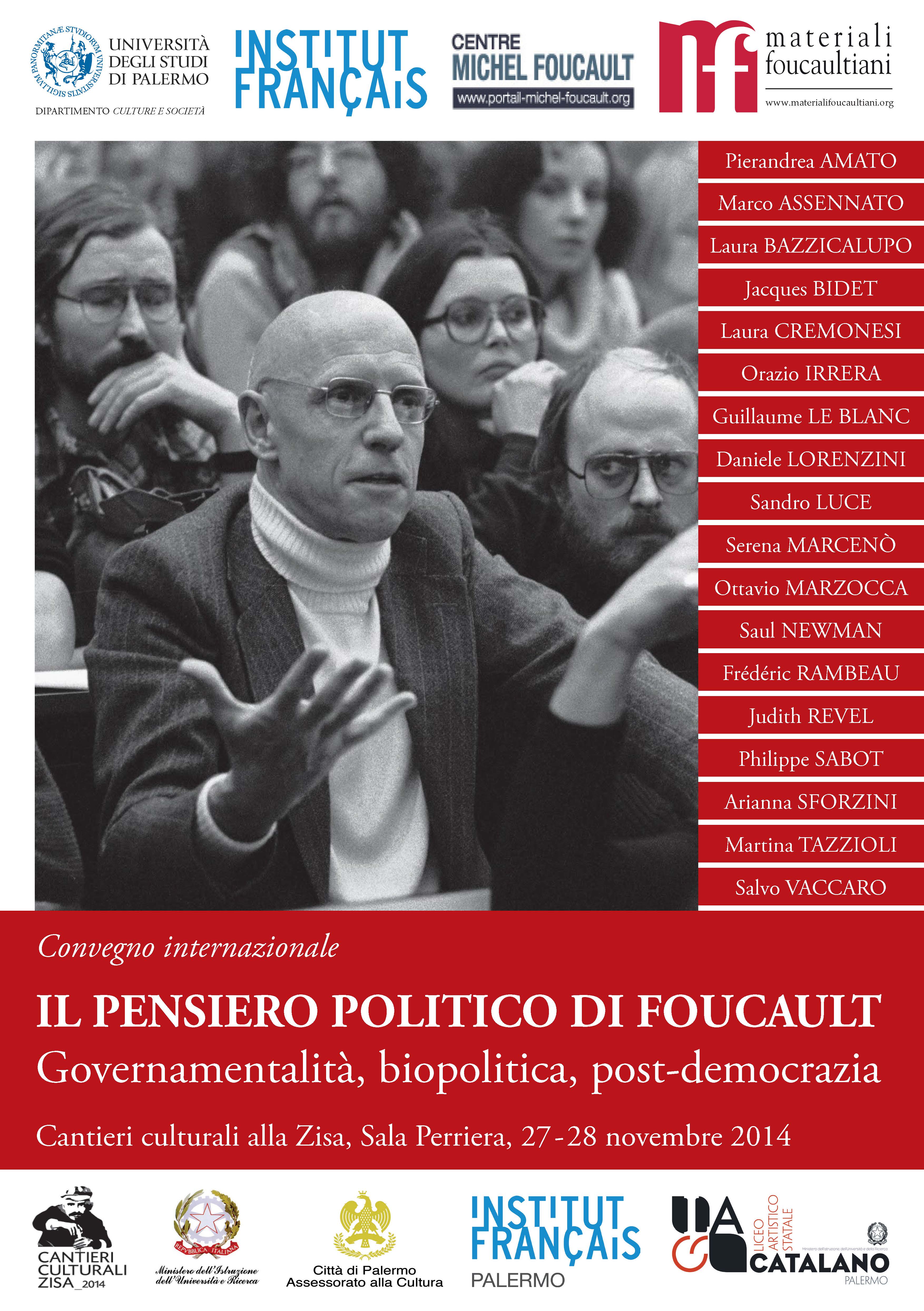
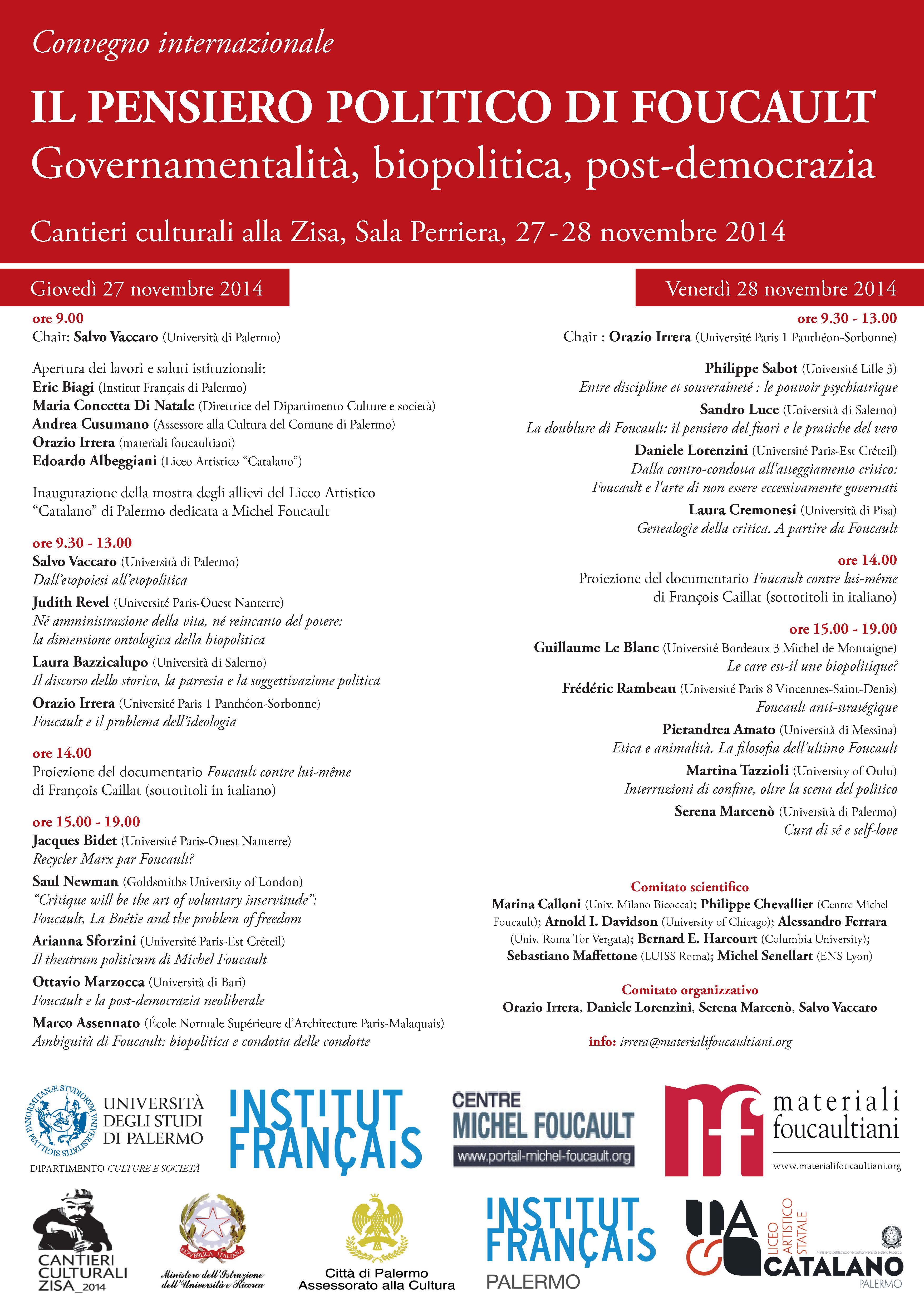
PDF for download

Conference website

Palermo2014_Page_1

Palermo2014_Page_2


CFP: Time Served: Discipline and Punish 40 Years On

Nottingham Trent University is now accepting submissions for their 2015 conference on Michel Foucault‘s “Discipline and Punish.” The deadline for submissions is March 1, 2015.

11-12 September 2015, The Galleries of Justice, Nottingham, UK

40 years after it was first published in French, the impact of Michel Foucault’s seminal text Discipline and Punish on theories of incarceration, discipline and power remains largely unchallenged. The aim of this conference is to revisit the text in light of the past four decades of penal developments, public debate and social consciousness on incarceration as it continues to constitute society’s mode of punishment par excellence.

In addition to thinking through the legacy of Discipline and Punish and its continued relevance today, specific focus will be given to the text itself, its position within Foucault’s wider critical project and its important relationship with his activism most notably the work of the GIP [Groupe d’Information sur les prisons] during the early 1970s. For example, the publication in 2013 of his 1973 lectures at the Collège de France on La Société Punitive, calls for a return to this period and a new engagement with Foucault’s work on prisons, not least in its pursuit of a more openly Marxist critique of the relationship between incarceration and bourgeois capital accumulation.

Here, attention should also be paid to Foucault’s methodology in researching and writing the text. Discipline and Punish marks his movement from an archeological to a genealogical approach towards what he terms the ‘history of the present.’ What is at stake in this shift and how effective is his genealogical method for thinking through the material and discursive structures of incarceration operating within our own society and moment? How does the juxtaposition set up between the torture and killing of Damiens and the prison timetable of the book’s opening raise important questions not simply about punishment but the role of representation – images and narratives of incarceration – in framing public consciousness about the space of the prison?

It is hoped that the conference will bring together a range of participants: scholars working in the fields of philosophy, sociology, criminology, urban geography, architecture, history, literature, media studies as well as artists, writers and activists involved in projects based in and about prisons and their conditions.

If you would like to offer a paper or other form of intervention, please send us a 250 word abstract along with your name, e-mail and (if relevant) institutional affiliation. If you would like to organize a panel of 3 or 4 presenters, please also send a panel title along with the abstracts and contact details.

Deadline for abstracts: 1 March 2015.

E-mail: sophie.fuggle@ntu.ac.uk

The conference is organized by Nottingham Trent University and will be held at the Galleries of Justice in Nottingham.

Call for Papers: Critical Spaces – Disorienting the Topological

Critical Spaces Call for Papers

Facebook page

***The deadline for applications has now been extended to Friday 14th November 2014***

A graduate conference in the critical humanities to be hosted by The London Graduate School at Kingston University, London.

Monday 5th January 2015

Keynote speakers will include:

Claire Colebrook

Eyal Weizman

Eleni Ikoniadou

Fred Botting

Call for Papers:

“The present epoch will perhaps be above all the epoch of space.” — Michel Foucault ‘Of Other Spaces’

“Oh God! I could be bounded in a nutshell and count myself a king of infinite space.” —Hamlet

Foucault’s assertion that the present epoch will be one of space immediately evokes the temporal. Whether we consider our epoch as modern, postmodern, or as nonmodern, the philosophical treatment of space has been subordinated to time. Elizabeth Grosz has suggested that philosophy could draw on architecture to consider itself as a form of building or dwelling rather than as reflection of thought, evoking the spatial already implied by Heidegger. Occupy Wall Street and other recent anti-establishment protests in Brazil and Istanbul have been defined by journalist Bernardo Gutierrez as forming ‘a new architecture of protest’, convened by networks of consensus rather than dominant groups and ideology. Current theories and practices surrounding geopolitics, metamodelling, neuroscience, cartography and choreography support this growing emphasis on spatiality – whether focusing on produced space, social space and spaces of resistance, imaginary and poetic space, psychoanalytical and embodied space, sovereign space, performative space, digital space and/or virtual space.

This conference invites interdisciplinary approaches to the spatial. In particular we are interested in how thinking spatially or spatial practices reveal and open up disruptive, subversive or minoritarian fields within already existing discourses, be they philosophical, political, cultural or aesthetic. As Foucault has done in defining heterotopias, and as Edward Soja shows us through the idea of ‘thirding as othering’, it aims to rupture not only the particularities of those discourses, but the very possibility of thought itself through challenging existing borders, boundaries, horizons, surfaces and planes.

We welcome proposals from all approaches including but not limited to: New Materialisms, Non-philosophy, Philosophy and Praxis, Cultural Studies, Political Theory, Geography, Architecture, Postcolonial Theory, Feminist and Queer Theory, Literature, Visual Cultures, and Art Theory and Practice, which consider space in the broadest terms. We also welcome proposals for practice based approaches and interventions.

Please send abstracts of no more than 300 words to lgscriticalspaces@gmail.com by Friday 31 October 2014.