Foucault News

News and resources on French thinker Michel Foucault (1926-1984)

Francescomaria Tedesco's avatarLe Palais Du Rire

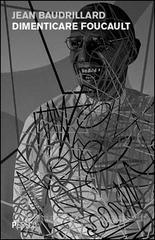
9788868020262A trent’anni esatti dalla scomparsa avvenuta per SIDA, l’autarchico acronimo francese, il 25 giugno del 1984, Michel Foucault è pienamente nel secolo, ovvero nell’opinione comune. Il suo magistero caleidoscopico ed erudito ha sedotto frotte di studiosi, in particolare quelli che hanno risciacquato i panni nella Senna e oggi li stendono al sole dell’Italian theory. E certo la sua riflessione sul potere, sulla sessualità, sul sé, sulla follia, ha fornito un abbecedario teoretico a tutti coloro che hanno pensato di fare i conti col dominio e con la resistenza. Ma Foucault è così utile in proposito, dal momento che la spirale generatrice del potere non è più, per il teorico francese, un’architettura dispotica, ma una filiazione abissale, un vortice e una strofa senza origine? Formulo questa domanda con le parole iniziali del saggio ustorio che nel 1977 Jean Baudrillard intitolò Dimenticare Foucault (tradotto da Cappelli all’epoca e ripubblicato meritoriamente da PGreco…

View original post 311 more words

Michel Foucault: The Late Lectures

Columbia Maison Française

November 7, 2014, a panel discussion with Seyla Benhabib, François Ewald, Bernard E. Harcourt, George Kateb, and Emmanuelle Saada.

In his late Collège de France lectures, Michel Foucault opened up new paths for research, what he so often referred to as “des pistes de recherche,” many of which have only come to light now as a result of the recent publication of the lectures. Ranging from the concept of security to the notion of truth-telling, to the relationship between veridiction and juridiction, to the arts of governing, the hermeneutics of the self, and the notion of “voluntary inservitude,” the late lectures represent a font of new material to allow us to think with Foucault. At the same time, they offer a new lens through which to reread the earlier published works, from the History of Madness, though Discipline and Punish, to the History of Sexuality.

This colloquium will discuss a number of the ideas and concepts that were born and sketched out in the lectures, but that remain today still to be explored.

Panelists:

– Seyla Benhabib is Eugene Meyer Professor of Political Science & Philosophy at Yale University
– François Ewald is Professor Emeritusat the Conservatoire National des Arts et Métiers
– Bernard E. Harcourt is Isidor and Seville Sulzbacher Professor of Law, and Director of Columbia Center for Contemporary Critical Thought at Columbia University
– George Kateb is William Nelson Cromwell Professor of Politics, Emeritus at Princeton University
– Emmanuelle Saada is Associate Professor of French and History at Columbia University (moderator)

Event co-sponsored by the Columbia Maison Française, Center for Contemporary Critical Thought and Heyman Center for the Humanities.

00:00 – Introduction by Emmanuelle Saada
02:04 – Seyla Benhabib
23:20 – George Kateb
40:25 – François Ewald
1:06:35 – Bernard Harcourt
1:24:00 – Q&A

We apologize for some interruptions due to technical problems.

A.C. Lee, Postmodern Velázquez and a ‘Hip-Hop Nutcracker’, New York Times, Dec 11 2014

In Michel Foucault’s  essay on Velázquez’s  baroque masterpiece “Las Meninas,”  he comments on Velázquez’s decision to insert his self-portrait into the painting’s narrative, planting a seed that would bloom into postmodernism.

That blossom continues to flower. “Las Meninas Renacen de Noche (Las Meninas Reborn in the Night),” a new exhibition of photographs by Yasumasa Morimura at the Luhring Augustine Gallery, sees the artist restaging, even remixing, Velázquez’s picture, using the actual canvas, as it hangs in the Prado in Madrid, as the focal point for a series of self-portraits in which Mr. Morimura inhabits different characters from the painting. Foucault clearly didn’t know the half of it.

You can get a first glimpse by attending the opening reception Friday night [19 Dec 2014] from 6 to 8; the show runs from Saturday through Jan. 24.

(Gallery hours: Tuesday through Saturday, 10 a.m. to 6 p.m.; 531 West 24th Street, Chelsea; 212-206-9100; luhringaugustine.com.)

Starting in 1974, not long after Foucault’s book “The Order of Things” — which begins with the Velázquez essay — first appeared in English, you could study postmodern painting in earnest at the New York Studio School, an institution in Greenwich Village that offered an alternative to the kind of traditional academic training that Velázquez would have received. On Saturday afternoon, the Steven Kasher Gallery will host a free symposium exploring the school’s influence, featuring the artists and critics Mira Schor, Barry Schwabsky, Robert Bordo, David Reed and Andrea Belag, in conjunction with the exhibition “12 Painters: The Studio School, 1974/2014,” which runs at the gallery through Jan. 10.

(Saturday at 2 p.m.; 515 West 26th Street, Chelsea; 212-966-3978; stevenkasher.com.)

Jason Maxwell, Killing Yourself to Live: Foucault, Neoliberalism, and the Autoimmunity Paradigm, Cultural Critique, Number 88, Fall 2014, pp. 160-186 10.1353/cul.2014.0038

Further info

In lieu of an abstract, here is a brief excerpt of the content:

Since the English translation first appeared in 2008, Michel Foucault’s The Birth of Biopolitics has become an object of intense fascination within academic circles. While any new translation of Foucault’s work reliably draws a substantial crowd, this lecture series from 1979 solicited more attention than usual because its contents resonated so strongly with the present historical moment. Indeed, The Birth of Bio-politics staged a long-awaited confrontation between two hugely influential discourses. In one corner stood Foucault, who even two decades after his death still received more citations than any other thinker in the ever left-leaning humanities. In the other corner stood neoliberalism, the economic doctrine that had underwritten American conservative political practice since Reagan. Released while a financial crisis was quickly dismantling the global economy, The Birth of Biopolitics shouldered a heavy burden of expectation. Could Foucault’s lectures land a clear and decisive blow to the conceptual foundations of neoliberalism, thereby signaling the end of one nightmarish era and the beginning of a more hopeful one?

The answer, in short, was no. For those anticipating an outright critique of neoliberalism, The Birth of Biopolitics proved to be an undeniable disappointment. Since the lectures actually preceded the election of Margaret Thatcher—lending the book an eerily prescient quality—Foucault could be forgiven for failing to detail the deleterious effects of neoliberalization that would begin in the 1980s. That the lectures refrained from adopting a clear stance toward the neoliberal principles underwriting this process, however, was less forgivable. Although he provides an excruciatingly detailed genealogy of neoliberalism, Foucault never distances himself from this material to offer a summary judgment or word of warning. In fact, Foucault’s engagement with neoliberalism frustrates the desire to place him in a camp that would either firmly reject or proudly affirm it. As he writes elsewhere, “there is not, on the one side, a discourse of power, and opposite it, another discourse that runs counter to it. … [Discourses] can, on the contrary, circulate without changing their form from one strategy to another, opposing strategy” (1980a, 101–2). Foucault shares more in common with neoliberal thinking than many critics would be comfortable admitting. More specifically, while most critiques of neoliberalism target its economism, which casts everything from personal health to familial relationships in the vocabulary of the market, Foucault’s own work also seems to subscribe to these premises. Put in slightly different terms, Foucault’s understanding of historical change, which privileges immanence over transcendence, could easily be characterized as economistic. If Foucault and neoliberalism both deploy an economistic mode of thinking that is rooted in a shared commitment to immanence, where does their work actually diverge? Examining Foucault’s treatment of neoliberalism will not only clarify our understanding of neoliberalism (and why it interested Foucault) but also our understanding of Foucault’s general project.

While acknowledging their many striking similarities, this essay argues that Foucault differs from neoliberal orthodoxy in at least one crucial respect. To echo Fredric Jameson in Postmodernism; or, The Cultural Logic of Late Capitalism, “we have much in common with the neoliberals, in fact virtually everything—save the essentials!” (265). Foucault’s essential difference from neoliberalism can be found in a crucial yet largely overlooked dimension of his engagement with Nietzsche and others concerning immunization as a broad conceptual category. Throughout his work, Foucault explores the dilemmas that emerge when phenomena that promise safety and growth simultaneously present the possibility of injury or even death. For instance, individuals and societies require defense mechanisms for their survival and development, yet the overgrowth of these mechanisms can actually produce harmful or deadly effects. Just as importantly, these defense mechanisms do not shield the individual or community from danger altogether but instead expose them to it in a manageable amount. The difference between poison and cure is one of degree rather than kind. Roberto Esposito has recently argued that this “autoimmunity paradigm” serves as a useful way of diagnosing a variety of phenomena far removed from the term’s medical and juridical origins. He writes that the “demand for exemption or protection” embodied in the auto-immunity paradigm has been gradually “extended to all those other sectors and languages…

Mitchell Dean, Michel Foucault’s ‘apology’ for neoliberalism. Lecture delivered at the British Library on the 30th anniversary of the death of Michel Foucault, June 25, 2014, Journal of Political Power, Volume 7, Issue 3, 2014, pages 433-442

Further info

Link to full paper on academia.edu

Abstract
This lecture evaluates the claim made by one of his closest followers, François Ewald, that Foucault offered an apology for neoliberalism, particularly of the American school represented by Gary Becker. It draws on exchanges between Ewald and Becker in 2012 and 2013 at the University of Chicago shortly before the latter’s death. It places Foucault in relation to the then emergent Second Left in France, the critique of the welfare state, and, more broadly, the late-twentieth-century social-democratic take-up of neoliberal thought. It indicates three limitations of his thought: the problem of state ‘veridiction’; the question of inequality; and the concept of the economy. It also indicates how these might be addressed within a general appreciation of his thought.

Peter Gratton adds some further thoughts to the discussion.

Peter Gratton's avatarPHILOSOPHY IN A TIME OF ERROR

Here. I had been rounding up a post on this but never got around to it, and Stuart makes excellent and helpful points (with the modesty to suggest his views are revisable once the book referenced in the Zamora interview is published). Daniel Zamora’s original interview at Jacobin got picked up quickly by two “libertarian” sources at Reasonand at, of all places least likely to see a reference to Foucault, the Washington Post in the form of Daniel Drezner’s piece on “Why Michel Foucault is the libertarian’s best friend.” First, from Stuart Elden:

Foucault’s mode of reading texts often makes it look like he is agreeing with arguments, when he is really trying to reconstruct them, to understand their logic, and so on. To suggest there is some sympathy to neoliberalism is one thing, to claim he was a neoliberal/libertarian or other labels is quite another. Compare these…

View original post 282 more words

A really useful and informative post by Stuart Elden on the history of the reception of Foucault’s lectures on neoliberalism, in the light of recent activity on this front. He comments ‘Foucault’s mode of reading texts often makes it look like he is agreeing with arguments, when he is really trying to reconstruct them, to understand their logic, and so on’.

stuartelden's avatarProgressive Geographies

FoucaultI’ve been away, but several people have been sending me links to a recent string of articles on Foucault’s supposed sympathies to neoliberalism. The start of the debate – in English at least – was the translation of an interview with Daniel Zamora at Jacobin. The interview relates to a book entitled Critiquer Foucault: Les années 1980 et la tentation néolibérale which has just been published. Clare O’Farrell rounds up the key pieces at Foucault News.

The book is a collective work, edited by Zamora. I’ve not read it yet, and suspect that very few of those commenting on it have either. Anything said now is necessarily provisional.

The first thing that struck me was the question – is this news? Foucault’s 1979 lectures on neoliberalism – the misnamed The Birth of Biopolitics – have been widely available for a decade. They were first published in French…

View original post 994 more words

Ahmad Mohammed Bani Salameh, Foucault’s Descending Individuation: The Unprivileged Under Panoptic Gaze in Shakespeare and Godwin, Dirasat: Human and Social Sciences, Vol 41, No 3 (2014)

Update October 2025: Journal site not connecting. Link above is to the listing of the article on ResearchGate

Abstract
This paper presents new critical insights into two selected literary works from the English literature, Shakespeare’s Measure for Measure and William Godwin’s Caleb Williams, in light of Michel Foucault’s “descending individuation” in Discipline and Punish. Through the lens of this theory, this study illumines these writers’ scathing critique of “descending individuation” in their cultures in which surveillance of individuals goes in an inverse relationship with their socio-economic statuses-namely, the lower one’s social and economic station is, the more liable s/he becomes to panoptic gaze. This paper shows these authors’ dissatisfaction with the flawed justice system of their culture, because surveillance, usually a disciplinary law-enforcement strategy, could backfire if enforced in a descending, prejudiced fashion.

Keywords
Foucault, Descending, Individuation, Disciplinary, Surveillance, Godwin, Shakespeare

The recent interview with Daniel Zamora on neoliberalism is causing quite a stir in the English language world at least.

Brian Doherty, Concerned Leftists Rediscover Michel Foucault Might Not Have Been As Anti-Market as They’d Like on the reason.com site

Daniel W. Drezner, Why Michel Foucault is the libertarian’s best friend, on the Washington Post online site.

Élisabeth Roudinesco: The Living Thought of Michel Foucault
, Verso Books site, 13 November 2014
Élisabeth Roudinesco, author of Lacan: In Spite of Everything, Jacques Lacan & Co. and Madness and Revolution, among many otherson the writing of Michel Foucault, written for Le Monde in May:

Thirty years after his death, Michel Foucault (1926–1984) is famed the world over. Author of a very rich body of teachings whose scope ranges from his critique of norms and institutions to the history of prisons, medicine, madness and sexuality, this philosopher-historian has enticed liberals, social-democrats, erudite scholars and rebels of all persuasions. Each of these different groups, respectively, sees him as an ardent defender of the invention of the self, an unstinting reformist, a sumptuous commentator on ancient Greek and Roman texts, and a brilliant militant for minorities’ causes. In sum, Foucault’s work is more than ever on the order of the day, as demonstrated by the publication of the lectures he gave at the Collège de France between January and April 1981 with regard to subjectivity and freedom.

read more