Foucault News

News and resources on French thinker Michel Foucault (1926-1984)

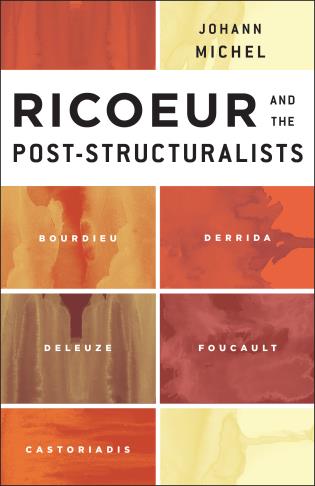
michelJohann Michel, Ricoeur and the Post-Structuralists Bourdieu, Derrida, Deleuze, Foucault, Castoriadis, Translated by Scott Davidson, Rowman & Littlefield, 2014

publisher’s page
French original edition

In this important and original book, Johann Michel paves the way for a greater understanding of Paul Ricoeur’s philosophy by exploring it in relation to some major figures of contemporary French thought—Bourdieu, Derrida, Deleuze, Foucault and Castoriadis.

Although the fertile dialogue between Ricoeur and various structuralist thinkers is well documented, his position in relation to the post-structuralist movement is less-widely understood. Does Ricoeur’s philosophy stand in opposition to post-structuralism in France or, on the contrary, is it in fact a unique variation of that movement? This book defends the latter statement. Michel speaks of post-structuralisms in the plural form and engages them in a dynamic confrontation between Ricoeur and his contemporaries in the French intellectual scene. The result is a better understanding of Ricoeur’s thought and also of the distinctive issues that emerge through confrontation between Ricoeur and each of these post-structuralist thinkers.

Foucault and neoliberalism. A pop-up online reading group.

This is a tumblr blog run by Jason Wilson with invitations to read various texts on Foucault and neoliberalism in live sessions on google hangouts.

Mark Kelly, Michel Foucault: Political Thought, Internet Encyclopedia of Philosophy.

The work of twentieth-century French philosopher Michel Foucault has increasingly influenced the study of politics. This influence has mainly been via concepts he developed in particular historical studies that have been taken up as analytical tools; “governmentality” and ”biopower” are the most prominent of these. More broadly, Foucault developed a radical new conception of social power as forming strategies embodying intentions of their own, above those of individuals engaged in them; individuals for Foucault are as much products of as participants in games of power.

The question of Foucault’s overall political stance remains hotly contested. Scholars disagree both on the level of consistency of his position over his career, and the particular position he could be said to have taken at any particular time. This dispute is common both to scholars critical of Foucault and to those who are sympathetic to his thought.

What can be generally agreed about Foucault is that he had a radically new approach to political questions, and that novel accounts of power and subjectivity were at its heart. Critics dispute not so much the novelty of his views as their coherence. Some critics see Foucault as effectively belonging to the political right because of his rejection of traditional left-liberal conceptions of freedom and justice. Some of his defenders, by contrast, argue for compatibility between Foucault and liberalism. Other defenders see him either as a left-wing revolutionary thinker, or as going beyond traditional political categories.

To summarize Foucault’s thought from an objective point of view, his political works would all seem to have two things in common: (1) an historical perspective, studying social phenomena in historical contexts, focusing on the way they have changed throughout history; (2) a discursive methodology, with the study of texts, particularly academic texts, being the raw material for his inquiries. As such the general political import of Foucault’s thought across its various turns is to understand how the historical formation of discourses have shaped the political thinking and political institutions we have today.

Foucault’s thought was overtly political during one phase of his career, coinciding exactly with the decade of the 1970s, and corresponding to a methodology he designated “genealogy”. It is during this period that, alongside the study of discourses, he analysed power as such in its historical permutations. Most of this article is devoted to this period of Foucault’s work. Prior to this, during the 1960s, the political content of his thought was relatively muted, and the political implications of that thought are contested. So, this article is divided into thematic sections arranged in order of the chronology of their appearance in Foucault’s thought.

Read more

The Centre for the History of European Discourses (CHED) at the University of Queensland (Australia) is looking for well-qualified and innovative postdoctoral researchers (no more than 5 years out of their PhD by June 30, 2015) whom it can support as applicants to the University of Queensland’s Postdoctoral Fellowship scheme, which offers full-time research-only positions for a period of three years beginning in January 2016. We are particularly interested in candidates specialising in the history of sexuality/history of medicine. A team of researchers within the Centre is currently working on topics in the intellectual and cultural history of sexuality, including Professor Peter Cryle and Dr Karin Sellberg.

Interested researchers should send their CV and a brief (200 word) outline for a project to Peter Cryle p.cryle@uq.edu.au and Karin Sellberg k.sellberg@uq.edu.au by February 8 2015

The criteria for selection are:
1.the quality and innovation of the project
2. neatness of fit with the centre’s research strengths
3. a relatively established record of publication in the field.

For further information, please visit CHED’s website or contact Peter Cryle p.cryle@uq.edu.au and Karin Sellberg k.sellberg@uq.edu.au

The comments quoted here appear at the end of a post from Barry Stocker’s blog reblogged earlier on Foucault News http://foucaultnews.com/2015/01/02/another-liberty-canon-foucault/

Brandon Christensen's avatarNotes On Liberty

Jacques and Barry had an excellent back-and-forth on Barry’s post about Foucault’s contributions to liberty. Here is Dr Stocker’s final response to Dr Delacroix’s questions:

Well Jacques, my last comment was not supposed to be the full reply to your preceding comment, as I tried to make clear. As I said I needed time to think before posting anything from Foucault. I was just preparing the way with comments on the background to Foucault’s style. On Montaigne, how easy is Montaigne? Maybe he seems clear to you and other French people who read him in the Lycée. I teach a lot of Montaigne in Istanbul and students don’t find him easy. Maybe his style at a sentence by sentence level is clearer than Foucault, but I would say only Foucault at his most supposedly obscure. Montaigne can seem clear because he writes in a conversational way, appearing to just comment…

View original post 1,306 more words

Séminaire « Avec Foucault 2015»
Responsable : Philippe Sabot

1ère séance de l’année 2015 : jeudi 29 janvier 2015, 16h30-18h30
Intervention de Philippe Sabot (STL / Lille 3) : « Archives »

Université Lille 3, Bât. B, salle de séminaire STL (B1. 663)

Seront proposés les premiers résultats d’un travail en cours sur les archives de Michel Foucault en dépôt à la BnF. Il sera question notamment du “Dossier préparatoire” aux Mots et les choses (le “fichier” de Foucault) mais aussi des méditations foucaldiennes sur le thème archéologique dans ce qu’il est convenu d’appeler son “Journal intellectuel”.

MOVIE REVIEW: ‘Blackhat’: Techno-thriller hacks into Michael Mann’s directorial signatures, By Peter Suderman — Special to The Washington Times – – Friday, January 16, 2015

The cinematic world of Michael Mann, the director behind “Heat,” “Collateral,” “The Insider” and “Miami Vice,” might look more or less like ours on the surface, but in fact it’s an alternate universe with unique rules and customs.

It’s a world in which the top three buttons of any men’s shirt are useless and designer sunglasses are always at hand. It’s a world of ultramodern architecture and eerie neon urban vistas, a world in which no human ever says “hello” or “goodbye” while on the telephone, and in which the most powerful form of communication between two individuals is the glower, the glance, the look that is at one mysterious and perfectly telling.

[…]

The alpha-hacker at the center of it all is Nicholas Hathaway (Chris Hemsworth), a convict with the legendary ability to penetrate practically any computer security system. When we first encounter him, he’s in prison, listening to high-end headphones and reading Foucault. He wears his hair long, in a lionlike blonde mane, and his biceps look like chiseled marble. He gets into trouble with the prison guards. Then he does some push-ups, just because.

Read more

stuartelden's avatarProgressive Geographies

Update 19Since the last update I’ve spent two long days working on the individual chapter files, checking and rechecking things, filling in references, and reorganising some things. In particular I reworked all the parts on the lettres de cachet. I’ve decided I need to re-read Le désordre des familles once more and might say more about it. It’s one of Foucault’s least-known works, but he worked on this topic, on and off, in the 1960s, 1970s and 1980s. This book is hard to fit into the overall chronology because it spans so much time, and I’m not yet convinced with how I’m dealing with it. I’ll be taking a copy with me to Melbourne.

I now have a single file for the manuscript of this book. It’s not quite as good as I’d hoped to have at this stage, and there are still lots of things to do. The book is…

View original post 388 more words

Catarina Dutilh Novaes, Conceptual genealogy for analytic philosophy – Part II.4: Foucault on archeology and genealogy, New APPS: Art, Politics, Philosophy, Science, 13 January 2015

Extract
I am now back to working on my conceptual genealogy project; this post is the fifth installment of a series of posts on the project.  Part I is herePart II.1 is herePart II.2 is here; Part II.3 is here; a tentative abstract of 2 years ago, detailing the motivation for the project, is here.

In this section, I pitch genealogy against its close cousin archeology in order to argue that genealogy really is what is needed for the general project of historically informed analyses of philosophical concepts that I am articulating. And naturally, this leads me to Foucault. As always, comments welcome! (This is the first time in like 20 years that I do anything remotely serious with Foucault’s ideas: why did it take me so long? Lots of good stuff there.)

—————————————–

I hope to have argued more or less convincingly by now that, given the specific historicist conception of philosophical concepts I’ve just sketched, genealogy is a particularly suitable method for historically informed philosophical analysis. In the next section, a few specific examples will be provided. However, and as mentioned above, I take genealogy to be one among other such historical methods, so there are options. Why is genealogy a better option than the alternatives? In order to address this question, in this section I pitch genealogy against one of its main ‘competitors’ as a method for historical analysis: archeology. Naturally, this confrontation leads me directly to Foucault.

As is well known, early in his career Foucault developed and applied the archeological method in a number of works, which then received a more explicit methodological reflection in The Archaeology of Knowledge (1969).

An “archaeology of knowledge” is an investigation that examines artifacts unearthed in an excavation, but the kind of artifact is not bone, pottery, or metalwork, it is what people said and wrote in the past: their “statements” (in French, énoncé: what has been enunciated or expressed). (Packer 2010, 345)


Read more