Foucault News

News and resources on French thinker Michel Foucault (1926-1984)

Colin Gordon, « Le possible : alors et maintenant. Comment penser avec et sans Foucault autour du droit pénal etdu droit public », Cultures & Conflits [En ligne], 94-95-96 | été-automne-hiver 2014, mis en ligne le 20 février 2016. URL : http://conflits.revues.org/18899

See academia.edu site for full text

Résumé
En essayant de contextualiser les enjeux des interventions de Michel Foucault à propos du droit pénal et de retrouver leur logique à l’intérieur du déroulement de son travail, ce texte tente de dégager en quoi Foucault a pu alors aider, d’un façon singulière, à ouvrir au moins pour un moment de nouvelles conceptions du possible. Pour faire ceci, il faut repérer à la fois les constantes et les éléments de déplacement dans le point de vue de Foucault sur le droit. Sous son refus notoire d’une juridification de l’analyse politique, il faut remarquer et prendre en acte une analyse historique positive, riche et complexe des engrenages entre droit, pouvoir et vérité. En reprenant en même temps les analyses (dites « prémonitoires ») de Foucault sur le néolibéralisme et ses travaux des années 1980 sur les jeux de vérité, on essaie enfin de dégager quelques pistes pour réouvrir, en notre présent à nous, une conception du possible en matière juridico-pénale.

Abstract
Seeking to contextualise the issues of Michel Foucault’s interventions relating to penal law, and to trace the logic of their development through the course of his work, this paper tries to recapture how Foucault was able in a singular way to open up for his time a new sense of the possible. This involves identifying both the invariants and the areas of displacement in Foucault’s viewpoint on law. Alongside his well-known rejection of a juridified mode of political analysis, one needs to notice and retrieve a positive, rich and complex historical analysis of the intermeshing of law, power and truth. Taking up side by side Foucault’s “premonitory” analyses of neoliberalism and his research in the 1980s on games of truth, the paper concludes by seeking to elicit some heuristics to help open up, in our own, altered present, a sense of the possible in juridico-penal practice.

Plan

« Ce qui était possible alors… »
Le possible, maintenant ?
Foucault et le droit en général
Constantes et négations
La Justice est servie
Foucault et le droit en général : plaies et accusations
Foucault et le droit en général : confusions, positivités
Positivité historique et généalogique du droit
Le droit public
Les séquelles de Surveiller et Punir : les mutations du droit et de l’histoire de la gouvernementalité
Foucault en 1980-84 : droit et pénalité dans le « trip gréco-latin »
Néolibéralisme et pénalité : la prescience de Foucault ?
Penser l’actualité, avec et sans Foucault : propositions
Néolibéralismes et illégalismes
Aveu et parrhésia des intellectuels spécifiques
Foucault et Badinter : jeu des conduites, cadre du droit ?
Conclusion : le possible alors et maintenant
Douter
Indocilité et inquiétude

Presentation by Matteo Pasquinelli and discussion – Devices of Affective Surveillance (2015)

Michael Bibby, Selections from Foucault’s Lectures on ‘Security, Territory, Population’ at the College de France (1977-78)

“Michel Foucault’s art consisted in using history to cut diagonally through contemporary reality. He could speak of Nietzsche or Aristotle, of expert psychiatric opinion or the Christian pastoral, but those who attended his lectures always took from what he said a perspective on the present and contemporary events.”

A selection from Foucault’s lectures at the College de France between 1977-78 titled Security, Territory, Population.

…if I had wanted to give the lectures I am giving this year a more exact title, I certainly would not have chosen “security, territory, population.” What I would really like to undertake is something that I would call a history of “governmentality.”

[WORK IN PROGRESS]

11 January 1978

In the seventeenth century, and at the beginning of the eighteenth century, the town still had a particular legal and administrative definition that isolated it and marked it out quite specifically in comparison with other areas and spaces of the territory. Second, the town was typically confined within a tight, walled space, which had much more than just a military function. Finally, it was much more
economically and socially mixed than the countryside.

…the growth of trade, and then, in the eighteenth century, urban demography, raised the problem of the town’s compression and enclosure within its walls. […] Broadly speaking, what was at issue in the eighteenth century was the question of the spatial, juridical, administrative, and economic opening up of the town: resituating the town in a space of circulation.

Take a text from the middle of the seventeenth century, La Metropolitee, written by someone called Alexandre Le Maitre. […] The problem of La Metropolitee is: Must a country have a capital city, and in what should it consists? Le Maitre’s analysis is the following: The state, he says, actually comprises three elements…; the peasants, the artisans, and what he calls the third order, or third estate, which is, oddly, the sovereign and the officers in his service. The state must be like an edifice in relation to these three elements. The peasants, of course, are the foundations of the edifice, in the ground, under the ground, unseen but ensuring the solidity of the whole. […] The foundations will be the countryside… . Le Maitre sees the relationship between the capital and the rest of the territory in different ways. It must be a geometrical relationship in the sense that a good country is one that, in short, must have the form of the circle, and the capital must be right at the centre of the circle. […] The capital must be the ornament of the territory. […] The capital must give the example of good morals. The capital must be the place where the holy orators are the best and are best heard, and it must also be the site of academics, since they must give birth to the sciences and truth that is to be disseminated in the rest of the country. Finally, there is an economic role: the capital must be the site of luxury so that it is a point of attraction for products coming from other countries, and at the same time, through trade, it must be the distribution point of manufactured articles and products, etcetera.

…the interesting thing is that Le Maitre dreams of connecting the political effectiveness of sovereignty to a spatial distribution. […] In short, Le Maitre’s problem is how to ensure a well “capitalized” state, that is to say, a state well organized around a capital as the seat of sovereignty and the central point of political and commercial circulation.

See more

Videos on youtube of lectures referring to Foucault

Institute for Philosophy and Social Theory, [Institut za filozofiju i društvenu teoriju] University of Belgrade is the only scientific research institutions in Serbia which deals with research in the field of philosophy and social theory in a systematic and long-term way. As part of its scientific activities, the Institute combines fundamental philosophical research with a multi-disciplinary (sociology, political science, legal, anthropological) study of the society problems.

The Center for Ethics, Law and Applied Philosophy (CELAP) is a think-tank based in Belgrade, Serbia. CELAP’s founders are philosophers, lawyers, political scientists and anthropologists, but also architects and urban theoreticians.

Sokhi-Bulley, B.
Performing Struggle: Parrhēsia in Ferguson
(2015) Law and Critique, 4 p. Article in Press.

DOI: 10.1007/s10978-015-9152-1

Abstract
‘The enigma of revolts.’ You can almost hear the sigh at the end of this sentence. Foucault is making a statement here, published under the title ‘Useless to Revolt’, on that ‘impulse by which a single individual, a group, a minority, or an entire people says, “I will no longer obey”’. In this short piece, I question the two sides of the enigma—how to label the revolt—is the act of rioting, such as what we witnessed in Ferguson, Missouri in August 2014 ‘proper resistance’—and, how to understand the ēthos of the rioter. The label of counter-conduct, I argue clarifies the enigma as it allows us, challenges us even, to see the event as political. Counter-conduct provides a new framework for reading spontaneous and improvised forms of political expression. The rioter can then be seen as political and rational, as demonstrating ethical behavior. The ēthos of this behavior is represented as an ethics of the self, a form of parrhēsia where the rioter risks herself and shows courage to tell the truth, the story of her community.

Keywords
Counter-conduct; Ferguson; Parrhēsia; Resistance; Riots

Wyly, E.
Where is an author?
(2015) City, 19 (1), pp. 5-43.

DOI: 10.1080/13604813.2014.962897

Abstract
If you’re reading these words on a digital device, we are not alone: our encounter as author and reader is taking/making place in and through an uneven, evolutionary planetary digital infrastructure of cognitive production, measurement and monetization. Five and a half millennia after symbolic discourses of literacy and authorship co-evolved with the first urban revolution, the material, embodied phenomenological encounters of planetary urbanization have arrived at the precise moment of explosive contingency in the scalar nexus between cities and literacy. ‘What is an author?’, Foucault asked in a brilliant lecture in Paris in February 1969. Today, if we put Foucault’s question into an intertextual dialogue with contemporary critical urban theory as well as earlier elements of Comte, Marx and Kant, we gain fresh insight into the ways reading and writing are being reconstituted through partially automated constellations of quantification and commodification of human consciousness. Foucault’s genealogy of the ‘author function’ has become an increasingly contested and lucrative circuit of accumulation as Marx’s concept of the ‘general intellect’ has materialized through the transnational urban networks of what is now widely described as ‘cognitive capitalism’. The growth and evolutionary adaptation of socially networked cultures of reading, viewing, sharing and writing are now performing a new neo-Kantian time-space construction of sense perception in a planetary version of Harvey’s ‘urbanization of consciousness’, putting individual authors into constitutive conversation with global knowledges once imagined by Comte as the ‘Great Being’ of collective intergenerational inheritance of post-theistic human knowledge.

Keywords
cognitive capitalism; cyborg; Foucault; general intellect; planetary urbanization

Lingard, B.
Thinking About Theory in Educational Research: Fieldwork in philosophy
(2015) Educational Philosophy and Theory, 47 (2), pp. 173-191.

DOI: 10.1080/00131857.2013.793928

Abstract
This article responds to and reflects upon the articles in this special issue. Specifically, it deals with the usage of theory in each of the articles, what we might see, as examples of re-descriptive usage in autonomous theorizing. The articles utilize different theories and varying intellectual resources—Foucault and Deleuze (Richard Niesche), Bourdieu (Carmen Mills), Levinas (Sam Sellar) and Butler (Christina Gowlett)—to analyse the topic of the My School website and associated new accountabilities in Australia schooling. This article argues that their usage of the My School website must be seen as a condensation symbol to signify a broader neo-liberal agenda in Australian schooling that has global as well as national elements to it. The fact that the social today is no longer straightforwardly homologous with the nation also challenges ‘methodological nationalism’ and suggests the pressing need to ‘deparochialize’ theory in research and reject a reading of Northern theory as universal. The article uses the provocations of these articles to reflect upon the necessity of theory in educational research more generally, and to consider its usage in research with different purposes, while accepting that theory should be endemic in all stages of research. Theory serves a different purpose in research with different goals; quantitative correlational research demands theory to move to explanation, interpretive research requires theory to strengthen interpretation and plausibility, while critical research utilizes theory to uncover the hidden as a step towards emancipation. These articles implicitly suggest alternative forms of accountability and politics, but I argue in conclusion that, additionally, we need a broader politics that will move us towards a non-utopian post neo-liberal social imaginary.

Mark G. E. Kelly, Foucault and Neoliberalism Today, Contriver’s Review, March 2015

Late last year, a PhD student in Belgium, Daniel Zamora, published a smallish edited collection of essays in French called “Criticising Foucault” (Critiquer Foucault). An interview he gave in relation to the book was translated into English for the Leftist journal Jacobin and then widely shared on social media. This interview contains some interesting and worthwhile discussion, but the strapline of the English translation (absent in the French original) focuses on an allegation that Michel Foucault had an “affinity” for neoliberalism, and indeed it is this claim of Zamora’s that leads the subsequent interview. The interviewer sets up the claim that Foucault was a neoliberal as something new and shocking, but it has been aired in Foucault scholarship for a decade at least (not least in articles now reprinted in Zamora’s collection). Despite this, search online for “Foucault” and “neoliberalism” and it’s now this interview that pops up first.

It is not so much that I have a specific gripe with Zamora—whose work I have not read, though I have read other work in his collection—but rather that I want to contradict both the likely impression that the allegation of neoliberalism against Foucault is some new scandal, and also that there is substance to that claim. And I won’t do the latter full-frontally, through point-by-point refutation. I will leave that to future scholarly work. I find these allegations almost entirely without merit and, here, I will explore the political motives and effects.

The first time I encountered the accusation that Foucault was a neoliberal was at a conference in London in 2004. The accuser was an American graduate student from Harvard’s history program, Eric Paras, who would go on to publish a reading of Foucault, entitled Foucault 2.0, which cherry-picked the most extreme moments in Foucault’s output and assembled them to make him into a figure of wild contradictions.

Gibson, K.E., Dempsey, S.E.
Make good choices, kid: biopolitics of children’s bodies and school lunch reform in Jamie Oliver’s Food Revolution
(2015) Children’s Geographies, 13 (1), pp. 44-58.

DOI: 10.1080/14733285.2013.827875

Abstract
In recent debates surrounding childhood nutrition and US school lunch reforms, the child’s body serves as a contested battleground in a destructive politics of blame over obesity and diabetes. Scalar discourses of the body play a significant role in constructing food-related problems and their solutions. We illustrate our claims through a critical analysis of Jamie Oliver’s Food Revolution; a celebrated national television program centered on chef Oliver’s attempts to address childhood nutrition through school lunch reform. Informed by Foucault’s biopolitics, our analysis highlights how moralizing scalar discourses of the body frames nutrition as an individual problem of personal choice. Food politics, when played out at the scale of young bodies, masks class divisions, marginalities, and governmental policies that structure access to nutritious food in the US school lunch system. Increased attention to biopower, scalar politics, and the political economy of childhood nutrition in the space of US public schooling challenges naturalized ideologies of food choice that regulate and delimit change to the scale of the body.

Keywords
biopower; childhood nutrition; media discourse; scalar politics; school lunch reform

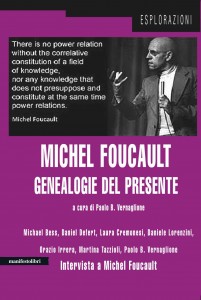
manifestolibriMichel Foucault. Genealogie del presente, Con un’intervista a Michel Foucault e un’intervista a Daniel Defert
Saggi di Laura Cremonesi, Daniele Lorenzini, Orazio Irrera, Martina Tazzioli, Paolo B. Vernaglione
Manifestolibri, 2015

Further info

Dall’Introduzione al volume:

L’occasione di questa pubblicazione è stato il trentennale della scomparsa di Michel Foucault. Nel 2014 in tutto il mondo convegni e libri hanno reso testimonianza dell’opera di chi, a ragione, può essere considerato tra i grandi della storia del pensiero. Ma l’occasione non ha fatto e non può fare di Foucault un “classico” della filosofia, o dell’epistemologia, tantomeno la sua vasta produzione può essere circoscritta nell’area accademica ­– benchè ormai università e centri di formazione, luoghi di produzione e condivisione del sapere e imprese editoriali abbiano moltiplicato l’interesse per l’autore dei corsi al College de France. La figura di Foucault infatti, come accade a quei filosofi che da una posizione decentrata riscrivono categorie e forme del sapere, vive in questi anni di un paradosso: un pensiero del fuori e una cultura della marginalità sono stati indagati e compresi a partire dalle scansioni temporali che filosofi, storici ed epistemologi hanno assegnato ai grandi eventi e ai passaggi d’epoca, l’antichità, l’epoca classica, la modernità. Con Foucault infatti la pratica della storia ha aperto il pensiero, infrangendo le barriere disciplinari e gli specialismi, per catturare un’ontologia del presente di cui l’attualità chiede la restituzione.

Del resto il paradosso di un archeologo non può che essere questo. D’altra parte produrre discorso nell’orizzonte di una critica radicale del sapere, dei rapporti di potere e delle forme di soggettivazione comporta una reazione forte di quella modernità che è stata criticata e messa in scacco con i suoi stessi strumenti concettuali.

Da questa particolare postura, assunta nell’elaborazione di un metodo genealogico, a partire dagli scorsi anni Sessanta, si stacca la problematizzazione dello strutturalismo e della fenomenologia, e deriva quello sguardo trasversale sul sapere e la storia che ha molto in comune con il gesto sovversivo di Nietzsche nei confronti della metafisica. L’”uso” che è stato e continuerà ad essere fatto del pensiero di Foucualt costituisce, non solo per questi motivi, il lascito più importante e produttivo per le generazioni a venire. Infatti movimenti di contestazione, comunità gay, teorici politici radicali, nonchè quei rari filosofi che assumono l’archeologia dei saperi e del linguaggio come orizzonte complessivo di ricerca, e la genealogia come metodo analitico, hanno continuato l’opera foucauldiana, rendendo esplicito l’intreccio inestricabile di pensiero e prassi e sgombrando in via definitiva il campo sia dall’ideologia dell’intellettuale come figura separata dalla società, ideologia resistente fino a Sartre, sia dall’idea che la militanza politica escluda la riflessione e sia l’orizzonte esclusivo dei conflitti.

D’altra parte la ricerca e il dibattito intorno alla follia, all’organizzazione discorsiva dei saperi, ai dispositivi disciplinari e alle forme di soggettivazione vivono nella contraddizione che si è aperta tra ricezione del pensiero di Foucault e la rilettura più o meno filologica della sua opera. Ricerca e confronto che hanno impegnato almeno tre generazioni di studiosi, militanti e ricercatori, prima di acquisire il rango di tematiche del presente, con l’inevitabile genericità che comporta l’adattamento ad un’attualità che le respinge, di questioni inscritte nella carne viva di esistenze compromesse. Così, mentre negli anni Sessanta il metodo inaugurato da Le parole e le cose e L‘ Archeologia del sapere si scontrava con la tradizione storicista e lo strutturalismo, risultando di difficile penetrazione anzitutto in Francia, negli anni Settanta la stagione dei conflitti operai e studenteschi produceva un controeffetto sul lavoro che Foucault sviluppava sulle istituzioni disciplinari e la microfisica del potere, annodando riflessione e pratica politica, teoria e analisi delle contraddizioni del capitalismo nel confronto con il pensiero di Marx, letto a sua volta per la prima volta fuori e contro i “marxismi”.

Laddove poi la modernità assumeva l’abito e il ritmo della “modernizzazione”, negli anni Ottanta, la grande riflessione di Foucault sulle pratiche di soggettivazione, la parresia, la cura di sè e il governo dei viventi, rendevano esplicito il rapporto essenziale tra l’ “inattualità” del metodo archivistico e la registrazione del presente, dotando il pensiero di un formidabile strumento di penetrazione di una realtà considerata debole perchè postideologica. Ciò che è successo dopo, con la pubblicazione progressiva dei Corsi, dell’impressionante mole dei Dits et Ecrits e con la progressiva pubblicazione delle conferenze e degli interventi degli anni Ottanta, di cui abbiamo anche parziale testimonianaza on line con le registrazioni audio e video, ha contribuito in larga misura a rendere popolare la ricezione e l’ascolto di Foucault, aprendo quel piano concettuale che va sotto il nome di “biopolitica”. Questo rimane a tutt’oggi il luogo più discusso e rielaborato del suo pensiero.
