
Foucault News

News and resources on French thinker Michel Foucault (1926-1984)

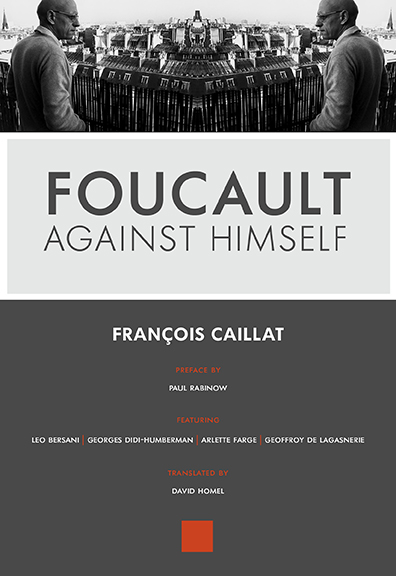
FoucaultAgainstHimselfFoucault against Himself
By (author) Francois Caillat
Translated by David Homel

Arsenal Pulp Press

Price: $17.95 CAD $17.95 USD
ISBN: 9781551526027
EPUB ISBN: 9781551526034 (check your favourite retailer)
Availability: Coming soon. For more information contact sales@arsenalpulp.com

A thought-provoking collection of essays on Michel Foucault that reframes his legacy.

In his private life, as well as in his work and political attitudes, Michel Foucault often stood in contradiction to himself, especially when his expansive ideas collided with the institutions in which he worked. In Francois Caillat’s provocative collection of essays and interviews based on his French documentary of the same name, leading contemporary critics and philosophers reframe Foucault’s legacy in an effort to build new ways of thinking about his struggle against society’s mechanisms of domination, demonstrating how conflict within the self lies at the heart of Foucault’s life and work.

Includes a foreword written especially for this edition by Paul Rabinow, Professor of Anthropology at the University of California (Berkeley) and an influential writer on the works of Foucault; he is the co-editor of The Essential Foucault.

Foucault against Himself features essays and interviews by

Leo Bersani, American Professor Emeritus of French at the University of California (Berkeley) and the author of Homos

Georges Didi-Huberman, French philosopher and art historian; his most recent book is Gerhard Richter: Pictures/Series

Arlette Farge, French historian and the author of The Allure of the Archives

Geoffroy de Lagasnerie, French philosopher and the author of La derniere lecon de Michel Foucault
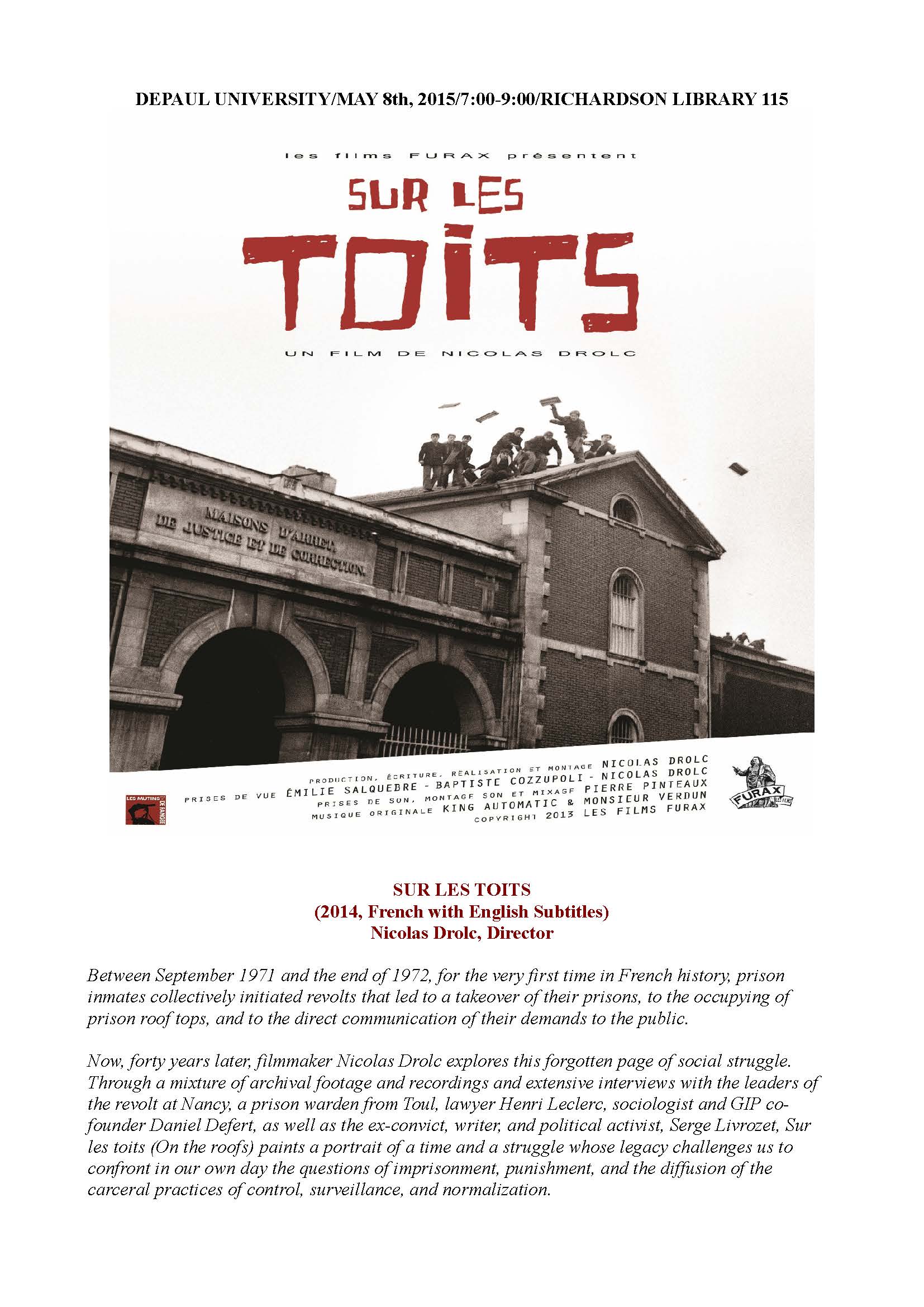
 

Sur les toits (95 mn)

Editor: You can buy the DVD from this site and watch a short clip. It is in French with English subtitles.

Début des années 70 : une série d’évènements fait monter la tension dans les prisons françaises. En réponse au traitement inhumain que leur fait subir l’administration pénitentiaire, les prisonniers de la centrale de Ney à Toul (Lorraine) ouvrent le bal et se mutinent au début du mois de décembre 1971. Les détenus de la maison d’arrêt Charles III à Nancy leur emboitent le pas le 15 janvier 1972 : “Au café”, les mutins prennent le contrôle de la prison, située en plein centre-ville, montent sur les toits, depuis lesquels ils interpellent les badauds, communiquent leurs revendications, et résistent à l’assaut des CRS.

Dans les mois qui suivent les révoltes de Toul et de Nancy, plus d’une trentaine de mutineries vont embraser les prisons françaises, qui n’avaient jamais connu une telle vague de révoltes. Malgré la répression musclée orchestrée par le gouvernement et le discours de la grande presse qui décrédibilise systématiquement les révoltes, le tour de force des prisonniers n’est pas vain. Relayées et défendues par une élite intellectuelle engagée, dans un contexte idéologiquement tendu, les mutineries des années 71/72 vont poser pour la première fois les problème des conditions de détention, de la fonction de la prison et du système pénitentiaire français.

Au cœur d’une actualité toujours brûlante autour de l’univers carcéral, d’où ressurgit l’inévitable constat d’échec de la fonction de la prison, le film dépoussière cette première grande période de lutte en compagnie de ceux qui ont vécu, déclenché, réprimé et défendu ces révoltes.

Avec : Maître Henri Leclerc, Daniel Defert, Serge Livrozet, Michel Foucault, Jean-Paul Sarte

Bonus : Entretien avec Serge Livrozet, ancien détenu, écrivain et militant – 35 mn
Langues : Français, sous-titres Anglais

With thanks to DMF for this link

Categories: Film

SUR LES TOITS Flyer

PDF of flyer

Film Screening

MAY 8th, 2015
Richardson Library 115
2350 N. Kenmore
Chicago, IL 60614

7:00-8:30 Sur les toits (2014, French with English Subtitles)

8:30-9:00 Q & A with Director Nicolas Drolc

SUR LES TOITS
(2014, French with English Subtitles)
Nicolas Drolc, Director

Between September 1971 and the end of 1972, for the very first time in French history, prison inmates collectively initiated revolts that led to a takeover of their prisons, to the occupying of prison roof tops, and to the direct communication of their demands to the public.

Now, forty years later, filmmaker Nicolas Drolc explores this forgotten page of social struggle. Through a mixture of archival footage and recordings and extensive interviews with the leaders of the revolt at Nancy, a prison warden from Toul, lawyer Henri Leclerc, sociologist and GIP co-founder Daniel Defert, as well as the ex-convict, writer, and political activist, Serge Livrozet, Sur les toits (On the roofs) paints a portrait of a time and a struggle whose legacy challenges us to confront in our own day the questions of imprisonment, punishment, and the diffusion of the carceral practices of control, surveillance, and normalization.

All events are free and open to the public.

Categories: Film

GIP Legacy

PDF of flyer

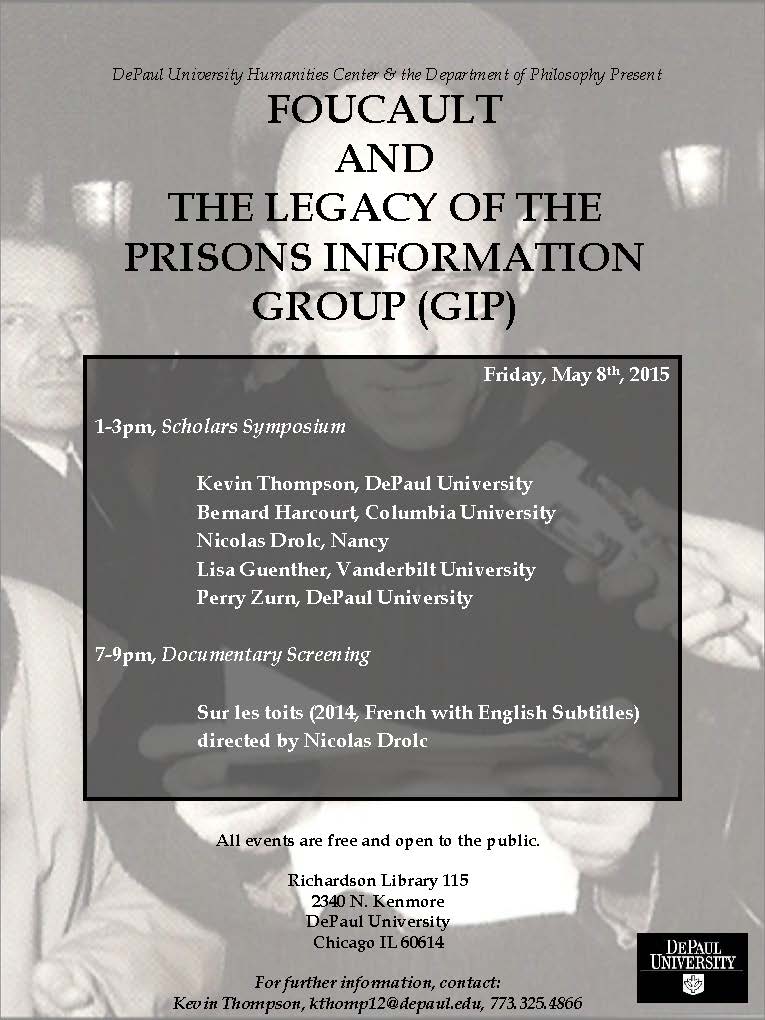
DePaul University Humanities Center & the Department of Philosophy

Foucault and the legacy of the prisons information group (GIP)

MAY 8th, 2015
Richardson Library 115
2350 N. Kenmore
Chicago, IL 60614

Scholars Symposium

1:00-1:10 Opening Remarks
Kevin Thompson, DePaul University

1:10-1:30 “The Dialectic of Theory and Practice”
Bernard Harcourt, Columbia University

1:30-1:50 “Prisoners Inside / Intellectuals Outside: The GIP and the French prison revolts (1971-2)”
Nicolas Drolc, Documentarian

1:50-2:10 “The Creaturely Politics of Prisoner Resistance Movements”
Lisa Guenther, Vanderbilt University

2:10-2:30 “The GIP and the Question of Failure”
Perry Zurn, DePaul University

2:30-3:00 Q & A

Film Screening

7:00-8:30 Sur les toits (2014, French with English Subtitles)

8:30-9:00 Q & A with Director Nicolas Drolc

SUR LES TOITS
(2014, French with English Subtitles)
Nicolas Drolc, Director

Between September 1971 and the end of 1972, for the very first time in French history, prison inmates collectively initiated revolts that led to a takeover of their prisons, to the occupying of prison roof tops, and to the direct communication of their demands to the public.

Now, forty years later, filmmaker Nicolas Drolc explores this forgotten page of social struggle. Through a mixture of archival footage and recordings and extensive interviews with the leaders of the revolt at Nancy, a prison warden from Toul, lawyer Henri Leclerc, sociologist and GIP co-founder Daniel Defert, as well as the ex-convict, writer, and political activist, Serge Livrozet, Sur les toits (On the roofs) paints a portrait of a time and a struggle whose legacy challenges us to confront in our own day the questions of imprisonment, punishment, and the diffusion of the carceral practices of control, surveillance, and normalization.

All events are free and open to the public.

Proceedings are forthcoming in a special issue of the Carceral Notebooks.

Guilfoyle, M.
Therapy and the aesthetics of the self
(2015) British Journal of Guidance and Counselling, 11 p. Article in Press.

DOI: 10.1080/03069885.2014.1002075

Abstract
Post-structuralists argue that personal identity is a function of societal power dynamics. This becomes especially problematic for persons recruited into problem-saturated identities. In this paper, inspired by Foucault’s call for us to ‘create ourselves as a work of art’ (p. 262), I explore the therapeutic value of an aesthetic approach to identity. Instead of orienting to the client as one to be known and understood, we might envisage his or her life as an open-ended, never quite finalised oeuvre. Identity is therefore conceptualised not as something one ‘is’, but as a creative performance. A therapeutic case is presented to highlight some of the possibilities and challenges associated with such an approach.

Author Keywords
aesthetics of experience; Foucault; multiplicity; narrative therapy; therapy; values

Devisch, I., Vanheule, S.
Foucault at the bedside: A critical analysis of empowering a healthy lifestyle
(2015) Journal of Evaluation in Clinical Practice, . Article in Press.

DOI: 10.1111/jep.12329

Abstract
Since quite a few years, philosophy is heading towards the bedside of the patient: the practice of philosophy has stepped out of its ivory tower, it seems, to deal with empirical or practical questions. Apart from the advantages, we should keep in mind the importance of a critical analysis of medical or clinical practice as such. If ethics partakes the clinical stage, it runs the risk only to discuss the how question and to forget the more fundamental what or why questions: what are we doing exactly and why is it good for? Starting from the principle of the empowerment of the patient, we will demonstrate how the discourse on empowerment in health care seems to forget a profound reflection upon this principle as such. By rehearsing some basics from the governmentality theory of Michel Foucault and the actualization of it by Nicolas Rose, we will argue how philosophical investigation in medical-ethical evolutions such as empowerment of the patient is still needed to understand what is really going on in today’s clinical practice. © 2015 John Wiley & Sons, Ltd..

Author Keywords
Evaluation; Patient-centred care; Public health

Language of Original Document: English

Turner, S.
Not So Radical Historicism
(2015) Philosophy of the Social Sciences, 45 (2), pp. 246-257.

DOI: 10.1177/0048393114531372

Abstract
Mark Bevir raises the question of how genealogy, understood as a technique-based radical historicism, and the notion of the contingency of ideas, ground “critique.” His problem is to avoid the relativism of radical historicism in a way that allows for “critique” without appealing to non-radical historicist absolutisms of the kind that ground the notion of false consciousness. He does so by appealing to the notion of motivated irrationality, which he claims avoids the problem of relativism and the problems of “false consciousness.” The genealogies of Nietzsche and Foucault, however, do not ground “critique.” The relevant normative judgments, of nobility in Nietzsche, for example, are presupposed. © The Author(s) 2014.

Author Keywords
critical theory; Foucault; genealogy; Mark Bevir; Nietzsche

Kendall R. Phillips
The Event of Dissension: Reconsidering the Possibilities of Dissent
(2015) Quarterly Journal of Speech, 101 (1), pp. 60-71.

https://doi.org/10.1080/00335630.2015.994899

Abstract
Dissent emerges out of unique prior conditions in which the coherence of dominant discourses is momentarily opened for contest. Drawing on the work of Michel Foucault, these conditions are conceptualized through the internal gaps and contradictions within dominant discourse—spaces of dissension—and the singular historical circumstances of the Event of dissension. The unique possibilities opened up in the Event of dissension include the prospects for a kind of critical contemplation on the conditions of the present, which Foucault defines as thought. The prospects for thoughtful dissent are considered. © 2015, © 2015 National Communication Association.

Author Keywords
Dissension; Dissent; Event; Foucault; Thought

Terry Eagleton, The Slow Death of the University, The Chronicle of Higher Education, 5 April 2015

Editor’s note: My excuse for posting this excellent analysis of the parlous state of the contemporary university, which readers of this blog who are employed by universities will no doubt recognise only too well, is that Eagleton does in fact refer to Foucault in an elegant alliterative passage (see below after the introductory paragraphs). The article is hidden behind a subscription paywall but you could try your luck using open access tools.

A few years ago, I was being shown around a large, very technologically advanced university in Asia by its proud president. As befitted so eminent a personage, he was flanked by two burly young minders in black suits and shades, who for all I knew were carrying Kalashnikovs under their jackets. Having waxed lyrical about his gleaming new business school and state-of-the-art institute for management studies, the president paused to permit me a few words of fulsome praise. I remarked instead that there seemed to be no critical studies of any kind on his campus. He looked at me bemusedly, as though I had asked him how many Ph.D.’s in pole dancing they awarded each year, and replied rather stiffly “Your comment will be noted.” He then took a small piece of cutting-edge technology out of his pocket, flicked it open and spoke a few curt words of Korean into it, probably “Kill him.” A limousine the length of a cricket pitch then arrived, into which the president was bundled by his minders and swept away. I watched his car disappear from view, wondering when his order for my execution was to be implemented.

This happened in South Korea, but it might have taken place almost anywhere on the planet. From Cape Town to Reykjavik, Sydney to São Paulo, an event as momentous in its own way as the Cuban revolution or the invasion of Iraq is steadily under way: the slow death of the university as a center of humane critique. Universities, which in Britain have an 800-year history, have traditionally been derided as ivory towers, and there was always some truth in the accusation. Yet the distance they established between themselves and society at large could prove enabling as well as disabling, allowing them to reflect on the values, goals, and interests of a social order too frenetically bound up in its own short-term practical pursuits to be capable of much self-criticism. Across the globe, that critical distance is now being diminished almost to nothing, as the institutions that produced Erasmus and John Milton, Einstein and Monty Python, capitulate to the hard-faced priorities of global capitalism.

[…]

As professors are transformed into managers, so students are converted into consumers. Universities fall over one another in an undignified scramble to secure their fees. Once such customers are safely within the gates, there is pressure on their professors not to fail them, and thus risk losing their fees. The general idea is that if the student fails, it is the professor’s fault, rather like a hospital in which every death is laid at the door of the medical staff. One result of this hot pursuit of the student purse is the growth of courses tailored to whatever is currently in fashion among 20-year-olds. In my own discipline of English, that means vampires rather than Victorians, sexuality rather than Shelley, fanzines rather than Foucault, the contemporary world rather than the medieval one. It is thus that deep-seated political and economic forces come to shape syllabuses. Any English department that focused its energies on Anglo-Saxon literature or the 18th century would be cutting its own throat.

With thanks to Stuart Elden at Progressive Geographies for this news

van Drenth, A. Sensorial experiences and childhood: nineteenth-century care for children with idiocy (2015) Paedagogica Historica, 19 p. Article in Press.

DOI: 10.1080/00309230.2015.1019711

Abstract
Following Foucault’s analysis of expanding psychiatric power, this article addresses the shift from psychiatry into pedagogy in interventions concerning children with mental problems in the nineteenth century. The aims of this article are twofold. First, to answer the question of how the notion of “idiocy” developed in the context of an increasing interest in sensorial experiences in childhood, in relation to both psychopathology and “normalcy”. New research into the early nineteenth-century case of the “wild boy of Aveyron” reveals the importance of care in the first observations of the boy and the connection that was subsequently made with sensorial experiences in childhood and child development. In the wake of the work of Enlightenment alienists such as Pinel and Itard, Edouard Séguin constructed an educational trajectory for children with mental impairments in which, through strict pedagogical guidance, the lack of “will” would be restored by stimulating the senses. The second aim is to examine the case of the first autonomous school for “idiotic” children in The Netherlands. Following the “praxeography” approach, I focus on the interventions by the Reverend Cornelis van Koetsveld, who shaped his “cure by education” through training the senses in children with problems.

Author Keywords
childhood; disability history; idiocy; praxeography; sensorial experiences; special education