Foucault News

News and resources on French thinker Michel Foucault (1926-1984)

Überwachen und Strafen heute
Bremen, 5.–7. November 2015
Frieder Vogelmann/Jörg Bernardy/Martin Nonhoff

Programm

Programm als PDF öffnen

Durchgehend zu sehen ist der künstlerische Beitrag von Christoph Faulhaber: Jedes Bild ist ein leeres Bild (2014)

Donnerstag, 5. November 2015

14:00–14:30 Uhr Begrüßung
14:30–15:30 Uhr Susanne Krasmann: Imagining Foucault. Über das digitale Subjekt und »visuelle Bürgerschaft«
15:45–16:45 Uhr Tobias Matzner: Subjektivierung durch Daten – Disziplin oder Performativität?
Pause 16:45–17:15 Uhr
17:15–18:15 Uhr Dietmar Kammerer: Das Panopticon zwischen Analyse und Inflation, Anschein und Wirklichkeit
18:30–19:30 Uhr Philipp Wüschner: Scham und Schuld, Verletzung und Verbrechen

Freitag, 6. November 2015

9:00–10:00 Uhr Friedrich Balke: Schandbilder und Schriftmacht. Zur Rolle der Medien in »Überwachen und Strafen«
10:15–11:15 Uhr René Aguigah: »Die Seele: Gefängnis des Körpers«. Zum Verhältnis von Zeitgenossenschaft und Philosophie in »Überwachen und Strafen«
11:30–12:30 Uhr Marita Rainsborough: Rereading Foucault. Foucaults Machtkonzeption aus Sicht der postkolonialen Theorien von Achille Mbembe und Walter Mignolo
Mittagspause 12:30–14:00 Uhr
14:00–15:00 Uhr Thomas Biebricher: Überwachen und Strafen der politischen Ökonomie: Der Fall Europa
15:15–16:15 Uhr Martin Nonhoff: Die Macht im Geldbeutel, oder: Zur Herstellung fiskalischer Normalität durch Einkommensteuern
Pause 16:15–16:45 Uhr
16:45–17:45 Uhr Jörg Bernardy: »Überwachen und Strafen« als Science-Fiction und Kriminalroman. Über Disziplinen und Drohnen
18:00–19:00 Uhr Petra Gehring: Das invertierte Auge

Samstag, 7. November 2015

9:00–10:00 Uhr Frieder Vogelmann: Zur Geburt der Sozialwissenschaften im Gefängnis
10:15–11:15 Uhr Maria Muhle: Normalisierung, Normierung, Normation
11:30–12:30 Uhr Martin Saar: Die Form der Macht
Mittagspause 12:30–14:00 Uhr
14:00–15:00 Uhr Katrin Meyer: Ausschließen und Eingrenzen. Neue Formen der Überwachung
15:15–16:15 Uhr Sophia Hoffmann: Der Archipel »Flüchtlingslager«. Überwachen und Strafen im jordanischen Lager Azraq

Foucault 4/13: LIVESTREAM

You can also find it at this link

This will also be available as a recording after the event

October 26, 2015, 6:15pm
Linda Zerilli, University of Chicago
Anna Lvovsky, Columbia University
Alondra Nelson, Columbia University

Moderators:
Bernard E. Harcourt, Columbia University
Jesús R. Velasco, Columbia University

Linda Zerilli, Alondra Nelson, and Anna Lvovsky discuss Foucault’s fourth lecture series at the Collège de France, Psychiatric Power (1973-1974). Please watch the video here or here. Please also read the introductory posts presenting the lectures by Linda Zerilli, Alondra Nelson, and Anna Lvovsky. Bibliographical references for the seminar are here.  Welcome to Foucault 4/13!

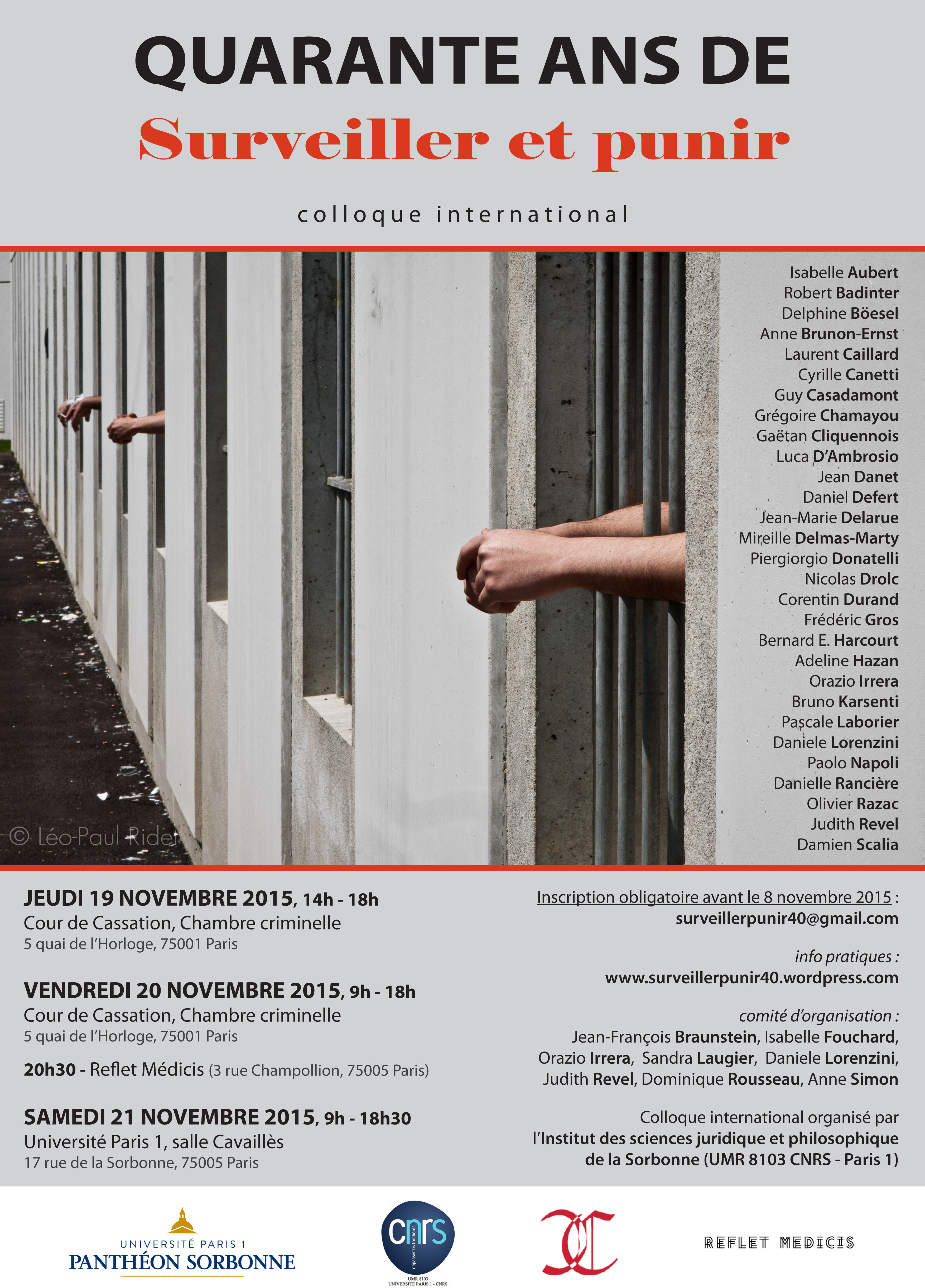
Affiche A3 S&P - HDPDF programme

Université Paris 1 Panthéon-Sorbonne

Colloque international

Quarante ans de Surveiller et punir

Institut des sciences juridique et philosophique de la Sorbonne (UMR 8103 CNRS Paris 1)
Centre de philosophie contemporaine de la Sorbonne (PhiCo)

19-21 novembre 2015

Paru en 1975, l’ouvrage de Michel Foucault Surveiller et punir. Naissance de la prison a fait date : non seulement il a connu un énorme succès lors de sa publication, mais il est aujourd’hui le livre le plus cité dans le domaine des sciences humaines et sociales. Cependant, dans ce colloque, quarante ans après, il ne s’agira pas tant de le célébrer que de s’interroger, avec la lucidité que permet le recul, sur ses enjeux, sa fortune et sur la valeur qu’il peut encore revêtir pour nous aujourd’hui.

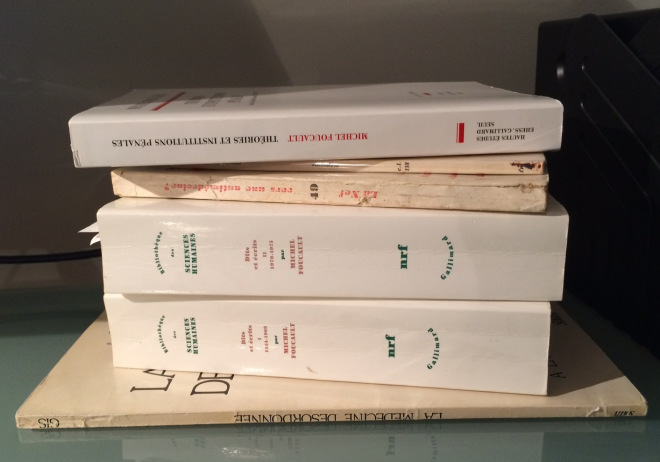
Avant tout, il faudra revenir sur le contexte historique et politique concret dans lequel cet ouvrage a émergé, en faisant scandale et en suscitant beaucoup de débats et de controverses. En même temps, on possède à présent davantage d’instruments pour inscrire de manière très précise la rédaction de cet ouvrage au sein du parcours intellectuel de Foucault. D’une part, il s’agira donc de reconstruire l’aventure du G.I.P. (Groupe d’information sur les prisons), qui a été plus ou moins directement à l’origine de l’intérêt de Foucault pour l’« objet-prison ». D’autre part, la publication récente de deux cours au Collège de France du début des années 1970 (Théories et institutions pénales, paru en mai 2015, et La société punitive, publié en 2013) rend désormais possible de retracer l’arrière-plan plus spécifiquement philosophique de Surveiller et punir et de suivre très précisément l’élaboration de l’étude du « pouvoir disciplinaire ».

Il sera également nécessaire de relire les écrits de Foucault à la lumière d’une actualité juridique dense. En effet, l’adoption de la loi pénitentiaire le 24 novembre 2009 a marqué une prise de conscience politique de la nécessité d’appréhender les questions pénales et pénitentiaires d’une manière globale et concertée. Depuis l’adoption de cette loi, les avancées concrètes semblent néanmoins limitées et deux réformes récentes ont pu sonner comme un aveu d’impuissance politique quant à l’amélioration du sort des personnes incarcérées. La première est l’adoption de la loi du 15 août 2014 qui créé une nouvelle peine : la contrainte pénale. L’exposé des motifs de la loi retient notamment l’exigence de développer les peines exécutées en milieu ouvert, eu égard notamment aux mauvaises conditions d’incarcération dans les établissements pénitentiaires français. Outre le fait que la contrainte pénale ne remplace pas l’emprisonnement mais s’y ajoute, la mesure pourrait donc être perçue comme un contournement de la problématique essentielle que représente l’avenir de la peine carcérale. L’autre évolution juridique, moins visible mais néanmoins significative, est le nouveau report pour 2020 de l’application du principe de l’encellulement individuel, pourtant consacré, une fois de plus, par la loi de 2009. Le droit pénitentiaire semble donc marqué du sceau de l’inertie et ce malgré un dynamisme jurisprudentiel interne et européen d’une rare intensité. L’étude approfondie de ces « vents contraires » apparaît dès lors indispensable.

Enfin, l’un des enjeux principaux de ce colloque sera de réfléchir sur la valeur – à la fois historique, philosophique, juridique et politique – des analyses foucaldiennes de la société punitive, de l’archipel carcéral, de la surveillance généralisée, du panoptisme, des illégalismes, de la délinquance, etc., afin d’en mesurer la portée réelle et de les mettre à l’épreuve de notre présent. Pour ce faire, il sera essentiel de mobiliser une pluralité d’approches différentes et de favoriser le dialogue entre plusieurs disciplines (philosophie, science politique, droit, historie, sociologie, anthropologie, géographie, etc.).

Comité d’organisation :

Jean-François Braunstein (Université Paris 1 Panthéon-Sorbonne)

Isabelle Fouchard (Université Paris 1 Panthéon-Sorbonne)

Orazio Irrera (Université Paris 1 Panthéon-Sorbonne)

Sandra Laugier (Université Paris 1 Panthéon-Sorbonne)

Daniele Lorenzini (Université Paris-Est Créteil)

Judith Revel (Université Paris Ouest Nanterre La Défense)

Dominique Rousseau (Université Paris 1 Panthéon-Sorbonne)

Anne Simon (Université Paris 1 Panthéon-Sorbonne)


Comité scientifique :

Sandro Chignola (Università degli Studi di Padova)

Arnold I. Davidson (University of Chicago)

Didier Fassin (Institute for Advanced Study, Princeton University)

Clare O’Farrell (Queensland University of Technology)

Pierrette Poncela (Université Paris Ouest Nanterre La Défense)

 

Foucault et Baudrillard — Hamdi Nabli (2015).
Livre: Foucault et Baudrillard: La fin du pouvoir (2015)

stuartelden's avatarProgressive Geographies

FBP 5

Most of the most recent work on this book project has been on the section of Chapter Two discussing the Nu-Pieds revolts. An analysis of these, and the repression that follows, takes up the first seven lectures of Théories et institutions pénales. It’s a fascinating story, and nowhere else does Foucault give so much attention to a struggle between people and state power. I will be speaking about this part of the course at the Historical Materialism conference in November, though the brevity of that talk will mean I can only highlight a few major themes. If you don’t read French, Barry Stocker’s analyses of the first few of these lectures are very useful. Chapter Two now exists in a complete, long, draft – a discussion of the Nu-Pieds; then on the shift from Germanic law to the Monarchical State, and the legal system of the high Middle…

View original post 575 more words

Editor: Palgrave Macmillan have kindly offered a 30% discount to readers of Foucault News on books in their Foucault collection

Works included in this collection are The Punitive Society and Michel Foucault: A Research Companion The full price on the latter work has been reduced since I last posted on this. I will repost again shortly with full details.

“Save 30% on all titles in the Palgrave Foucault Collection. Just enter discount code PM15THIRTY at checkout when ordering on palgrave.com. Offer valid until December 31, 2015. Terms and conditions apply.”

This offer is not available to Australasia and Canada.

Michel Foucault vu par son neveu La Novelle République, Communes, Vienne – Vendeuvre-du-Poitou – Vendeuvre-du-poitou, 23/09/2015

Henri-Paul Fruchaud raconte Foucault au quotidien.

Henri-Paul Fruchaud raconte Foucault au quotidien.

A l’occasion des journées du patrimoine, une exposition promenade était organisée dans les jardins de la maison familiale où Michel Foucault a écrit une grande partie de son œuvre durant les vacances. Pour Jocelyne Berge, présidente de l’association Le Jardin de Michel Foucault, il s’agit de faire découvrir aux Vendeuvrais ce philosophe connu au niveau national mais pas nécessairement localement.

“ C’est toujours lui qui faisait la mayonnaise ! ”

Environ 70 personnes étaient présentes pour assister à la causerie donnée par Henri-Paul Fruchaud, aîné des neveux de Michel Foucault. Il a évoqué le parcours professionnel et l’œuvre de son oncle à travers certaines étapes significatives de la réflexion de Foucault. L’« Histoire de la folie » (1961) marque une première étape, « Les mots et les choses » (1966) pose un deuxième jalon. Le parcours évolue ensuite avec « Surveiller et punir » (1975) qui traite de la naissance de la prison utilisée comme seul moyen de punition.
C’était aussi l’occasion de découvrir le philosophe sous un angle familial. Henri-Paul Fruchaud a raconté de nombreuses anecdotes, à commencer par l’habitude qu’il avait d’observer le travail du philosophe assis dans son bureau. Foucault écrivait au moins 3 versions de ses livres et finalisait la troisième à Vendeuvre. Il écrivait 5 à 6 heures par jour. Il participait aussi à la vie familiale. Ainsi, « c’est toujours lui qui faisait la mayonnaise ! ». Ses promenades inspiraient ses réflexions.

Il trichait au poker

Il s’adressait aux enfants comme à des adultes, jouait et trichait au poker en famille et était doté d’un rire très sonore. Henri-Paul Fruchaud a également évoqué les indignations du philosophe.

En terminant la causerie, il a annoncé que 37.000 feuillets écrits par Foucault sont déposés à la Bibliothèque Nationale. Son œuvre devrait être publiée dans La Bibliothèque de la Pleïade en novembre prochain. Désormais, on s’oriente vers la publication de ses cours, causeries et conférences enregistrés.

With thanks to Stuart Elden and Colin Gordon for this news

Mitchell Dean, Foucault must not be defended, History and Theory, Volume 54, Issue 3, pages 389–403, October 2015

DOI: 10.1111/hith.10767

Available on academia.edu. You need to log in

ABSTRACT

This paper responds to and comments on many of the themes of the book under consideration concerning Foucault and neoliberalism. In doing so, it offers reflections on the relation between the habitus of the intellectual and the political contexts of action and engagement in the case of Foucault, and the strengths and weaknesses of his characterization of his work in terms of an “experimental” ethos. It argues that it is possible to identify his distinctive views on neoliberalism as a programmatic ideal, as a language of critique of the postwar welfare state, and as an element within actual political forces such as the French “Second Left” of the 1970s. It examines the legacy of Foucault in “governmentality studies” and argues for attentiveness to the different intellectual positions, and their potentially divergent political consequences, within this school of thought. It concludes by suggesting that the discussion currently taking place, and in part inaugurated by this book, might signal a change of his status in the humanities and social sciences today from “unsurpassable horizon” of critical thought to acknowledged classical thinker, with strengths and limitations, and a series of problems that might not be our own.

Keywords:

Foucault;neoliberalism;Marxism;governmentality;politics;critique;ethos;habitus

stuartelden's avatarProgressive Geographies

Michel_Focault_13102015There is an interview with Daniel Defert in German here, in which he discusses Foucault’s life and work, Adorno, May 68 and political activism, the AIDES group he founded after his death, the lecture courses and the material sold to the BNF, and confirms that the History of Sexuality, Vol IV, Les aveux de la chair, will eventually be published. I already knew this from Defert, but this might be the first place it’s been publicly announced.

The article can be viewed by clicking on ‘Weiter zum Artikel’ when you load the page. Many thanks to Kai Frederik Lorentzen for the link.

View original post

Editor: See Colin Gordon’s response from the comments section of this blog post below.

Michel Foucault’s Iranian Folly
Jeremy Stangroom on Michel Foucault’s political naiveté, TPM Online (The Philosopher’s magazine)

Extract
Everywhere outside Iran, Islam serves as a cover for a feudal or pseudo revolutionary oppression… The Left should not let itself be seduced by a cure that is perhaps worse than the disease.”

Foucault, unfortunately, was precisely seduced by the popular uprising in Iran, which he claimed might signify a new “political spirituality”, with the potential to transform the political landscape of Europe, as well as the Middle East.

read more

Guest – Colin Gordon, Oxford, UK
[Editor:Foucault’s birthday was 15 October 1926]

Your site’s taste in posthumous birthday offerings is duly noted.

Mr Stangroom is a promising parrot – good at recycling other people’s smears; but short on forensic and reading skills – checking allegations against evidence. Or perhaps one should say he is a talented manipulator of evidence, like the American authors he relies on. The second text he quotes – including the words on the rights of women – is not Foucault’s manifesto for Iranian government, it is a summary of comments by a senior Shi’ite cleric, forming part of Foucault’s newspaper reports on ideas current in Iran at the time of an uprising which mobilized overwhelming popular support – a fact which at the time impressed many international observers besides Foucault. Foucault stated more than once before the fall of the Shah’s regime that there were disquieting aspects to the agenda for Islamic government and that he did not find its assurances about human and minority rights entirely reassuring. He did not endorse a Khomeini regime, either before or after the fact. He did not recommend ‘political spirituality’ as an elixir for the West. He did, on the other hand, refuse to treat all contemporary manifestations of Islam with uncomprehending or a priori contempt – a position which continues to earn comments such as these from some philosophers and other trolls.

By the way, the first text Stangroom has managed happens to open with a mistranslation. Foucault did not write that the Iranian situation could be understood as a great joust – he wrote that it seemed at that point in time to be tied to (‘semble être suspendue à’) the highly visible public confrontation between two personal figures, Shah and Khomeini. Anyone who bothers to read Foucault’s reports will find that they contained a broad and nuanced picture of the sociopolitical, economic and cultural background and components of the uprising, a shrewd analysis of the unfolding conflict, and an accurate assessment of the survival prospects of the regime – at a time when the New Left’s renowned middle eastern expert, the late Fred Halliday, was predicting it could stay in power for decades.