
Foucault News

News and resources on French thinker Michel Foucault (1926-1984)

Gordon Hull, Foucault, Descartes and Monastic Subjectivity, New APPS: Art, Politics, Philosophy, Science, 07 January 2016

Extracts
[,,,]

So Descartes is an Augustinian, at least on this point. What I’d like to do here is point out that Foucault further situates Descartes in a traditional Catholic framework of confession. Recall that, in general, On the Government of the Living basically argues that modern, Western subjectivity developed with Christianity and out of its break with the ancient Greeks and Romans, and that one of the key breaks was around the topic of confession. Beginning with 4th Century monasticism, Christianity developed a very precise theory of confession as an enumeration of specific faults and failures, a practice of alethurgy (producing the truth of the subject) that was alien to the forward-looking Greeks and Romans.

In the last lecture of GL, Foucault distinguishes between ancient and Christian concepts of discretio. For the ancients, the problem is straightforwardly one of passions. For Christians, on the other hand, the problem was “illusion, the lack of discrimination between the representation of good and the representation of evil between the representation or suggestion coming from God, that coming from Satan, and that coming from oneself” (GL 297). In other words, the focus is “on the subject himself, on the subject insofar as he is inhabited by another principle, by a foreign principle that is at the same time a source of illusions” (GL 297). We need, ultimately, God’s help in sorting this out through “the structure, the examination-confession apparatus” (GL 297). “It is not the question of the truth of what I think, but of the truth of I who things” (GL 303)

[,,,]

Finally, it is not too hard to see why Foucault would see neoliberalism as confessional (and thus reject it.  For a more detailed argument, though one that does not take GL into account and which focuses on employee wellness programs, see here): we become known through a permanent data trail of Facebook likes, phone metadata, GPS tracking, Amazon purchases, etc. Confession becomes sufficiently intensified that we no longer have to do anything deliberately confessional at all: mere existence becomes confessional because whatever we do (or don’t do) reveals something about us as compared to others. This isn’t causal knowledge, of course, but it is often enough to justify action, particularly at the population level (this point is made very well in Mayer-Schönberger and Cukier’s Big Data).
Hardy C., Maguire S.
Organizing risk: Discourse, power, and “riskification”
(2016) Academy of Management Review, 41 (1), pp. 80-108.

DOI: 10.5465/amr.2013.0106

Abstract
Drawing on the work of Foucault, we develop an integrated framework for understanding how risk is organized in three different modes: prospectively, in real time, and retrospectively. We show how these modes are situated in a dominant discourse of risk that leads organizations to normalize risk in particular ways by privileging certain forms of knowledge and authorizing certain risk identities over others. In addition to identifying the common way risk is organized in each mode and showing how it is held in place by the dominant discourse, we propose alternative ways to organize risk that resist this dominant discourse, and we explain why they are difficult to enact. We then extend our analysis by theorizing how, even when it occurs, resistance to the dominant discourse of risk can contribute to “riskification,” with more and more organizing undertaken in the name of risk because of intensification, discipline, and governmentality

Vichnar, D.
‘Territories Of Risk’ within ‘Tropological Space’: From Zero to 2666, and back
(2015) Fear and Fantasy in a Global World, 81, pp. 55-73.

DOI: 10.1163/9789004306042_005

Abstract
The essay examines the subversive treatment of discourses of fear and anxiety on both local and global scales to which they are subjected within what Michel Foucault has described as the “tropological space” of literature. The two case studies under focus are Ignacio de Loyola Brandão’s 1979 novel Zero and Roberto Bolaño’s 2004 novel 2666. Brandão’s fictitiously journalistic narrative of a complex discursive collage subverts the hypocrisy of some of the official political discourses of the 1970s Brazilian dictatorship, while Bolaño’s epically broad narrative revolves around Ciudad Juárez, the scene of some of the most terrifying, yet continuously silenced, crimes of post-World War II history. The essay hopes to demonstrate that although incapable of competing with social sciences in their analytic depth and methodological breadth, literature engaging with evil, violence, fear and fantasy can aspire to enrich their viewpoints in two broadly conceived fashions: in staging the problematic nature of writing and writability, and in calling attention to the medium through which any such writing must take place. Ugliness, shapelessness and repulsiveness are no longer the concerns of aesthetic novelty, but the very condition of writing that takes its task (of an ethical engagement with the complex present) seriously. © 2015 by Koninklijke Brill nv, Leiden, The Netherlands. All rights reserved.

Andreas Folkers, Daring the Truth: Foucault, Parrhesia and the Genealogy of Critique, Theory, Culture & Society, January 2016 vol. 33 no. 1 3-28

doi: 10.1177/0263276414558885

Abstract
This paper draws attention to Foucault’s genealogy of critique. In a series of inquiries, Foucault traced the origins and trajectories of critical practices from the ancient tradition of parrhesia to the enlightenment and the (neo)liberal critique of the state. The paper will elucidate the insights of this history and argue that Foucault’s turn to the genealogy of critique also changed the valence of his theoretical assumptions. Foucault developed a more affirmative practice of genealogy that not only discredits truth claims by tracing them back to their inglorious origins. Rather, he presents a politics of truth as a complex interaction of (governmental) power-knowledge and critique that questions the power effects of truth and rationality. This genealogy of critique contributes to current problematizations of critique by thinkers like Boltanski, Latour and Rancière in highlighting the role of epistemological and technical critique of social rationalization and political reason.

Keywords
critique Foucault genealogy governmentality neoliberalism rationality truth

Cristina Chimisso,
Narrative and epistemology: Georges Canguilhem’s concept of scientific ideology
(2015) Studies in History and Philosophy of Science Part A, 54, pp. 64-73.

https://doi.org/10.1016/j.shpsa.2015.08.016

Abstract
In the late 1960s, Georges Canguilhem introduced the concept of ‘scientific ideology’. This concept had not played any role in his previous work, so why introduce it at all? This is the central question of my paper. Although it may seem a rather modest question, its answer in fact uncovers hidden tensions in the tradition of historical epistemology, in particular between its normative and descriptive aspects. The term ideology suggests the influence of Althusser’s and Foucault’s philosophies. However, I show the differences between Canguilhem’s concept of scientific ideology and Althusser’s and Foucault’s respective concepts of ideology. I argue that Canguilhem was in fact attempting to solve long-standing problems in the tradition of historical epistemology, rather than following the lead of his younger colleagues. I argue that Canguilhem’s ‘refurbishment without rejection’ of Bachelard’s epistemology, which the concept of scientific ideology was aimed to implement, was necessary to justify the historical narratives that Canguilhem had constructed in his own work as a historian of concepts. A strict acceptance of Bachelard’s epistemology would have made it impossible to justify them. Canguilhem’s concept of scientific ideology therefore served as a theoretical justification of his practice as a historian. I maintain that the concept of scientific ideology was needed to reconcile Bachelard’s normative epistemology with Canguilhem’s view of the history of science and its aims, which differed from Bachelard’s more than it is generally acknowledged. © 2015 Elsevier Ltd.


Author Keywords

Gaston Bachelard; Georges Canguilhem; Historical epistemology; Ideology; Louis Althusser; Michel Foucault

Lee Quinby, Anti-Apocalypse. Exercises in Genealogical Criticism, University of Minnesota Press, 1994

As the year 2000 looms, heralding a new millennium, apocalyptic thought abounds-and not merely among religious radicals. In politics, science, philosophy, popular culture, and feminist discourse, apprehensions of the End appear in images of cultural decline and urban chaos, forecasts of the end of history and ecological devastation, and visions of a new age of triumphant technology or a gender-free utopia. There is, Lee Quinby contends, a threatening “regime of truth” prevailing in the United States-and this regime, with its enforcement of absolute truth and morality, imperils democracy. In Anti-Apocalypse, Quinby offers a powerful critique of the millenarian rhetoric that pervades American culture. In doing so, she develops strategies for resisting its tyrannies.

Drawing on feminist and Foucauldian theory, Quinby explores the complex relationship between power, truth, ethics, and apocalypse. She exposes the ramifications of this relationship in areas as diverse as jeanswear magazine advertising, the Human Genome project, contemporary feminism and philosophy, texts by Henry Adams and Zora Neale Hurston, and radical democratic activism. By bringing together such a wide range of topics, Quinby shows how apocalypse weaves its way through a vast network of seemingly unrelated discourses and practices.

Tracing the deployment of power through systems of alliance, sexuality, and technology, Quinby reveals how these power relationships produce conflicting modes of subjectivity that create possibilities for resistance. She promotes a variety of critical stances-genealogical feminism, an ethics of the flesh, and “pissed criticism”-as challenges to apocalyptic claims for absolute truth and universal morality. Far-reaching in its implications for social and cultural theory as well as for political activism, Anti-Apocalypse will engage readers across the cultural spectrum and challenge them to confront one of the most subtle and insidious orthodoxies of our day.

Dorrestijn, S.
The Uses of Reason in Times of Technical Mediation
(2015) Foundations of Science, 5 p. Article in Press.

DOI: 10.1007/s10699-015-9443-x

Abstract
The art of living idiom suits well a practice-oriented approach in ethics of technology. But what remains or becomes of the functioning and use of reason in ethics? In reaction to the comments by Huijer this reply elaborates in more detail how Foucault’s art of living can be adapted for a critical contemporary ethics of technology. And the aesthetic-political rationality in Foucault’s ethics is compared with Wellner’s suggestions of holding on to the notion of code but with a new meaning. Foucault’s fourfold scheme of subjectivation and a distinction of “below and above reason” structure the argument. © 2015 The Author(s)

Author Keywords
Ethics; Foucault; Fourfold of subjectivation; Technical mediation; Uses of reason

Index Keywords
Social sciences; Ethics, Foucault, Fourfold of subjectivation, Technical mediation, Uses of reason; Philosophical aspects

Stephen John Kelly, Governing civil society: How literacy, education and security were brought together, PhD Thesis, Queensland University of Technology, 2015

Abstract
This study investigates the representation and deployment of the categories literacy, education and security in government policy. Each of these categories is the foci of significant inquiry and occupies distinct spaces in academic literature. Taken independently, questions about education, literacy and security generate academic, political, public and private debate over concerns about the material effects of government policy and intervention. The question of how human subjects and civil society are discursively and non – discursively produced, are shared by investigations in education, literacy and security. The study questions how the categories of security, education and literacy, can be thought about together as related elements of a whole – of – government strategy in the production of civil society.

The key focus of this study was to examine the deployment of literacy and education by the Australian Government when expressing concerns about the security of the nation and its geopolitical interests. A Foucauldian conceptualisation of discourse and governmentality was used to form the theoretical basis for the analysis of political texts, while Foucault’s conceptions of genealogy and archaeology informed the epistemology and research design. The primary analytical focus was on texts selected from 1995 – 2007, although texts from the beginning of the Enlightenment, starting with Hobbes’ Leviathan in 1651 to the emergence of human security in 1994 were used to establish a network of relations and continuities in political discourse. Three key discursive fields are identified in the analysis: human capital, national identity and the government of human security. These fields are examined for the way dispersed government practices can be connected by a whole – of – government strategy. In addition key political statements were examined at length for whether they drew together realms of government activity into an intelligible statement about the role of government. In staging an analysis of diverse practices and key texts , the study was concerned to identify an emergent relationship between education, literacy and the government of security. The analysis questioned how representations of “problems” in political discourse produced consequences for human subjects and the nature of civil society. The examination of texts was concerned about the government of human life through the formation of cultural and geographical spaces; containment of uncertainty and complexity; the management of population through distribution of risk across social fields and the discursive and non – discursive responses to situations of perceived crisis. Assumptions about the nature of rule, liberalism, national identity and the effects of globalisation are examined for their use in government strategies that deploy constructs of literacy, education and security.

The study argues that the categories of education and literacy have been used in diverse ways in the production of national, social, economic and geopolitical security interests. As dialogue about security has intensified, rationalizations about the national interest have engaged notions of security leading to the legitimation, proliferation, re – contextualisation and implementation of a diverse set of policy instruments, incorporating literacy as a cultural and political tool engaging notions of capability, economic productivity, and cultural capital. The analysis suggests that government apparatuses have been strategically used in order to contain the rise of complex social forces and protect a set of homogenous cultural values. The purposes of education and uses of literacy are seen as instruments for the inscription of a coded set of values understood to be synonymous with neoliberal civil society. The incorporation of education and literacy into a whole – of – government security strategy can be seen as a feature of biopolitical government interested in governing the conduct of diverse and unpredictable populations.

Michael Scott Christofferson, May 1968’s Black Sheep, Interview with Daniel Zamora, Jacobin, 26 December 2015

André Glucksmann died last month. Why did he and so many other French intellectuals turn to the right after May 1968?

Extract
DZ: You underline in your book the strange episode of Michel Foucault’s review of Glucksmann’s The Master Thinkers. This gushing review does not correspond with the idea that one has of Foucault today. The book was violently anticommunist and anti-revolutionary — even anti-Keynesian one could say. It seems astonishing that Foucault, that one classifies as on the Left, could support such a book. Foucault apparently said that Glucksmann’s earlier The Cook and the Cannibal was a “very important” book. How do you explain this?

MSC: First, I think it is important to understand that the 1970s was a decade in which the very definition of the “Left” was in debate. Foucault was no less hostile than Glucksmann to the traditional Left of the French Communist Party and the Union of the Left.

Foucault had concluded that the old idea of revolution as a seizure of state power was misguided because it did not address the disciplining micro-powers that constituted the subject and were at the origins of abhorrent institutions like the prison system. Fundamental change had to begin at this level of reality, Foucault believed.

These were ideas embraced by Glucksmann in the mid-1970s. More than that, they were ideas developed by Foucault during his association with the Maoist Gauche prolétarienne and the Prison Information Group that began as a Maoist initiative. Some of Foucault’s notions from this period, like the value he placed on plebian resistance, may indeed have been borrowed from Glucksmann and the Maoists.

In short, Foucault was no ivory tower theorist; rather he was in the midst of “the movement” alongside the Maoists and participated in many of the era’s preoccupations and illusions. Among the latter is his dismissal of the state, an institution that he saw as doing no good.

But, Foucault was a subtle thinker, and Glucksmann’s polemical The Master Thinkers was not. The Master Thinkers denounced the coercive state and, like The Cook and the Cannibal, argued that plebian resistance was the only viable politics.

The book went beyond his earlier condemnation of Marxism to argue that Western philosophy was essentially a philosophy of the state that justifies its power and thereby squashes plebian protest at its inception by making it inconceivable. Intellectuals, science, and reason are all complicit in the project of state domination. Against it, revolution is not an option because it only reinforces state power. The French Union of the Left was little more than a ruse of the state to increase its domination. The only defensible politics was the unreflective, self-interested action of plebian resistance.

Why would Foucault endorse this? One reason, most certainly, is his own dismissal of state-based politics and of the Union of the Left. Foucault, like Glucksmann, believed that the state was the enemy, and that the Union of the Left failed to understand that a progressive (a term the Foucault, the Nietzschean, did not use) politics could not be based on state power. Also, like Glucksmann, Foucault believed that the masses, acting on their own, would challenge disciplinary institutions and thereby bring about real, consequential change that would never come from the state, no matter who controlled it.

So, there were important convergences between Foucault and Glucksmann that reflected the period’s presuppositions and, in my view at least, point to important weaknesses in Foucault’s thought. If Glucksmann was rather more simplistic than Foucault, Foucault probably felt that The Master Thinkers, which praised him to the skies, was still useful as a vulgarization of his ideas in the intense ideological battle of 1977.

read more

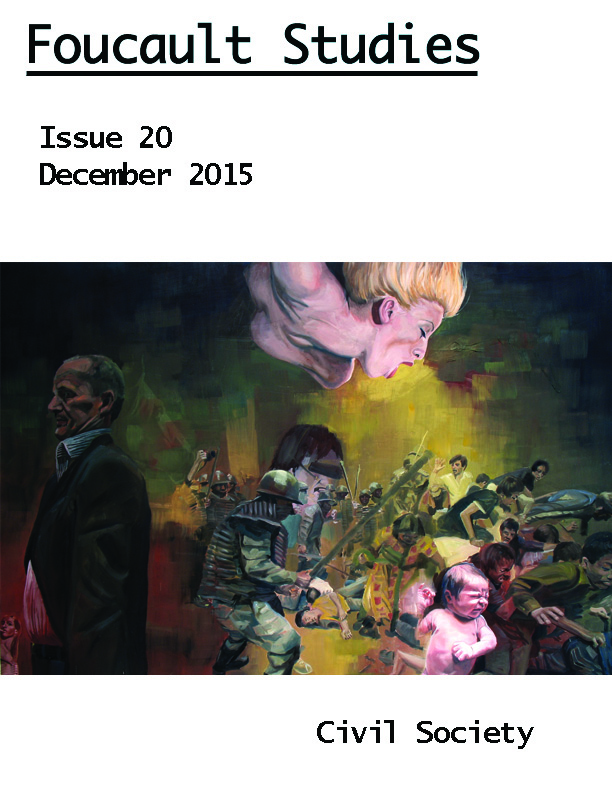
New Issue of Foucault Studies
Number 20: December 2015: Civil Society

All articles open access

fs-20

 Table of Contents

Editorial

Editorial PDF
Sverre Raffnsøe et al. 1-3

Special Issue on Civil Society

Introductory Note: Foucault and Civil Society PDF
Miikka Pyykkönen 4-7
Liberalism, Governmentality and Counter-Conduct; An Introduction to Foucauldian Analytics of Liberal Civil Society Notions PDF
Miikka Pyykkönen 8-35
Foucault, Ferguson, and civil society PDF
Samantha Ashenden 36-51
Haunted by the Rebellion of the Poor: Civil Society and the Racialized Problem of the (Non-)economic Subject PDF
Anna Selmeczi 52-75
Civil Society and Biopolitics in Contemporary Russia: The Case of Russian “Daddy-Schools” PDF
Pelle Åberg 76-95
Civil Society Organizations and Care of the Self: An Ethnographic Case Study on Emancipation and Participation in Drug Treatment PDF
Riikka Perälä 96-115

Section in collaboration with Foucault Circle

Introduction PDF
Margaret McLaren, Dianna Taylor 116-121
Foucault’s Fossils: Life Itself and the Return to Nature in Feminist Philosophy PDF
Lynne Huffer 122-141
Foucault, Laughter, and Gendered Normalization PDF
Emily R. Douglas 142-154
Against Totalitarianism: Agamben, Foucault, and the Politics of Critique PDF
C. Heike Schotten 155-179

Articles

“Is power always secondary to the economy?” Foucault and Adorno on Power and Exchange PDF
Deborah Cook 180-198
Academic Subjectivities: Governmentality and Self-Development in Higher Education PDF
Fabian Cannizzo 199-217
Technologies of the Other: Renewing ‘empathy’ between Foucault and psychoanalysis. PDF
Andrea Lobb 218-235

Review Symposium

Introduction to Review Symposium: On Government of the Living PDF
Alan Milchman, Alan Rosenberg 236-242
The Christian Art of Being Governed PDF
Colin Gordon 243-265
Foucault’s On the Government of the Living PDF
David Konstan 266-276
“Spiritual Gymnastics”: Reflections on Michel Foucault’s On the Government of the Living 1980 Collège de France lectures PDF
Jeremy Carrette 277-290

Review Essay

Foucault’s Flirt? Neoliberalism, the Left and the Welfare State; a Commentary on La dernière leçon de Michel Foucault and Critiquer Foucault PDF
Magnus Paulsen Hansen 291-306

Book Reviews

Marcelo Hoffman, Foucault and Power: The Influence of Political Engagement on Theories of Power (New York and London: Bloomsbury, 2014), i-ix, 1-221, hb $120.00 (US), ISBN: 9781441180940 PDF
Ben Golder 307-311
Keith Ansell-Pearson (ed.), Nietzsche and Political Thought (New York: NY: Bloomsbury, 2013), 256, $120, ISBN: 978-1-4411-2933-8. PDF
Eric Guzzi 312-316
Warren Montag, Althusser and His Contemporaries: Philosophy’s Perpetual War (Durham: Duke University Press, 2013), 256pp., $23.95 pb ISBN: 978-0-8223-9904-9. PDF
Martin Paul Eve 317-319
Claudio Colaguori (ed.), Security, Life and Death: Governmentality and Biopower in the Post 9/11 Era (Whitby: De Sitter Publications, 2013), $39.00, ISBN: 978-1-897160-81-7 PDF
Carlos Torres 320-323
P. Cesaroni and S. Chignola (eds.), La forza del vero; Un seminario sui Corsi di Michel Foucault al Collège de France (1981-1984) (Verona: Ombre Corte, 2013), 7-179, € 15.00, ISBN: 978-88-97522-54-6 PDF
Giovanni Maria Mascaretti 324-328
Hutter, Horst, and Eli Friedland (eds.), Nietzsche’s Therapeutic Teaching for Individuals and Culture (New York: NY: Bloomsbury, 2013), 264 pp., $ 130, 978-1-4411-2533-0. PDF
Eric Guzzi 329-333
John Protevi, Life, War, Earth: Deleuze and the Sciences (Minnesota: Minnesota University Press, 2013), Pagination, Price, ISBN: 978-0-8166-8102-0. PDF
Mohammad-Ali Rahebi 334-338

Toolbox

Editorial: Toolbox PDF
Sverre Raffnsøe et al. 339
The Uncollected Foucault PDF
Stuart Elden 340-353

Exchanges

Editorial: Exchanges PDF
Sverre Raffnsøe et al. 354-355
Neoliberalism, Governmentality, Ethnography: A Response to Michelle Brady PDF
Mitchell Dean 356-366
Neoliberalism, Governmentality, and Ethnography: A rejoinder PDF
Michelle Brady