Foucault News

News and resources on French thinker Michel Foucault (1926-1984)

Aldo Avellaneda, “Las escalas del poder político. Artes, redes y técnicas en los estudios de gubernamentalidad”, Astrolabio. Nueva Época, Núm. 14 (2015)

Full PDF available

Resumen:
Este trabajo avanza la tesis de que los estudios de gubernamentalidad se han definido por la ausencia de un perímetro o dominio concerniente al poder político para realizar sus análisis. Lo han hecho por la sencilla razón de que se trata de un fenómeno interior a las mismas artes de gobierno. Y esto, lejos de obstaculizar el estudio de las complejas formas de conducción de conductas y el papel de las instancias estatales, privadas, o comunitarias en ellas, comporta la ventaja de realizar un diagnóstico a partir de la inmanencia de sus propios modos de inteligir lo real. Para dar cuenta de esto, propongo una lectura sujeta a estos objetivos de las principales apuestas analíticas involucradas en el enfoque. Concluyo exponiendo brevemente que la diferencia específica de los estudios de gubernamentalidad ya no radica tanto en la propuesta explícita y puntual respecto a la forma de entender al estado (no es uno, no tiene esencia, etc.) sino en el movimiento que consiste en atribuir a las artes de gobierno sus propias escalas de poder político. Es aquí donde el enfoque sobre las artes gubernamentales se distancia de buena parte de los proyectos de teoría y filosofía política imperantes a comienzos del siglo XXI, aún en pugna en las altas cumbres de las definiciones.

Palabras Clave:
estudios en gubernamentalidad, poder político, artes, escalas, redes
Magnus Paulsen Hansen, Foucault’s Flirt? Neoliberalism, the Left and the Welfare State; a Commentary on La dernière leçon de Michel Foucault and Critiquer Foucault, Foucault Studies, No. 20, pp. 291-306, December 2015

Foucault Studies is an open access journal.

Extract

You have been read as an idealist, as a nihilist, as a “new philosopher,” an anti-Marxist, a new conservative, and so on… Where do you stand?

I think I have in fact been situated in most of the squares on the political checkerboard, one after another and sometimes simultaneously: as anarchist, leftist, ostentatious or disguised Marxist, nihilist, explicit or secret anti-Marxist, technocrat in the service of Gaullism, neoliberal, and so on. […] None of these descriptions is important by itself; taken together, on the other hand, they mean something. And I must admit that I rather like what they mean.

[I]f all the writers are claimed to have meant to articulate the doctrine with which they are being credited, why is it that they so signally failed to do so, so that the historian is left reconstructing their implied intentions from guesses and vague hints? The only plausible answer is of course fatal to the claim itself: that the author did not (or even could not) have meant after all to enunciate such a doctrine.

As the first quote above indicates, it is not a new task to try to politically position Foucault. However, recently, the wish to make tactical use of this position to promote or denounce a particular political programme seems to have intensified. The debate especially concerns Foucault’s lectures on neoliberalism. Two recent books interpret the lectures as tokens of Foucault becoming “seduced” by neoliberalism. Both books draw upon this ‘insight’ in order to renew the left. However, the conclusions with regards to the role of the left we get from each book are almost diametrically opposite. Whereas Geoffroy de Lagasnerie’s La dernière leçon de Michel Foucault: Sur le néolibéralisme, la théorie et la politique proposes that the left should embrace Foucault’s endorsement of neoliberalism as a necessary step towards reinventing the left; Daniel Zamora’s edited volume Critiquer Foucault : Les années 1980 et la tentation néoliberale sees it as Foucault’s betrayal of the left and defection to the dark side, resulting in a contribution to the left’s current state of decay. We are thus located in the midst of Star Wars: Did Foucault remain the innocent Jedi knight capable of using the force of the enemy to rebel against him or was he finally, as Anakin Skywalker, in that same act, seduced by the almightiness of the empire and the persuasive skills of Emperor Palpatine (who else but Hayek?), finally turning into the incarnation of evil as Darth Vader?

Message from Jesús Velasco and Bernard Harcourt

We are launching a new website for Foucault 13/13! The new website will allow readers to go directly to all of the individual seminars and find there the video, your posts, and other resources. We think that it will make the articles and video far more accessible.

Please visit the new site

You will land on the upcoming seminar, 9/13, but then will be able to navigate to all the others. The official homepage is here: http://blogs.law.columbia.edu/foucault1313/about/

Naturally, we are working out all the kinks and checking that the links are all good, if you come across any problems, please do not hesitate to bring it to our attention. Especially for those of you who have already posted, please tell us if you encounter any problems with your posts.

We want to thank the tireless efforts of Alex Gil, who has spearheaded this new site and our dedicated graduate students who have made this possible, Ibai Atutxa, Raphaëlle Burns, Agnese Codebo, and Luca Provenzano.

We hope you enjoy the new site and share it with others! Please do share it with anyone who you think might find it useful. And we look forward to seeing you this Thursday at Foucault 9/13!

Warm regards, Jesús Velasco and Bernard Harcourt

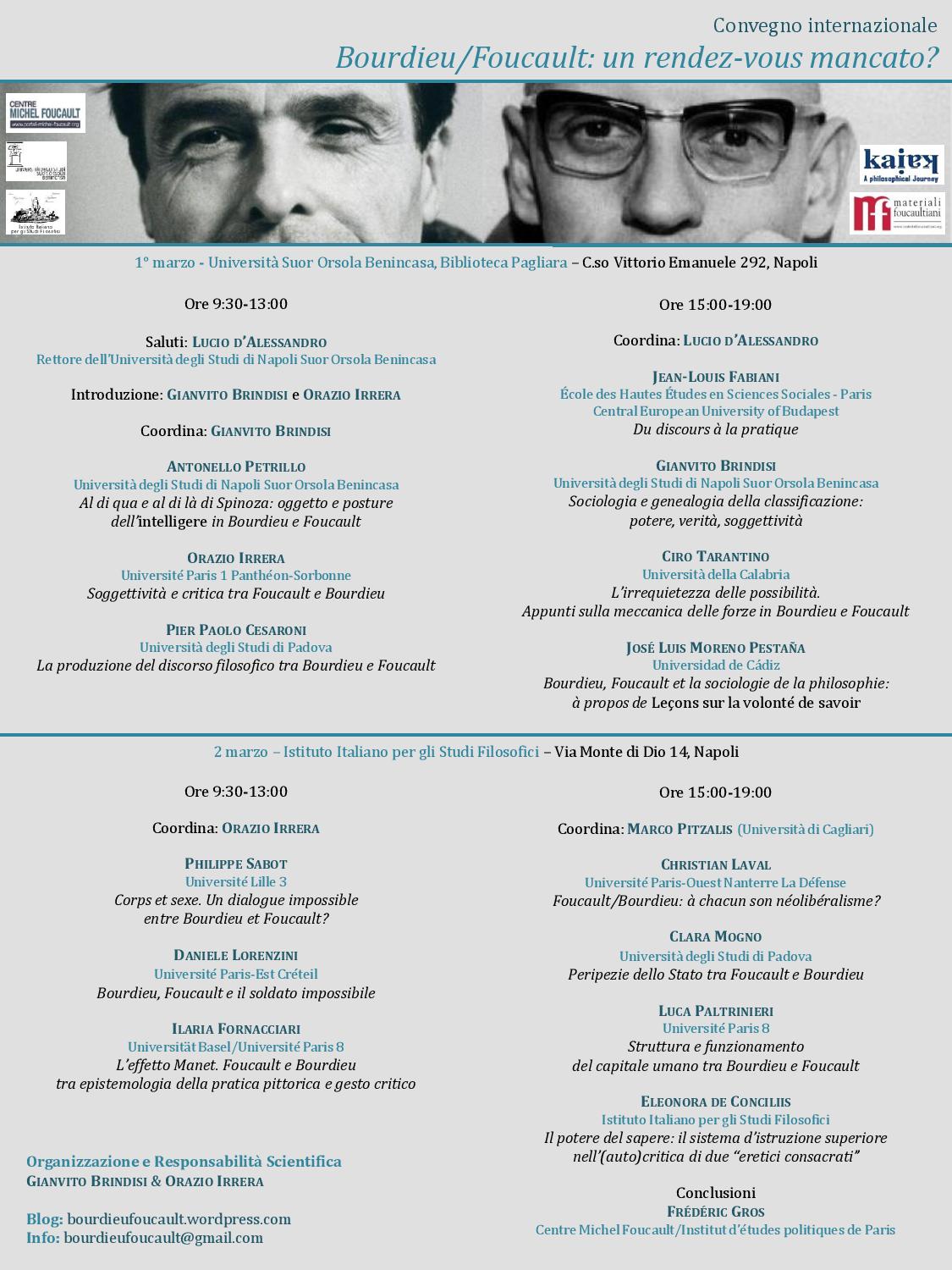
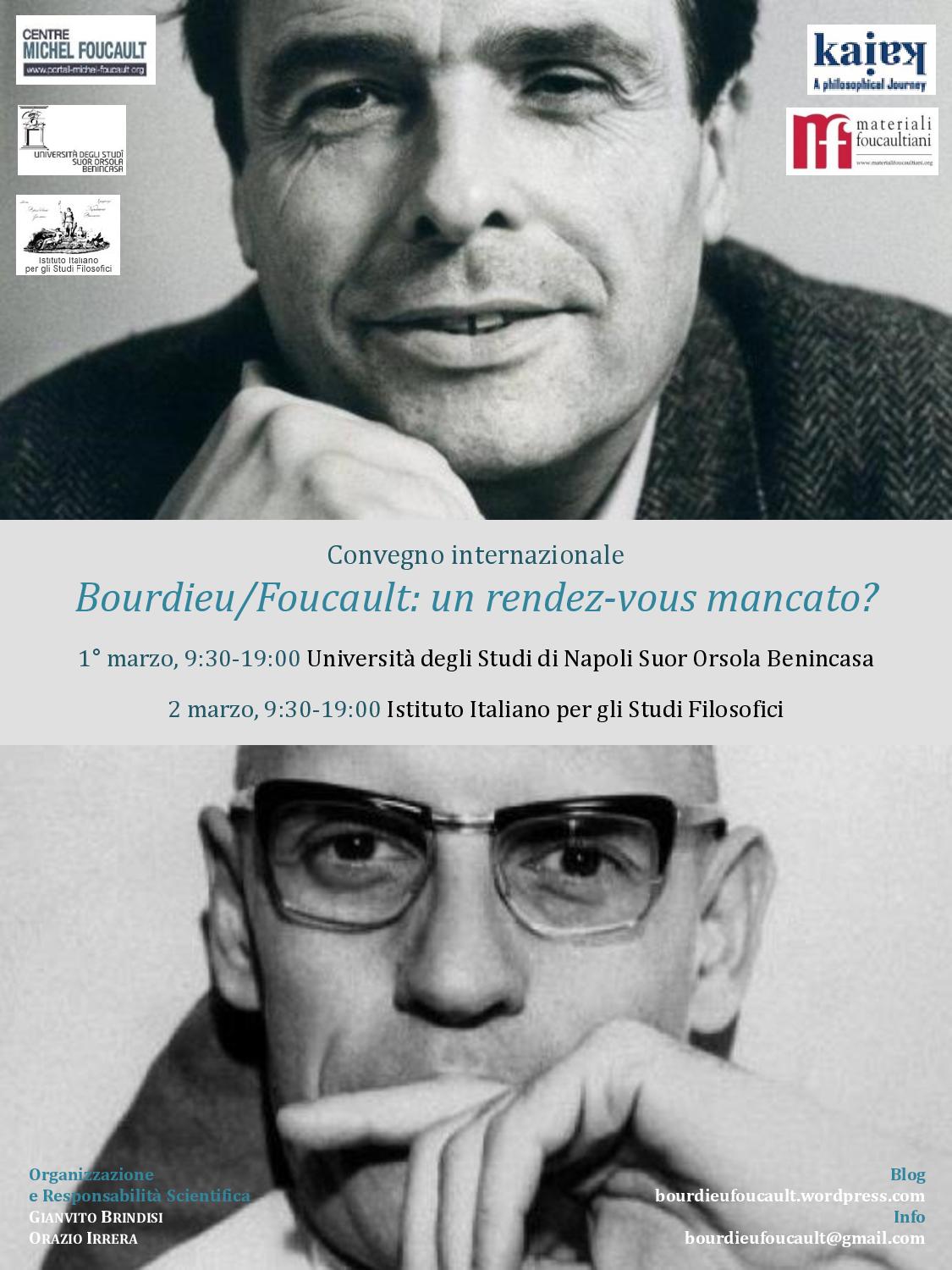
BOURDIEU / FOUCAULT : UN RENDEZ-VOUS MANCATO? 
Convegno Internazionale – Napoli, 1-2 marzo 2016
Università Suor Orsola Benincasa & Istituto Italiano per gli Studi Filosofici

Affiche-bourdieu-foucault
Affiche-bourdieu-foucault2

Convegno organizzato da Gianvito BRINDISI & Orazio IRRERA
con il sostegno del Centre Michel Foucault e in partenariato con le riviste
Kaiak Philosophical Journey & MF / materiali foucaultiani

Blog: https://bourdieufoucault.wordpress.com

Programma: 
1 marzo 2016 – Università Suor Orsola Benincasa (Biblioteca Pagliara)
C.so Vittorio Emanuele 292, Napoli

9h30 – Saluti del Rettore : Lucio d’Alessandro
Introduzione : Gianvito Brindisi & Orazio Irrera

Chair : Gianvito Brindisi (Università degli Studi di Napoli “Suor Orsola Benincasa”)
• Antonello PETRILLO (Università degli Studi di Napoli “Suor Orsola Benincasa”)
Al di qua e al di là di Spinoza: oggetto e posture dell’intelligere in Bourdieu e Foucault
• Orazio IRRERA (Université Paris 1 Panthéon-Sorbonne)
Soggettività e critica tra Foucault e Bourdieu
• Pierpaolo CESARONI (Università degli Studi di Padova)
La produzione del discorso filosofico tra Bourdieu e Foucault

15h00 – Chair : Lucio d’Alessandro (Università degli Studi di Napoli “Suor Orsola Benincasa”)
• Jean-Louis FABIANI (EHESS / Central European University of Budapest)
Du discours à la pratique
• Gianvito BRINDISI (Università degli Studi di Napoli “Suor Orsola Benincasa”)
Sociologia e genealogia della classificazione: potere, verità, soggettività
PAUSA
• Ciro TARANTINO (Università della Calabria)
L’irrequietezza delle possibilità. Appunti sulla meccanica delle forze in Bourdieu e Foucault
• José Luis MORENO PESTAÑA (Universidad de Cádiz)
Bourdieu, Foucault et la sociologie de la philosophie: à propos de Leçons sur la volonté de savoir

2 marzo 2016
Istituto Italiano per gli Studi Filosofici
Via Monte di Dio 14, Napoli
9h30 – Chair : Orazio Irrera (Université Paris 1 Panthéon-Sorbonne)
• Philippe SABOT (Université Lille 3)
Corps et sexe. Un dialogue impossible entre Bourdieu et Foucault ?
• Daniele LORENZINI (Université Paris-Est Créteil)
Bourdieu, Foucault e il soldato impossibile
• Ilaria FORNACCIARI (Universität Basel/Université Paris 8)
L’effetto Manet. Foucault e Bourdieu tra epistemologia della pratica pittorica e gesto critico

15h00 – Chair : Marco Pitzalis (Università degli Studi di Cagliari)
• Christian LAVAL (Université Paris-Ouest Nanterre La Défense)
Foucault/Bourdieu: à chacun son néolibéralisme ?
• Clara MOGNO (Università degli Studi di Padova)
Peripezie dello Stato tra Foucault e Bourdieu
PAUSA
• Luca PALTRINIERI (Université Paris 8)
Struttura e funzionamento del capitale umano tra Bourdieu e Foucault
• Eleonora DE CONCILIIS (Istituto Italiano per gli Studi Filosofici)
Il potere del sapere: il sistema d’istruzione superiore nell’(auto)critica di due “eretici consacrati”

Conclusioni : Frédéric Gros (Centre Michel Foucault / Institut d’études politiques de Paris)

Affiche20fev

INVITATION
Michel Foucault : le dire-vrai entre éthique et politique

Rencontre autour de deux nouveautés foucaldiennes publiées aux Éditions Vrin :

Michel Foucault, Discours et vérité / La parrêsia
Daniele Lorenzini, Éthique et politique de soi

en compagnie de
Henri-Paul Fruchaud,
Frédéric Gros,
Daniele Lorenzini
Judith Revel

20 février – 14h30
Librairie philosophique J. Vrin
6 place de la Sorbonne 75005 Paris

Lawrence D. Berg, Edward H. Huijbens, Henrik Gutzon Larsen, Producing Anxiety in the Neoliberal University
Forthcoming in The Canadian Geographer/le Géographe Canadien
Special issue on
Critical Reflections on Cultivating an Ethic of Wellness in Geography
Guest edited by Linda Peake, Kate Parizeau, and Beverley Mullings

Draft on Academia.edu

Abstract:
This paper presents a theoretical analysis of the neoliberal production of anxiety in academic faculty members in universities in Northern Europe. The paper focuses on neoliberalization as it is instantiated through audit and ranking systems designed to produce academia as a space of economic efficiency and intensifying competition. We suggest that powerful forms of competition and ranking of academic performance have been developed in Northern Europe. These systems are differentiated and differentiating, and they serve to both index and facilitate the neoliberalization of the academy. Moreover, these audit and ranking systems produce an ongoing sense of anxiety among academic workers. We argue that neoliberalism in the academy is part of a wider system of anxiety production arising as part of the so-called ‘soft governance’ of everything, including life itself, in contemporary late liberalism.

Keywords:
Neoliberalism, Higher Education, Human Capital, Academic Audit Systems, Anxiety and Mental Health

Key Messages:
This article investigates processes of neoliberalization of the academy. It argues that neoliberalism entails shifts from exchange to competition, from equality to inequality, and turns academics into human capital. It suggests that auditing systems are key mechanisms of neoliberalization and produce unhealthy levels of anxiety and stress in the academy

Foucault 8/13 | Richard R.W. Brooks on Foucault’s “The Birth of Biopolitics” (1979)
By Richard R. W. Brooks

My comments on Foucault’s The Birth of Biopolitics will focus on the distinctions he observes (in discussing neoliberalism) between abstract economic and legal subjects (subject of interests and subject of rights) and actual individuals in concrete interactions of civil society. Interestingly, a number of the features and fractures that Foucault identifies between the German ordo-liberalism and the American (Chicago School) neo-liberalism, surfaced earlier in the U.S. context between advocates of the marginalist revolution in economics and their counterparts among progressive institutional economists (themselves, to a non-trivial extent, influenced by the German historical tradition) at the turn of the nineteenth century. I hope to usefully relate this marginalist-institutionalist debate to Foucault’s insightful analysis of economic subjects as developed by the Chicago School, significantly in the Journal of Political Economy, and particularly through Gary Becker’s theories on human capital and criminality.

read more

Lars Thorup Larsen & Deborah Stone (2015): “Governing Health Care through Free Choice: Neoliberal Reforms in Denmark and the United States”, Journal of Health Politics, Policy and Law 40(5): 941-70.

doi: 10.1215/03616878-3161162

Abstract
We compare free choice reforms in Denmark and the United States to understand what ideas and political forces could generate such similar policy reforms in radically different political contexts. We analyze the two cases using our own interpretation of neoliberalism as having “two faces.” The first face seeks to expand private markets and shrink the public sector; the second face seeks to strengthen the public sector’s capacity to govern through incentives and competition. First, we show why these two most-different cases offer a useful comparison to understand similar policy tools. Second, we develop our theoretical framework of the two faces of neoliberalism. Third, we examine Denmark’s introduction of a free choice of hospitals in 2002, a policy that for the first time allowed some patients to receive care either in a public hospital outside their local area or in a private hospital. Fourth, we examine the introduction of free choice among private managed care plans into the US Medicare program in 1997. We show how policy makers in both countries used neoliberal reform as a mechanism to make their public health care sectors governable. Fifth, on the basis of our analysis, we draw five lessons about neoliberal policy reforms.

Un moment de l’histoire de la psychiatrie
Mercredi 10 février 2016 , 9h-13h, Salle Beckett, 45 rue d’Ulm 75005 Paris

Un moment de l’histoire de la psychiatrie.
Autour de l’ouvrage Foucault à Münsterlingen. À l’origine de l’« Histoire de la folie », Paris, EHESS, 2015, éd. par Jean-François Bert et Elisabetta Basso

Matinée d’étude organisée par le CAPHÉS – UMS 3610 (CNRS-ENS)
sous la responsabilité de Elisabetta Basso, Mireille Delbraccio et Emmanuel Delille

9h-9h15
Ouverture par Mathias Girel, Directeur du CAPHÉS UMS 3610 (CNRS-ENS)

9h15-9h45
Présentation de la Matinée par Mireille Delbraccio, CAPHÉS

9h45-10h30
Chantal Marazia (IEA Paris)
La révolution thérapeutique entre psychiatrie biologique et psychiatrie anthropologique

10h30-11h15
Emmanuel Delille (Centre Marc Bloch Berlin/CAPHÉS)
Henri Ellenberger à Münsterlingen : remettre le jeune Foucault dans le contexte de la psychiatrie dynamique des années 1950

11h15 : Pause

11h30-12h15
Elisabetta Basso (Université de Lisbonne/CAPHÉS)
L’expérience de Rorschach entre Münsterlingen et Paris dans les années 1940 et 1950

12h15-12h45 : Discussion

Planting Foucault in Juárez. A Translator’s Reflections on the Story of Two Teenage Murderers Separated by Almost Two Centuries by John Washington

“He donned his holiday clothes, had his sister sing a canticle beginning ‘O happy day! holy joy!” and, his mind wholly deranged, his weapon, an ax, in hand, he executed his mother, his sister, and his young brother.”

So one Dr. Vastel describes Pierre Rivière’s parricide-fratricide of June 3, 1835 in the rural French village of Faucterie. The description comes from the book, edited by Michel Foucault, I, Pierre Rivière, Having Slaughtered My Mother, My Sister, and My Brother. The astonishing volume includes the seventy-page memoir (“of remarkable eloquence,” according to presiding judge M. Daigrement) written by the nineteen-year-old murderer, Pierre, in which he candidly describes the particulars of his difficult family life and the details before, during, and after he murders his mother, his sister, and his brother, in that order.

Read more