Foucault News

News and resources on French thinker Michel Foucault (1926-1984)

stuartelden's avatarProgressive Geographies

The manifesto of the Groupe d’information sur les prisons, authored by Foucault, Pierre Vidal-Nanuet and Jean-Marie Domenich, which I translated for this site a couple of years ago, has been reprinted in Viewpoint magazine. The prison group, along with Foucault’s involvement in the parallel health group and other activist work are discussed in detail in Foucault: The Birth of Power.

article.php.gifarticle.php.gif

View original post

Embodying Temporalities: Deep Time, Genealogy, Exile

The Collegium Phaenomenologicum will convene for its 41st annual session in Città di Castello, Italy, from July 11–29, 2016. The Collegium is intended for faculty members and advanced graduate and postdoctoral students in philosophy and related disciplines. The core of the program consists in a series of lecture courses, individual lectures, and intensive text-based seminars.

A participants conference will be held July 9-10.

Courses, Lectures, and Instructors

Week 1: Deep Time: Nietzsche, Heidegger, Derrida

David Wood, Vanderbilt University  

Additional Lectures by Mauro Carbone (Université de Lyon), Paul Davies (University of Sussex),John Sallis (Boston College), Ted Toadvine (University of Oregon)

Week 2: Genealogical and Corporeal Temporalities: Nietzsche, Foucault

Charles Scott & Nancy Tuana, Vanderbilt and Penn State University

Additional Lectures by Robert Bernasconi (Penn State University), David Farrell Krell (DePaul University), Omar Rivera (Southwestern University), Anne O’Byrne (Stony Brook University)

Week3: Time in Exile: Heidegger, Blanchot, Lispector

Marcia Sá Cavalcante Schuback (SödertörnUniversity)

Additional Lectures by Claudia Baracchi (Università degli Studi di Milano-Bicocca),Sean Kirkland (DePaul University), Jason Winfree (CSU Stanislaus)

Participants will be comfortably housed at Hotel Le Mura (***) in the historic center of Città di Castello. The cost for room and board (full pension) will be €40 (double occupancy) and €54 (single room) per day. The program fee for the three-week session will be €275. The deadline for applications is February 15, 2016.(This is flexible).

Prof. Alejandro A. Vallega and Daniela Vallega-Neu
Directors
Department of Philosophy
University of Oregon
1295 University of Oregon
Susan Campbell Hall 211
Eugene, OR 97403
USA
dneu@uoregon.edu and
avallega@uoregon.edu

Prof. Andrew Benjamin
Australian Correspondent
Department of Philosophy and Australian Centre for Jewish Civilization
Monash University
Tel: (+03) 99035003
andrew.benjamin@monash.edu

Prof. Gert-Jan van der Heiden
European Correspondent
Department of Philosophy
Radboud Universiteit Nijmegen
Po Box 9103
6500 HD Nijmegen
The Netherlands
Tel: 31-24-3616227
g.vanderheiden@ru.nl

Prof María Acosta
Latin American Correspondant
Department of Philosophy
DePaul University
USA
macostal@depaul.edu

Benjamin Brewer
Graduate Assistant
Emory University
561 South Kilgo Circle
214 Bowden Hall
Atlanta, GA 30322
USA
benjamin.brewer@emory.edu

The Colonial and Settler Studies Research Network
and

The Centre for Critical Human Rights Research
present

Biopolitics: An Interdisciplinary Roundtable

How and in what ways is the body a site of intervention for power in colonial and postcolonial situations? How do race and gender affect modes of governmentality and representation? This roundtable considers these and related questions from the perspectives of historical, literary and cultural studies.

Panelists:
Chair: Anshuman Mondal (English and Postcolonial Studies, Brunel University).
Jane Carey (History, University of Wollongong)
Timothy Neale (Institute for Culture and Society, Western Sydney University)
Michael R. Griffiths (English and Writing, University of Wollongong)
Vera Mackie (History, University of Wollongong)

Tuesday 23rd February, 2016
3:30–5:00 pm
LHA Research Hub 19.2072

Launch
The event will be followed by a launch of Griffiths’s edited collection Biopolitics and Memory in Postcolonial Literature and Culture (Ashgate 2016).

Tuesday 23rd February 5:00 pm–6:00 pm

The book addresses the intersection of biopolitics and public practices of memory from the Truth and Reconciliation Commission in South Africa to the United Nations Permanent Memorial to the Victims of Slavery and the Transatlantic Slave Trade to the Stolen Generations in Australia.

If you would like to attend, please reply to Alexander Brown  by Monday 22nd February for catering purposes.

surtymind's avatarPhilosophical Naturalism

“An experiment with a panoptic  system would suffice to find out;  different things could be taught to different children in different cells;  we could teach no matter what to no matter which child, and we would see the result. In this way we could raise children in completely different systems, or even systems incompatible with each other; some would be taught the Newtonian system, and then others would be got to believe that the moon was made of cheese. When they were eighteen or twenty, they would be put together to discuss the question” (Psychiatric Power p. 78)

When one reads the words of Foucault describing Bentham’s imagined Panoptic System  one thinks of Applied Behavioural Analysis (henceforth ABA). Bentham of course was one of the fathers of utilitarianism and ABA seems to implicitly adopt the approach a utilitarian approach to ethics e.g. a cost/benefit calculation. When one reads about Bentham’s…

View original post 3,695 more words

Lacan contra Foucault Subjectivity Universalism Politics Part 1 of 4 parts

Seminar “Lacan contra Foucault Subjectivity, Universalism, Politics at The American University of Beirut Arts and Humanities (Mellon Grant) Faculty of Arts and Sciences in December 2015

Mitchell Dean, Rebel, Rebel? Revisiting the radical legacy of Michel Foucault via David Bowie, Stanford University Press blog, 19 Feb 2016

In order to understand any major thinker and their legacy, it is important to consider their context—a truism that is very hard to put into practice, especially when the thinker in question belongs both to the recent past but is still very much a part of our present. In part, this explains the wealth of discussion swirling around the recent passing of a certain protean pop icon who left behind a singular era-defining legacy. It’s also for this reason that another standout cultural figure of the seventies—a certain French philosopher—has become so difficult to situate in our contemporary moment.

I speak, of course, of David Bowie and Michel Foucault whose political projects paralleled one another in intriguing ways. Whether in the intellectual works of the philosopher, or the records and performances of the artist, both men were concerned with questions of identity, whether sexual or personal; both focused on the persona or the construction of subjectivity rather than the more fixed humanist subject; both supported and even celebrated the marginal—whether incarnated as Bowie’s space alien or Foucault’s “abnormals” produced through disciplinary knowledges; and both made the experience of madness, transgression and intensity part of their art or thought. Both would also go on to develop an aesthetics of the self, turning life and ultimately death into a work of art or self-transformation. Blackstar, Bowie’s last album, was released days before he succumbed to cancer and Foucault’s final two volumes of History of Sexuality were published in the weeks preceding his death. With these swan songs, the pop star and the intellectual celebrity each died with a flourish and left us with work that spoke to and beyond their own deaths. Indeed, like this album, Foucault’s very last lectures, delivered when he surely suspected his condition was terminal, meditate on death and demise.


Read more

stuartelden's avatarProgressive Geographies

3-understanding-henri-lefebvreTranslations of Understanding Henri Lefebvre and Foucault’s Last Decade are forthcoming in Korean with Kyungsung University Press and Nanjing Press respectively. These might be the first of my authored books to appear in translation, since potential translations of The Birth of Territory into Portuguese by a Brazilian press and into Korean have stalled, though a Chinese version is still in progress.

The edition of Lefebvre’s Rhythmanalysis Gerald Moore and I translated was translated into Korean and Persian, with our notes, my introduction etc., and several articles have been translated in the past, but a whole book by me in translation will be a nice moment.

View original post

Miguel de Beistegui (University of Warwick) – The Government of Desire: a Genealogical Perspective
Introduction By Professor Peter Osborne
Event Date: 4 February 2016
Audio recording on the Backdoor Broadcasting Company site

David Garland, Bars and stripes. Review of The Punitive Society. The Times Literary Supplement, 27 January 2016.

The thinking and rethinking that led Michel Foucault to write his finest book.

Le Collège de France, founded in 1530 and located in Paris’s Latin Quarter, is one of France’s elite institutions. It is a public institution of higher education but it enrols no students and grants no degrees. Instead, it requires its professors to give an annual course of lectures – free of charge and open to all – reporting on their on­going research. Michel Foucault, who was admitted to the Collège in 1970 as professor of “The History of Systems of Thought”, took this obligation very seriously, preparing his lectures with exquisite care and presenting them to a packed amphitheatre at 5:45 pm each Wednesday from January to March. His lectures were intense, austere performances. Reading aloud from his prepared text, he made little concession to the oral form, refraining from informality and permitting himself a minimum of levity or improvisation. For ninety minutes at a time, he would set out historico-philosophical questions, summarize his archival findings, and outline explanatory hypotheses, speaking to his hundreds of auditors – many of whom were academic tourists come to hear the famous maître penseur – as if he were addressing a small group of fellow specialists. He evidently regarded these lectures as a specific kind of production: not working drafts, not thinking aloud but a completed scholarly performance of a certain kind. And indeed, mimeographed transcripts of lecture recordings soon circulated, samizdat-style, bringing the first results of Foucault’s new thinking to eager audiences in France and abroad.

Read more

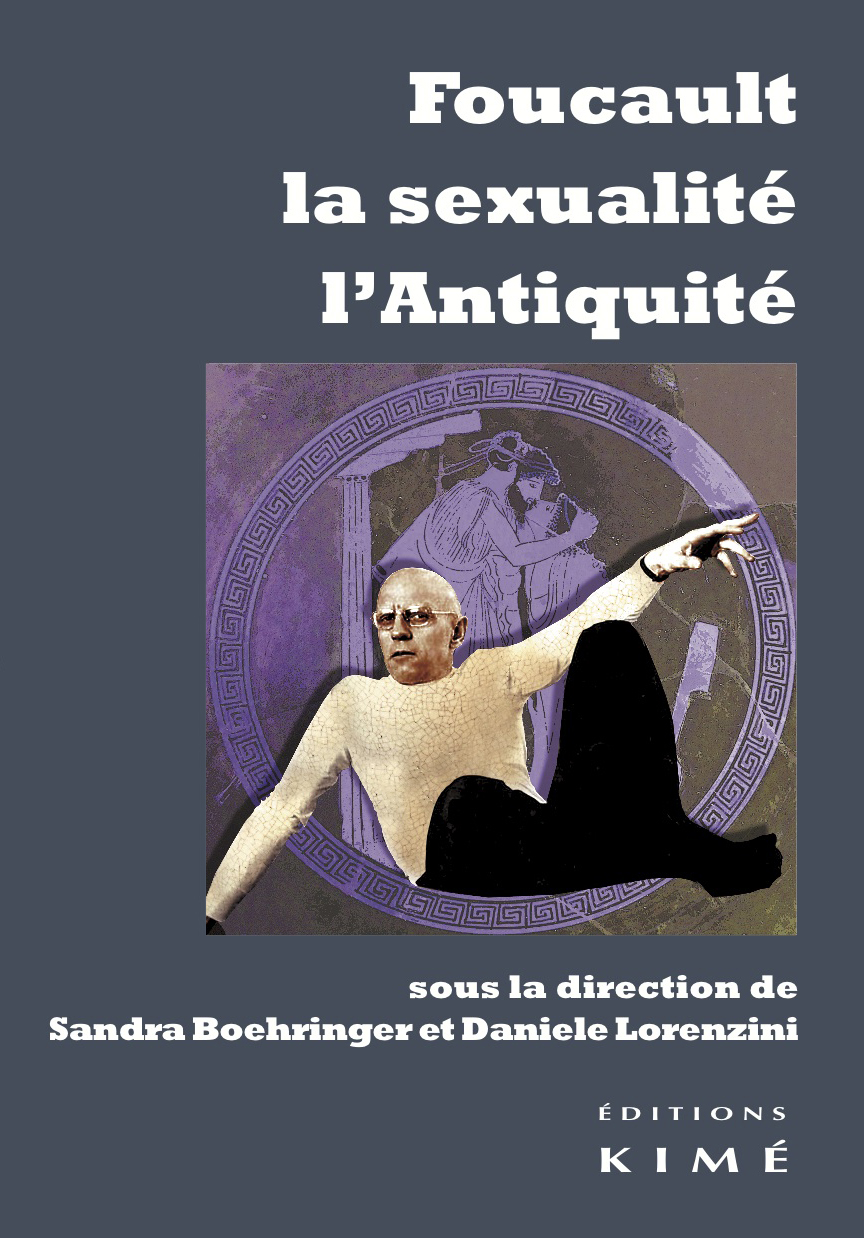
bochringer-lorenziniFoucault, la Sexualité, l’Antiquité
sous la direction de Sandra Boehringer et Daniele Lorenzini

PDF of flyer

Ont contribué à cet ouvrage :
Jean Allouch, Thamy Ayouch, Sandra Boehringer, Claude Calame, Frédéric Gros, Daniele Lorenzini, Kirk Ormand, Olivier Renaut, Arianna Sforzini

Éditions Kimé – Philosophie en cours – 196 pages ISBN 978-2-84174-739-9 – 20 € – février 2016

Couverture : Shan Deraze

Compte rendu par Jan Nelis

Ouvrage publié avec le concours de l’Association pour le Centre Michel Foucault, le centre de recherches Psychanalyse, Médecine et Société (CRPMS, EA 3522) de l’Université Paris Diderot et l’équipe d’accueil « Lettres, Idées, Savoirs »
(LIS, EA 4395) de l’Université Paris-Est Créteil

La sexualité est l’un des derniers grands chantiers ouverts par Michel Foucault. L’Histoire de la sexualité est une entreprise immense, qui marqua profondément le champ des sciences humaines : dans les deux volumes portant sur l’Antiquité, Foucault allait proposer de nouveaux epistemai aux spécialistes pour aborder les sociétés grecque et romaine, et un nouveau cadre épistémologique pour penser l’érotisme et le processus par lequel l’individu est amené à se reconnaître comme sujet de son désir et de sa propre existence.

Qu’en est-il trente ans après ? Comment définir l’impact dans le champ des sciences humaines des travaux de Foucault sur la sexualité et l’Antiquité, au moment où paraît le volume Subjectivité et vérité – le premier cours de Foucault au Collège de France entièrement consacré à l’Antiquité gréco-romaine ? Et quel est l’usage qu’en font actuellement les anthropologues des mondes grec et romain, vingt-cinq ans après l’ouvrage pionnier Before Sexuality. The Construction of Erotic Experience in the Ancient Greek World ? Dans cet ouvrage, il s’agit de comprendre comment les travaux de Foucault ont in échi les ré exions des chercheur-e-s et des intellectuel-le-s qui s’appuient aujourd’hui sur l’Antiquité dans les domaines nom- breux que sont l’éthique, les études de genre, la philosophie, l’histoire, l’anthropologie, la politique et la psychanalyse.

TABLE DES MATIÈRES

Introduction. Une histoire de l’Histoire de la sexualité
Sandra BOEHRINGER et Daniele LORENZINI
« Foucault, la sexualité et l’Antiquité : trente ans après »
Frédéric GROS
« L’Usage des plaisirs et Le Souci de soi : généalogie d’un texte »

Partie 1. Avant la sexualité
Sandra BOEHRINGER
« Refuser les universaux.
Une histoire foucaldienne de la sexualité antique, une histoire au présent »
Kirk ORMAND
« Peut-on parler de perversion dans l’Antiquité ?
Foucault et l’invention du raisonnement psychiatrique »

Partie 2. C’est à quel sujet ?
Jean ALLOUCH
« La scène sexuelle est à un seul personnage »
Claude CALAME
« Sujet de désir et sujet de discours foucaldiens.
La sexualité face aux relations érotiques de Grecques et Grecs »

Partie 3. Question(s) de désir
Olivier RENAUT
« Sexualité antique et principe d’activité. Les paradoxes foucaldiens sur la pédérastie »
Daniele LORENZINI
« Le désir comme “transcendantal historique” de l’histoire de la sexualité »

Partie 4. Repenser les corps et les normes
Arianna SFORZINI
« Corps de plaisir, corps de désir.
La théorie augustinienne du mariage relue par Michel Foucault »
Thamy AYOUCH
« De l’herméneutique au stratégique. Sexuations, sexualités, normes et psychanalyse »