Foucault News

News and resources on French thinker Michel Foucault (1926-1984)

Mitchell Dean, Rebel, Rebel? Revisiting the radical legacy of Michel Foucault via David Bowie, Stanford University Press blog, 19 Feb 2016

In order to understand any major thinker and their legacy, it is important to consider their context—a truism that is very hard to put into practice, especially when the thinker in question belongs both to the recent past but is still very much a part of our present. In part, this explains the wealth of discussion swirling around the recent passing of a certain protean pop icon who left behind a singular era-defining legacy. It’s also for this reason that another standout cultural figure of the seventies—a certain French philosopher—has become so difficult to situate in our contemporary moment.

I speak, of course, of David Bowie and Michel Foucault whose political projects paralleled one another in intriguing ways. Whether in the intellectual works of the philosopher, or the records and performances of the artist, both men were concerned with questions of identity, whether sexual or personal; both focused on the persona or the construction of subjectivity rather than the more fixed humanist subject; both supported and even celebrated the marginal—whether incarnated as Bowie’s space alien or Foucault’s “abnormals” produced through disciplinary knowledges; and both made the experience of madness, transgression and intensity part of their art or thought. Both would also go on to develop an aesthetics of the self, turning life and ultimately death into a work of art or self-transformation. Blackstar, Bowie’s last album, was released days before he succumbed to cancer and Foucault’s final two volumes of History of Sexuality were published in the weeks preceding his death. With these swan songs, the pop star and the intellectual celebrity each died with a flourish and left us with work that spoke to and beyond their own deaths. Indeed, like this album, Foucault’s very last lectures, delivered when he surely suspected his condition was terminal, meditate on death and demise.

Read more

stuartelden's avatarProgressive Geographies

3-understanding-henri-lefebvreTranslations of Understanding Henri Lefebvre and Foucault’s Last Decade are forthcoming in Korean with Kyungsung University Press and Nanjing Press respectively. These might be the first of my authored books to appear in translation, since potential translations of The Birth of Territory into Portuguese by a Brazilian press and into Korean have stalled, though a Chinese version is still in progress.

The edition of Lefebvre’s Rhythmanalysis Gerald Moore and I translated was translated into Korean and Persian, with our notes, my introduction etc., and several articles have been translated in the past, but a whole book by me in translation will be a nice moment.

View original post

Miguel de Beistegui (University of Warwick) – The Government of Desire: a Genealogical Perspective
Introduction By Professor Peter Osborne
Event Date: 4 February 2016
Audio recording on the Backdoor Broadcasting Company site

David Garland, Bars and stripes. Review of The Punitive Society. The Times Literary Supplement, 27 January 2016.

The thinking and rethinking that led Michel Foucault to write his finest book.

Le Collège de France, founded in 1530 and located in Paris’s Latin Quarter, is one of France’s elite institutions. It is a public institution of higher education but it enrols no students and grants no degrees. Instead, it requires its professors to give an annual course of lectures – free of charge and open to all – reporting on their on­going research. Michel Foucault, who was admitted to the Collège in 1970 as professor of “The History of Systems of Thought”, took this obligation very seriously, preparing his lectures with exquisite care and presenting them to a packed amphitheatre at 5:45 pm each Wednesday from January to March. His lectures were intense, austere performances. Reading aloud from his prepared text, he made little concession to the oral form, refraining from informality and permitting himself a minimum of levity or improvisation. For ninety minutes at a time, he would set out historico-philosophical questions, summarize his archival findings, and outline explanatory hypotheses, speaking to his hundreds of auditors – many of whom were academic tourists come to hear the famous maître penseur – as if he were addressing a small group of fellow specialists. He evidently regarded these lectures as a specific kind of production: not working drafts, not thinking aloud but a completed scholarly performance of a certain kind. And indeed, mimeographed transcripts of lecture recordings soon circulated, samizdat-style, bringing the first results of Foucault’s new thinking to eager audiences in France and abroad.

Read more

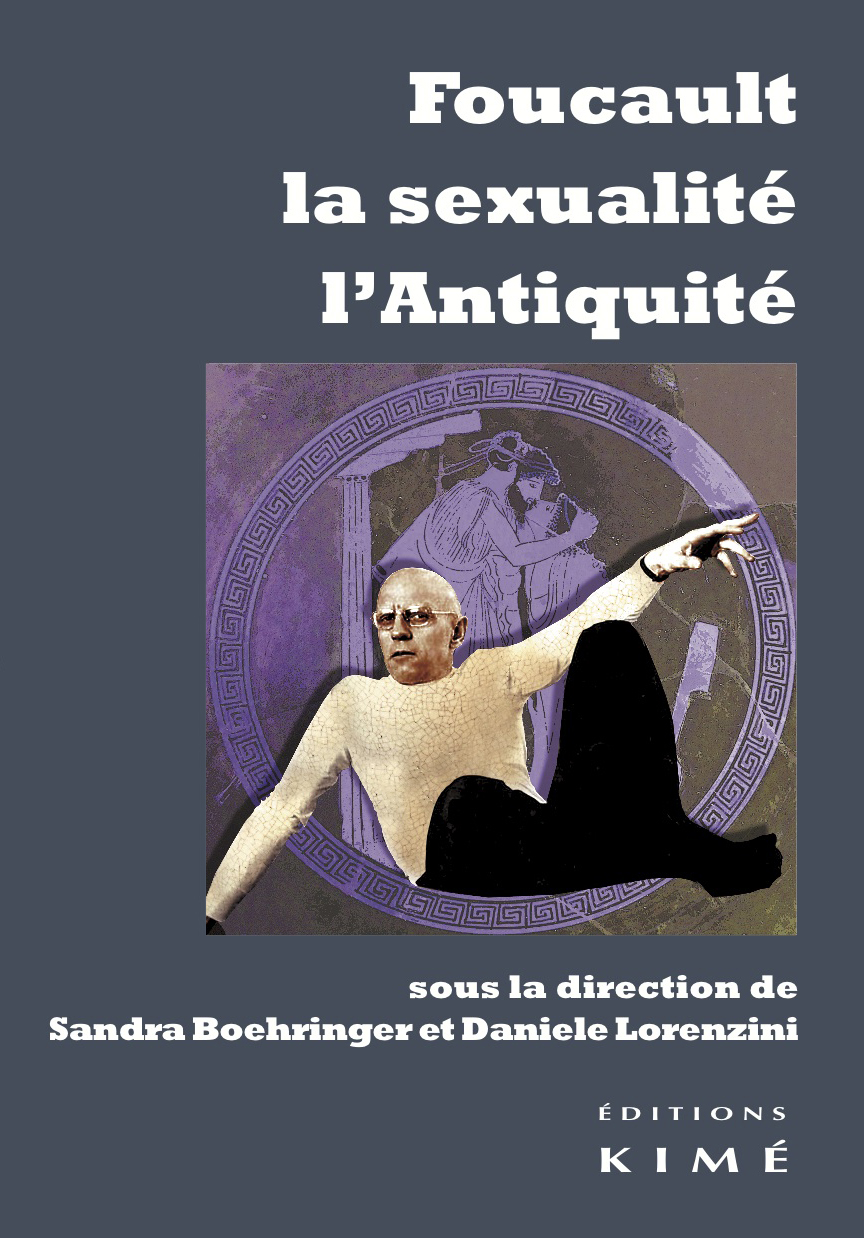
bochringer-lorenziniFoucault, la Sexualité, l’Antiquité
sous la direction de Sandra Boehringer et Daniele Lorenzini

PDF of flyer

Ont contribué à cet ouvrage :
Jean Allouch, Thamy Ayouch, Sandra Boehringer, Claude Calame, Frédéric Gros, Daniele Lorenzini, Kirk Ormand, Olivier Renaut, Arianna Sforzini

Éditions Kimé – Philosophie en cours – 196 pages ISBN 978-2-84174-739-9 – 20 € – février 2016

Couverture : Shan Deraze

Compte rendu par Jan Nelis

Ouvrage publié avec le concours de l’Association pour le Centre Michel Foucault, le centre de recherches Psychanalyse, Médecine et Société (CRPMS, EA 3522) de l’Université Paris Diderot et l’équipe d’accueil « Lettres, Idées, Savoirs »
(LIS, EA 4395) de l’Université Paris-Est Créteil

La sexualité est l’un des derniers grands chantiers ouverts par Michel Foucault. L’Histoire de la sexualité est une entreprise immense, qui marqua profondément le champ des sciences humaines : dans les deux volumes portant sur l’Antiquité, Foucault allait proposer de nouveaux epistemai aux spécialistes pour aborder les sociétés grecque et romaine, et un nouveau cadre épistémologique pour penser l’érotisme et le processus par lequel l’individu est amené à se reconnaître comme sujet de son désir et de sa propre existence.

Qu’en est-il trente ans après ? Comment définir l’impact dans le champ des sciences humaines des travaux de Foucault sur la sexualité et l’Antiquité, au moment où paraît le volume Subjectivité et vérité – le premier cours de Foucault au Collège de France entièrement consacré à l’Antiquité gréco-romaine ? Et quel est l’usage qu’en font actuellement les anthropologues des mondes grec et romain, vingt-cinq ans après l’ouvrage pionnier Before Sexuality. The Construction of Erotic Experience in the Ancient Greek World ? Dans cet ouvrage, il s’agit de comprendre comment les travaux de Foucault ont in échi les ré exions des chercheur-e-s et des intellectuel-le-s qui s’appuient aujourd’hui sur l’Antiquité dans les domaines nom- breux que sont l’éthique, les études de genre, la philosophie, l’histoire, l’anthropologie, la politique et la psychanalyse.

TABLE DES MATIÈRES

Introduction. Une histoire de l’Histoire de la sexualité
Sandra BOEHRINGER et Daniele LORENZINI
« Foucault, la sexualité et l’Antiquité : trente ans après »
Frédéric GROS
« L’Usage des plaisirs et Le Souci de soi : généalogie d’un texte »

Partie 1. Avant la sexualité
Sandra BOEHRINGER
« Refuser les universaux.
Une histoire foucaldienne de la sexualité antique, une histoire au présent »
Kirk ORMAND
« Peut-on parler de perversion dans l’Antiquité ?
Foucault et l’invention du raisonnement psychiatrique »

Partie 2. C’est à quel sujet ?
Jean ALLOUCH
« La scène sexuelle est à un seul personnage »
Claude CALAME
« Sujet de désir et sujet de discours foucaldiens.
La sexualité face aux relations érotiques de Grecques et Grecs »

Partie 3. Question(s) de désir
Olivier RENAUT
« Sexualité antique et principe d’activité. Les paradoxes foucaldiens sur la pédérastie »
Daniele LORENZINI
« Le désir comme “transcendantal historique” de l’histoire de la sexualité »

Partie 4. Repenser les corps et les normes
Arianna SFORZINI
« Corps de plaisir, corps de désir.
La théorie augustinienne du mariage relue par Michel Foucault »
Thamy AYOUCH
« De l’herméneutique au stratégique. Sexuations, sexualités, normes et psychanalyse »

Aldo Avellaneda, “Las escalas del poder político. Artes, redes y técnicas en los estudios de gubernamentalidad”, Astrolabio. Nueva Época, Núm. 14 (2015)

Full PDF available

Resumen:
Este trabajo avanza la tesis de que los estudios de gubernamentalidad se han definido por la ausencia de un perímetro o dominio concerniente al poder político para realizar sus análisis. Lo han hecho por la sencilla razón de que se trata de un fenómeno interior a las mismas artes de gobierno. Y esto, lejos de obstaculizar el estudio de las complejas formas de conducción de conductas y el papel de las instancias estatales, privadas, o comunitarias en ellas, comporta la ventaja de realizar un diagnóstico a partir de la inmanencia de sus propios modos de inteligir lo real. Para dar cuenta de esto, propongo una lectura sujeta a estos objetivos de las principales apuestas analíticas involucradas en el enfoque. Concluyo exponiendo brevemente que la diferencia específica de los estudios de gubernamentalidad ya no radica tanto en la propuesta explícita y puntual respecto a la forma de entender al estado (no es uno, no tiene esencia, etc.) sino en el movimiento que consiste en atribuir a las artes de gobierno sus propias escalas de poder político. Es aquí donde el enfoque sobre las artes gubernamentales se distancia de buena parte de los proyectos de teoría y filosofía política imperantes a comienzos del siglo XXI, aún en pugna en las altas cumbres de las definiciones.

Palabras Clave:
estudios en gubernamentalidad, poder político, artes, escalas, redes

Magnus Paulsen Hansen, Foucault’s Flirt? Neoliberalism, the Left and the Welfare State; a Commentary on La dernière leçon de Michel Foucault and Critiquer Foucault, Foucault Studies, No. 20, pp. 291-306, December 2015

Foucault Studies is an open access journal.

Extract

You have been read as an idealist, as a nihilist, as a “new philosopher,” an anti-Marxist, a new conservative, and so on… Where do you stand?

I think I have in fact been situated in most of the squares on the political checkerboard, one after another and sometimes simultaneously: as anarchist, leftist, ostentatious or disguised Marxist, nihilist, explicit or secret anti-Marxist, technocrat in the service of Gaullism, neoliberal, and so on. […] None of these descriptions is important by itself; taken together, on the other hand, they mean something. And I must admit that I rather like what they mean.

[I]f all the writers are claimed to have meant to articulate the doctrine with which they are being credited, why is it that they so signally failed to do so, so that the historian is left reconstructing their implied intentions from guesses and vague hints? The only plausible answer is of course fatal to the claim itself: that the author did not (or even could not) have meant after all to enunciate such a doctrine.

As the first quote above indicates, it is not a new task to try to politically position Foucault. However, recently, the wish to make tactical use of this position to promote or denounce a particular political programme seems to have intensified. The debate especially concerns Foucault’s lectures on neoliberalism. Two recent books interpret the lectures as tokens of Foucault becoming “seduced” by neoliberalism. Both books draw upon this ‘insight’ in order to renew the left. However, the conclusions with regards to the role of the left we get from each book are almost diametrically opposite. Whereas Geoffroy de Lagasnerie’s La dernière leçon de Michel Foucault: Sur le néolibéralisme, la théorie et la politique proposes that the left should embrace Foucault’s endorsement of neoliberalism as a necessary step towards reinventing the left; Daniel Zamora’s edited volume Critiquer Foucault : Les années 1980 et la tentation néoliberale sees it as Foucault’s betrayal of the left and defection to the dark side, resulting in a contribution to the left’s current state of decay. We are thus located in the midst of Star Wars: Did Foucault remain the innocent Jedi knight capable of using the force of the enemy to rebel against him or was he finally, as Anakin Skywalker, in that same act, seduced by the almightiness of the empire and the persuasive skills of Emperor Palpatine (who else but Hayek?), finally turning into the incarnation of evil as Darth Vader?

Message from Jesús Velasco and Bernard Harcourt

We are launching a new website for Foucault 13/13! The new website will allow readers to go directly to all of the individual seminars and find there the video, your posts, and other resources. We think that it will make the articles and video far more accessible.

Please visit the new site

You will land on the upcoming seminar, 9/13, but then will be able to navigate to all the others. The official homepage is here: http://blogs.law.columbia.edu/foucault1313/about/

Naturally, we are working out all the kinks and checking that the links are all good, if you come across any problems, please do not hesitate to bring it to our attention. Especially for those of you who have already posted, please tell us if you encounter any problems with your posts.

We want to thank the tireless efforts of Alex Gil, who has spearheaded this new site and our dedicated graduate students who have made this possible, Ibai Atutxa, Raphaëlle Burns, Agnese Codebo, and Luca Provenzano.

We hope you enjoy the new site and share it with others! Please do share it with anyone who you think might find it useful. And we look forward to seeing you this Thursday at Foucault 9/13!

Warm regards, Jesús Velasco and Bernard Harcourt

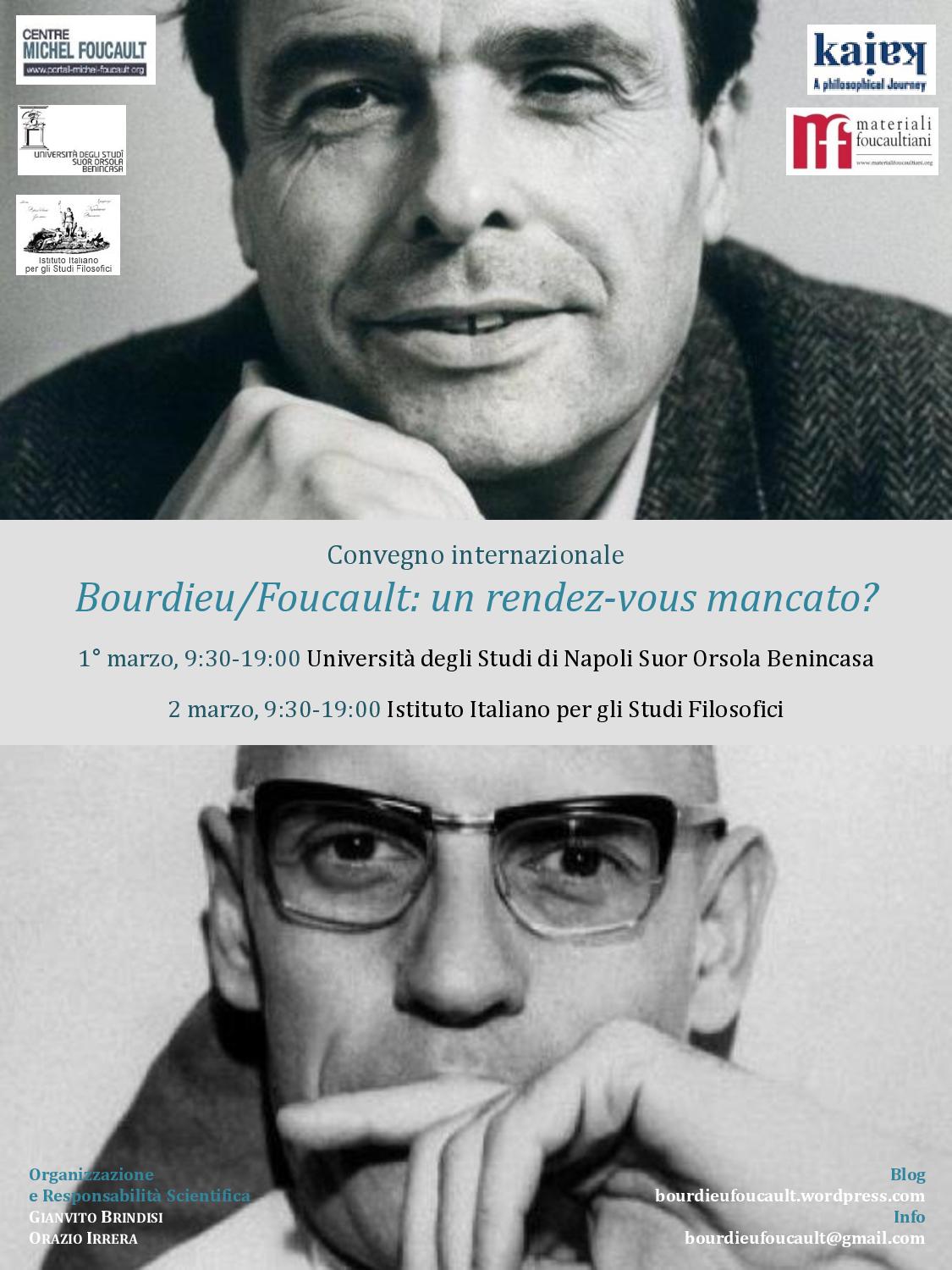
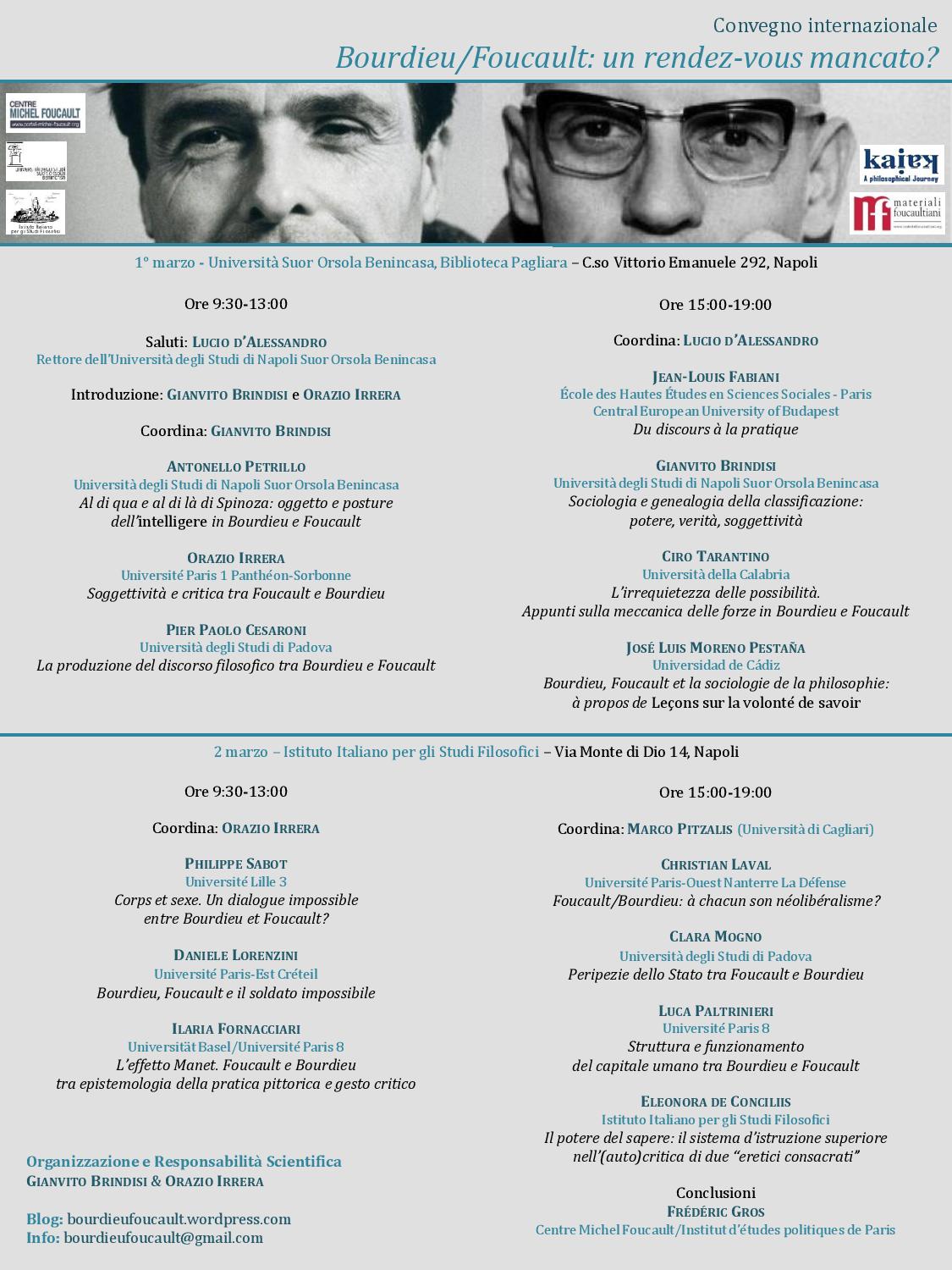
BOURDIEU / FOUCAULT : UN RENDEZ-VOUS MANCATO? 
Convegno Internazionale – Napoli, 1-2 marzo 2016
Università Suor Orsola Benincasa & Istituto Italiano per gli Studi Filosofici

Affiche-bourdieu-foucault
Affiche-bourdieu-foucault2

Convegno organizzato da Gianvito BRINDISI & Orazio IRRERA
con il sostegno del Centre Michel Foucault e in partenariato con le riviste
Kaiak Philosophical Journey & MF / materiali foucaultiani

Blog: https://bourdieufoucault.wordpress.com

Programma: 
1 marzo 2016 – Università Suor Orsola Benincasa (Biblioteca Pagliara)
C.so Vittorio Emanuele 292, Napoli

9h30 – Saluti del Rettore : Lucio d’Alessandro
Introduzione : Gianvito Brindisi & Orazio Irrera

Chair : Gianvito Brindisi (Università degli Studi di Napoli “Suor Orsola Benincasa”)
• Antonello PETRILLO (Università degli Studi di Napoli “Suor Orsola Benincasa”)
Al di qua e al di là di Spinoza: oggetto e posture dell’intelligere in Bourdieu e Foucault
• Orazio IRRERA (Université Paris 1 Panthéon-Sorbonne)
Soggettività e critica tra Foucault e Bourdieu
• Pierpaolo CESARONI (Università degli Studi di Padova)
La produzione del discorso filosofico tra Bourdieu e Foucault

15h00 – Chair : Lucio d’Alessandro (Università degli Studi di Napoli “Suor Orsola Benincasa”)
• Jean-Louis FABIANI (EHESS / Central European University of Budapest)
Du discours à la pratique
• Gianvito BRINDISI (Università degli Studi di Napoli “Suor Orsola Benincasa”)
Sociologia e genealogia della classificazione: potere, verità, soggettività
PAUSA
• Ciro TARANTINO (Università della Calabria)
L’irrequietezza delle possibilità. Appunti sulla meccanica delle forze in Bourdieu e Foucault
• José Luis MORENO PESTAÑA (Universidad de Cádiz)
Bourdieu, Foucault et la sociologie de la philosophie: à propos de Leçons sur la volonté de savoir

2 marzo 2016
Istituto Italiano per gli Studi Filosofici
Via Monte di Dio 14, Napoli
9h30 – Chair : Orazio Irrera (Université Paris 1 Panthéon-Sorbonne)
• Philippe SABOT (Université Lille 3)
Corps et sexe. Un dialogue impossible entre Bourdieu et Foucault ?
• Daniele LORENZINI (Université Paris-Est Créteil)
Bourdieu, Foucault e il soldato impossibile
• Ilaria FORNACCIARI (Universität Basel/Université Paris 8)
L’effetto Manet. Foucault e Bourdieu tra epistemologia della pratica pittorica e gesto critico

15h00 – Chair : Marco Pitzalis (Università degli Studi di Cagliari)
• Christian LAVAL (Université Paris-Ouest Nanterre La Défense)
Foucault/Bourdieu: à chacun son néolibéralisme ?
• Clara MOGNO (Università degli Studi di Padova)
Peripezie dello Stato tra Foucault e Bourdieu
PAUSA
• Luca PALTRINIERI (Université Paris 8)
Struttura e funzionamento del capitale umano tra Bourdieu e Foucault
• Eleonora DE CONCILIIS (Istituto Italiano per gli Studi Filosofici)
Il potere del sapere: il sistema d’istruzione superiore nell’(auto)critica di due “eretici consacrati”

Conclusioni : Frédéric Gros (Centre Michel Foucault / Institut d’études politiques de Paris)

Affiche20fev

INVITATION
Michel Foucault : le dire-vrai entre éthique et politique

Rencontre autour de deux nouveautés foucaldiennes publiées aux Éditions Vrin :

Michel Foucault, Discours et vérité / La parrêsia
Daniele Lorenzini, Éthique et politique de soi

en compagnie de
Henri-Paul Fruchaud,
Frédéric Gros,
Daniele Lorenzini
Judith Revel

20 février – 14h30
Librairie philosophique J. Vrin
6 place de la Sorbonne 75005 Paris