Foucault News

News and resources on French thinker Michel Foucault (1926-1984)

Kaveh L. Afrasiabi, Iran: The ‘Spirit Of A Spiritless World’ – OpEd (2016), Eurasia Review: A Journal of Analysis and News 13 February 2016

On the occasion of the thirty seventh anniversary of the Islamic Revolution in Iran, we are compelled to revisit the unique insights of Michel Foucault, the late French philosopher, who observed the revolution first-hand and praised it as a liberation struggle with global connotations. As millions of Iranians across the nation partake in mass rallies to commemorate the revolution that dislodged a corrupt, US-backed monarchy with the blood, honor, courage and determination of an entire nation led by a “mythical chief,” to borrow from Foucault, the debate about this historical event and its significance and ranking in the annals of modern world revolutions persist.

read more

Robert Maggiori, Bouveresse, Opération Vérité, Libération, 12 février 2016

Jacques Bouveresse, Nietzsche contre Foucault. Sur la vérité, la connaissance et le pouvoir Avant-propos de Benoît Gaultier et Jean-Jacques Rosat, Agone, 2016 148 pp., 18 €.

Une analyse serrée de la pensée de Foucault et de sa lecture de Nietzsche.

Rien ne peut effacer la dette que l’on doit à Michel Foucault. Parce qu’il a permis qu’on apprenne «une quantité de choses nouvelles et essentielles sur certaines de nos institutions et de nos pratiques», et«montré l’exemple dans la lutte contre ce qu’elles peuvent avoir d’inacceptable et d’inhumain». Parce qu’il a appelé à «regarder constamment de près les réalités historiques, sociales et culturelles elles-mêmes, plutôt que les représentations qu’en construisent les philosophes». Parce qu’il a souligné une «série de dangers» guettant la démocratie libérale et mis en garde contre l’abandon de toute«dissidence» de la part du «milieu intellectuel». Celui qui témoigne de cette «reconnaissance» n’est pas un «thuriféraire» de Foucault. C’est un de ses pairs, professeur comme lui au Collège de France, détenteur jusqu’en 2010 de la chaire de «Philosophie du langage et de la connaissance», le spécialiste incontesté de Wittgenstein et du positivisme logique, de Gottlob Frege, Rudolf Carnap, Bertrand Russell, ou d’écrivains tels que Robert Musil ou Karl Kraus, un penseur rationaliste, à qui l’on doit d’avoir introduit en France la philosophie du langage anglo-saxonne, la philosophie analytique : Jacques Bouveresse.

suite

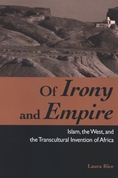
riceLaura Rice, Of Irony and Empire. Islam, the West, and the Transcultural Invention of Africa, SUNY series, Explorations in Postcolonial Studies, 2007

Examines the transformative power of irony in the creation of Muslim Africa.

Of Irony and Empire is a dynamic, thorough examination of Muslim writers from former European colonies in Africa who have increasingly entered into critical conversations with the metropole. Focusing on the period between World War I and the present, “the age of irony,” this book explores the political and symbolic invention of Muslim Africa and its often contradictory representations. Through a critical analysis of irony and resistance in works by writers who come from nomadic areas around the Sahara—Mustapha Tlili (Tunisia), Malika Mokeddem (Algeria), Cheikh Hamidou Kane (Senegal), and Tayeb Salih (Sudan)—Laura Rice offers a fresh perspective that accounts for both the influence of the Western, instrumental imaginary, and the Islamic, holistic one.

“This is one of the rare studies of African literature to bridge the gap between North African and Sub-Saharan literature, two worlds that rarely meet in the minds of most specialists in the field of African literature … [it] is a valuable contribution to studies of African literature and society today. For this reason, it is a book that should be read by all who claim to be specialists in African literature.” — Comparative Literature Studies

“This book is beautifully written in clear, elegant prose and provides an original, imaginative, and compelling argument regarding alternative modernities in twentieth-century Africa.” — Winifred Woodhull, author ofTransfigurations of the Maghreb: Feminism, Decolonization, and Literatures

“This is an excellent critical examination of some of Africa’s most celebrated novels and the author approaches this rather complicated field with a unique commentary and balanced perspective.” — Chouki El Hamel, Arizona State University

Laura Rice is Professor of Comparative Literature at Oregon State University and cotranslator (with Karim Hamdy) of Century of Locusts by Malika Mokeddem and Departures by Isabelle Eberhardt.

Table of Contents

Acknowledgments

1. Prologue: Of Irony and Empire

2. African Conscripts/European Conflicts: Race, Memory, and the Lessons of War

3. Ambiguous Adventure: Reading Cheikh Hamidou Kane

4. Heimlich un-Heimlich: Of Home as Heterotopia in Salih, Tlili, and Mokeddem

5. Epilogue: The Ends of Irony

CouvFoucDV Michel Foucault, Discours et vérité. Précédé de La parrêsia.
Édition et apparat critique établis par H.-P. Fruchaud et D. Lorenzini.
Introduction par F. Gros.
Vrin – Philosophie du présent
320 pages – 12,5 × 18 cm
ISBN 978-2-7116-2656-4 – février 2016

À l’automne 1983, Michel Foucault prononce, à l’Université de Californie à Berkeley, un cycle de six conférences intitulé Discours et vérité, dont on trouvera ici, pour la première fois, l’édition complète et critique.

Dans ces conférences, la richesse de la notion de parrêsia et son rôle stratégique pour la réflexion éthique et politique de Foucault émergent de manière évidente. Foucault retrace notamment les transformations de cette notion dans le monde antique : d’abord droit politique du citoyen athénien, la parrêsia devient, avec Socrate, l’un des traits essentiels du discours philosophique puis, avec les cyniques, de la vie philosophique elle-même dans ce qu’elle peut avoir de provoquant et même de scandaleux; enfin, aux premiers siècles de l’Empire, la parrêsia apparaît au fondement des relations entre le maître et le disciple dans la culture de soi. En faisant l’analyse de la notion de parrêsia, Foucault poursuit en même temps son projet d’une histoire du présent et pose des jalons pour une généalogie de l’attitude critique dans nos sociétés modernes et contemporaines.

Ce volume contient également la transcription d’une conférence prononcée par Foucault en mai 1982 à l’université de Grenoble, devant un public de spécialistes de la philosophie antique, qui présente un état antérieur et différent de sa réflexion sur la parrêsia.

Vandaele, J.
What is an author, indeed: Michel Foucault in translation
(2016) Perspectives: Studies in Translatology, 24 (1), pp. 76-92.

DOI: 10.1080/0907676X.2015.1047386

Abstract
Though the issue of translation occasionally surfaces in Foucault Studies, it remains an area that deserves more attention. To that effect, I briefly introduce some basic concepts of Translation Studies and then compare a chapter from Surveiller et punir (‘Les moyens du bon dressement’) with its English, Spanish, and Norwegian translations. Moving beyond the blatant errors, I argue that these translations are not generally ‘the same text in a different language’. Rather, concepts are carved up in translation; or the analysis shifts from the structural to the historical; or syntactic adjustments make Foucault sound like an instruction book writer. Although I have deep respect for the work of the translators, who have brought Foucault to multitudes of new readers, I also argue that Foucault interpretation could profit from a translational turn. © 2016 Taylor & Francis.

Author Keywords
cultural values; French theory; Michel Foucault; politics of translation; Surveiller et punir; translation criticism

stuartelden's avatarProgressive Geographies

The manifesto of the Groupe d’information sur les prisons, authored by Foucault, Pierre Vidal-Nanuet and Jean-Marie Domenich, which I translated for this site a couple of years ago, has been reprinted in Viewpoint magazine. The prison group, along with Foucault’s involvement in the parallel health group and other activist work are discussed in detail in Foucault: The Birth of Power.

article.php.gifarticle.php.gif

View original post

Embodying Temporalities: Deep Time, Genealogy, Exile

The Collegium Phaenomenologicum will convene for its 41st annual session in Città di Castello, Italy, from July 11–29, 2016. The Collegium is intended for faculty members and advanced graduate and postdoctoral students in philosophy and related disciplines. The core of the program consists in a series of lecture courses, individual lectures, and intensive text-based seminars.

A participants conference will be held July 9-10.

Courses, Lectures, and Instructors

Week 1: Deep Time: Nietzsche, Heidegger, Derrida

David Wood, Vanderbilt University  

Additional Lectures by Mauro Carbone (Université de Lyon), Paul Davies (University of Sussex),John Sallis (Boston College), Ted Toadvine (University of Oregon)

Week 2: Genealogical and Corporeal Temporalities: Nietzsche, Foucault

Charles Scott & Nancy Tuana, Vanderbilt and Penn State University

Additional Lectures by Robert Bernasconi (Penn State University), David Farrell Krell (DePaul University), Omar Rivera (Southwestern University), Anne O’Byrne (Stony Brook University)

Week3: Time in Exile: Heidegger, Blanchot, Lispector

Marcia Sá Cavalcante Schuback (SödertörnUniversity)

Additional Lectures by Claudia Baracchi (Università degli Studi di Milano-Bicocca),Sean Kirkland (DePaul University), Jason Winfree (CSU Stanislaus)

Participants will be comfortably housed at Hotel Le Mura (***) in the historic center of Città di Castello. The cost for room and board (full pension) will be €40 (double occupancy) and €54 (single room) per day. The program fee for the three-week session will be €275. The deadline for applications is February 15, 2016.(This is flexible).

Prof. Alejandro A. Vallega and Daniela Vallega-Neu
Directors
Department of Philosophy
University of Oregon
1295 University of Oregon
Susan Campbell Hall 211
Eugene, OR 97403
USA
dneu@uoregon.edu and
avallega@uoregon.edu

Prof. Andrew Benjamin
Australian Correspondent
Department of Philosophy and Australian Centre for Jewish Civilization
Monash University
Tel: (+03) 99035003
andrew.benjamin@monash.edu

Prof. Gert-Jan van der Heiden
European Correspondent
Department of Philosophy
Radboud Universiteit Nijmegen
Po Box 9103
6500 HD Nijmegen
The Netherlands
Tel: 31-24-3616227
g.vanderheiden@ru.nl

Prof María Acosta
Latin American Correspondant
Department of Philosophy
DePaul University
USA
macostal@depaul.edu

Benjamin Brewer
Graduate Assistant
Emory University
561 South Kilgo Circle
214 Bowden Hall
Atlanta, GA 30322
USA
benjamin.brewer@emory.edu

The Colonial and Settler Studies Research Network
and

The Centre for Critical Human Rights Research
present

Biopolitics: An Interdisciplinary Roundtable

How and in what ways is the body a site of intervention for power in colonial and postcolonial situations? How do race and gender affect modes of governmentality and representation? This roundtable considers these and related questions from the perspectives of historical, literary and cultural studies.

Panelists:
Chair: Anshuman Mondal (English and Postcolonial Studies, Brunel University).
Jane Carey (History, University of Wollongong)
Timothy Neale (Institute for Culture and Society, Western Sydney University)
Michael R. Griffiths (English and Writing, University of Wollongong)
Vera Mackie (History, University of Wollongong)

Tuesday 23rd February, 2016
3:30–5:00 pm
LHA Research Hub 19.2072

Launch
The event will be followed by a launch of Griffiths’s edited collection Biopolitics and Memory in Postcolonial Literature and Culture (Ashgate 2016).

Tuesday 23rd February 5:00 pm–6:00 pm

The book addresses the intersection of biopolitics and public practices of memory from the Truth and Reconciliation Commission in South Africa to the United Nations Permanent Memorial to the Victims of Slavery and the Transatlantic Slave Trade to the Stolen Generations in Australia.

If you would like to attend, please reply to Alexander Brown  by Monday 22nd February for catering purposes.

surtymind's avatarPhilosophical Naturalism

“An experiment with a panoptic  system would suffice to find out;  different things could be taught to different children in different cells;  we could teach no matter what to no matter which child, and we would see the result. In this way we could raise children in completely different systems, or even systems incompatible with each other; some would be taught the Newtonian system, and then others would be got to believe that the moon was made of cheese. When they were eighteen or twenty, they would be put together to discuss the question” (Psychiatric Power p. 78)

When one reads the words of Foucault describing Bentham’s imagined Panoptic System  one thinks of Applied Behavioural Analysis (henceforth ABA). Bentham of course was one of the fathers of utilitarianism and ABA seems to implicitly adopt the approach a utilitarian approach to ethics e.g. a cost/benefit calculation. When one reads about Bentham’s…

View original post 3,695 more words

Lacan contra Foucault Subjectivity Universalism Politics Part 1 of 4 parts

Seminar “Lacan contra Foucault Subjectivity, Universalism, Politics at The American University of Beirut Arts and Humanities (Mellon Grant) Faculty of Arts and Sciences in December 2015