Foucault News

News and resources on French thinker Michel Foucault (1926-1984)

Stephane J Baele, Live and let die: did Michel Foucault predict Europe’s refugee crisis?, The Conversation, February 25, 2016

Translation into French

Translation into Turkish

In March 1976, philosopher Michel Foucault described the advent of a new logic of government, specific to Western liberal societies. He called it biopolitics. States were becoming obsessed with the health and wellbeing of their populations.

And sure enough, 40 years later, Western states rarely have been more busy promoting healthy food, banning tobacco, regulating alcohol, organising breast cancer checks, or churning out information on the risk probabilities of this or that disease.

Foucault never claimed this was a bad trend – it saves lives after all. But he did warn that paying so much attention to the health and wealth of one population necessitates the exclusion of those who are not entitled to – and are perceived to endanger – this health maximisation programme.

Biopolitics is therefore the politics of live and let die. The more a state focuses on its own population, the more it creates the conditions of possibility for others to die, “exposing people to death, increasing the risk of death for some people”.

read more

Vol 7 (2016): Special issue: Special education and the deviant child in the Nordic countries – the impact of Foucault, Nordic Journal of Social Research

Table of Contents

Letters

Guest editorial: special education and the deviant child in the Nordic countries – the impact of Foucault PDF
Julie Allan, Bjørn Hamre

Articles

The subject of exemption: through discourses of normalization and individualization in Denmark PDF
Bjørn Hamre, Tine Fristrup, Gerd Christensen
Intelligence testing, ethnicity, and construction of the deviant child: Foucault and special education in Sweden PDF
Thom Axelsson
Why Michel Foucault in Norwegian Special-Education Research? PDF
Hege Knudsmoen, Eva Simonsen
Foucault and deaf education in Finland PDF
Lauri Siisiäinen
Diagnosing, special education, and ‘learnification’ in Danish schools PDF
Bjørn Hamre
Democratic and Inclusive Education in Iceland: Transgression and the Medical Gaze PDF
Ólafur Páll Jónsson

 
This work is licensed under a Creative Commons Attribution 3.0 License.

ISSN 1892-2783

La fracture politique. Archéologie de l’inégalité démocratique,

par Hamdi NABLI, diplômé de Science Politique, Consultant indépendant, Enseignant à la Sorbonne Nouvelle et Fondateur du Centre d’Etudes et de Prospective Internationale (C.E.P.I.). Connaissances et Savoirs, 2016

Cet essai constitue une explication du malaise que ressentent les citoyens et les dirigeants face à la distance qui les sépare tous les jours un peu plus. Cette explication s’oriente autour d’une reconstruction de la notion de « représentation », avec ses deux versants principaux : le premier, royal et monarchique, permettait à l’élite de faire reposer son pouvoir sur une domination traditionnelle relative à une pratique discursive transcendantale. Le second, bourgeois et parlementaire, permet à l’élite des Temps modernes de faire reposer son pouvoir sur une domination légale-rationnelle relative à une pratique discursive immanente. C’est cette matrice qui s’ébranle à l’âge postmoderne. Fin de la représentation, volonté de ressemblance. L’État-nation n’est plus le modèle sociopolitique des pays occidentaux, et c’est la scène sur laquelle jouaient les dirigeants modernes qui s’effondre, via la démocratie de l’opinion, en même temps que le public ‘‘citoyen et humaniste” s’éclipse à travers l’abstention…

Informations complémentaires
Version papier : 13,95 € ISBN : 9782753902831
134 pages – Histoire/Politique – Edition brochée

Comment commander cet ouvrage

Ce livre est disponible à la vente au format papier. Pour vous le procurer, connectez-vous sur le site Internet de Connaissances et Savoirs (www.connaissances-savoirs.com) ou commandez-le en librairies.

Relations presse

Clémence BOURDON – Responsable Communication
e-mail : clemence@connaissances-savoirs.com – Tél. : 01 84 74 10 03
Ouvrage numérique disponible en service de presse sur simple demande par e-mail avec vos coordonnées complètes.

Connaissances et Savoirs – S.A.S. au capital de 120 000 € – R.C.S. PARIS B 453 879 306 – SIRET : 453 879 306 000 18 – Code NAF : 5811Z

Editor: With thanks to the researcher who sent me this dossier. Foucault’s work is invoked in this media controversy.

François Ewald, Apologie de Claude Allègre Les Echos.fr 2/3/10

Voir aussi ce lien

[…]
Le travail de Claude Allègre montre que la thèse du réchauffement climatique produit par l’activité humaine suppose tout un dispositif à la fois scientifique et politique qu’il démonte dans ses différentes composantes. Il ne fait rien d’autre que ce qu’un Michel Foucault a pu faire pour expliquer d’autres propositions qui nous sont devenues familières comme « la folie est une maladie mentale » ou « la sexualité est fondamentalement réprimée dans nos sociétés ». Il démonte le mythe d’une science du climat qui serait pure et désintéressée comme les écolos le font de leur côté pour les OGM et autres technologies.

suite

Olivier Godard dénonce «l’imposture du climat» de Claude Allègre, Libération, 10 mai 2010

L’économiste Olivier  Godard, directeur de recherche au Cnrs et enseignant en économie à l’Ecole Polytechnique, vient de publier un texte percutant dans le N° de mai de la revue Esprit. Son titre ? «De l’imposture au sophisme, la science du climat vue par Claude Allègre, François Ewald et quelques autres». Il y dénonce en particulier le dernier livre de Claude Allègre «L’imposture climatique» (Plon).

suite

Olivier Godard, Le climat, l’imposteur et le sophiste, Alternatives Economiques, 12 mars 2010

Olivier Godard, directeur de recherche au CNRS, économiste du développement et de l’environnement, répond aux « sophistes » et aux « imposteurs » qui, de Claude Allègre à François Ewald, prétendent s’appuyer sur la science pour contester les études du Giec sur le dérèglement climatique.

[…]

C’est dans ce contexte que le 2 mars, Les Echos publiaient une « apologie de Claude Allègre » signée François Ewald, cet ancien assistant de Michel Foucault devenu l’intellectuel de la Fédération française des sociétés d’assurances puis le titulaire d’une chaire au Conservatoire national des arts et métiers (Cnam). Ewald s’en prenait aux journalistes qui auraient fait preuve d’intolérance et cédé à leurs convictions militantes. Protestant avec gravité, il le faisait, prétendait-il, au nom de l’éthique des sciences : pointer les erreurs serait une manière d’esquiver la thèse centrale de l’ancien ministre. Et Ewald de juger impératif un débat national sur les conditions de transformation d’une « hypothèse douteuse » (sic) (celle du réchauffement climatique en cours et à venir) en « dogme »(sic). Et de voir en Allègre un nouveau Michel Foucault déconstruisant l’imposture climatique née des amours adultères de la science et du pouvoir ! Pauvre Foucault !

suite

De l’imposture au sophisme, la science du climat vue par Claude Allègre, François Ewald et quelques autres. Esprit, mai 2010. Full PDF

Le dernier livre d’entretiens de Claude Allègre publié en février 2010 est un livre de dénonciation d’une soi-disant imposture climatique. La théorie selon laquelle les émissions de gaz à effet de serre dues à l’activité humaine depuis le début de la révolution industrielle seraient en train de bouleverser le climat de la planète, théorie dont les prémisses ont été le fait de savants du XIXe siècle comme Joseph Fourier ou Svante Arrhenius , est présentée comme un mythe sans fondement scientifique. Qui plus est, un mythe imposé à la communauté internationale à la suite d’une prise du pouvoir par un petit groupe d’hommes sans scrupules, avides de fortune ou de gloire, ou emportés par une idéologie écologiste totalitaire – quelques scientifiques mafieux, quelques responsables politiques dont Olof Palme, Premier ministre socialiste suédois assassiné en 1986, et Margaret Thatcher, Premier ministre du Royaume-Uni de 1979 à 1990, et quelques hauts fonctionnaires onusiens. Cette prise de pouvoir n’aurait de précédent, aux yeux d’Allègre, que celle des bolcheviks lors de la révolution russe de 1917.

suite

A voir aussi

Olivier Godard, Dossier Adaptation aux changements climatiques.

François Ewald, The Precautionary Principle and Water Management.

FOUCAULT 8/13 EPILOGUE: MICHEL FOUCAULT, NEOLIBERALISM AND BEYOND

The following is a guest post by Stephen Sawyer, organizer of the March 25-26 Foucault and Neoliberalism Conference at the American University of Paris. Professor Sawyer has kindly provided us with concluding remarks on the conference.

By Stephen Sawyer

Michel Foucault’s reflections on neoliberalism have ultimately left us with more questions than answers. They have opened a path toward a more sophisticated reflection on one of the most important thinkers of the last half century, while providing an unexpected point of entry into one of the most vexing political, economic, cultural and social movements of our contemporary world. While the “critique” of Foucault as a closet neoliberal by the far left and the right is tenuous at best (Steinmetz-Jenkins), the extraordinary success of neoliberal ideology has made Foucault’s interest in this question in the late 1970s at once prescient, puzzling and alluring. Moreover, the full release of Foucault’s Collège de France lectures along with the spate of previously unreleased material has led to something of a Foucault renaissance that has only raised the stakes. The question, then, almost four decades after Foucault’s reflections is: How do we craft a sophisticated history of this moment without either falling into sensationalist critiques or an uncritical assumption that Foucault’s exploration of neoliberalism was an insignificant passing concern.

read more

mckinlayAlan McKinlay and Ken Starkey (eds) Foucault, Management and Organization Theory: From Panopticon to Technologies of Self, Sage, 1998

This volume draws together critical assessments of Michel Foucault’s contribution to our understanding of the making and remaking of the modern organization.
The volume provides a valuable summary of Foucault’s contribution to organization theory, which also challenges the conventions of traditional organizational analysis. By applying Foucauldian concepts such as discipline, surveillance and power/knowledge, the authors shed new light on the genesis of the modern organization and raise fresh questions about organization theory. The bureaucratic career is, for example, analyzed as a disciplinary device, a mechanism that seeks to alter rational choice rather than constrain bodies. This raises questions about Foucault’s linking of the modern organization’s birth with the enlightenment. Other contributions review the impact of totalizing managerial discourses and the limits and possiblities of resistance, and question the profound pessimism of Foucault. The volume concludes by examining the implications of Foucault’s later work in which he suggests that people are much freer than they feel.

Luca Provenzano, Foucault 8/13 epilogue: Foucault and neoliberalism conference report

Foucault and Neoliberalism: A Report from American University of Paris

On Friday, March 25 and Saturday, March 26, participants in Foucault 13/13 went to Paris to present at (and report from) the conference “Foucault and Neoliberalism” organized by the Center for Critical Democracy Studies at the American University of Paris. Organized by Daniel Steinmetz-Jenkins and Stephen W. Sawyer, the goal of the conference was to take an inventory of the current scholarship on Foucault and neoliberalism and promote an exchange of views at a time when “The question of neoliberalism and particularly its ostensible triumph remains as vexing as ever” (Sawyer).

In his introduction on Friday, Stephen Sawyer noted that in a sense, conference participants came ‘après la bataille’: much of the most acrimonious debate in the immediate aftermath of Critiquer Foucault volume by Daniel Zamora (2014) and Penser le néolibéralisme by Serge Audier (2015) appears to be behind us, though perhaps the English publication of Critiquer Foucault will interrupt the calm. Nevertheless, Sawyer noted that recent works have raised more questions than answers about how the lectures on neoliberalism fit into Foucault’s oeuvre. In particular, Sawyer asked about how Foucault’s neoliberal moment relates to his later turn to the issue of democracy via his final lectures on the Greeks.

read more

Student reads Foucault to donkey (2012)
Published on May 11, 2012
8 May 2012 was International Donkey Day.

Editor: The student doesn’t appear to be reading from Foucault himself but from J.G. Merquior’s 1985 book Foucault (Fontana Press). The donkey appears to be less than attentive!

Donkey Conference at SOAS (School of Oriental and African Studies) at the University of London as held on 8-9 May 2012.

From youtube site
We organised a charity photoshoot, with Clover the Donkey from Hackney City Farm. This clip contains the photos that we took. If you want a copy of any of these photos, contact: ed.emery[ @] soas.ac.uk

You may also be interested in the World Donkey Day facebook page:

Bourke, T., Carter, J.
“There’s nothing standard about standards”: exploring tensions between two standards documents in higher education
(2016) Journal of Geography in Higher Education, pp. 1-16. Article in Press.

DOI: 10.1080/03098265.2016.1144730

Abstract
Quality in education at the tertiary level is constantly questioned, and increasingly “professional standards” are offered as the solution to the perceived decline in quality. Foucauldian archaeological analysis of teacher graduate and geography graduate standards in Australia is conducted, revealing tensions between the different document sets. Teacher graduate standards reflect two discourses (one of knowledge and understanding, and one of skills) that are anti-intellectual and based on jargon and formulaic prescriptions. In contrast, disciplinary standards give primacy to geography as an intellectual inquiry such that its knowledge and understanding, skills, and concepts lead to progressively higher order thinking in graduates. © 2016 Informa UK Limited, trading as Taylor & Francis Group

Author Keywords
Foucault; geography; standards

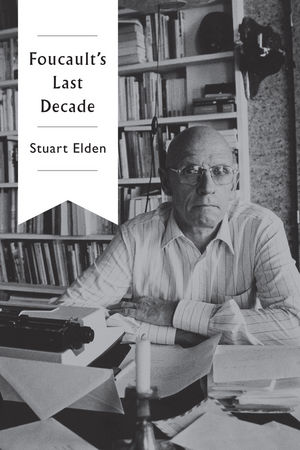
eldenStuart Elden, Foucault’s Last Decade, Polity Press, Official release date 1 April 2016
Publisher’s page

Description
On 26 August 1974, Michel Foucault completed work on Discipline and Punish, and on that very same day began writing the first volume of The History of Sexuality. A little under ten years later, on 25 June 1984, shortly after the second and third volumes were published, he was dead.

This decade is one of the most fascinating of his career. It begins with the initiation of the sexuality project, and ends with its enforced and premature closure. Yet in 1974 he had something very different in mind for The History of Sexuality than the way things were left in 1984. Foucault originally planned a thematically organised series of six volumes, but wrote little of what he promised and published none of them. Instead over the course of the next decade he took his work in very different directions, studying, lecturing and writing about historical periods stretching back to antiquity.

This book offers a detailed intellectual history of both the abandoned thematic project and the more properly historical version left incomplete at his death. It draws on all Foucault s writings in this period, his courses at the Collège de France and lectures elsewhere, as well as material archived in France and California to provide a comprehensive overview and synthetic account of Foucault s last decade.

Table of Contents
Contents
Acknowledgements
Abbreviations
Introduction
1. Pervert, Hysteric, Child
2. The War of Races and Population
3. The Will to Know and the Power of Confession
4. From Infrastructures to Governmentality
5. Return to Confession
6. The Pleasures of Antiquity
7. The Two Historical Plans of the History of Sexuality
8. Speaking Truth to Power
Notes
Top of Page

Author Information
Stuart Elden is Professor of Political Theory and Geography at the University of Warwick