Foucault News

News and resources on French thinker Michel Foucault (1926-1984)

Foucault and Contemporary Theory in Education Special Interest Group SIG 45

Part of the AARE. The American Educational Research Association (AERA), founded in 1916, is concerned with improving the educational process by encouraging scholarly inquiry related to education and evaluation and by promoting the dissemination and practical application of research results.

SIG Purpose
The Foucault and Contemporary Theory in Education SIG provides a forum for scholars and researchers interested in postmodern approaches to educational research. We are dedicated to historical and philosophical studies of education that engage the writings of Michel Foucault and the work of related/sympathetic contemporary theorists. We are interested in work that aims to identify and push the boundaries of Foucault’s and these other theortists’ thought and that which plays in the interstices between Foucault and these other theorists.

Further info

Anders Fogh Jensen, Foucault – Systems of Thought – Systems of Management and Governance (2013)

Foucault – Systems of Thought: Systems of Management and Governance.
Danish philosopher Anders Fogh Jensen guides us through some of the primary issues in the philosophy of Michel Foucault (1926-84). Anders demonstrates that, to Foucault, the history of the systems of thought and the systems of governance – the history of how we think and how we think about governance – are one and the same. He also shows how Foucault is an extension of both Kant and Nietzsche in a history of how the categories of the sciences and thought change throughout time, and how knowledge, built on the categories of a certain time, is also always entangled in power. This explanation is about how punitive discipline functions, and finally also a suggestion of how the post-disciplinary society can be understood as a Project Society.
This lecture is based on Anders Fogh Jensen’s book “Mellem ting – Foucaults filosofi” (“In Between Things – The Philosophy of Foucault”). You can read the first chapters here:

PDF programme
Website

Affiche A3 S&P - mai 2016

Programme SP - mai 2016 (LD)_Page_2

PDF programme
Website

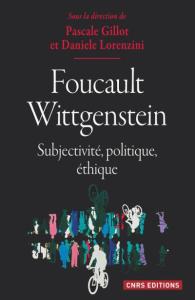
foucault-wittgenstein Foucault / Wittgenstein. Subjectivité, politique, éthique
Sous la direction de Pascale Gillot et Daniele Lorenzini
CNRS Editions, 2016

Les œuvres de Foucault et de Wittgenstein, qui relèvent de traditions philosophiques fort éloignées, peuvent toutefois entrer en résonance et se relancer mutuellement : cette mise en perspective permet alors de cerner les points aveugles comme l’insistance contemporaine du questionnement philosophique propres à chacune d’elles.

Ces deux auteurs ont en effet proposé une critique radicale de la notion classique d’une subjectivité souveraine, contre une compréhension traditionnelle d’un sujet de l’action et du savoir transparent à soi-même.

Quelles sont dès lors les conséquences éthiques et politiques d’une telle conception – non psychologique et non métaphysique – de la subjectivité ?

En explorant, hors de tout clivage institué, des thèmes tels que le « rapport à soi », la conscience et ses illusions, l’identité subjective dans sa dimension institutionnelle et politique, les rapports entre le Je et le Nous, il s’agit de faire émerger de la confrontation Foucault/ Wittgenstein un « style de pensée » qui nous pousse à repenser radicalement la forme de nos intérêts et de nos préoccupations éthiques et politiques.

Introduction : La subjectivité à l’épreuve
Pascale Gillot et Daniele Lorenzini

Première Partie. La question de l’anti-psychologisme

Chapitre I : La psychologie comme « champ des décisions ». Déclinaisons et enjeux de l’antipsychologisme chez Foucault
Elisabetta Basso

Chapitre II : Foucault / Wittgenstein : une « subjectivité sans sujet » ?
Pascale Gillot

Chapitre III : Wittgenstein après Foucault. Le sujet à la limite entre archéologie et littérature
Matteo Vagelli

Deuxième Partie. Langage, histoire et politique

Chapitre IV : Du conventionnalisme linguistique à l’historicisation radicale : Foucault avec Wittgenstein ?
Judith Revel

Chapitre V : Foucault, Wittgenstein et la philosophie analytique de la politique
Daniele Lorenzini

Chapitre VI : Le gouvernement, les savants et la tribu sans âme. Peut-on penser une forme de vie pour des automates ?
Sabine Plaud

Troisième Partie. Le Je et le Nous

Chapitre VII : Le sujet hors d’action
Marc Pavlopoulos

Chapitre VIII : Moi et les autres : une critique wittgensteinienne de Foucault
Pierre Fasula

Chapitre IX : Retour au sol raboteux des pratiques. Le statut de la déviance de Foucault à Wittgenstein
Élise Marrou

Quatrième Partie. L’éthique du rapport à soi

Chapitre X : « Work on philosophy is really more a work on oneself ». Le travail de soi sur soi chez Foucault et Wittgenstein
Orazio Irrera

Chapitre XI : Infléchir le cours de nos vies. Foucault et Wittgenstein à propos de l’éthique et de la subjectivité
Piergiorgio Donatelli

Despard, E.
Diagram of a love for plants gone bad
(2016) Environment and Planning D: Society and Space, 34 (2), pp. 337-354.

DOI: 10.1177/0263775815615124

Abstract
This article uses a surprising horticultural event—an unplanned, collective ‘theft’ of plants from the Montreal Botanical Garden in 1981—as impetus to interrogate the contribution of garden plants to public life in so-called ‘green’ cities of the late twentieth century. As sites of both social nature and material culture that are perceived as socially and environmentally beneficial and frequently designed to appear more-or-less natural, gardens are normally quite difficult to see or think in politically differentiated terms. Taking a historical ‘eventalization’ of civic horticulture as a means to enable critical perception, I develop the diagram (as introduced by Foucault and interpreted by Deleuze) as an analytical tool conducive to identifying and historicizing the perceptual and socio-spatial effects produced by the use of garden plants in urban public spaces. I outline the local historical context of the theft at the Botanical Garden and analyze the functioning of a program of horticultural beautification coincident with it as a means of establishing the theft’s more general intelligibility. This illuminates, not only a change in the functioning of plants in Montreal’s urban landscape, but also a means of recognizing the historical specificity of relations between people and plants, and socio-cultural change as more-than-human. © 2015, © The Author(s) 2015.

Author Keywords
civic horticulture; Diagram; plants; public gardens; social nature; urban environmental history

Robert Shaw, Nuit Debout as Heterotopia: Some Early Thoughts, Blog post (2016)

Since March 31st, protestors in the Place de La République in Paris have been convening every evening, staying in place the full night as part of the ‘Nuit Debout’ protests. The protests, which began in opposition to the ‘Loi Travail’ labour laws, form part of the wider series of anti-austerity, anti-neoliberalist protests by young people in Europe that date back to the Occupy movement. Indeed, ‘Nuit Debout’ translates roughly as ‘here all night’ and this implies a strength and permanence that the term occupy also sought.

[…]

These protestors are making several interesting uses of ‘night’. Spending time with people in darkness is more intimate than daylight, as we can’t as clearly distinguish between people, objects and the environment. Ideas, sounds and sensations thus more easily flow between people, generating a closeness. Added to this, the protests have incorporated impromptu concerts, debates and other events, more easily held in night as a time associated with leisure. This intimacy in combination with a relaxed atmosphere creates a moment, space-time for discussion and conversation among strangers. Michel Foucault describes such places as ‘heterotopias’, moments which operate outside of the normal rules of hegemony. For Nuit Debout, the night is key to making this a heterotopia.

Read more

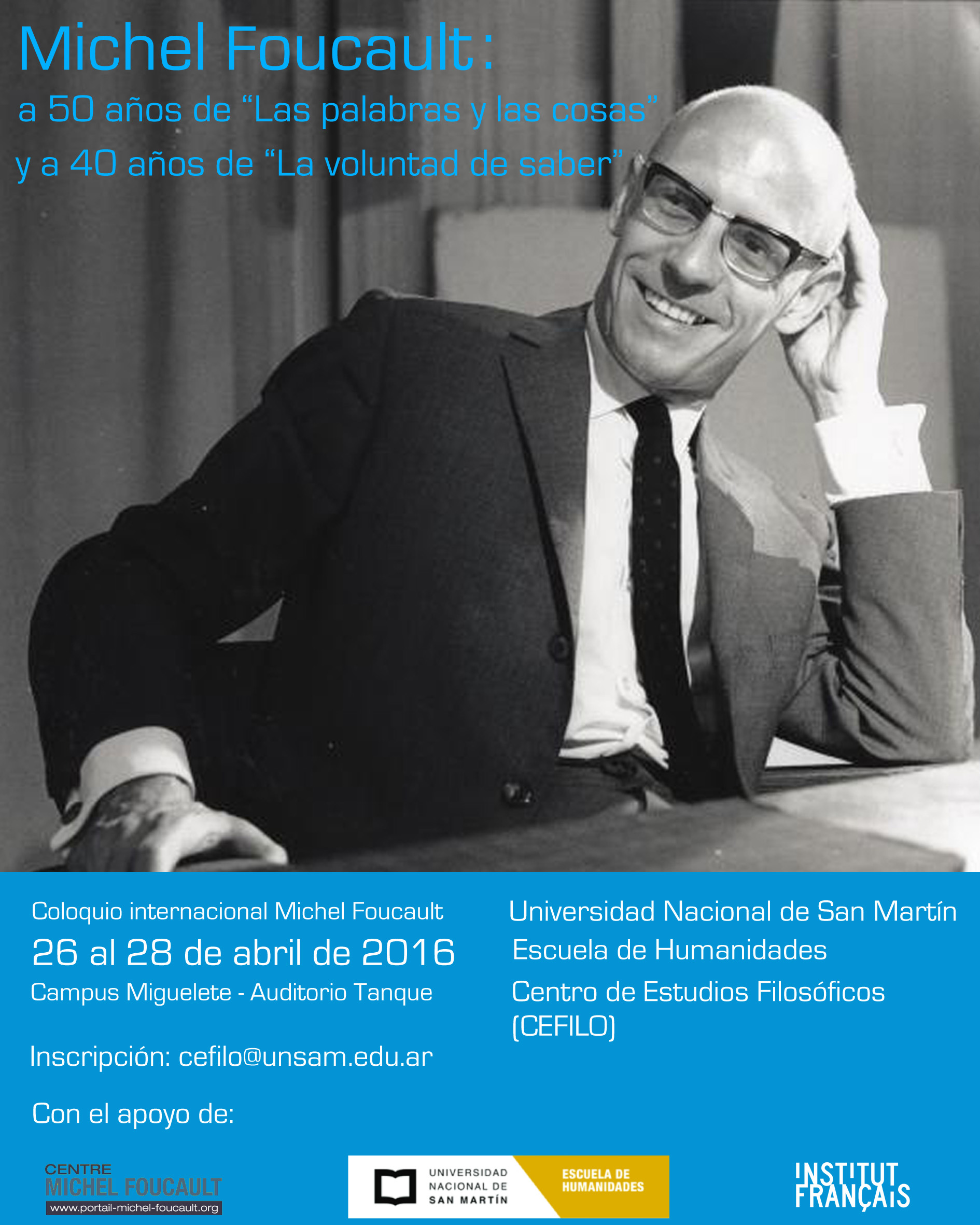
Flyer Foucault UNSAM 1

UNIVERSIDAD NACIONAL DE SAN MARTÍN

Escuela de Humanidades

Centro de Estudios Filosóficos (CEFILO)
Coloquio Internacional Michel Foucault:
a cincuenta años de “Las palabras y las cosas
y a cuarenta años de “La voluntad de saber

26 al 28 de abril de 2016 – Campus Miguelete – Auditorio Tanque

Programa de Exposiciones

Programa de Exposiciones

Martes 26 de abril

Mesa 1: Los desafíos filosóficos de Las palabras y las cosas

Coordina: Marcelo Raffin.

14:00 hs.: Cristina López (Humanidades–Unsam)El desafío filosófico del libro sobre los signos”.

14:30 hs.: Cesar Candioto (Pontifícia Universidade Católica do Paraná) “La finitud en Las Palabras y las cosas”.

15:00 hs.: Philippe Sabot (Université Lille 3) “Aux sources des Mots et les choses: l’archéologie et ses archives”.

15:30 hs.: Debate.

16:00 hs.: Pausa café.

Mesa 2. Los desafíos filosóficos y políticos de Historia de la sexualidad 1

Coordina: Cristina López.

16:30 hs.: Arianna Sforzini (BNF) “Histoire de la sexualité: première version”.

17:00 hs.: Orazio Irrera (Université Paris 1 Panthéon-Sorbonne) “La bête d’aveu et l’animal idéologique, ou comment sortir de l’humanisme?”.

17:30 hs.: Edgardo Castro (Conicet-Unsam) “Michel Foucault, una filosofía de la voluntad”.

18:00 hs. Debate.

18:30 hs. Fin primera jornada.

Miércoles 27 de abril

Mesa 3. Los desafíos genealógicos de La palabras y las cosas a Historia de la sexualidad 1

Coordina: Beatriz Podestá.

14:00 hs.: Daniel Verginelli Galantin (Universidade Federal do Parana) “Do ser da linguagem à insurreição: Michel Foucault e Georges Bataille”.

14:30 hs.: André de Macedo Duarte (Universidade Federal do Parana) “Foucault y Butler en torno a Herculine o ¿qué significa resistir al dispositivo de la sexualidad?”.

15:00 hs.: Agustín Colombo (Paris 8-Uba) “De la carne como punto de emergencia del dispositivo de sexualidad a la carne como modo de subjetivación”.

15:30 hs.: Debate.

16:00 hs.: Pausa café.

Mesa 4: Las postrimerías filosóficas de Las palabras y las cosas

Coordina: Agustín Colombo.

16;30 hs.: Tuillang Yuing (Instituto de Asuntos públicos-Universidad de Chile) “De Foucault a Foucault, pasando por Rancière”.

17:00 hs.: Beatriz Podestá (Facultad de Filosofía/UNSJ)“En torno a Las palabras y las cosas“.

17:30 hs.: Thiago Fortes Ribas (Universidad Positivo) “Foucault, el “a priori histórico” y la productividad del discurso”.

18:00 hs.: Luca Paltrinieri (Université de Paris 8, CNRS-Collège International de Philosophie.) “Discours philosophique et ethnologie. Après les Mots et les choses“.

18:30 hs.: Debate.

19: 00 hs.: Fin segunda jornada.

Jueves 28 de abril

Mesa 5: Las incidencias teóricas y políticas de Las palabras y las cosas

Coordina: Luis Blengino.

14:00 hs.: Senda Sferco (Conicet-IIGG de la Uba)El retiro del origen y las temporalidades de la experiencia”.

14:30 hs.: Luciano Nosetto (Gino Germani, Uba / CONICET) “Retroceso y retorno del origen en el discurso político”.

15:00 hs.: Ariane Revel (UPEC) “De l’histoire naturelle des régimes à l’analyse historique du politique: le savoir politique classique à l’épreuve de la contingence”.

15:30 hs.: Debate.

16:00 hs.: Pausa café.

Mesa 6: Filosofía y política en Historia de la sexualidad 1

Coordina: Senda Sferco.

16:30 hs.: Luis Blengino (UnLaM)  “La política como pregunta. A propósito de la hipótesis de 1976 en relación con las de 1979”.

17:00 hs.: Marcelo Raffin (Conicet/UBA) Historia de la sexualidad”: entre el dispositivo de sexualidad y la gubernamentalidad”.

17:30 hs.: Frédéric Gros (Science Po–Paris) “Sexualidad y obediencia”.

18:00 hs.: Debate.

18:30 hs.: Fin del Coloquio.

Contacto
cefilo@unsam.edu.ar

 Con el patrocinio del Centre Michel Foucault y el Institut Français

The Art of Thought


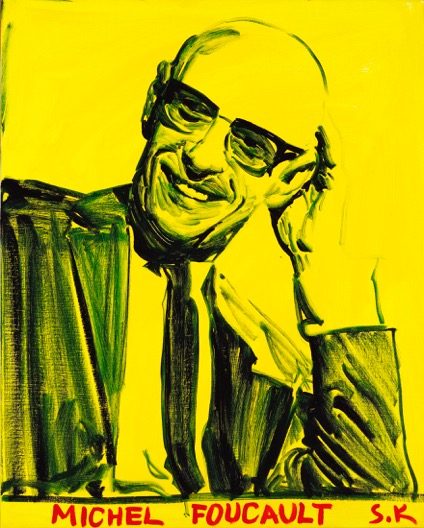
Sam Kaprielov, Foucault 2016

Press release PDF

April 13th – May 6th 2016

Exhibition at The Cob Gallery
205 Royal College Street
London NW1 0SG

All artworks are available for purchase.

The Cob Gallery is delighted to present celebrated Russian artist Sam Kaprielov’s new exhibition ‘The Art of Thought’ on 14th April.

The show is a series of 40 oil on canvas portraits depicting renowned thinkers. They range from history’s founding Philosophers to modern day Royalty and Rock Stars.

Kaprielov suggests that the mind is the most potent tool known to mankind. Its used by the philosopher to ponder metaphysics and by the artist to create images that lead to thought and inspiration. With ‘The Art Of Thought’ he has brought these two fields of human endeavour together as friendly bedfellows.

His extraordinarily agile and, yet, very precise brushwork has conjured up on canvas a collection of some of the most influential thinkers of centuries past so that we may retain a modicum of cognition, lest we forget the contribution that these fellows have made to the development of humanity throughout history, leading us to where we are now.

Amongst the portraits of more traditional philosophers such as Plato and Socrates, Kaprielov has included a few of what he describes as ‘red herrings’, such as Ian ‘Lemmy’ Kilmister, Prince Philip and Roberto Cavalli, to name a few.

The works are straightforward painterly interpretations of likenesses found on Google, and not an attempt to visually represent philosophical concepts of the thinkers. The mono coloured canvases represent those personalities in the history of philosophy whom we know nothing about.

In most of the paintings the ice-cold precision of the philosopher’s outlook is nicely balanced out with the warmth of palette. During his formative years, Kaprielov spent countless hours in Leningrad’s Hermitage Museum contemplating somewhat yellowish old master works and came to firmly believe that a truly good oil painting should be yellow.

Torrano, A.
Werewolves in the immunitary paradigm
(2016) Philosophy Today, 60 (1), pp. 153-173.

DOI: 10.5840/philtoday2016113102

Abstract
This article problematizes the political category of the monster in Hobbes’s thought from a biopolitical perspective. Even though political thought has been tra-ditionally focused on Leviathan’s figure as a political monster, here we pay particular attention to the maxim homo homini lupus, which can be identified with the wereWolf. This figure allows us on the one hand, to show how the Wolf becomes man with the creation of the State, and on the other hand, to show how there is a constant threat of man becoming Wolf, of the lupification of man. Hobbes’s discourse of sovereignty aims to neutralize the wereWolf. This neutralization can be seen as immunization. In this sense, the wereWolf operates both as poison and as antidote-pharmakon-within the State. The wereWolf produces an inoculation with a therapeutical function: it is a dose of the same poison from which the State seeks to protect itself. © 2016. Philosophy Today.

Author Keywords
Biopolitics; Immunization; Monstrosity; Sovereignty; Werewolf

Marianne Fenech and Jennifer Sumsion, Early Childhood Teachers and Regulation: Complicating Power Relations Using a Foucauldian Lens, Contemporary Issues in Early Childhood, June 2007 vol. 8 no. 2 109-122

doi: 10.2304/ciec.2007.8.2.109

Abstract
This article both supports and complicates the positioning of reconceptualists who frame the regulation of early childhood services as repressive. Drawing on Foucault’s construction of power and, in particular, his notion of an ‘analytics of power’, the authors analyse findings from an Australian study investigating university-qualified early childhood teachers’ perceptions of regulation. The authors contend that whilst most participants in this study experienced regulation as constraining, they resisted perceived threats to themselves and quality practices in ways that problematize a reconceptualist repressive construction of regulation. The authors show, firstly, that teachers strategically positioned regulation as an ally so as to resist perceived threats to themselves and to children; and secondly, that they strategically positioned themselves to resist perceived adversarial aspects of regulation. Exercising agency in these ways meant that regulation was experienced as enabling and its constraining potential somewhat mitigated. After highlighting the role critical thinking plays in early childhood teachers’ exercising of agency through resistance, the authors conclude by urging early childhood teachers to contest not only the elements of regulation they perceive to be constraining, but also the contextual factors that can influence how early childhood teachers view regulation.