
Foucault News

News and resources on French thinker Michel Foucault (1926-1984)

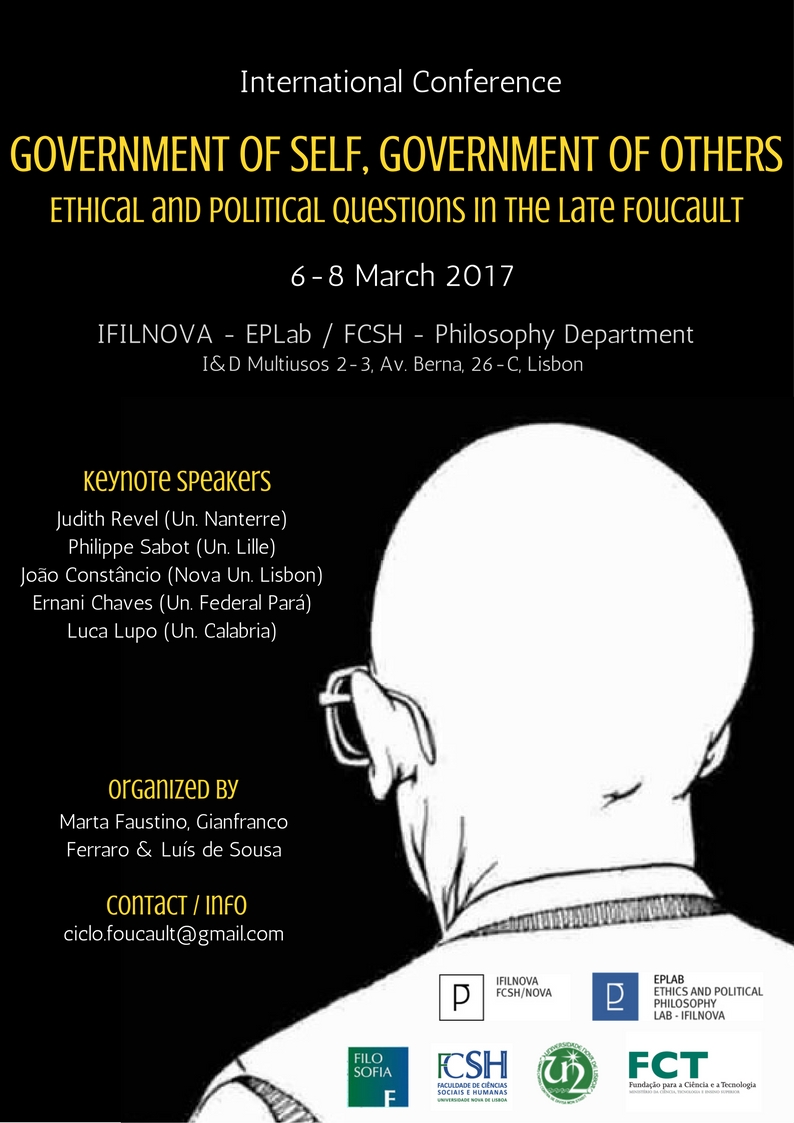
cartaz

International Conference
“GOVERNMENT OF SELF, GOVERNMENT OF OTHERS.
Ethical and political questions in the late Foucault”

6-8 March 2017

IFILNOVA – EPLab / FCSH – Philosophy Department
I&D Multiusos 2-3, Av. Berna 26C, Lisbon

Live streaming: https://videocast.fccn.pt/live/fcsh_unl/foucaultconference

PROGRAM

6th March | Multiusos 3

09h30 – 10h00 Opening
António Marques (Director of IFILNOVA)
João Luís Lisboa (Coordinator of the Philosophy Department)
10h00 – 11h00 | Chair: Gianfranco Ferraro
Judith Revel (Paris West University Nanterre, France), “Subjectivation éthique, subjectivation politique: du “Je” au “Nous”?”

11h00 – 11h30 Coffee-Break

11h30 – 13h00 | Chair: Susana Viegas
• Ester Jordana (Bau/University of Barcelona, Spain), “Ethics of care (of the self and the others)”
• Amélie Berger-Soraruff (University of Dundee, UK), “Why We Should Take Care of Ourselves: Foucault According to Stiegler”
• Dominika Partyga (London School of Economics, UK), “Judith Butler on Self-Crafting: Between Nietzsche and Foucault”

13h00 – 14h30 Lunch

14h30 – 15h30 | Chair: Luís de Sousa
João Constâncio (IFILNOVA/New University of Lisbon, Portugal), “Foucault and the Problem of Recognition”
15h30 – 17h00 | Chair: Marta Faustino
• Karim Barakat (Duquesne University, USA), “Understanding Power relations through Governmentality”
• Laurence Barry (Hebrew University of Jerusalem, Israel), “Truth, Government, Subjectivity”
• Edgar Straehle (University of Barcelona, Spain), “On authority: a discussion between Foucault and Arendt”

17h00 – 17h30 Coffee-Break

17h30 – 19h00 | Chair: Marília Muylaert
• Marta Faustino (IFILNOVA/New University of Lisbon, Portugal), “Truth-telling as therapeutic practice: self-examination and confession in Foucault’s late writings”
• Andrea Teti (University of Aberdeen, UK), “Rethinking Foucault’s ‘Confessing Animal’”
• Kurt Borg (Staffordshire University, UK), “The Subversive Truth-Telling of Trauma: Survivors as Parrhesiastes”

***

7th March | Multiusos 2

10h00 – 11h00 | Chair: Gianfranco Ferraro
Philippe Sabot (University of Lille, France), “Le sujet et le pouvoir (de la vérité)”

11h00 – 11h30 Coffee-Break

11h30 – 13h00 | Chair: Bruno Dias
• Gianfranco Ferraro (IFILNOVA/New University of Lisbon, Portugal), “Qu’est-ce que nous sommes?” L’impatience de la liberté comme travail critique”
• Sam O’Brien (Monash University, Australia), “Parrhesia, Self-Government and the Political”
• Valeria Gammella (University of Naples Federico II, Italy), “La «conjoncture socratique»: la parrêsia philosophique comme tâche éthique et politique”

13h00 – 14h30 Lunch

14h30 – 15h30 | Chair: Marta Faustino
Luca Lupo (University of Calabria, Italy), “A matter of time. The stance of the Ancients towards the future in Foucault’s lectures at the Collège de France”
15h30 – 17h00 | Chair: Bartholomew Ryan
• Federico Testa (Monash University, Australia/ University of Warwick, UK), “‘The great cycle of the world’: Knowledge of Nature and the Cosmologic Perspective of the Care of the Self in HS”
• Bruno Dias (Centro de Filosofia/University of Lisbon, Portugal), “Critique of power within the bounds of mere resistance: the political uses of the late Foucault”
• Antonio Moretti (University Vita-Salute San Raffaele, Italy), “The issue of power between will to truth and parrhesiastic subjectivation”
17h00 – 17h30 Coffee-Break
17h30 – 19h00 | Chair: Luís de Sousa
• Giovanni Damele (IFILNOVA/New University of Lisbon, Portugal), “Which liberalism? Foucault, neoliberalism and ordo-liberalism”
• Matko Krce-Ivancic (University of Manchester, UK), “The care of self: is it perpetuating neoliberalism?”
• Rainer Mühlhoff (Free University of Berlin, Germany), “Governing by Affect. Subject and Power in post-industrial economy”

***

8th March | Multiusos 3

10h00 – 11h00 | Chair: Marta Faustino
Ernani Chaves (UFPA/Federal University of Pará, Brasil), “Cinismo e política: Foucault contra Hadot”

11h00 – 11h30 Coffee-Break

11h30 – 13h00 | Chair: Luís de Sousa
• Marília Muylaert (UNESP/São Paulo State University, Assis, Brasil), “O Cuidado de si, a dobra do fora, Foucault e Deleuze: intercessores para a ética-estética-política da Psicologia”
• José Caselas (Centro de Filosofia/University of Lisbon, Portugal), “A questão política em Foucault e Agamben: do Cuidado de Si ao Uso de Si”
• Susana Viegas (IFILNOVA/New University of Lisbon, Portugal), “A dobra e a anulação do sujeitar-se nos filmes de Joachim Trier”

13h00 – 14h30 Lunch

14h30 – 16h00 | Chair: Gianfranco Ferraro
• Evgenia Ilieva (Ithaca College, USA), “Foucault and Patočka on the Care of the Self”
• Élise Escalle (HAR/Paris West University Nanterre, France), “Notes towards a critical history of «musicalities». The use of musical pleasures and the care of the self in the 4th book of «Περί Μουσικής» («On Music») by Philodemus of Gadara”
• Erik Zimmerman (The New School for Social Research, USA), “Defending the Care of the Self from an Ethics of Self-Care”

16h00 – 16h30 Closing remarks

Visser, L.M., Bleijenbergh, I.L., Benschop, Y.W.M., Van Riel, A.C.R., Bloem, B.R.
Do online communities change power processes in healthcare? Using case studies to examine the use of online health communities by patients with Parkinson’s disease
(2016) BMJ Open, 6 (11), art. no. e012110,

DOI: 10.1136/bmjopen-2016-012110

Abstract
Objective: Communication technologies, such as personal online health communities, are increasingly considered as a tool to realise patient empowerment. However, little is known about the actual use of online health communities. Here, we investigated if and how patients-use of online communities supports patient empowerment. Setting: A network of primary and secondary care providers around individual patients with Parkinson’s disease. Participants: We conducted case studies to examine our research question. We interviewed 18 patients with Parkinson’s disease and observed the use of online health communities of 14 of them for an average of 1 year. Primary outcome measures: We analysed the interviews and the online conversations between patients and healthcare providers, using Foucault’s framework for studying power processes.

Results: We observed that patient empowerment is inhibited by implicit norms that exist within these communities around the number and content of postings. First, patients refrained from asking too many questions of their healthcare providers, but felt obliged to offer them regular updates. Second, patients scrutinised the content of their postings, being afraid to come across as complainers. Third, patients were cautious in making knowledge claims about their disease.

Conclusions: Changing implicit norms within online communities and the societal context they exist in seems necessary to achieve greater patient empowerment. Possibilities for changing these norms might lie in open dialogue between patient and healthcare providers about expectations, revising the curriculum of medical education and redesigning personal online health communities to support two-way knowledge exchange.

Sabrina Smith and Matthew Atencio, “Yoga is yoga. Yoga is everywhere. You either practice or you don’t”: a qualitative examination of yoga social dynamics
(2017) Sport in Society, 20(9), 1167–1184.

https://doi.org/10.1080/17430437.2016.1269082

Abstract
Within the context of yoga’s increasing popularity, the prevailing view that yoga is ‘good for everyone’ is often perpetuated by participants. This view is derived from popular media portrayals and activities, as well as scientific research purporting yoga’s health benefits for all citizens. This paper accordingly investigates these dominant claims reproduced about yoga practise in the United States using a qualitative study involving five practitioners. We specifically invoke Michel Foucault’s concepts of discourse and governmentality to interrogate how yogic ‘truths’ are negotiated, taken up, and reproduced by several participants in the San Francisco area. Five in depth semi-structured interviews were conducted with a diverse demographic sample of yoga participants. Our findings suggest that these various individuals invested in and reproduced the ideals of social inclusion and multicultural diversity with the accompanying view that yoga operated as a community or ‘family’. The practitioners subsequently acknowledged specific barriers and instances of exclusive practises within yoga and its communities. Yet, in some cases the participants countered that these perceptions of exclusion and barriers to practise could be overcome by individual choice-making; this latter view implicates a specific mode of neo-liberal self-governance. Our analysis therefore suggests that the yoga participants invested in and reproduced ideals of individualism and meritocracy relative to normative neo-liberal yoga discourses. © 2017 Informa UK Limited, trading as Taylor & Francis Group

Index Keywords
California, human, human tissue, individuality, perception, physician, qualitative research, semi structured interview

visibility_is_a_trap_grasso

Andrew Russeth, Art Basel Hong Kong Announces Plans for Large-Scale ‘Encounters’ Section, Observer blog, 18 March 2013
[…]
– Edouard Malingue Gallery (Hong Kong) will showcase a neon text installation by French artist Laurent Grasso (*1972). Over seven meters wide, Visibility is a Trap, 2012, is a direct reference to Michel Foucault’s theory of Panopticism as elaborated in the theorist’s seminal text ‘Discipline and Punish’ (1975).

Picture from the archello site

Springer RA, Clinton ME. Doing Foucault: inquiring into nursing knowledge with Foucauldian discourse analysis. Nursing Philosophy. 2015 Apr;16(2):87-97

DOI: 10.1111/nup.12079

Abstract
Foucauldian discourse analysis (FDA) is a methodology that is well suited to inquiring into nursing knowledge and its organization. It is a critical analytic approach derived from Foucault’s histories of science, madness, medicine, incarceration and sexuality, all of which serve to exteriorize or make visible the ‘positive unconscious of knowledge’ penetrating bodies and minds. Foucauldian discourse analysis (FDA) holds the potential to reveal who we are today as nurses and as a profession of nursing by facilitating our ability to identify and trace the effects of the discourses that determine the conditions of possibility for nursing practice that are continuously shaping and (re)shaping the knowledge of nursing and the profession of nursing as we know it. In making visible the chain of knowledge that orders the spaces nurses occupy, no less than their subjectivities, FDA is a powerful methodology for inquiring into nursing knowledge based on its provocation of deep critical reflection on the normalizing power of discourse.

KEYWORDS:
Foucault; discipline; identity; methodology; nursing knowledge; professional self

Borovoy, A.
Japan’s Public Health Paradigm: Governmentality and the Containment of Harmful Behavior
(2017) Medical Anthropology: Cross Cultural Studies in Health and Illness, 36 (1), pp. 32-46.

DOI: 10.1080/01459740.2016.1148033

Abstract
In this essay, I revisit the politics of social control in the context of contemporary public health discussions, touching on the management of obesity and chronic illness. Foucault’s cautionary observations regarding the infiltration of normative social values into the terrain of healing offer a productive framework for considering the politics of public health in the industrialized world. I explore Japan’s public health paradigm and its key features of bureaucratic reform and health interventions through screening, socialization, education, and aggressive lifestyle training, and I consider the close proximity between health and socio-cultural values in the management of chronic conditions in Japan. © 2016 Taylor & Francis.

Author Keywords
Chronic conditions; Japan; obesity; public health; screening

Quartermaine, A.
The disposition of concern: an exploration into the affects of the power-knowledge dynamics uncovered during research into pupils’ perceptions of terrorism
(2016) International Journal of Research and Method in Education, pp. 1-13. Article in Press.

DOI: 10.1080/1743727X.2016.1186631

Abstract
In recent years, counter-terrorism measures have become incorporated into the UK education system, with the latest 2015 Counter-Terrorism and Security Act expanding on previous government policy by making it mandatory for schools to be actively involved with counter-terrorism measures [Clause 21, H.M. Government 2015. Counter-Terrorism and Security Act. London: Crown Copyright, 18]. However, during my research into pupils’ perceptions of terrorism, I discovered that conducting such discussions within the classroom setting were restricted from the outset. These findings are useful in demonstrating the difficulties facing those expected to deliver government policy and highlight how education researchers (and teachers) need to be aware of certain considerations prior to engaging in such sensitive subject matter with young people. This article provides an overview of my findings in this regard and demonstrates the complexities associated with discussing the topic of terrorism, in particular it’s relationship with religion, within schools. By using Foucault’s philosophical insights into power-knowledge [[1975] 1991. Discipline and Punish: The Birth of the Prison. London: Penguin] to analyse this data, I discovered a common trait, which I categorized as ‘the disposition of concern’, that affected and restricted the scope of such discussions. © 2016 Informa UK Limited, trading as Taylor & Francis Group

Author Keywords
education; Foucault; Terrorism

Foucault & Religion
What consequences has Michel Foucault’s thought had for the study of religion?

The Martin Marty Center for the Advanced Study of Religion
March 10-11, 2017 | Swift Common Room and Lecture Hall

Update 18 July 2026. Link above is to the archived page on the Wayback Machine.

For more information, contact conference organizers Daniel Schultz (danielschultz@uchicago.edu) or Maureen Kelly (makelly@uchicago.edu).

This two-day conference will bring scholars from a range of disciplines in the humanities and social sciences into a conversation about Foucault and religion.

How has Foucault’s thought contributed to the formation of “religion” as an object of inquiry in different fields? What are the points of contact between practices of the self (spiritual exercises) and the anthropology of ethics?

How do empirical studies of religious and spiritual practices provoke us to rethink Foucault’s corpus?

In what ways do genealogies of the secular trade on Foucault’s analysis of power-knowledge and his use of the concept of critique?

What productive tensions are generated by interdisciplinary appropriations of Foucauldian concepts and critical-genealogical methodologies?

The “and” in the conference’s title intends to evoke a number of possible conjunctures between the two stated themes: the significance of religion within Foucault’s conceptual architecture, as well as the ways in which Foucault’s work has recast anthropological, sociological, and historical discourses on religion as an object of knowledge.

Sponsored by the Martin Marty Center at the Divinity School, the Lichtstern Foundation, the France Chicago Center, the Stevanovich Institute on the Formation of Knowledge, the Philosophy of Religions Workshop, the Graduate Council, and the Divinity Students Association.

9:30-10:00         Coffee
10:00                 Welcome Remarks and Introduction to keynote speaker:

Arnold I. Davidson, University of Chicago

10:15-12:15         Keynote by Daniele Lorenzini, Université Paris 1 Panthéon-Sorbonne / Columbia University: “
Pleasures, Desire, Concupiscence: The Christian Chapter of Foucault’s History of Sexuality”

Respondents:
Dawn Herrera Helphand, University of Chicago
Steve Collins, University of Chicago

12:15-13:15        Lunch for conference participants

13:15-14:45        Panel 1: Ethics, Self-transformation, and Political resistance 

Jonathan Schofer, University of Texas at Austin: “Foucault’s Ethics, the Present Day, and Deuteronomy Rabbah”

Daniel Wyche, University of Chicago: “The Practice of Dignity: The Care of the Self, Relations of Power, and the Montgomery Bus Boycott”

Respondent(s): Maureen Kelly, University of Chicago

14:45-15:15        Coffee break

15:15-16:45        Panel 2: Askesis and the Spirituality of Thought

Jim Faubion, Rice University: “The Indecorous Ascetic”

Ann Burlein, Hofstra University: “A Passion of/for the Unlivable: Raymond Roussel and the Spirituality of Thought”

Respondent(s):
Daniel Schultz, University of Chicago
Xiao-bo Yuan, University of Chicago

16:45-18:00        Reception, Swift Hall, 1st Floor, Common Room

Fredrik Sandberg, Andreas Fejes, Magnus Dahlstedt, Maria Olson
Adult Education as a Heterotopia of Deviation: A Dwelling for the Abnormal Citizen (2016) Adult Education Quarterly, 66 (2), pp. 103-119.

https://doi.org/10.1177/0741713615618447

Abstract
We argue that municipal adult education (MAE) can be seen as a place for displaced and abnormal citizens to gain temporary stability, enabling their shaping into desirable subjects. Drawing on a poststructural discursive analysis, we analyze policy texts and interviews with teachers and students. Our analysis illustrates how two distinct but interrelated student subjectivities are shaped: the rootless, unmotivated, and irresponsible student; and the responsible, motivated, and goal-oriented student. The difference is that the latter of these subjectivities is positioned as desirable. MAE provides a temporary place in time, a heterotopia of deviation, allowing students to escape precarious employment. The heterotopia places the students in a positive utopian dream of the future. A utopia is not a real place, and what is to become of the students after finishing MAE is not determined; the students themselves should shape it. If they fail, in line with a neoliberal governmentality, it is their own fault. © 2015, © The Author(s) 2015.

Author Keywords
adult education; citizenship; Foucault; heterotopia of deviation; poststructuralism; power; precarious employment

Alain de Libera, Destructionis destructio. Heidegger, Foucault et la pensée médiévale

Collège de France
13 février – 27 mars 2017
17:00 19:00 Cours
Amphithéâtre Marguerite de Navarre – Marcelin Berthelot

Les cours et séminaires sont gratuits, en accès libre, sans inscription préalable.

With thanks to Eric Hennion for this news