Foucault News

News and resources on French thinker Michel Foucault (1926-1984)

Chris Gavaler, Michel Foucault Is Not a Comics Scholar, The Patron Saint of Superheroes blog, August 21, 2023

[…]

Foucault is not a comics scholar. He did, however, provide one of the earliest analyses of the comics gutter:

“On the page of an illustrated book, we seldom pay attention to the small space running above the words and below the drawings, forever serving them as a common frontier. It is there, on these few millimeters of white, the calm sand of the page, that are established all the relations of designation, nomination, description, classification. […] The slender, colorless, neutral strip, which in Magritte’s drawing separates the text and the figure, must be seen as a crevasse — an uncertain, foggy region now dividing the pipe floating in its imagistic heaven from the mundane tramp of words marching in their successive line. Still it is too much to claim that there is a blank or lacuna: instead, it is an absence of space, an effacement of the “common place” between the signs of writing and the lines of the image.” ([This is not a pipe] 28-9)

To Foucault, the background color of the image is somehow both “colorless” and “sandy,” while, if “foggy” is visually connotative, also gray. The color (which Magritte painted on a canvas but may evoke the beige of a book page) is also conceptually “neutral” — what Foucault further calls “a neutral, limitless, unspecified space” (15), a space “possessing the neutrality, openness, and inert blankness of paper” (20) — recalling the racial paradox of racial Whiteness, which while literally “sandy” is also sometimes treated as conceptually “colorless” and so outside of race as Color. The “frontier” could be literal but is also as metaphorically suggestive as the “crevasse,” while “an absence of space” is pure abstraction and further paradox.

Foucault is not describing a comics gutter directly but a more general phenomenon that includes comics gutters as a subset. Magritte’s painting, he writes, “is as simple as a page borrowed from a botanical manual: a figure and the text that names it” (19). Foucault is describing any page that combines image and text. This more general approach is useful to comics theory, in part because comics theory has a tendency to describe and analyze gutters as if they were unique to comics, while also sometimes mistaking their merely conventional features for their definingly formal ones.

[…]

Chris Gavaler is a professor of English at W&L University, comics editor of Shenandoah magazine, and series editor of Bloomsbury Comics Studies. He has published seven books of comics-related scholarship: On the Origin of Superheroes (Iowa 2015), Superhero Comics (Bloomsbury 2017), Superhero Thought Experiments (with Nathaniel Goldberg, Iowa 2019), Revising Fiction, Fact, and Faith (with Nathaniel Goldberg, Routledge 2020), Creating Comics (with Leigh Ann Beavers, Bloomsbury 2021), The Comics Form (Bloomsbury 2022), and Revising Reality (with Nathaniel Goldberg, Bloomsbury 2024). His comics appear INKS, Studies in Comics, Sequentials, Ilanot Review, and other journals.

Michel Serres, Hermes III: Translation, Translated by Randolph Burks, University of Minnesota Press, Publication date: February 17th, 2026

Unlocking the hidden patterns of knowledge—where science, art, and philosophy speak a common language

Hermes III: Translation is the third volume in Michel Serres’s renowned Hermes series, an ambitious exploration of the deep interconnections among disparate fields of knowledge. While Hermes II: Interference traced the overlapping echoes of ideas across realms, Hermes III moves to translate the structural logics of one field—be it genetics, painting, or philosophy—into the language of another. Revealing how the humanities, science, and art share hidden combinatory architectures, Serres exposes the underlying unity of knowledge systems typically thought distinct.

Through an array of examples—from Monod’s Chance and Necessity to works by Descartes, Leibniz, Comte, Turner, and Roumain—Serres shows how translation uncovers informational and mathematical patterns that shape both ancient and modern thought. This illuminating methodology leads Serres to issue a stark warning: when knowledge is detached from its guiding purpose, it becomes vulnerable to appropriation by destructive political forces.

Yet Serres’s vision remains ultimately hopeful. By tracing knowledge systems back to their mythic and structural roots, Hermes III: Translation gestures toward more harmonious relationships between fields. A rare synthesis of philosophy, science, art, and literature, this work will engage readers interested in the interdependence of disciplines and the possibilities for a more unified, humane understanding of knowledge.

ABOUT THE AUTHOR AND TRANSLATOR
Michel Serres (1930–2019) was author of more than sixty books, including Biogea, Variations on the Body, and The Parasite (all available in translation from Minnesota). He was widely known for his poetic prose and interdisciplinary form of thought.

Randolph Burks is an independent scholar who has translated many works by Michel Serres, including Variations on the Body, Biogea, and Hermes II, all published by the University of Minnesota Press.

Le thermomètre de Foucault
Journée d’étude

9 Janvier 2026
09:00 – 18:00

École normale supérieure – PSL
29 rue d’Ulm 75005 2e étage, salle Théodule Ribot, U209
Grégoire Chamayou (CNRS-ENS Paris), Frédéric Keck (CNRS-EHESS Paris) et Jean-Claude Monod (CNRS-ENS Paris)

Dans sa généalogie des savoirs biopolitiques, Michel Foucault a beaucoup parlé des milieux mais peu du climat. Pourtant, les notions de milieu et de climat sont souvent confondues au 19e siècle pour décrire les conditions d’existence d’un vivant qui rendent possible l’intervention d’un pouvoir. Mais si la notion de milieu conduit à contrôler les flux, comme le font les sciences de la population, celle de climat conduit à contrôler les températures, comme le font les sciences de l’acclimatation.

Peut-on relire Michel Foucault à partir de la notion de climat, qui a pris un sens nouveau avec les mesures du réchauffement climatique ? En quoi la mesure de la température par des outils technologiques conduit-elle à interroger le moteur de la temporalité historique ?

Une telle question permet de revenir sur les relations entre Michel Foucault et Claude Lévi-Strauss. La distinction entre « sociétés froides » et « sociétés chaudes » renvoyait pour celui-ci à des modèles thermodynamiques différents d’insertion de l’évènement dans une structure qui lui préexiste. Foucault s’y réfère via Furet et ́la distinction entre une “histoire chaude”, où l’observateur investit les mêmes discours que les acteurs, et une “histoire froide”, que l’on peut approcher avec la même distance que l’ethnologue aborde les mythes des sociétés qu’il étudie. Il n’est pas question ici non plus de réchauffement climatique, mais d’usages de la métaphore du chaud et du froid et du modèle de la thermodynamique pour penser les modalités par lesquelles les sociétés contiennent ou opèrent leur transformation et son rythme. Peut-on dire alors que Foucault, en faisant une ethnologie des sociétés européennes, a refroidi notre histoire pour mieux diagnostiquer notre présent ? Quels seraient les objets et les terrains pour lesquels il serait urgent aujourd’hui de refroidir l’histoire ?

Programme

Faire l’histoire des sociétés chaudes

Modération : Jean-Claude Monod (CNRS-ENS Paris)

9h : accueil et présentation par les organisateurs

Remarques introductives : Le chaud et le froid entre anthropologie structurale et généalogie de l’actualité : pour un paradigme « thermopolitique » ? Jean-Claude Monod (CNRS-ENS, Paris)

9h30 : Les chaleurs limites. Généalogie des seuils de température humide.
Grégoire Chamayou (CNRS-ENS Paris)

10h15 : Du pouvoir cynégétique à la cryopolitique : transformations des techniques des chasseurs de virus
Frédéric Keck (CNRS-EHESS Paris)

La notion de biopolitique proposée par Michel Foucault à la fin des années 1970 ne considère les relations entre les humains et les autres animaux que de façon métaphorique à travers la notion de pouvoir pastoral. Depuis son « tournant ontologique », l’anthropologie aborde ces relations comme des réalités qui transforment les techniques de pouvoir. En prenant le terme de transformation au sens que lui donne Claude Lévi-Strauss, c’est-à-dire comme une inversion dans les polarités structurales qui orientent les relations entre les vivants dans un environnement, je montrerai comment les techniques des chasseurs de virus se transforment en passant de ce que Grégoire Chamayou appelle un « pouvoir cynégétique », défini comme la capacité à prendre le point de vue de sa proie pour la traquer et ce qu’Emma Kowal et Joanna Radin appellent une « cryopolitique », définie comme la capacité à prélever des échantillons sur les êtres vivants pour les conserver dans une forme de « vie latente ». J’interrogerai alors les formes d’émancipation qui sont possibles au sein de ces techniques qui utilisent la chaîne du froid pour capturer et conserver les vivants.

11h-11h15 : pause

11h15 : L’histoire foucaldienne de la gouvernementalité : une nouvelle ‘ethnographie interne de notre culture’ ?
Florence Hulak (Université Paris 8)

Cette intervention entend revenir sur la théorie de l’histoire associée à l’étude des gouvernementalités, que Foucault a peu explicitée. Alors que l’on associe en général surtout le dialogue Foucault/Lévi-Strauss à la période archéologique, je voudrais montrer que Foucault s’efforce en réalité toujours de répondre au défi lévi-straussien consistant à faire l’ethnographie des sociétés chaudes, dont la particularité est de produire des “grille d’intelligibilité” du réel qui sont aussi des principes de transformation du réel. Mais il se heurte, dans la réalisation de ce projet, à certaines difficultés théoriques qu’il faudra éclairer.

12 h : L’ethos du moderne, le regard de l’anthropologue. Foucault, Lévi-Strauss et l’enjeu du présent
Giuseppe Al Majali (ENS Paris)

Le problème de la modernité est central aussi bien dans l’œuvre de Lévi-Strauss que dans celle de Foucault. Si dans le premier cas, il se manifeste de manière plus latente, il est bien plus explicite dans l’œuvre de Foucault, qui en propose une thématisation claire à plusieurs endroits. L’une des plus célèbres concerne la définition de l’épistème moderne dans Les mots et les choses (1966), où l’ethnologie occupe une place privilégiée. Une deuxième occurrence remarquable peut paraître à première vue plus éloignée des travaux de Lévi-Strauss, car elle apparaît dans les derniers textes de Foucault (1978-1984) où sa réflexion constante sur l’histoire se concentre sur la définition de l’acte critique du « diagnostic du présent ». Nous nous proposons de comparer les deux auteurs autour de ce deuxième axe éthique, à partir du célèbre texte « Qu’est-ce que les Lumières ? » (1978) où Foucault définit la modernité moins comme une rupture historique que comme un certain ethos à l’égard de son propre présent, ethos qui refuse avant tout de se renfermer dans le choix d’être « pour ou contre » la modernité. Notre hypothèse consiste à voir dans la posture foucaldienne une série d’analogies avec l’attitude esthétique de la sagesse anthropologique de Lévi-Strauss. Nous comparerons l’ethos du moderne et le regard éloigné de l’anthropologue dans leurs points de contact, de rupture et dans leurs éclaircissements réciproques. De l’anthropologie comme ethos critique, à l’ « ontologie du présent » comme technique de refroidissement de l’histoire, nous croiserons ces deux chemins de pensée autour du problème de la modernité comme rapport au présent.

Population et climat dans la biopolitique

Modération : Judith Revel (Université Paris 1-Panthéon Sorbonne)

14h30 : Le baromètre démographique : de Lévi-Strauss à Foucault, en passant par Chakrabarty
Luca Paltrinieri (Université de Rennes)

Les craintes de Lévi-Strauss concernant la surpopulation mondiale sont bien connues : elles s’inscrivent dans un zeitgeist de l’après-guerre que certains ont qualifié de « moment malthusien » ou d’emballement « démo-ressourciste » (1945-1974). La démographie pourrait toutefois jouer un rôle plus profond dans l’anthropologie structurale si l’on prend au sérieux la limitation populationnelle des sociétés « froides » face à la croissance illimitée des sociétés « chaudes », l’héritage rousseauiste de Lévi-Strauss, ainsi que son indifférence au seul problème des ressources : tout se passe en effet comme si la répartition humaine dans l’espace, la pression démographique ou encore la densité insuffisante jouaient un rôle dans l’organisation (ou la désorganisation) de la pensée. Problématisant la « population » comme un niveau de pertinence propre à la gouvernementalité libérale, Foucault considère au contraire la question démographique comme un aspect du gouvernement des sociétés par elles-mêmes, à intégrer dans une histoire de la biopolitique. Dans les deux cas, nous le verrons, la réflexion sur la démographie humaine n’est pas sans rapport à la question environnementale, voire climatique, mais les deux styles de réflexion ne sont ni homogènes ni réductibles à une perspective globale. Il convient alors de les comparer à la lumière de l’observation plus récente de Dipesh Chakrabarty, pour qui, même en abandonnant explicitement les perspectives néo-malthusiennes, la population demeure « l’éléphant dans la pièce » du moment planétaire.

15h15 : L’autolimitation climatique et écologique au risque de Foucault
Ferhat Taylan (Université de Bordeaux)

Au cours de des années 1970, tandis que Foucault formule ses concepts de biopolitique et de gouvernementalité libérale, l’émergence de la question climatique sur la scène politique mondiale donne lieu à une problématisation progressive des « limites » des actions humaines sur la planète. Qu’il s’agisse des « limites de la croissance » en 1972, des efforts de limiter le réchauffement climatique mondiale à moins de 2°C par les Conventions de Rio en 1992, ou de la proposition plus récente des « limites planétaires », la question climatique émergente se trouve encastrée dans une réflexion sur la limitation, voire de l’autolimitation, face aux défenseurs d’un illimitisme technosolutionniste et/ou climatosceptique. Ce thème était également présent dans la réflexion écopolitique en France dans cette période, chez Gorz et Castoriadis, qui tentèrent de formuler une écologie politique sous forme d’une autolimitation démocratique, en prenant chacun des distances théoriques à l’égard de Foucault. A partir de ce contexte, cette intervention a pour objectif d’analyser la manière dont les problématiques foucaldiennes de la biopolitique et de la gouvernementalité s’articulent avec les questions relatives à la limitation et à l’autolimitation climatique et écologique, en mettant en lumière les principales zones de tension qui en découlent.

16h-16h15 : pause

16h15 : Biopolitiques et écopolitiques à la lumière du climat
Andrea Angelini (Université Paris 8)

À partir de quelques repères historiques autour de la co-constitution des discours anthropologique, biologique et géographique, entre la fin du XVIIIᵉ et le XIXᵉ siècle, nous voudrions soutenir l’opportunité d’élargir et de pluraliser, dans une perspective à la fois écologique et coloniale, le chantier ouvert par les études foucaldiennes sur la biopolitique. Les recherches récentes en histoire des sciences et des techniques, ainsi qu’en histoire environnementale, invitent à reconsidérer les différentes formes modernes de “réflexivité” concernant les relations socio-environnementales et anthropozoologiques. Cela conduit à repenser à la fois les espaces visés par ces technologies de gouvernement et les vivants, humains et non humains, qui les habitent. Les liens entre le développement des technologies biopolitiques et ce qu’on pourrait appeler des éco-politiques (Lascoumes) permettent d’accorder une nouvelle centralité au rôle du climat, à la fois comme objet de science et de préoccupations gouvernementales, et d’investiguer les significations très diverses que cette notion assume dans les transformations des “savoirs de l’environnement” entre le XVIIIᵉ et le XXᵉ siècle. Dans le cadre limité de cette intervention, nous nous concentrerons sur la dimension globale acquise par les études sur le climat dès le XIXᵉ siècle, ainsi que sur leurs transformations au XXᵉ. Nous aborderons notamment la notion de biosphère et sa reprise dans l’écologie globale de la seconde moitié du XXᵉ siècle, moment où écologie et sciences du climat nouent une nouvelle alliance. Enfin, il s’agira de réfléchir au rôle différent des sciences biologiques au sein d’une écopolitique centrée sur les sciences du climat et les Earth System Sciences, dans le contexte plus large du tournant systémique de l’écologie après la Seconde Guerre mondiale. Nous tenterons ainsi de mesurer quelques-uns des enjeux épistémologiques et politiques liés à l’envergure que la climatologie a acquise dans les débats écologiques contemporains, de réfléchir sur son importance ainsi que sur ses aspects problématiques.

17h : Thermal (Dis)Comfort in Bahrain: How Air-Conditioning Changed Everything (en ligne)
Marwa Koheji (New York University, Abu Dhabi)

In the Arab Gulf, air-conditioning consumes about 60% of the domestic consumption of electricity. Yet, the ascendency of this technology is far from simple. Beyond simply providing coolness, air-conditioning transformed life as people knew it. In a remarkably short period of time, this seemingly innocent device reshaped houses, cities, practices of daily life, social relations, and even, bodies. Today, one can argue there is no society that is more air-conditioned than in the Gulf, where even the outdoors is being air-conditioned. This talk brings historical and ethnographic insights to explore how and why air-conditioning became ubiquitous in the Gulf and to what social and material consequences.

Stephen W. Sawyer, Daniel Steinmetz-Jenkins (Eds.), Foucault, Neoliberalism, and Beyond, Rowman & Littlefield Publishers, 2018.

Description
Few philosophers have garnered as much attention globally as Michel Foucault. But even within this wide reception, the consideration given to his relationship to neoliberalism has been noteworthy. However, the debate over this relationship has given rise to a great deal of polemics and confusion.

This volume brings together leading figures in the field to provide a reliable guide to one of the most controversial subjects in recent continental thought. It puts across the case for Foucault’s importance for post-colonial, race, queer and feminist studies, among other areas, and opens up his relationship to neoliberalism to offer a broader picture of tensions brewing within the left more generally.

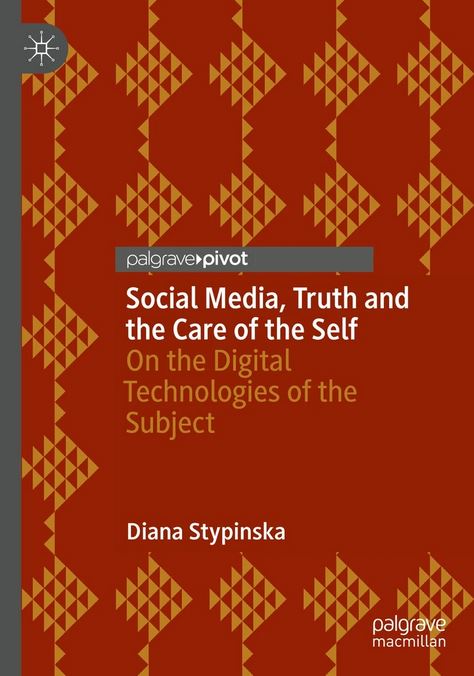
Ilaria Santoemma, From Pervasive Technologies to Technology of the Self. A Counter-Subjectivation argument for a Shift in the Critical Theory of Cyberspace, Soft Power, pp. 49-68 Issue 22 (11,2) July-December 2024
https://doi.org/10.14718/SoftPower.2024.11.2.3

Abstract
This paper aims to contribute to the discourse on the intersection of power dynamics and subjectivation processes as explored in critical theory, particularly in response to the digital transformation brought about by information and communications technologies and cyberspace. It argues that, despite some important attempts being made in literature to conceptualize a Foucauldian analytics of power regarding the impact of the digital dominion on subjectivity production, there is a lack of understanding of the technology of the self. The premise of the argument is that of info-dominion and subjectivity production, found in mechanisms such as profiling, dematerialization, and machinery determinism, that are extensively reliant on a subject as the inscription surface of digital reality. This paper will contribute to the subjectivity-making debate in the digital shift, recasting some conceptualities from French philosopher Michel Foucault that are relatively undeveloped in the critical studies of cyberspace, arguing for a thesis of counter-subjectivation.

Keywords
technology of the self, cyberspace, digital authonomy, power, subjectivity
Download the article in PDF

Nick Gallent, Menelaos Gkartzios, Mark Scott, Andrew Purves (Eds), Postcapitalist Countrysides. From commoning to community wealth building, UCL Press, 2025

Open access

Postcapitalist Countrysides explores the tensions that arise from the established conventions of economic production and private accumulation, as they affect life, wealth and work in rural areas. Its premise is that capitalism, as we experience it today, is incapable of solving key societal challenges – centred on social justice and sustainable livelihoods. By rethinking land, capital and labour relationships, postcapitalism offers glimpses of alternative modes of socio-economic organisation, achievable through local pre-figurative actions today and scalable through structural supports in the future. The glimpses of hopeful futures offered in this collection focus on rural places, communities and economies.

1 The postcapitalist countryside
Nick Gallent, Andrew Purves, Menelaos Gkartzios and Mark Scott

Part I: Private land enclosure and public commoning

2 Land and rent in capitalist production
Andrew Purves, Nick Gallent, Menelaos Gkartzios and Mark Scott
3 From enclosure to commoning
Andre Pusey
4 Postcapitalist trajectories, beyond land
Menelaos Gkartzios

Part II: Commoning processes and experiences

5 Postcapitalist struggles and the ‘gift of land’
Franklin Obeng-Odoom
6 Experimental food commons in capitalist heartlands
Adam Calo
7 Making a postcapitalist countryside? Community landownership in Scotland
Madhu Satsangi and Andrew Purves
8 Community landownership: means and outcomes – experiences of community acquisition processes in Scotland
Annie McKee, Jayne Glass, Anna Lawrence and Robert Mc Morran
9 ‘Back to the land’: evaluating One Planet Development as a planning mechanism for promoting alternative forms of rural living
Neil Harris
10 Rural women’s business-led commoning in Mexico and Japan: A transnational feminist analysis
Chizu Sato, Nanako Nakamura and Jozelin María Soto Alarcón
11 From land reparations to land justice: Reframing relationships to place using Indigenous Australians’ wisdom
Ed Wensing and Bhiamie Williamson
12 Land art as commoning and resistance: aesthetics, ecology and community
Emily Brady

Part III: De-commoditised collective assets and community infrastructure

13 Rural social enterprises as vehicles for postcapitalism
Nikolaos Apostolopoulos and Sotiris Apostolopoulos
14 Rural enterprise hubs and postcapitalism
Ian Merrell
15 Platform capitalism and the rural
Mark Scott
16 Community land trusts in rural locations: a postcapitalist housing transition?
Tom Moore
17 Unpacking the energy commons
Thomas Bauwens and Robert Wade
18 Rural heritage as a commons
Mark Scott

Part IV: The social transformation

19 Re-distributed private landholding as postcapitalism: homeownership and inequality in Britain
Nick Gallent and Phoebe Stirling
20 The land question and postcapitalist countrysides: towards a town-country synthesis
Yousaf Nishat-Botero and Matt Thompson
21 Achieving a socialisation of rent through land taxation
Andrew Purves, Nick Gallent, Mark Scott and Menelaos Gkartzios
22 Towards hopeful postcapitalist futures?
Nick Gallent, Mark Scott, Menelaos Gkartzios and Andrew Purves

Robin Hickman, Discourses on Sustainable Urban Mobility, UCL Press, 2025

Open access

Achieving sustainable transport systems and travel behaviours is proving problematic in many cities, including contestation over strategies and projects. Discourses on Sustainable Urban Mobility challenges the dominant discourses of motorisation and the ineffective implementation of sustainable mobility, arguing that transport planning history is not merely a record of successful projects but a reflection of how transport has been provided, including who and what has been included or excluded. Using discourse analysis, the book examines socially constructed realities in transport planning across 20 international case studies. Drawing from Michel Foucault’s concepts, it explores why transport systems and travel behaviours differ by space and time.

The discussion starts in Plymouth, a city rebuilt around motorisation. A range of cities are then examined, following different trajectories for transport planning, including Oxford; Freiburg; Singapore; Bogotá; Houten; Chongqing; London, King’s Cross; Rio de Janeiro; Utrecht; Copenhagen; Malmö; Dar es Salaam; Shenzhen; Manchester; Valenciennes; Medellín; Delhi; London, West Ealing-South; and Portland. Each city offers unique discursive formations and practices for transport and city planning, suggesting progressive pathways towards sustainable urban mobility. Comprehensive and critical, this book aids students, policy makers, consultants and the public in reconsidering their transport systems for greater sustainability.

Author
Robin Hickman is Professor in Transport & City Planning at the Bartlett School of Planning, UCL and Director of the MSc in Transport & City Planning. He has previously been a Visiting Research Associate at the Transport Studies Unit, University of Oxford, and has worked in practice in transport consultancy at Halcrow, on masterplanning and transport research at Llewelyn-Davies and local transport planning at Surrey County Council. He has research interests in transport and climate change, transport and social equity, urban structure and travel, discourse and contestation in transport and urban development, multi-criteria appraisal and sustainable transport strategies in the UK, Europe and Asia. His previous books include Discourse Analysis in Transport and Urban Development (2023), A Companion to Transport, Space and Equity (2019), Handbook on Transport and Development (2015) and Transport, Climate Change and the City (2014).

Emanuele Iula, Transizioni. Il soggetto sessuale al vaglio della filosofia e della psicoanalisi, Orthotes Editrice, 2025

Il soggetto sessuale è una categoria emersa dalle ricerche di Michel Foucault, ma già presente nei testi di Simone de Beauvoir. Il nucleo concettuale, da cui si dipanano i vari tipi di esperienza menzionati dagli autori, consiste in una transizione, la cui chiave di volta è normativa. In linea generale, essa nasce in una condizione di assoggettamento rispetto a una norma, o in seno a istituzioni coercitive, per sfociare in una situazione di emancipazione. Ne nasce un approccio che identifica nella verità, nel piacere e nelle relazioni umane differenti agenti di soggettivazione.

Oltre al versante filosofico, il saggio presenta vari sondaggi nell’ambito della psicoanalisi, interloquendo con alcuni tra i suoi interpreti principali, tra cui Sigmund Freud, Jacques Lacan e Melanie Klein. Rimanendo nel medesimo solco disciplinare, spicca lo studio sul volto decostruito della psicoanalisi, che si rende visibile nei lavori di René Major. Da questo confronto emerge un quadro teorico in cui il soggetto, anziché confrontarsi con un rito di passaggio, è chiamato a fare i conti con i temi del raddoppiamento e della différance.

Description
The sexual subject is a philosophical category born in the field of gender studies. An important definition of this term is provided by the large corpus of writings on human sexuality signed by Michael Foucault. Nevertheless, the very first trace of this notion is available in the writings of Simon de Beauvoir. The conceptual core of the sexual subject is given by a transition, from a certain condition of subjugation in a normative key, to a wider form of freedom and socio-sexual emancipation. The three main experiences of this existential movement of subjectification are the truth, pleasure and different kind of human relationships. The second side of the research is focused on psychoanalysis. Despite a large number of variations, the concept of the sexual subject remains a good perspective of observation vis-à-vis the implicit development of the discipline, all along XX century. The essay openly faces several perspectives: Freud, Lacan, Irigaray, Klein and Deleuze among others. The last chapter touches on the relationship between psychoanalysis and deconstruction, thanks to the works of René Major. According to this new theoretical framework, the sexual subject is no longer identifiable by a transition, but it faces the problem of the unconscious as a form of doubling and différance.

Carr, M. Bring Your Whole Self to Work: Boundary Conditions of Subjectivity in Diversity and Inclusion Discourse on Investment Bank Websites. Journal of Business Ethics (2025).
https://doi.org/10.1007/s10551-025-06055-0

Abstract
This article critically examines the discourse of ‘bring your whole self to work’ within the diversity, equality, and inclusion (DEI) narratives of investment banks. While inclusion is often framed as essential for leveraging diversity, scholars argue that ‘whole self’ approaches risk individualising diversity and reinforcing systemic exclusions. Drawing on Foucault’s concepts of biopower, technologies of the self, and governance, this study explores how inclusion operates as a mechanism of organisational power, shaping subjectivities through corporate DEI statements. Using discourse analysis of investment banks’ websites, the article identifies three subjectivities constructed through ‘whole self’ discourse: the whole self as a driver of productivity, the whole self shaped by wellness and mindset, and the whole self oriented towards personal growth. By interrogating the boundary conditions of inclusion, the article highlights the ethical implications of DEI discourse, questioning how organisations define acceptable identities and reinforcing the need for structurally inclusive practices that move beyond surface-level commitments.

Alex Dubilet, Foucault, Our Contemporary, boundary 2 (2025) 52 (4): 7–48
https://doi.org/10.1215/01903659-11938189

Abstract
In fall 1978, Michel Foucault proposes political spirituality as a prism for understanding the Iranian uprising’s contravention of modernity’s secular coordinates, thus continuing the chain of conceptualization begun earlier that year with counter‐conduct and the critical attitude. But in extricating the facticity of uprising from revolutionary normative frameworks and narrative schemas, Foucault avowed — however briefly — a lived collective refusal incommensurable with the order of government, the kind of absolute refusal of government that appeared earlier only via negation, equivocation, and disavowal. This essay argues that Foucault thereby prefigured avant la lettre the contemporary paradigm of destituent power, adding to it the subsequently forgotten insight that thinking destituent uprising demands a correlated suspension of the secularizing disjuncture imposed with the age of revolution. From his reflections on Iran, this essay retrieves other uncharacteristic gestures — an antistrategic ethics, a prophetic vision of indefinite experimentation, and a call for world refusal — resulting in a nearly unrecognizable image of Foucault. In uncovering this minor Foucault, a stranger to his dominant portrayals, this essay suggests that a genuine fidelity to such a heterodox thinker may involve inventively attending to the rhetorical hesitations, conceptual ambivalences, and theoretical deviations of his discourse at least as much as systematizing his explicit utterances, an approach it finds characteristic of Daniele Lorenzini’s The Force of Truth.

Keywords
Michel Foucault, destituent power, refusal, political spirituality, revolution