Foucault News

News and resources on French thinker Michel Foucault (1926-1984)

Editor: I have added a list of open access tools and repositories to the side bar of the Foucault News blog (see list below) to assist readers who don’t have institutional access to journals. If anything is missing please let me know

(See these cautions about the commercial aspirations of both academia.edu and Research Gate).


Update 5/5/18. I’ve added Scribd to the list. It operates on a similar model to the streaming music service Spotify, or Neflix in that for a reasonable monthly subscription fee you have online access to books, journal articles, audiobooks and other documents.

Patricio Lepe-Carrión, Educación, racismo cultural y seguridad nacional: la escuela intercultural en contextos de violencia, Educação e Pesquisa, vol.44 São Paulo 2018 Epub 16-Abr-2018
DOI:10.1590/s1678-4634201844174819
Open access

Education, cultural racism and national security: the intercultural school in contexts of violence

RESUMEN
El artículo recoge conclusiones parciales de un proyecto en curso, financiado por Fondecyt (nº11140804) y Becas-Chile, y patrocinado por la Universidad de Chile, Universidad de Sao Paulo, y Universidad de La Frontera. Tiene como objetivo analizar el discurso educativo intercultural en contextos de violencia, tomando como foco específico de estudio, la función que la escuela intercultural cumple al interior del conflicto armado que el Estado chileno mantiene con el pueblo mapuche en la región de la Araucanía. La perspectiva teóricometodológica utilizada es el Análisis del Discurso desde las contribuciones y posibilidades abiertas por el filósofo Michel Foucault, tomando como archivo de análisis dos tipos de muestras: documentales y etnográficas; las primeras, recopiladas desde los años 1990-2016; y las segundas, adquiridas en el transcurso de los último dos años (2015-2016). En la primera parte, intentaré visibilizar aquellas prácticas no-discursivas implicadas en la desestabilización del modelo extractivista y monoexportador en Chile, y de sus efectos en la militarización de la región de la Araucanía. Luego, describiré brevemente las características de la racionalidad etnogubernamental que opera en los discursos y prácticas multiculturales en post-dictadura, para después mostrar el modo en que funcionan los procesos de etnicidad en los programas educativos sobre interculturalidad. En la última parte, a modo de conclusión, formularé algunas reflexiones que pretenden establecer vínculos entre los programas de educación intercultural, culturalismo o racismo cultural, gubernamentalización del Estado, y estrategias securitarias de percepción y construcción del enemigo interno.

Palabras-clave: Educación; Interculturalidad; Racismo; Violencia; Pueblo Mapuche

ABSTRACT
The article collects partial conclusions of an ongoing project, financed by Fondecyt (nº11140804) and Becas-Chile, and sponsored by the University of Chile, University of Sao Paulo, and the University of La Frontera. Its objective is to analyze the intercultural educational discourse in contexts of violence, taking as a specific focus of study the function that the intercultural school fulfills within the armed conflict that the Chilean State maintains with the Mapuche people in the Araucanía region. The theoretical-methodological perspective used is the Discourse Analysis from the contributions and possibilities opened by philosopher Michel Foucault, taking as a file of analysis two types of samples: documentary and ethnographic; the first, collected from the years 1990-2016; and the second, acquired during the last two years (2015-2016). In the first part, I will try to make visible those non-discursive practices involved in the destabilization of the extractivist and mono-exporting model in Chile, and its effects on the militarization of the Araucanía region. Then, I will briefly describe the characteristics of ethno-governmental rationality that operates in multicultural discourses and practices in post-dictatorship period, and then show how ethnicity processes work in educational programs on interculturality. In the last part, as a conclusion, I will formulate some reflections that intend to establish links between intercultural education programs, culturalism or cultural racism, governmentalization of the State, and security strategies of perception and construction of the internal enemy.

Key words: Education; Interculturality; Racism; Violence; Mapuche People

Editor: I’ve made a few changes and additions to Foucault News. I have merged my old michel-foucault.com site with Foucault News and have also transferred the domain name. Henceforth, the url for the Foucault News site will be https://michel-foucault.com. The domain name of foucaultnews.com will continue to work however and links with that address will all redirect to this site.

I have brought a number of (updated) pages across from my old michel-foucault.com website. You can find a list of these pages below and also in the top and bottom menu bars under ‘Foucault Resources’. If there is information missing which you would like to see on the resource pages, please email me or leave a comment in the comments boxes on the relevant pages.

My original Foucault site went online on January 1997, and was initially used to advertise an edited volume of papers from a conference I ran in 1994 on the Gold Coast in Queensland, Foucault: The Legacy (Brisbane: QUT, 1997). See here, courtesy of the wayback machine what my website looked like in 1998, complete with dire amateur retro design. The site was initially coded by hand in html (a slow painstaking process!) before the advent of sophisticated web design software.

I subsequently expanded the site and here is a ‘redesigned’ version in 2000 and then its final form (done in 2007) as it appeared after its last update in July 2013.

New pages on Foucault News
Key concepts
Bibliographies (includes an updated bibliography by Richard Lynch of English translations of Foucault’s shorter works).
Gallery of images relating to Foucault
Notes on translations
Foucault related links

I will also be adding select quotations from Foucault’s work at regular intervals to the blog. I have commented on some of these quotations, as well as others, on my own personal blog.

Ian Leask, ‘”The Happy Limbo of a Non-Identity” (Or: Herculine Barbin’s Possibility)’, Yearbook of the Irish Philosophical Society 2014-15, pp.85-98. [published in 2018]

The treatment of the ‘hermaphrodite’ in Foucault’s work remains ripe for scholarly attention, especially given the insight it provides into the nature and development of his thinking about issues like the construction and policing of ‘normality’, the question of identity, and the role of agency. Accordingly, this paper gives close attention to the two occasions on which Foucault himself gives close attention to the inter-sexed condition: first, the introduction he publishes in 1980 to the story of Herculine Barbin,who,raised as a girl, was forced by authorities and ‘experts’ to live as a man,once she reached adulthood, and who, as a result, was driven to suicide and, secondly, a lecture Foucault gives in 1975, as part of his broader consideration of the genesis of the notion of ‘the Abnormal’,in which he provides fuller empirical details regarding changes in the institutional reception and treatment of inter-sexed people.

Colloque international

« Une généalogie littéraire de la pensée des pratiques de soi »

Date : 8, 9 novembre 2018
Lieu : Université Bordeaux-Montaigne

Laboratoire de recherche : TELEM
(Textes, Littératures : Écritures et Modèles)

URL DE RÉFÉRENCE
https://procesosdesubjetivacion.com/inicio/

Il s’agira dans le cadre de ce colloque de s’interroger, du point de vue de la littérature et de la philosophie, sur ce moment charnière de la fin des années 1970 qui voit infléchir la pensée de Michel Foucault vers une problématisation autre de son objet de recherche. Après avoir publié en 1976, le premier tome de l’Histoire de la sexualité, Foucault délaisse les ars eroticae pour recentrer son propos sur les pratiques du souci de soi antiques, l’Epimeleia heautou.

Ce moment coïncide avec un retour implicite, indirect et non-dit à la littérature. S’il évoque alors officiellement un intérêt pour la « non-littérature », dans « La vie des hommes infâmes » c’est bien une généalogie de la « littérature au sens moderne » qu’il tente d’échafauder. De même, s’il définit à partir de Kant et de l’article « Was ist Aüklarung ? », une « attitude de la modernité » répondant à une « critique ontologique de soi-même », c’est Baudelaire qui vient l’incarner.

Alors même que Michel Foucault avait souhaité rompre avec la littérature dans les années 1960, n’y voyant plus un extérieur du langage qui pourrait interrompre un ordre du discours, le tournant des années 1970-1980 s’ouvre sur une nouvelle approche du littéraire, de l’écriture littéraire, qui n’est plus un objet d’étude mais paraît revêtir un intérêt autre. Ce retour à la littérature semble nourrir sa réflexion sur les pratiques de soi alors même qu’il n’écrit qu’un seul article, en 1983, dans le numéro consacré à l’autoportrait de la revue Corps écrit, sur l’ « Écriture de soi ». Ce que Michel Foucault définissait sous l’expression de « trip gréco-latin » pourrait avoir été pensé non seulement à l’aune des textes de l’Antiquité, mais plus encore sous l’observation de pratiques littéraires contemporaines qui relevaient d’un modèle d’une « esthétique de l’existence ». La littérature aurait été en quelque sorte l’autre de la pensée foucaldienne des pratiques de soi, cette « belle étrangère ». Comme il l’a souvent affirmé, c’est à partir d’une époque contemporaine qu’il problématise son objet d’étude, dans un mouvement centré sur l’actualité, une actualité relevant alors de pratiques littéraires comme pratique de soi.

Quelles fonctions joue la littérature dans la pensée du dernier Foucault ? Les dernières influences ne sont-elles pas essentiellement littéraires ? Et l’on pense aux dernières amitiés du philosophe pour Jean Genet et Claude Mauriac dès 1971, Hervé Guibert dans les années 1980 et avec Roland Barthes dont il se rapproche à nouveau à partir de 1976.

On pourra donc s’intéresser, par exemple, aux cours du Collège de France de Roland Barthes,  Comment vivre ensemble, Le neutre et plus encore La préparation du roman afin de s’interroger sur un dialogue possible entre les deux œuvres sur la littérature comme moyen d’échapper au langage et à « l’ordre du discours », mais encore sur la question des pratiques de subjectivation.

De même, le cycle du Temps immobile de Claude Mauriac a pu constituer un exemple de mise en pratique du souci de soi par l’écriture littéraire.

D’autres affinités électives foucaldiennes pourront aussi nourrir notre réflexion comme l’amitié pour Lindon et Guibert, ce dernier affirmant, dans A l’ami qui ne m’a pas sauvé la vie, avoir pratiqué l’écriture de soi dans l’esprit des pratiques de soi selon Foucault.

Mais notre intérêt se portera avant tout, dans ce premier temps de notre recherche, sur un dialogue possible avec Barthes et Mauriac, concernant la théorie et la pratique littéraire dans la pensée foucaldienne.

Le colloque pourra s’organiser autour de quatre axes :

  • Processus de subjectivation et écritures politiques
  • Pratique de soi et formes d’existence
  • De la théorie littéraire comme processus de subjectivation
  • Poétiques de l’écriture de soi

Comité scientifique

Oscar Barroso (Université de Granada)
Philippe Baudorre (Université Bordeaux-Montaigne)
Arnold Davidson (Université de Chicago)
Valéry Laurand (Université Bordeaux-Montaigne)
Judith Revel (Université Paris-Nanterre)
Tiphaine Samoyault (Université Sorbonne Nouvelle – Paris 3)

Les propositions de communication (300 mots maximum), en français, espagnol ou anglais, accompagnées d’une courte notice bio-bibliographique devront être adressées à l’adresse suivante : isabelle.galichon@orange.fr

La durée des communications sera de 20 minutes

Date limite d’envoi des propositions : 31 mai 2018

Date limite de réponse : 30 juin 2018

À l’issue du colloque, le comité scientifique sélectionnera les communications qui feront l’objet d’une publication.

RESPONSABLE :
Isabelle Galichon
Mitchell Dean and Daniel Zamora, Did Foucault Reinvent His History of Sexuality Through the Prism of Neoliberalism? Los Angeles Review of Books

THE RECENT PUBLICATION of the long-awaited fourth volume of his History of Sexuality, Les Aveux de la chair, [1] raises questions as to why and how Foucault chose to reinvent his magnum opus as an investigation of ancient “techniques of the self” and their incorporation in early Christianity. In some ways, this shift parallels his reformulation of power relations in terms of governmentality, which was triggered by his encounter with neoliberalism during the same period.

read more

stuartelden's avatarProgressive Geographies

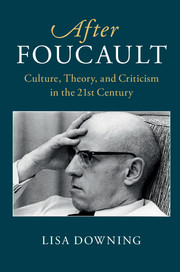
9781316506042.jpgLisa Downing (ed.) After Foucault: Culture, Theory, and Criticism in the 21st Century – forthcoming with Cambridge University Press. Thanks to James Tyner for the alert.

The work of Michel Foucault is much read, widely cited, and occasionally misunderstood. In response to this state of affairs, this collection aims to clarify, to contextualize, and to contribute to Foucauldian scholarship in a very specific way. Rather than offering either a conceptual introduction to Foucault’s work, or a series of interventions aimed specifically at experts, After Foucault explores his critical afterlives, situates his work in current debates, and explains his intellectual legacy. As well as offering up-to-date assessments of Foucault’s ongoing use in fields such as literary studies, sexuality studies, and history, chapters explore his relevance for urgent and emerging disciplines and debates, including ecology, animal studies, and the analysis of neoliberalism. Written in an accessible style, by leading experts, After Foucault…

View original post 22 more words

Albert, M., Vasilache, A.
Governmentality of the Arctic as an international region
(2018) Cooperation and Conflict, 53 (1), pp. 3-22.

DOI: 10.1177/0010836717703674

Abstract
Linked to the image of a wild and still-to-be-explored territory, as well as to images of the region as one of new economic opportunities, discourses on the Arctic also tie in with issues of climate change, cooperation and conflict, Arctic governance, international law and the situation and rights of indigenous people, as well as Great Power politics. Taken together, these aspects characterize a region whose formation is different from regionalization processes in other parts of the world. As the regional peculiarity of the Arctic is reflected by a variety and plurality of representations, discourses, perceptions and imaginaries, it can usefully be analyzed as a region of unfolding governmentality. The present article argues that the prospects for the Arctic are strongly intertwined with perceptions and depictions of it as an international region subject to emerging practices of governmentality. By drawing on both Foucault’s texts and governmentality studies in international relations (IR), we discuss how the Arctic is affected by governmental security rationalities, by specific logics of political economy and order-building, as well as becoming a subject for biopolitical rationalizations and imaginaries. The discourses and practices of governmentality that permeate the Arctic contribute to its spatial, figurative and political reframing and are aimed at making it a governable region that can be addressed by, and accessible for, ordering rationalities and measures.

Author Keywords
Arctic; biopolitics; Foucault; governmentality; pole; regionalization

stuartelden's avatarProgressive Geographies

I wrote the last update on this book over two months ago, just as I was finishing up an extended research visit to Paris. Since then I’ve mainly been focusing on the Canguilhem manuscript, which is inching toward a near complete draft. I will share more about the Canguilhem book in due course. While that has taken up most of my time, I did also write a long review essay on Foucault’s Les aveux de la chair, the fourth volume of his History of Sexuality. It’s available open access on the Theory, Culture & Society blog, and should appear in the journal itself later this year.

In early April I was in New York for a workshop at Columbia University, and used the opportunity to take a side-trip to the Beinecke rare books and manuscripts library at Yale University. This library owns the Michel Foucault Library of…

View original post 799 more words

Life After Sundown: Disco Architecture in the Global City | Features | Archinect, By Alan Ruiz, Feb 7, 2017

Samuel Delaney describes the disco as one site of  “inter-class contact,”²  rehearsing a now familiar understanding of the dance floor as teeming with the possibility for alternative forms of sociality. In this sense, the disco is the heterotopia par excellence, a space outside all other spaces. While Michel Foucault located the heterotopia in sites of control such as the colony, prison, or psychiatric hospital, the disco certainly might also qualify as a space for “individuals whose behavior is deviant in relation to the required mean or norm.”³ After all, it was people of color and queer bodies that not only popularized disco culture, but also found respite inside them from the racist, homophobic and hegemonic ideology of urban life. We might then consider the dance club as a space in which non-normative subjectivity was produced relationally through collective social formations. For many, the disco was a space of becoming. Yet, while the Dionysian narrative of the disco is well rehearsed, we might also consider the disco as a post-industrial site of unproductive labor. It was a site for a kind of spatial practice of self-making where a body could be mechanized by electronic BPMs, while still navigating the disciplining of a routinized, assembly line production, scored to the repetitive and mechanic pulse of Detroit techno.