
Foucault News

News and resources on French thinker Michel Foucault (1926-1984)

Schweber, L.
Jack-in-the-black-box: Using Foucault to explore the embeddedness and reach of building level assessment method
(2017) Energy Research and Social Science, 34, pp. 294-304.

DOI: 10.1016/j.erss.2017.08.005

Abstract
Environmental policy in Western countries is marked by extensive reliance on voluntary self-regulation, designed to influence market behavior. In many instances, these policy tools fail to deliver on their promise, while nonetheless influencing professional and user behavior. This paper draws on Foucault’s theory of governmentality and the Sociology of Standards to explore the effect of voluntary policy tools. Whereas most research focuses on the effect of tools on either intended outcomes or formal policies, this paper considers their effect on the people who directly engage with them. The paper uses the case of the Building Research Establishments Environmental Assessment Method (BREEAM) to consider the embeddedness and reach of policy tools across communities of practice. The contribution of the paper lies in its focus on the way in which organizational features of BREEAM contribute to its effect on the definition of green building and peoples’ engagement with them. Theoretically, the focus on organizational aspects of governing techniques draws attention local variations in the power/knowledge effect of techniques, thereby contributing to a relatively neglected aspect of governmentality. The paper concludes with reflection on the relevance of this approach for research into other types of policy tools and technical standards. © 2017

Author Keywords
BREEAM; Building environmental assessment methods; Governmentality; Policy tools; Standards; Voluntary governance

Gerdin, G.
‘It’s not like you are less of a man just because you don’t play rugby’—boys’ problematisation of gender during secondary school physical education lessons in New Zealand
(2017) Sport, Education and Society, 22 (8), pp. 890-904.

DOI: 10.1080/13573322.2015.1112781

Abstract
Despite clear messages from current physical education (PE) curricula about the importance of adopting socially critical perspectives, dominant discourses of gender relating to physical activity, bodies and health are being reproduced within this school subject. By drawing on interview data from a larger ethnographic account of boys’ PE, this paper aims to contribute to our understanding of boys’ experiences of gendered discourses in PE, particularly by acknowledging boys not only as docile or disciplined bodies but also as active subjects in negotiating power relations. In the analysis of the data, particular emphasis is placed on whether the boys recognise the influence of gendered discourses and power relations in PE, how they act upon this knowledge and how they understand themselves as gendered subjects through these particular discourses/power relations. Using Foucault’s (1985. The use of pleasure: The history of sexuality, vol. 2. London: Penguin Books) framework related to the ‘modes of subjectivation’, this paper explores boys’ problematisation of dominant discourses of gender and power relations in PE. In summary, these boys perform gendered selves within the context of PE, via negotiation of gendered discourses and power relations that contribute to an alternative discourse of PE which creates spaces and opportunities for the production of more ethical and diverse masculinities. © 2015 Taylor & Francis.

Author Keywords
Boys; Foucault; gender; masculinity; physical education

Le Moment philosophique des années 1960 en France, Sous la direction de Patrice Maniglier, Paris: Presses Universitaires de France, 2011

Présentation

Les années 1960 furent le théâtre de l’un des épisodes les plus brillants de l’histoire de la pensée philosophique en France. Elles s’ouvrirent sur le triomphe public du structuralisme, avec La Pensée sauvage de Lévi-Strauss, se continuèrent par le renouvellement du marxisme proposé par Althusser et de la psychanalyse par Lacan, et s’achevèrent avec une série d’œuvres comme celles de Foucault, Deleuze, Derrida et Lyotard, qui ont décidé du visage de la philosophie contemporaine.

L’héritage de cette période a néanmoins été difficile, suscitant tantôt une fascination mimétique, tantôt un rejet caricatural. Depuis quelques années, les auteurs qui l’ont marquée font individuellement l’objet d’une réception savante plus mesurée et plus profonde, au risque cependant de perdre la dimension collective et transversale qui la caractérisait. Le but de cet ouvrage est de réunir certains des meilleurs spécialistes pour prendre toute la mesure de ce qui a constitué, par son intensité et son ampleur, un « moment philosophique » exceptionnel.

Il offre à la fois une traversée de quatre dimensions transversales (épistémologique, politique, esthétique et philosophique) et une relecture de quatre livres singuliers : La Pensée sauvage de Lévi-Strauss (1962), Lire Le Capital et Pour Marx d’Althusser (1965), les livres de Derrida autour de De la grammatologie (1967), et Discours, Figure de Lyotard (1971). Traversant aussi bien les mathématiques de Bourbaki que la linguistique structurale, l’anthropologie de Lévi-Strauss que la psychanalyse freudienne, le marxisme d’Althusser que celui d’Adorno, le théâtre de Brecht que le cinéma de Godard, ce livre invite à redécouvrir ce moment non pas comme un objet historique à circonscrire, mais comme un mouvement ouvert où se sont décidées certaines des tâches qui nous incombent encore, aujourd’hui.

Raaper, R.
‘Peacekeepers’ and ‘machine factories’: tracing Graduate Teaching Assistant subjectivity in a neoliberalised university
(2017) British Journal of Sociology of Education, pp. 1-15. Article in Press.

DOI: 10.1080/01425692.2017.1367269

Abstract
Guided by a Foucauldian theorisation, this article explores Graduate Teaching Assistant (GTA) experiences of their work and subjectivity in a neoliberalised higher education environment. By drawing on a research project with GTAs from one UK university, the article argues that GTA work is increasingly shaped by neoliberal reforms. The GTAs interviewed are critical of internationalisation, marketisation and client culture, and see these processes as acting on their subjectivity. The GTAs position themselves as mediators between demanding students and overworked academics: they have turned into much-needed ‘peacekeepers’ and ‘machine factories’. The findings also demonstrate that the subjectivity enforced by a dominant market ideology is further negotiated in the GTA experience. The discourses reveal that a lack of institutional control and coordination of graduate teaching provides the means for, and indeed enables, the GTAs to express some, but often limited, discontent with neoliberalism. © 2017 Informa UK Limited, trading as Taylor & Francis Group

Author Keywords
Foucault; Graduate Teaching Assistants; Higher education; neoliberalism; subjectification

Burgess, C.
‘Having to say everyday … I’m not black enough … I’m not white enough’. Discourses of Aboriginality in the Australian education context
(2017) Race Ethnicity and Education, 20 (6), pp. 737-751.

DOI: 10.1080/13613324.2016.1195353

Abstract
This paper interrogates discourses of Aboriginality about, and by, early career Aboriginal teachers as they negotiate their emergent professional identity in specific Australian school contexts. These discourses position the respondents via their ethnic and cultural background and intersect with self-positioning. This relates to the desire to be positioned as teacher rather than (only) as an ‘Aboriginal’ teacher. Consequently, the over-determination of Aboriginality includes such suppositions as the ‘think-look-do’ Aboriginality with a ‘natural’ connection to community, the ‘good’ Aboriginal teacher who fixes Aboriginal ‘problems’, the Aboriginal teacher as ‘Other’, and [the notion that] ‘Aboriginal work’ as easy, not real work and peripheral to core business. Through qualitative methodology, eleven Aboriginal teachers from the University of Sydney were interviewed. They were able to construct stories of early career teaching and the data was analysed to explore how the participants interpreted, accepted and/or resisted various discourses in their efforts to be agentic and resilient and to make a difference for the Aboriginal students they teach. © 2016 Informa UK Limited, trading as Taylor & Francis Group.

Author Keywords
Aboriginal teachers; discourses; Foucault; narrative; relationships of power; teacher identity

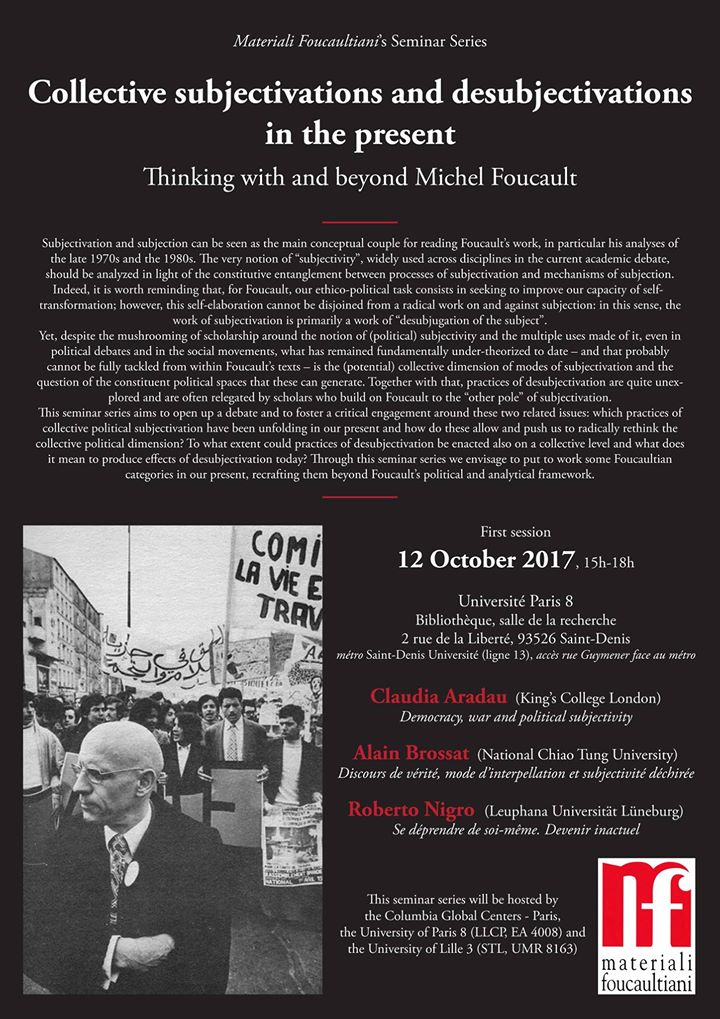
Collective subjectivations and desubjectivations in the present (2017)

12 October 2017

Bouilloud, J.-P., Deslandes, G., Mercier, G.
The Leader as Chief Truth Officer: The Ethical Responsibility of “Managing the Truth” in Organizations
(2017) Journal of Business Ethics, pp. 1-13. Article in Press.

DOI: 10.1007/s10551-017-3678-0

Abstract
Our aim is to analyze the position of the leader in relation to the ethical dimension of truth-telling within the organization under his/her control. Based on Michel Foucault’s study of truth-telling, we demonstrate that the role of the leader toward the corporation and the imperative of organizational performance place the leader in an ambiguous position: he/she is obliged to take the lead in “telling the truth” internally and externally, but also to bear the consequences of this “truth-telling” for the organization and for himself/herself. In this process of construction and implementing the truth, the leader is organizer and figurehead of the corporation’s truth-telling practices: determining the frontiers between truth that can be said and that which should remain hidden, both inside and outside the corporation; establishing a dialogue based on truth (i.e., an authentic, sincere relationship with all partners); guaranteeing that the rules of truth-telling are respected; and offering a truth which is compatible with the firm’s economic and ethical interest. Invested with the authority—the office—of managing truth within the corporation, the leader can be considered to be the “Chief Truth Officer.” From this perspective, we demonstrate that this role requires specific skills, like courage and practical wisdom. © 2017 Springer Science+Business Media B.V.

Author Keywords
Aletheia; Foucault; Parrhesia; Secrecy; Truth-telling; Truthfulness

Macneill, P.
Balancing bioethics by sensing the aesthetic
(2017) Bioethics, 31 (8), pp. 631-643.

DOI: 10.1111/bioe.12390

Abstract
This article is critical of “bioethics” as it is widely understood and taught, noting in particular an emphasis given to philosophical justification, reason and rationality. It is proposed that “balancing” bioethics be achieved by giving greater weight to practice and the aesthetic: Defined in terms of sensory perception, emotion and feeling. Each of those three elements is elaborated as a noncognitive capacity and, when taken together, comprise aesthetic sensitivity and responsiveness. This is to recognise the aesthetic as a productive element in bioethics as practice. Contributions from the philosophy of art and aesthetics are drawn into the discussion to bring depth to an understanding of “the aesthetic”. This approach is buttressed by philosophers – including Foucault and 18th century German philosophers (in particular Kant) – who recognized a link between ethics and aesthetics. The article aims to give substance to a claim that bioethics necessarily comprises a cognitive component, relating to reason, and a non-cognitive component that draws on aesthetic sensibility and relates to practice. A number of advantages of bioethics, understood to explicitly acknowledge the aesthetic, are proffered. Having defined bioethics in conventional terms, there is discussion of the extent to which other approaches to bioethics (including casuistry, virtue ethics, and narrative ethics) recognize aesthetic sensitivity in their practice. It is apparent that they do so to varying extents although not always explicitly. By examining this aspect of applied ethics, the paper aims to draw attention to aesthetic sensitivity and responsiveness as integral to ethical and effective health care. © 2017 John Wiley & Sons Ltd.

Author Keywords
Aesthetics; Bioethics; Emotion; Feeling; Medical humanities; Reason

Index Keywords
attention, bioethics, casuistry, human, human experiment, medical humanities, narrative, perception, sensibility

Jordan, T.
A genealogy of hacking
(2017) Convergence, 23 (5), pp. 528-544.

DOI: 10.1177/1354856516640710

Abstract
Hacking is now a widely discussed and known phenomenon, but remains difficult to define and empirically identify because it has come to refer to many different, sometimes incompatible, material practices. This article proposes genealogy as a framework for understanding hacking by briefly revisiting Foucault’s concept of genealogy and interpreting its perspectival stance through the feminist materialist concept of the situated observer. Using genealogy as a theoretical frame, a history of hacking will be proposed in four phases. The first phase is the ‘prehistory’ of hacking in which four core practices were developed. The second phase is the ‘golden age of cracking’ in which hacking becomes a self-conscious identity and community and is for many identified with breaking into computers, even while non-cracking practices such as free software mature. The third phase sees hacking divide into a number of new practices even while old practices continue, including the rise of serious cybercrime, hacktivism, the division of Open Source and Free Software and hacking as an ethic of business and work. The final phase sees broad consciousness of state-sponsored hacking, the re-rise of hardware hacking in maker labs and hack spaces and the diffusion of hacking into a broad ‘clever’ practice. In conclusion, it will be argued that hacking consists across all the practices surveyed of an interrogation of the rationality of information technocultures enacted by each hacker practice situating itself within a particular technoculture and then using that technoculture to change itself, both in changing potential actions that can be taken and changing the nature of the technoculture itself. © The Author(s) 2015.

Author Keywords
Cybercrime; free software; hacking; hacktivism; Open Source

Vappereau, M. (2014). Les Carnets de René Allio : une nécessaire publication. Sociétés & Représentations, 37,(1), 179-193. doi:10.3917/sr.037.0179.

Les événements de la fin de l’année 2013, depuis le colloque de novembre à l’INHA jusqu’à l’exposition au Muséum national d’histoire naturelle, permirent de faire redécouvrir René Allio, peintre, scénographe et cinéaste du second xxe siècle, et n’oublièrent pas de saluer l’artiste en tant que diariste. Arlette Farge, en tant que collaboratrice [2] Arlette Farge collabora à l’écriture du scénario du… et amie, ouvrit la manifestation et revint sur ses choix d’extraits de ses carnets pour l’ouvrage publié aux Éditions Lieu commun en 1991 et aujourd’hui épuisé. C’est sur ces petits Carnets de poche au papier quadrillé, que René Allio aligna son écriture serrée, fine et rapide durant près de trente-six ans.

[…]
Allio, en véritable artiste matérialiste, conçoit la création comme le « seul remède à l’aliénation [15] René Allio, Carnets, 25 août 1966. ». Au cinéma, il retrouve encore ce trait chez ses héros, ces hommes du peuple qui l’émeuvent et qu’il veut faire revivre à l’écran. Le monstre parricide, Pierre Rivière, petit paysan rattrapé par le drame du droit, est lui aussi possédé par cette passion du « faire » qui finit par le dépasser jusque dans le meurtre. Le mémoire de Rivière et les témoignages collectés dans le dossier par l’équipe de Michel Foucault rapportent que le jeune homme avait conçu un instrument inconnu qu’il nommait calibène, à la grande stupéfaction de tout le voisinage. Et René Allio peut ainsi écrire, alors qu’il travaille au scénario de son film normand :

“Ce qui me motive cette fois ce n’est pas ce qu’il y a à dire, c’est ce que ces textes et les événements qu’ils rapportent me donnent désir et besoin de faire : moi aussi une calibène, un instrument tout nouveau pour me distinguer, eh oui ! secrète ressemblance de Pierre Rivière avec tous ceux qui veulent, ou qui doivent dire autrement” [16] Ibid., 31 août 1974..