Foucault News

News and resources on French thinker Michel Foucault (1926-1984)

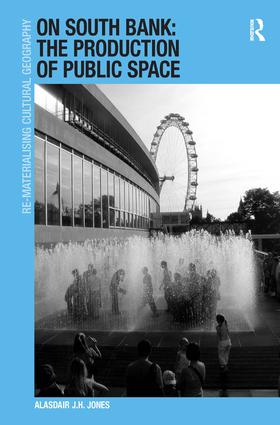
Alasdair J.H. Jones, On South Bank: The Production of Public Space, Routledge, 2014

Description

Tensions over the production of urban public space came to the fore in summer 2013 with mass protests in Turkey sparked by a plan to redevelop Taksim Gezi Park, Istanbul. In London, concomitant proposals to refurbish an area of the ’South Bank’ historically used by skateboarders were similarly met by staunch opposition. Through an in-depth ethnographic examination of London’s South Bank, this book explores multiple dimensions of the production of urban public space. Drawing on user accounts of the significance of public space, as well as observations of how the South Bank is ’practised’ on a daily basis, it argues that public space is valued not only for its essential material characteristics but also for the productive potential that these characteristics, if properly managed, afford on a daily basis. At a time when policy-makers, urban planners and law enforcement authorities simultaneously grapple with pressures to deal with social ‘problems’ (such as street drinking, vandalism, and skateboarding) and accusations that new modes of urban planning and civic management infringe upon civil liberties and dilute the publicity of ’public’ space, this book offers an insightful account of the daily exigencies of public spaces. In so doing, it questions the utility of the public/private binary for our understanding both of common urban space and of different sets of social practices, and points towards the need to be attentive to productive processes in how we understand and experience urban open space as public.

“What Do You Want Me to Regret?”: An Interview with François Ewald
Johannes Boehme interviews François Ewald, Los Angeles Review of Books, 3 November 2017

NOBODY COULD HAVE PREDICTED, in 1968, that François Ewald would one day receive the French state’s highest order for civil merit. At the time he was a young, ambitious, and radical philosophy student. He became a Maoist, demonstrated in the streets of Paris, and witnessed the violence that followed. In the early 1970s he went to the countryside. There he found himself swept up in one of France’s most notorious criminal scandals, the “Affaire Bruay-en-Artois.” A young miners’ daughter was killed, a lawyer was arrested (and later released), and the radical left staged mass demonstrations against “class violence.” It was then, in the small town of Bruay-en-Artois, that he first met Michel Foucault. Soon Ewald would become Foucault’s assistant at the Collège de France and one of his closest associates.

Ewald wrote a masterful 600-page dissertation, supervised by Foucault, on the history of the French welfare state. Foucault, who died in June 1984, never got to read the final version. After Foucault’s death, Ewald became the de facto executor of his estate. He edited most of his unfinished manuscripts and lectures. He also took a job in an unlikely field for a Foucauldian: the insurance industry. He struck up relationships with captains of industry like Claude Bébéar, the founder of AXA, and Denis Kessler, the CEO of SCOR, a French financial services company. In 2006 he received the Légion d’honneur.

And during the early 2000s his views seemed to change as well. He became a vocal advocate for liberal reforms of the French welfare state. He opposed the introduction of the 35-hour workweek and argued for the privatization of the pension-system.

[…]

Where did [Foucault’s] interest in liberalism come from?

His interest wasn’t ideological. It was a way to criticize traditional political philosophy. He didn’t study liberalism out of personal conviction, but as a way of passage — to get a clearer sense of what government actually meant. He was drawn to it, because it was so relevant to understand the contemporary situation. But he was much more interested in its epistemology than its politics. To read his lectures on liberalism as a statement of approval makes absolutely no sense. But on the other hand, there is a complication. Foucault didn’t believe in socialism. He wanted to criticize government practices. And liberalism at the time was one avenue of government-critique in France. But only one among many.

Recently there has been a heated debate about Michel Foucault’s attitude toward neoliberalism. The sociologist Daniel Zamora accused Foucault of adhering to neoliberal ideas. Do you agree?

Let me tell you two things. First of all, I am completely fed up with this entire discussion. Secondly, in terms of actual evidence, the claim that Michel Foucault held neoliberal views is just so far-fetched. Look, during those weeks in which Foucault was lecturing about liberalism at the Collège de France, he also visited Ayatollah Khomeini at Neauphle-le-Château. The Iranian Revolution happened shortly afterward and Foucault was particularly interested in the events in Tehran. He was fascinated by the fact that people were willing to die for a religious idea in the streets of Tehran! But nobody would say that he became a militant supporter of the Iranian Revolution. Based on the evidence it doesn’t make more sense to say that Foucault was a closet neoliberal, either.

[…]

read more

Séminaire “Penser l’identité et le sujet avec Foucault” à Curitiba (UFPR et PUCPR)
22 et 23 novembre 2017

Ce séminaire constitue le premier volet du programme TaFac (Travailler avec Foucault: approches contemporaines). Ce séminaire sera suivi, les 19 et 20 mars 2018, d’un colloque à Lille sur le thème “Discours et politiques de l’identité – avec et à partir de Foucault”.

Edward Mendelson, Book reviews: In the depths of the digital age, Financial Review, Nov 17 2016

Extract
The most socially alarming effect of the digital revolution is the state of continuous surveillance endured, with varying levels of complaisance, by everyone who uses a smartphone. Bernard Harcourt’s intellectually energetic book Exposed surveys the damage inflicted on privacy by spy agencies and private corporations, encouraged by citizens who post constant online updates about themselves. “We are not being surveilled today,” he writes, “so much as we are exposing ourselves knowingly, for many of us with all our love, for others anxiously and hesitantly.” In place of the medieval idea of the king’s two bodies – the king’s royal powers derived from heaven and his natural self – Harcourt proposes the two bodies of “the liberal democratic citizen … the now permanent digital self, which we are etching into the virtual cloud with every click and tap, and our mortal analog selves, which seem by contrast to be fading like the colour on a Polaroid instant photo.” (This seems accurate about common feelings, but overestimates the likelihood of digital immortality; in fact vast web-based communities, with all their history, have been swept away with a click.)

Harcourt draws heavily on Michel Foucault’s Discipline and Punish (1975) in his account of today’s “expository society”. Unlike Jeremy Bentham’s never-built 19th-century panopticon analysed by Foucault, where all-knowing, all-powerful jailers observed unknowing, unwilling prisoners, everyone in Harcourt’s expository society of Twitter posts and Instagram feeds can spy on everyone else and with few exceptions everyone wants to be spied on. A new kind of celebrity, perceived both as enviable and appalling, comes to those whose only talent is for insistent self-exposure. Worst of all, for Harcourt, is the knowing compliance of today’s consumers with forms of censorship and control once in government hands but now, for better or worse, practised by corporations. The Apple Store, gateway for all software accessible to iPhone users, blocks apps designed specifically to display politically sensitive matter like pictures of drone strikes. “Apple, it seems, has taken on [the] state function of censorship, though its only motive seems to be profit.”

After Harcourt’s book appeared, Apple and the state came into conflict when the FBI tried to force Apple to make it possible to decrypt a terrorist’s iPhone. Apple holds to the largely admirable view that it should provide no means to invade anyone’s privacy, while its software is designed to intrude on everyone’s privacy with messages, ads, alerts, and notifications, and to record and sell everything spoken to the phone’s built-in “digital assistant,” all in the name of convenience and profit. The knowledgeable and elite can reduce these intrusions to the extent that Apple permits, and the strong-willed can turn off their phones, but Apple relies on everyone else’s passive acceptance of interruption and eavesdropping in order to keep its profitable data moving.

Harcourt describes a new kind of psyche that seeks, through its exposed virtual self, satisfactions of approval and notoriety that it can never truly find. It exists in order to be observed; it must continually create itself by updating its declared “status,” by revealing itself in Facebook narratives and Instagram images, while our “conscientious ethical selves” need to be reminded – by ourselves and others – to exist at all. Harcourt apparently does not expect such reminders to have much effect and concludes despairingly: “It is precisely our desires and passions that have enslaved us, exposed us, and ensnared us in this digital shell as hard as steel.”

Read more

Elaine Blair, Chris Kraus, Female Antihero, The New Yorker, November 21, 2016

She turned her failures as a filmmaker and in her romantic relationships into the boundary-breaking autobiographical novel “I Love Dick.”
[…]

“I Love Dick,” Kraus’s first book, was published in 1997 by the independent press Semiotext(e) and received little notice. Semiotext(e), founded in 1974 as a journal by Sylvère Lotringer, whom Kraus later married, was a shoestring operation that had a loyal following in the art world and some corners of academia for having introduced the French theorists Gilles Deleuze, Michel Foucault, and Paul Virilio to American readers. “I Love Dick” sold fewer than a hundred copies a year until it was reissued, in 2006. Through word of mouth and the endorsement of some influential writers and critics, a new generation of readers has discovered the novel. In 2013, Sheila Heti wrote, in The Believer, that “I Love Dick” belongs to the category of novels that “tear down so many assumptions about what the form can handle.” Last year, Lena Dunham gave a copy to the singer-songwriter Lorde, who Instagrammed its distinctive white cover. It has sold about fourteen thousand copies so far this year. In August, the director Jill Soloway released a pilot for a television show based on the novel.

read more

Birman, J. & Hoffmann, C. (2016). Lacan et Foucault, une nouvelle lecture. La clinique lacanienne, 28,(2), 155-166. doi:10.3917/cla.028.0155.

Premières lignes
Les rapports entre Jacques Lacan et Michel Foucault sont plus riches qu’on le pense habituellement en rencontres entre les deux hommes et leurs œuvres. Une grande partie des malentendus provient de la différence de conceptions épistémologiques de l’histoire, qui de la psychanalyse à la médecine et à la psychiatrie, constituent des ruptures ou une continuité. La réception française du mouvement psychanalytique…

Zembylas, M.
Affect and counter-conduct: cultivating action for social change in human rights education
(2017) Discourse, pp. 1-13. Article in Press.

DOI: 10.1080/01596306.2017.1300573

Abstract
This paper explores the entanglement between two partially connected concerns that offer the potential to animate current discussions on human rights teaching and learning: ‘affect’ and ‘counter-conduct’. Both terms are at the heart of human rights education (HRE) approaches that aim at cultivating resistance in children and youth so that they respond in critically affective and action-oriented ways to human rights violations and social injustices in ‘the everyday’. These concepts are used to explore: first, how to encourage children and youth to enact forms of counter-conduct that are critical in human rights struggles, rather than responses which are sedimented through the governing technologies of declarational approaches of HRE; and second, how these counter-conduct practices may constitute ethical and political practices that critique liberal and sentimental forms of affect about human rights violations. It is argued that theoretical insights that pay attention to counter-conduct and affect offer possibilities for reconsidering normalized ideas in HRE. © 2017 Informa UK Limited, trading as Taylor & Francis Group

Author Keywords
Affect; counter-conduct; Foucault; human rights; human rights education; sentimentality

Kevin S. Jobe, Foucault and the Telos of Power (2017) Critical Horizons, 18 (3), pp. 191-213.
https://doi.org/10.1080/14409917.2017.1293888

Abstract
In this paper, I argue that the unique contributions of Foucault’s late work to critical social theory can be identified in the ways in which power relations are refined as the material condition of “politics” as distinguished from that of law, where “politics”: (a) includes both competitive and goal-oriented strategic actions and interactions, (b) excludes the coercive technologies of law embodied in State institutions, (c) presupposes “incomplete” reciprocity between actors engaged in directing others, (d) always entails modes of revealing truth and acting upon the self. By contextualising the break between pastoral power and direction in the 1979–1980 lectures, I show how for the late Foucault, power relations constitute the material condition of “politics” precisely because, unlike relations of control or coercion, their aims and objectives remain open to the possibility of building new relationships and potentially more “political” forms of social action. I conclude by situating this major distinction within Foucault’s unfulfilled project to study the “military dimension” of society, and the relevance and urgency of this project for contemporary struggles against new forms of militarism and austerity.

Author Keywords
action; Foucault; Habermas; law; parresia; politics; power

Catherine Manathunga, Mark Selkrig, Kirsten Sadler, and (Ron) Kim Keamy, Rendering the paradoxes and pleasures of academic life: using images, poetry and drama to speak back to the measured university (2017) Higher Education Research and Development, 36 (3), pp. 526-540.
https://doi.org/10.1080/07294360.2017.1289157

Abstract
Measurement of academic work has become more significant than the intellectual, pedagogical, cultural, political and social practices in which academics and students engage. This shifting emphasis creates paradoxes for academics. They experience a growing sense of disconnection between their desires to develop students into engaged, disciplined and critical citizens and the activities that appear to count in the enterprise university. As measurement discourses preclude the possibilities of human emotion and hinder intellectual labour, we embarked on an arts-informed research project that established new creative spaces for our colleagues to illustrate the pleasures and paradoxes of their academic work. In the research project, we developed critical pedagogies through art and poetry that enabled academics to speak back to university management–and each other–about how they experience their work. In this paper, we draw upon poststructural ‘micro-physics’ of power, the poststructuralist ‘politics of reinscription’, and art, poetry and drama as critical pedagogies to interrogate the potential of arts-informed research to speak back to the measured university. The key contribution of this article is to recommend arts-informed methodologies as a forum for dissent and resistance at a time when the spaces of collegiality, pleasure and democracy in the measured university are under attack. © 2017 HERDSA.

Author Keywords
academic work; arts-informed research; critical pedagogies; Foucault; neoliberal university

Fludernik, M.
Panopticisms: From fantasy to metaphor to reality
(2017) Textual Practice, 31 (1), pp. 1-26.

DOI: 10.1080/0950236X.2016.1256675

Abstract
Since Foucault’s popularisation of Bentham’s panopticon in Discipline and Punish, panopticism has become a master trope in literary criticism and inspired novelists to adopt panoptic scenarios in their work. This article follows the trajectory of the panopticon metaphor in criticism and fiction and demonstrates how the merely metaphoric model has become a reality in current penal contexts. In particular, it will be shown how literary criticism and fiction reinterpret the original Benthamite and Foucauldian constellations of the panoptic for their own purposes and that present-day penal and nonpenal surveillance contradicts the rationale under which the panopticon operated for Jeremy Bentham. © 2016 Informa UK Limited, trading as Taylor & Francis Group.

Author Keywords
Angela carter; D.A. miller; Jeremy bentham; Michel foucault; Panopticon; Sarah waters; Supermax prisons