Foucault News

News and resources on French thinker Michel Foucault (1926-1984)

Hinchliffe, G.
Epistemic freedom and education
(2018) Ethics and Education, 13 (2), pp. 191-207.

DOI: 10.1080/17449642.2018.1438150

Abstract
First of all, I define the concept of epistemic freedom in the light of the changing nature of educational practice that prioritise over-prescriptive conceptions of learning. I defend the ‘reality’ of this freedom against possible determinist-related criticisms. I do this by stressing the concept of agency as characterised by ‘becoming’. I also discuss briefly some of the technical literature on the subject. I then move on to discuss Gramsci’s concept of hegemony and Foucault’s idea of ‘productive power’: I argue for the need of a counter-narrative of freedom that takes the form of a genealogy. Finally I discuss in more detail the nature of epistemic freedom and briefly discuss the ethical implications of the concept. © 2018 Informa UK Limited, trading as Taylor & Francis Group.

Author Keywords
agency; domination; Freedom; hegemony; power

Pembroke, S.
Foucault and Industrial Schools in Ireland: Subtly Disciplining or Dominating through Brutality?
(2018) Sociology, . Article in Press.

DOI: 10.1177/0038038518763490

Abstract
Industrial Schools run by Catholic Religious Orders in Ireland were a form of institutionalised child-welfare that incarcerated children in need for most of the 20th century. During the last decade, Industrial Schools were one of the most controversial elements of Ireland’s recent history; the abuse scandal associated with such places has led to a state apology, the setting up of an inquiry and redress process, with its final report (the Ryan Report), published in 2009. Although a fast growing literature exists on Industrial Schools, they do not analyse the precise nature of the regime inside these institutions. This article contributes to understandings of Foucault by looking at the regime and practices imposed on children incarcerated in Industrial Schools in Ireland in the 20th century, and exploring why they were used. Twenty-five interviews were conducted with male and female Industrial School survivors and analysed using a grounded theory approach. © 2018, The Author(s) 2018.

Author Keywords
Catholic Church; child abuse; Foucault; Industrial Schools; institutionalisation; Ireland

‘What is philosophy if not a way of reflecting, not so much on what is true and what is false, as on our relationship to truth? … The movement by which, not without effort and uncertainty, dreams and illusions, one detaches oneself from what is accepted as true and seeks other rules – that is philosophy.’

Michel Foucault. (1997) [1980]. ‘The Masked Philosopher’. In J. Faubion (ed.). Ethics: Subjectivity and Truth. The Essential Works of Michel Foucault 1954-1984. Volume One. Tr. Robert Hurley and others.Harmondsworth, Middlesex: Penguin, Allen Lane, p. 327. Translation modified.

Editor: Reflections on my blog

Editor: I am delighted to have just received a first copy of the new book.
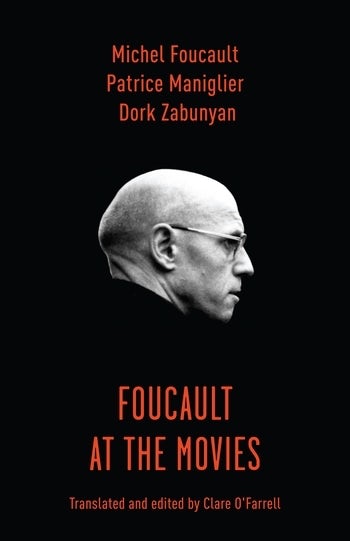
Foucault at the Movies
Michel Foucault, Patrice Maniglier, Dork Zabunyan. Translated and edited by Clare O’Farrell, Columbia University Press, 2018

Michel Foucault’s work on film, although not extensive, compellingly illustrates the power of bringing his unique vision to bear on the subject and offers valuable insights into other aspects of his thought. Foucault at the Movies brings together all of Foucault’s commentary on film, some of it available for the first time in English, along with important contemporary analysis and further extensions of this work.

Patrice Maniglier and Dork Zabunyan situate Foucault’s writings on film in the context of the rest of his work as well as within a broad historical and philosophical framework. They detail how Foucault’s work directly or indirectly inspired both film critics and directors in surprising ways and discuss his ideas in relation to significant movements within film theory and practice. The book includes film reviews and discussions by Foucault as well as his interviews with the prestigious film magazine Cahiers du cinéma and other journals. Also included are his dialogues with the noted French feminist writer Hélène Cixous and film directors Werner Schroeter and René Féret. Throughout, Foucault and those he is in conversation with reflect on the relationship of film to history, the body, power and politics, knowledge, sexuality, aesthetics, and institutions of internment. Foucault at the Movies makes all of Foucault’s writings on film available to an English-speaking audience in one volume and offers detailed, up-to-date commentary, inviting us to go to the movies with Foucault.

Contents

Translator’s Preface, by Clare O’Farrell
Introduction: Michel Foucault’s Cut, by Patrice Maniglier and Dork Zabunyan

Part 1. Foucault and Film: A Historical and Philosophical Encounter

1. What Film Is Able to Do: Foucault and Cinematic Knowledge, by Dork Zabunyan
2. Versions of the Present: Foucault’s Metaphysics of the Event Illuminated by Cinema, by Patrice Maniglier

Part 2. Michel Foucault on Film

3. Film, History, and Popular Memory
4. Marguerite Duras: Memory Without Remembering
5. Paul’s Story: The Story of Jonah
6. The Nondisciplinary Camera Versus Sade
7. The Asylum and the Carnival
8. Crime and Discourse
9. The Return of Pierre Rivière
10. The Dull Regime of Tolerance
11. The Four Horsemen of the Apocalypse
12. Werner Schroeter and Michel Foucault in Conversation

Appendix: Foucault at the Movies—a Program of Films
Notes
Bibliography
Index

ABOUT THE AUTHORS

Michel Foucault, a French historian, philosopher, and social theorist, was one of the most important figures in twentieth-century thought. His work has had enormous influence throughout the humanities and social sciences.

Patrice Maniglier is senior lecturer in the department of philosophy at the University of Paris–Nanterre.

Dork Zabunyan is professor of film studies at the University of Paris–8.

Clare O’Farrell is senior lecturer in the Faculty of Education at the Queensland University of Technology. Her books include Foucault: Historian or Philosopher? (1989) and Michel Foucault (2005).

Reviews

Like all of his great interviews, Foucault at the Movies presents Foucault speaking in his own voice. We find Foucault saying that “the art of living” means that psychology must be killed; that the body must be dismantled; that memory must function without remembering; and that passion is more interesting than love. Foucault at the Moviesis an invaluable addition to our understanding of Foucault’s thought.
Leonard Lawlor, Penn State University

Michel Foucault’s writings have led many of us to think differently. Do his observations on film introduce us to fresh ways of seeing? If philosophers have primarily studied discourses of truth, perhaps they need to give equal consideration to the overpowering fabrication of regimes of fiction, especially those of our cinematic culture. Is Fascism comprehensible apart from the images of Leni Riefenstahl’s Triumph of the Will? Foucault at the Movies is a stimulating engagement with a frequently overlooked contribution from the French thinker.
James Bernauer, Boston College

Casey, A., Larsson, H.
“It’s Groundhog Day”: Foucault’s Governmentality and Crisis Discourses in Physical Education
(2018) Quest, pp. 1-18. Article in Press.

DOI: 10.1080/00336297.2018.1451347

Abstract
Dominant discourses in physical education research center on subject-wide crisis. This is despite repeated calls to address enduring concerns about how physical education is taught. In short, the subject seems caught in Groundhog Day (defined by Oxford Dictionaries (n.d.) as “a situation in which a series of unwelcome or tedious events appear to be recurring in exactly the same way”). This article scrutinizes this position through Foucault’s lens of governmentality, which focuses particularly on power/knowledge relations and their relationship to subjectivity. Through this lens, research functions as a shaper of contemporary understanding and becomes a means for intervention by “experts.” The article is structured as a conversation between authors about dominant discourses in physical education research and issues of governmentality. It argues that research approaches such as action research are framed within other power/knowledge relations and may provide a way to wake up on a new day. © 2018 National Association for Kinesiology in Higher Education (NAKHE)

Author Keywords
action research; crisis discourse; Foucault; governmentality; Physical education research

Angermuller, J.
Accumulating discursive capital, valuating subject positions. From Marx to Foucault
(2018) Critical Discourse Studies, pp. 1-12. Article in Press.

DOI: 10.1080/17405904.2018.1457551

Abstract
Whenever people use language, they participate in valuation practices, i.e. they give value to themselves as well as to others. To account for the construction of social inequality through discursive valuation practices, discourse theorists need Marxist theory and Marxists need discourse theory. By going from the early Marx to the late Foucault, I will revisit Marx’s value theory in light of practice-oriented approaches to social inequality. I will discuss examples from two distinct arenas, the monopolization of attention by populist leaders and the academic star system, both of which are accounted for in terms of the accumulation of discursive capital. This perspective asks how the value of subject positions is constructed and hierarchies between them are established in discursive practices. Investigating the construction of valuable subject positions in discourse communities, this perspective attempts to overcome the traditional division between language, the economic and the social. Discourse not only represents value and the social order but, through representation, it also contributes to constituting the social as a hierarchical world of more or less valued subject positions. © 2018 Informa UK Limited, trading as Taylor & Francis Group

Author Keywords
academic discourse; academic star system; discourse analysis; linguistic pragmatics; Marxist value theory, valuation; Populism; Strong Programme in Discourse Studies; subjectivity; Trump

Peter Triantafillou and Naja Vucina, The politics of health promotion. Case studies from Denmark and England, Manchester University Press, 2018

Description
This book examines the quest to promote the health and vigour of individuals and populations of liberal democracies. It provides a detailed account of the emergence and working of Danish and English health promotion policies and programs in the areas of obesity control and mental recovery. The book shows that these interventions are supported by a form of optimistic vitalism, according to which we should all work indefinitely to improve our health and vigour. In the areas of both obesity control and mental recovery, equally particular individuals, and the social environment in which they live, are the target of political interventions. The book is above all relevant for social and political science researchers and graduate students as well as for policymakers and practitioners in the field of public health.

Contents
Introduction
1 Critical studies of the politics of public health promotion
2 Governing public health in England and Denmark
3 Fighting obesity in England
4 Governing obesity in Denmark
5 Promoting recovery in England
6 Promoting recovery in Denmark
Conclusion

Authors

Peter Triantafillou is a Professor of Public Policy and Performance Management at Roskilde University, Denmark

Naja Vucina is Coordinator of the Research Unit and Competence Centre for Psychotherapy at Stolpegård Psychotherapy Centre, Denmark

Gera Roy, A.
Dream of a World Without Borders: A Century After the Komagata Maru
(2018) Social and Legal Studies, 27 (2), pp. 219-235.

DOI: 10.1177/0964663917746484

Abstract
This essay revisits the ‘Komagata Maru’ incident of 1914 to investigate the legalities that have complicated migration from some parts of the world to others since the era of apparently porous colonial borders to the highly bordered contemporary world that is differentially porous. It shows that the promise of free movement in the global village is undercut by the reality of legislation and juridical issues that continue to regulate the movements of people from one part of the world to the other. It focuses on legal borders that restrict the movement of people in the contemporary world by returning to an earlier moment when several of these issues were foregrounded. The essay draws on Hardt and Negri’s (2000) Empire and Foucault’s notion of governmentality to identify the juridical procedures, tactics, apparatuses of security and machineries of surveillance that the British government employed against imperial subjects during the Komagata Maru episode of 1914. It argues that the national and supranational organisms united under the single logic of the sovereignty of the British Empire, through which state-centric imperialism obstructed the mobility of the passengers on the Komagata Maru, make it resemble the new Empire. © 2017, © The Author(s) 2017.

Author Keywords
Empire; governmentality; juridical procedures; migration; mobility; sovereignty

Angelaki, Journal of the Theoretical Humanities Special Issue: Problems in twentieth-century French philosophy Vol 23, no. 2 2018
Issue editors: Sean Bowden and Mark G.E. Kelly

Introduction
PROBLEMS IN TWENTIETH-CENTURY FRENCH PHILOSOPHY
Sean Bowden & Mark G.E. Kelly
Page: 1

Editorial
PROBLEMATIZING PROBLEMS
Sean Bowden & Mark G.E. Kelly
Pages: 2-7

THE MISADVENTURES OF THE “PROBLEM” IN “PHILOSOPHY”
from kant to deleuze
Giuseppe Bianco
Pages: 8-30

BERGSON’S METHOD OF PROBLEMATISATION AND THE PURSUIT OF METAPHYSICAL PRECISION
Craig Lundy
Pages: 31-44

AN ANTI-POSITIVIST CONCEPTION OF PROBLEMS
deleuze, bergson and the french epistemological tradition
Sean Bowden
Pages: 45-63

CAVAILLÈS, MATHEMATICAL PROBLEMS AND QUESTIONS
Pierre Cassou-Noguès
Pages: 64-78

LAUTMAN ON PROBLEMS AS THE CONDITIONS OF EXISTENCE OF SOLUTIONS
Simon B. Duffy
Pages: 79-93

SIMONDON ON THE NOTION OF THE PROBLEM
a genetic schema of individuation
Daniela Voss
Pages: 94-112

ON THE PROBLEM AND MYSTERY OF EVIL
marcel’s existential dissolution of an antinomy
Jill Hernandez
Pages: 113-124

TOWARDS A PHENOMENOLOGY OF SAGESSE
uncovering the unique philosophical problematic of pierre hadot
Matthew Sharpe
Pages: 125-138
Published online: 10 Apr 2018

THE ERRORS OF HISTORY
knowledge and epistemology in bachelard, canguilhem and foucault
Alison Ross
Pages: 139-154

PROBLEMATIZING THE PROBLEMATIC
foucault and althusser
Mark G.E. Kelly
Pages: 155-169

FOUCAULT, PSYCHOANALYSIS, AND CRITIQUE
two aspects of problematization
Amy Allen
Pages: 170-186

PROBLEMATIZATION IN FOUCAULT’S GENEALOGY AND DELEUZE’S SYMPTOMATOLOGY
or, how to study sexuality without invoking oppositions
Colin Koopman
Pages: 187-204

Judith Fathallah, Fanfiction and the Author – E-book | Amsterdam University Press, 2017

The production, reception and discussion of fanfiction is a major aspect of contemporary global media. Thus far, however, the genre has been subject to relatively little rigorous qualitative or quantitative study-a problem that Judith M. Fathallah remedies here through close analysis of fanfiction related to Sherlock, Supernatural, and Game of Thrones. Her large-scale study of the sites, reception, and fan rejections of fanfic demonstrate how the genre works to legitimate itself through traditional notions of authorship, even as it deconstructs the author figure and contests traditional discourses of authority. Through a process she identifies as the ‘legitimation paradox’, Fathallah demonstrates how fanfic hooks into and modifies the discourse of authority, and so opens new spaces for writing that challenges the authority of media professionals.

See review

Earlier pages suggest this work intends to draw heavily from vanguard postmodernist Michel Foucault. Fortunately, Fathallah steadies a relatable and digestible understanding of Foucault’s contributions to discourse analysis. The researcher combines an assessment of discourse analysis with taut reviews of Internet Studies and Fan Studies. As a trained academic, her work is robust and impressive. Delving through the research references will be a treat to grad students and faculty readers alike. Fathallah remixes old and new sources that showcase a quality of fit between the author and her subject. In effect, she’s practicing meta-genre mixing in textual and mixed methods form.