
Foucault News

News and resources on French thinker Michel Foucault (1926-1984)

Laboratorio “archeologia filosofica” (www.archeologiafilosofica.it) is proud to present the new book series directed by Alessandro Baccarin and Paolo Vernaglione Berardi, for Efesto publisher.

The aim of the series is to follow the foucauldian direction of The Archaeology of Knowledge, with the philosophical problematizations elaborated by Enzo Melandri and Giorgio Agamben, along the genealogical research that  intertwines  knowledge, power and subjectivity.

Scientific Committee: Paolo Godani (Univ. Macerata), Gabriele Guerra (Univ “Sapienza” – Roma), Christian Laval (Univ. Paris-Nanterre), Cristina Marras (CNR – Roma), Clare O’Farrell (Qld Univ of Tech (QUT) – Brisbane), Stefano Velotti (Univ “Sapienza” – Roma).
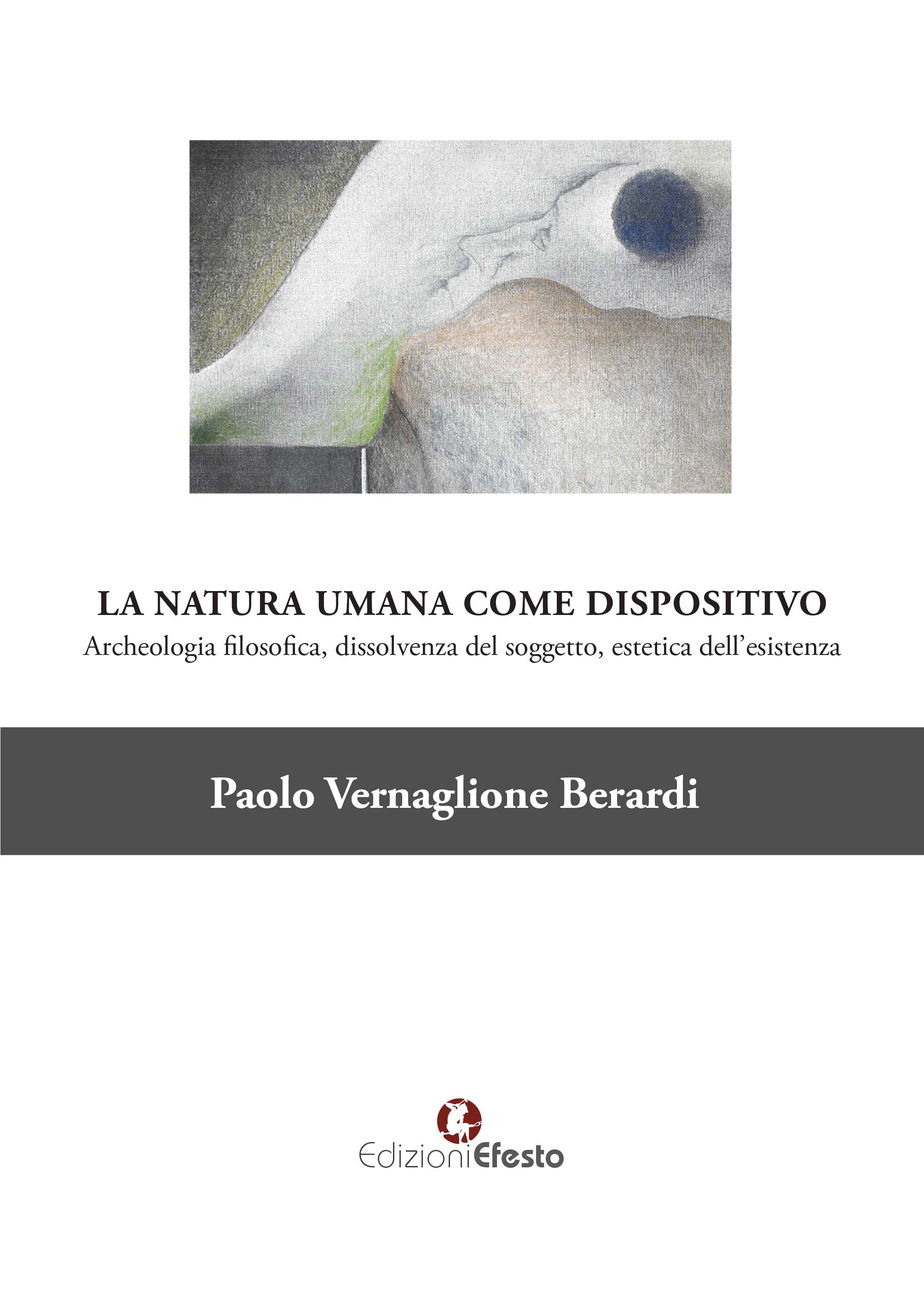
The idea of human nature produces and accompanies different ways of thinking the essence of the human being as a power-knowledge dispositive. Along the ages of the Western civilization, this concept describes the curve of the modern time and generates the permanent ambiguous and concept of “humanity”. Attempting a genealogical search of the typical “will of knowledge”, this book paints a large map of the relationships between philosophical archaeology after Foucault, Melandri and Agamben, and the dissolution of subjectitivy. In this case emerges the perspective of an aesthetic of the existence in which coincides life and form of life.

Paolo Vernaglione Berardi, insegnante di filosofia e storia, è autore di saggi e testi tra cui: Il sovrano l’altro, la storia (Roma, 2008), Dopo l’umanesimo. Sfera pubblica e natura umana (Macerata 2010), Filosofia del comune (Roma, 2014), Michel Foucault: genealogie del presente ( a cura di, Roma 2015), Scritti su Walter Benjamin (a cura di, Roma 2016). Ha fondato il Laboratorio “archeologia filosofica” (www.archeologiafilosofica.it).
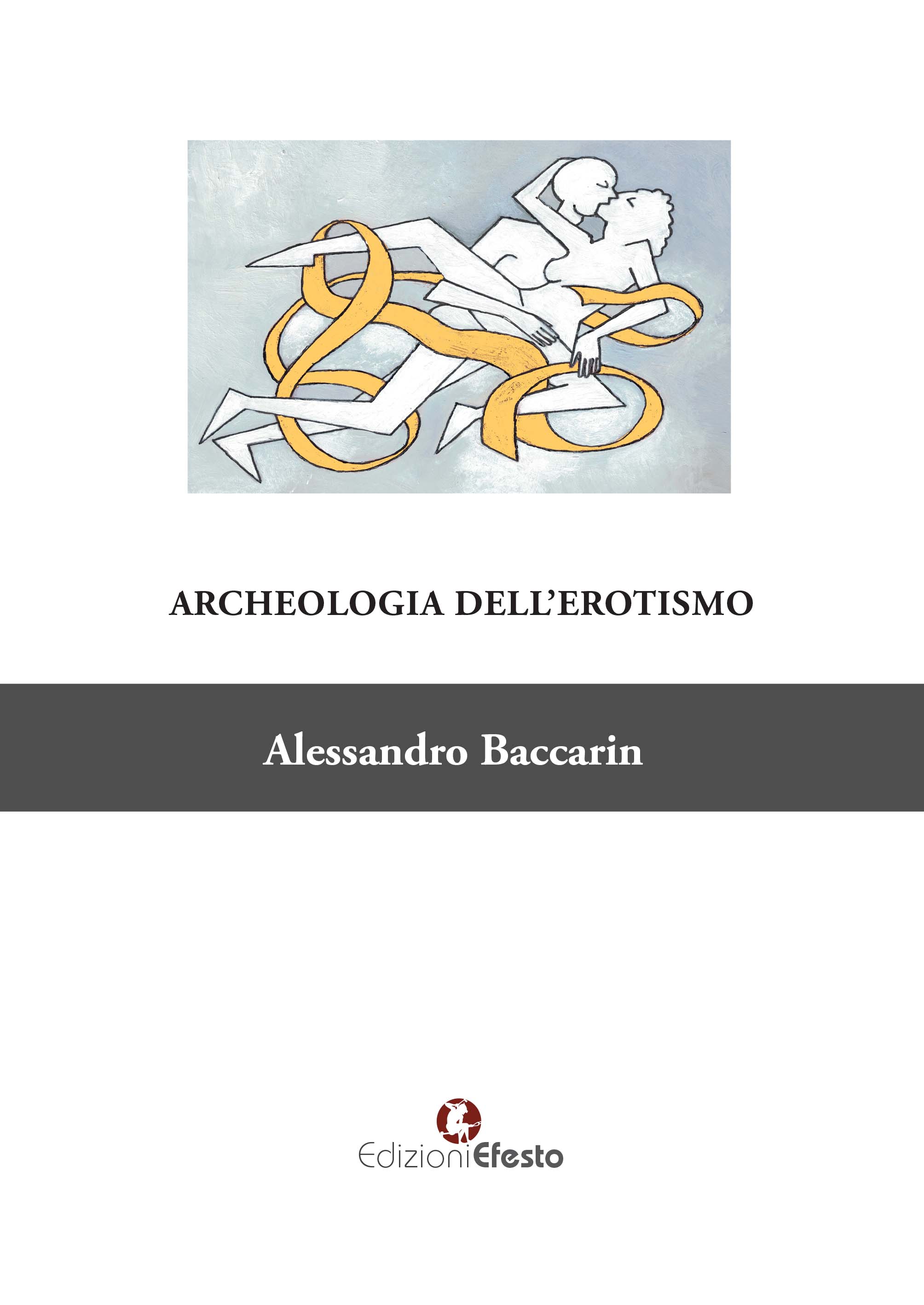
Nel grande naufragio della letteratura greco-romana uno spazio particolare, sebbene del tutto misconosciuto, occupa la manualistica erotica. L’autorialità che rese celebre questo genere era composta per lo più da figure femminili, donne come Filenide di Samo, la più antica autrice di un  manuale erotico greco, o l’egiziana Elefantide, autrice amata dall’imperatore Tiberio. Autrici la cui dimestichezza con la filosofia rendeva possibile scrivere un manuale di “comportamento” sessuale o erotico e ironizzare, proprio attraverso il testo, con le principali correnti filosofiche antiche.

Il recupero della dimensione espositiva dell’erotismo, consente l’individuazione dell’emergenza non solo del soggetto di desiderio, ma anche l’impostazione di un lavoro archeologico-filosofico su quella sfera del desiderio che, a partire dal dispositivo di sessualità, per dirla con Michel Foucault, la modernità ha assegnato d’autorità alla psichiatria e allo psichismo del soggetto.

Alessandro Baccarin vive e lavora a Roma. I suoi campi di studio interessano la storia e la filosofia antica, l’arte erotica e la sessualità nel mondo antico. Si è interessato anche di studi di genere e del pensiero di Michel Foucault (vedi Il sottile discrimine. I corpi tra dominio e tecnica del sé, Verona, OmbreCorte 2014). Si è interessato alla ricezione del pensiero del filosofo francese presso il mondo degli antichisti (vedi L’esploratore e l’intruso. Le scienze dell’antinchità di fronte a Michel Foucault, «Rationes Rerum», 5, 1, 2015, 217-242) e i suoi studi sulla dimensione “pre-sessuale” del mondo antico, con particolare attenzione alla produzione letteraria e artistica di carattere erotico dell’antichità greco-romana, compaiono in numerose riviste scientifiche.

Elliott, B.
Work, culture, and play in the neoliberal condition
(2018) Information Communication and Society, 21 (9), pp. 1279-1292.

DOI: 10.1080/1369118X.2018.1476568

Abstract
Foucault’s [2008. The birth of biopolitics: Lectures at the collège de France 1978–1979. New York, NY: Picador] lectures on neoliberalism present a powerful challenge to the Marxist critique of capitalist work as alienating and dehumanizing. Foucault suggests that neoliberalism allows work to be seen in terms of an individual’s pursuit of personal happiness. Seminal cultural theory in Hoggart [1957/2009. The uses of literary: Aspects of working-class life. London: Penguin] and Williams [1961. The long revolution. London: Chatto & Windus] view working-class culture as a matter of tacit rules and a ‘structure of feeling’ that permeates everyday life. Adorno’s critique of the capitalist ‘culture industry’, by contrast, suggests that a culture of neoliberal capitalism would be an oxymoron. This perspective is self-defeating, I argue, as we then essentially give up the task of understanding how neoliberalism translated into a pervasive social psychology. Following Richard Sennett’s [2008. The craftsman. New Haven, CT: Yale University Press; 2012. Together. New Haven, CT: Yale University Press] work on craft and cooperation, I examine some elements of such neoliberal culture. Across many contemporary cities, there is a clear trend of local small-scale production that stands at odds with the aesthetics if not the underlying reality of the globalized economy. This suggests that utopian counter-currents to neoliberal governance are better drawn from reconfiguration rather than abandonment of work. © 2018, © 2018 Informa UK Limited, trading as Taylor & Francis Group.

Author Keywords
culture; Foucault; Neoliberalism; play; Sennett; work

stuartelden's avatarProgressive Geographies

Canguilhem cover.jpegI’m pleased to share the cover design of my forthcoming book Canguilhem(Polity, 2019).
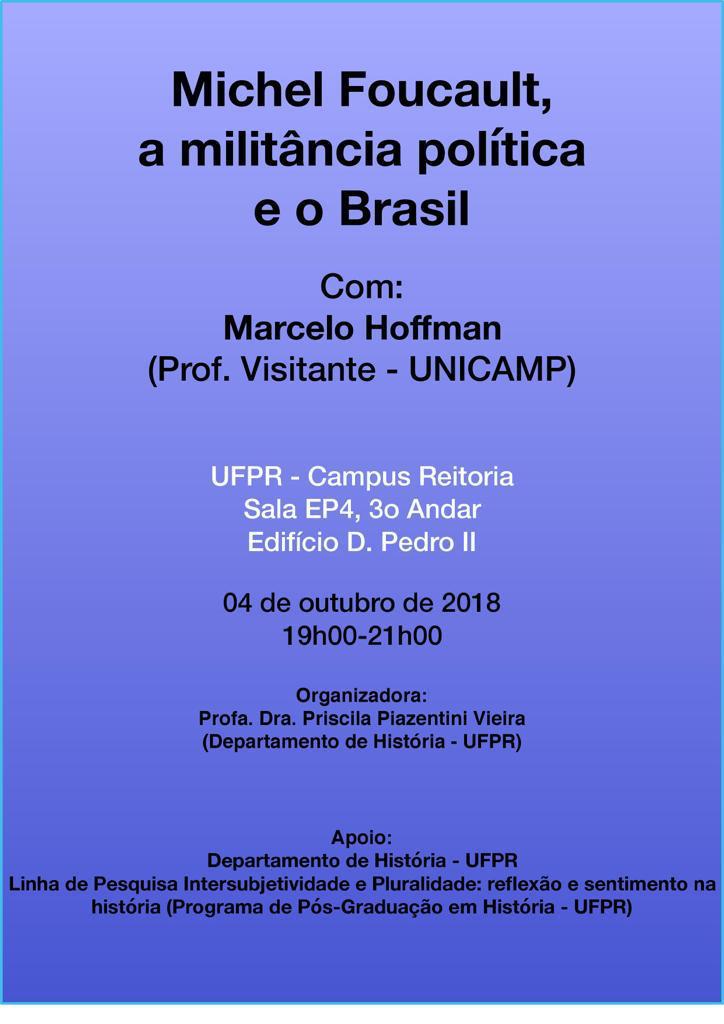
It’s part of the Key Contemporary Thinkers series and is available to preorder from Wiley in ebook, paperback and hardcover. The book is due for publication in February in the UK, and April in the rest of the world. The proofs are on my desk, and this schedule fits with my previous experience with Polity.

Here are the generous endorsements, description and table of contents:

‘The patience, clarity, and erudition we expect of Stuart Elden’s books are on full display in this exceptional work. More than a simple Introduction, Canguilhem enables readers to see the outlines, stakes, and details of the works of an important thinker.’
John Protevi, Louisiana State University

‘This impressive and meticulously researched volume which includes a wealth of references to archival material provides the first comprehensive introduction in English to a figure…

View original post 240 more words

Gandy, O.H., Jr., Nemorin, S.
Toward a political economy of nudge: smart city variations
(2018) Information Communication and Society, pp. 1-15. Article in Press.

DOI: 10.1080/1369118X.2018.1477969

Abstract
Transformations in strategies of governmentality have been implemented around the globe through behavioral interventions characterized as ‘nudges.’ This article will focus on the implementation of these practices within geopolitical areas referred to as ‘smart cities.’ Specifically, the article will examine the impacts of technological developments on neuroeconomics and behavioral economics as foundational contributions to smarty city governance. Given the resonance between several areas of governmentality explored by Foucault in the 1970s, and by an increasing number of theorists of late, this article sets out a program of research and policy analysis organized by a political economy of communications framework. As such, smart city governance will be identified and assessed in terms of the processes of commodification, spatialization, and structuration. Important concerns emerging from our assessment of the nudge as a governmental policy tool are the implications that this and related approaches to management of populations have for direct and indirect surveillance of people, places, and things. Information and communication technology is expected to play a central role here via its extension of surveillance through multidimensional analysis of massive transaction-generated-information, environmental and personal sensing, and what we have come to refer to as the big data that enable management by code from afar. The implications of these processes for groups within society, especially those already disadvantaged by poverty, segregation, and disregard, will be described and illustrated with examples from around the globe. The article will conclude with an articulation of public policy concerns, including those related to privacy and surveillance. © 2018 Informa UK Limited, trading as Taylor & Francis Group

Author Keywords
discrimination; Political economy; privacy; smart city

Valentim, I.V.L.
Between Academic Pimping and Moral Harassment in Higher Education: an Autoethnography in a Brazilian Public University
(2018) Journal of Academic Ethics, 16 (2), pp. 151-171.

DOI: 10.1007/s10805-018-9300-y

Abstract
It is shocking to notice that universities still research few of what daily happens inside their walls. Even though knowledge amount to just a small part of the numerous things that are produced in/between academic relations, it is rare to find investigations in which academic modus operandi is the research focus. The text relies on references like Foucault, Deleuze and Guattari to investigate the subjectivities produced in Academia’s daily routines. With attention to experiences, to what many times is naturalized and said only in the corridors and behind the scenes, this paper uses autoethnography as its method with the aim of analysing academic relations in the context of a Brazilian public university. The narratives constructed here are traversed by songs, lived situations, and affectations. Stories that deal with trajectories of a professor since his arrival at a new workplace. E-mails, threats, exoneration. What is considered to be normal in Academia? What still shocks and affect us? The paper draws on concepts like moral harassment and academic pimping to guide the written narratives and to deepen analyses built throughout the paper. How is it possible to de-naturalize what we daily do in universities? Without predefined or definite answers, the text questions the ways how we relate to each other in Academia and stimulates reflections on the impacts of our academic relations, not only to work itself, but also to the lives of the involved ones. © 2018, Springer Science+Business Media B.V., part of Springer Nature.

Author Keywords
Academia; Autoethnography; Bullying; Higher education; Moral harassment; Teachers’ work

Voase, R.
Holidays under the hegemony of hyper-connectivity: getting away, but unable to escape?
(2018) Leisure Studies, pp. 1-12. Article in Press.

DOI: 10.1080/02614367.2018.1475503

Abstract
Holidays have been imagined as occasions of escape and liminal leisure. This conceptualisation requires re-evaluation as a consequence of the widespread adoption of portable communication devices (smartphones) and the use of Web 2.0 interactive platforms (social media). Studies suggest that the gratifications of contact with the ‘other’, and the enjoyment of the licence associated with the liminal condition, are compromised by endemic contact with the domicile. An analysis draws on the work of Heidegger and Althusser, and is supported by insights from Foucault, Arendt and Lacan. It is argued that users are ‘enframed’ and subjected by their devices. This re-imagining is representative of an evolving change in the human condition, of which the compromising of tourism-as-escape is but one manifestation. © 2018 Informa UK Limited, trading as Taylor & Francis Group

Author Keywords
escape; holiday; liminal; smartphone; social media; Tourism

Guy, S., Muchtar, O., Ronel, N.
How Can Governmental Positive Power Decrease Violence in Crime-Oriented Arenas? The Case of English Football
(2018) International Journal of Offender Therapy and Comparative Criminology, 62 (8), pp. 2488-2504.

DOI: 10.1177/0306624X17694375

Abstract
This article will survey the dramatic change English football had undergone since the end of the last century. The authors will closely explore the implementation of the Taylor Report recommendations, to convince that which power and management techniques were used to decrease violence in public areas that were previously considered dangerous and crime-oriented. It will be argued that disciplinarian techniques were practiced, much like those described in Foucault’s Discipline and Punish, while this very power has proven to be positive and revitalizing. It will be therefore concluded that power is at its most effective when operated via techniques of discipline and social inclusion. These arguments correspond with the positive criminology theory whose popularity within the discipline is gradually increasing. © 2017, © The Author(s) 2017.

Author Keywords
discipline; English football; positive criminology; positive power; social inclusion

Index Keywords
article, criminology, football, human, violence

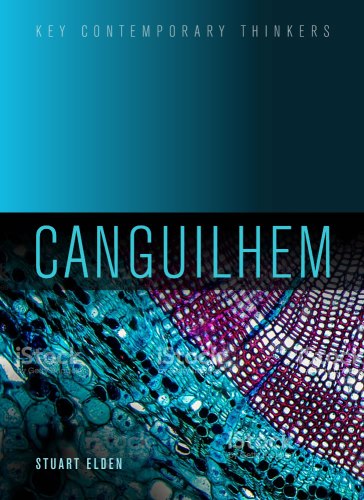
Michel Foucault a militância politíca e o Brasil (2018)

4 October 2018

Kabgani, S., Zargarian, A., Clarke, M.
The morbid dance of ideology on the scaffold: On subjectivity and capital punishment in Iran
(2018) Psychoanalysis, Culture and Society, pp. 1-18. Article in Press.

DOI: 10.1057/s41282-018-0083-2

Abstract
In this paper we examine the discursive structures adopted by the Iranian state in the context of public execution. Specifically, we argue that the state’s insistence upon executing an offender in public is nourished by an intangible yet efficacious violence that has politically and psychically determinative consequences. As such, what is foregrounded in this paper are not the legal aspects of executing the offender and the act itself, but the visibility of this act and its after-effects in terms of the formation of particular subjectivity. The paper’s analysis draws on examinations of the psycho-discursive structure of the punitive state from the points of view of thinkers such as Foucault, Butler and Lacan. © 2018 Macmillan Publishers Ltd., part of Springer Nature

Author Keywords
Iran; Lacan; public execution; subjectivity; violence

Holloway, J., Keddie, A.
‘Make money, get money’: how two autonomous schools have commercialised their services
(2018) Discourse, pp. 1-13. Article in Press.

DOI: 10.1080/01596306.2018.1451305

Abstract
Using the stories of two autonomous public schools in Australia, this paper demonstrates how commercialisation can simultaneously position schools as both consumer and for-profit producer. Drawing on Foucault’s articulation of discourse as that which constitutes and makes available what is possible to be said, done and imagined, the paper illustrates how the current marketised articulation of education is allowing for new possibilities of commercialisation in schools. Together these stories demonstrate that there are creative ways that these schools have embraced their autonomy, while relying on market solutions to acquire the resources they deem necessary for their students and their communities. However, it also shows how these resources and the attainment for them are inextricably constituted by the market orientation of education more broadly and how this presents potential dangers for what schools may be and become as a result. © 2018 Informa UK Limited, trading as Taylor & Francis Group

Author Keywords
autonomous schools; Commercialisation; marketisation; privatisation