Foucault News

News and resources on French thinker Michel Foucault (1926-1984)

Valladares, C., Boelens, R. Mining for Mother Earth. Governmentalities, sacred waters an nature’s rights in Ecuador (2019) Geoforum, 100, pp. 68-79.

DOI: 10.1016/j.geoforum.2019.02.009

Abstract
Getting public opinion to see ‘mining’ and ‘Nature’s Rights’ as non-contradictory and even equivalent and harmonious, calls for far-reaching power strategies. Nature was entitled to rights by Ecuador’s Constitution at about the same time that the Government began promoting mining as central to Ecuador’s future. Building this equivalence to make ‘mining mean nature’, and materialize large-scale mining in the Quimsacocha páramo wetlands, the State and its institutions tested new tactics to manage territory, coined new imaginaries and subjectivities, and limited indigenous/rural political participation. In response, communities started to dispute these governmentality strategies through political practices that framed new meanings of territory and identity. They use formal political and legal arenas but, above all, their day-to-day practices. This article analyzes forms of power and counter-power in the Quimsacocha páramo mining conflict, through the four different, inter-related ‘arts of government’ (Foucault, 2008) and mutual strategies by promoters and detractors of extractive industry who, in apparent paradox, both appeal to Nature’s Rights. We conclude that using Nature’s Rights to promote mega-mining manifests the limitations of social and environmental rights recognition under neoliberal governance, and the tensions inherent in Nature’s Rights themselves. However, anti-extraction struggles like Quimsacocha’s critically make visible as well as challenge the development model and economic system that is implicit in the debate over Nature’s Rights, inviting us to re-think the socio-natural order and foster more just, equitable alternatives. © 2019 Elsevier Ltd

Author Keywords
Cultural politics; Ecuador; Governmentality; Mining; Rights of nature

Index Keywords
environmental legislation, governance approach, mining, political conflict, political participation, public attitude, state role; Ecuador

Round Table: Foucault, neoliberalism and ideology
March 27 2019
New School for Social Research, New York

Thomas Skorucak, Le courage des gouvernés. Michel Foucault et Hannah Arendt, Paris: CNRS Editions, 2019

En ces temps marqués par la grande désillusion des citoyens face au politique, alors même que l’action collective est plus que jamais nécessaire, n’est-il pas urgent de réactualiser la notion de courage ? Mais comment penser ce courage loin de l’image d’une posture héroïque, apanage exclusif des puissants et des natures exceptionnelles, représentation à laquelle nous l’avons trop souvent cantonné ?

Ce courage des citoyens, cette vertu des gouvernés, Thomas Skorucak la met en scène dans des procès emblématiques où s’affrontent l’autorité et la vérité. Procès de Socrate et Galilée où le vrai s’est progressivement imposé comme source unique de l’autorité. Procès des criminels nazis où est patente la difficulté à s’affirmer face au pouvoir de sujétion de la vérité et à la démultiplication des régimes d’obéissance.

Comment dès lors élaborer une forme de courage qui serait une élaboration quotidienne et patiente de soi par soi, résistante à l’emprise du pouvoir sur notre conduite ? La question n’a rien de rhétorique. Michel Foucault et Hannah Arendt ouvrent la voie, revenant tous deux à l’Antiquité et à la figure tutélaire de Socrate. Ils permettent de penser un courage sans référence à aucune transcendance, comme fidélité à soi-même, ou comme stylistique de l’existence.

Une tentative de désassujettissement, dont l’actualité n’est pas à démontrer.

Thomas SKORUCAK
Docteur en philosophie politique, spécialiste de Michel Foucault, Thomas Skorucak exerce aujourd’hui au sein de l’Institut d’Études Occurrence comme directeur d’études

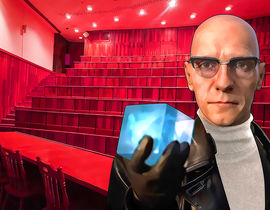
Editor: I just came across this. A competition for a picture of Foucault for a website. There are 35 entries. The competition was run by Kai Erikson who runs the Diiple site

GTA-style cover illustration about Michel Foucault

Contest Brief

We are a new lifestyle brand that designs high-quality and exciting americana-inspired casual wear for socially aware young adults. Initially, the target group consist mainly of university students. In addition to our online store, we are developing interesting infographics for our coming website. The intention is to create a website in which many contemporary figures and concepts from the different fields of theory and culture are given a short surveys in the form of data visualization. Although the information given is fact-based and researched specifically for this purpose, the visual presentation will be rather playful, colorful and fun.

Now, what we would like to get is a cover illustration about the French philosopher Michel Foucault.

VII Coloquio Latinoamericano de Biopolitica
Ontologías del presente

PDF – Full information and details
Facebook page

PRESENTACION´
Con el objeto de potenciar el desarrollo del pensamiento crítico en América Latina, se convoca, con el apoyo y patrocinio de diversas universidades chilenas, a los investigadores e investigadoras interesados a presentar trabajos al VII Coloquio de Biopolítica: Ontologías del Presente, a realizarse entre los días 30 de septiembre y 3 de octubre de 2019 en Santiago de Chile

Social Work and Neoliberalism: The Trondheim Papers, European Journal of Social Work,, vol 22 2019

A number of the papers in this special issue refer to Foucault’s work.

Art and craft: Sinquefield Prize winner combines history with theory and simplicity By Elena K. Cruz, Columbia Daily Tribune
Posted Dec 21, 2018

[…]
Schroeder won for his composition “genealogy I.” Although he has a history with rock ‘n’ roll, the piece’s restraint made it stand out, said Jacob Gotlib, Mizzou New Music managing director and a judge for the first of two rounds of submissions.

“We were very impressed by the level of detail in the music and the way he focused on the quality of the instrumental sounds and the sensitivity that he had toward the individual sounds of each instrument and how they combined with each other,” Gotlib said.

“He had a very detailed and sensitive ear, I thought particularly, and so we thought that was very strong and very sophisticated.”

Schroeder’s piece was written for piano, violin and cello, and took influence from folk music, philosopher Michel Foucault and an observation of colonialism’s impact on history, Schroeder said.

“What he was doing was challenging the norms of the power structures of history, which is something that Foucault loved to do. But he proposed a problem but not a solution because it’s so unviable to do these sorts of things,” Schroeder said. “What the piece aims to do is try to start from these points of little blips of history that come into history, these unconnected events, and merge them into some sort of narrative that’s not linear or directional or all these things that are problematic about archaeology.”
[…]

Rosie Hastie: Pendulous, Art Guide Australia, 16 January 2019

Bett Gallery
18 January—9 February 2019

Tasmanian artist Rosie Hastie exploits the photographic medium like an illusionist. To create her work, Hastie combines skillfully placed lighting with wads of crumpled paper to produce the impression of a fantastical landscape. Conjuring lo-fi special effects made with a mixture of bicarb and dry ice to add atmosphere and depth, Hastie’s landscapes challenge our sense of what is reality and what is imagined.
[…]

Pendulous is loosely based on the ideas behind Michel Foucault’s Heterotopia, a theory investigating parallel spaces and worlds within worlds.

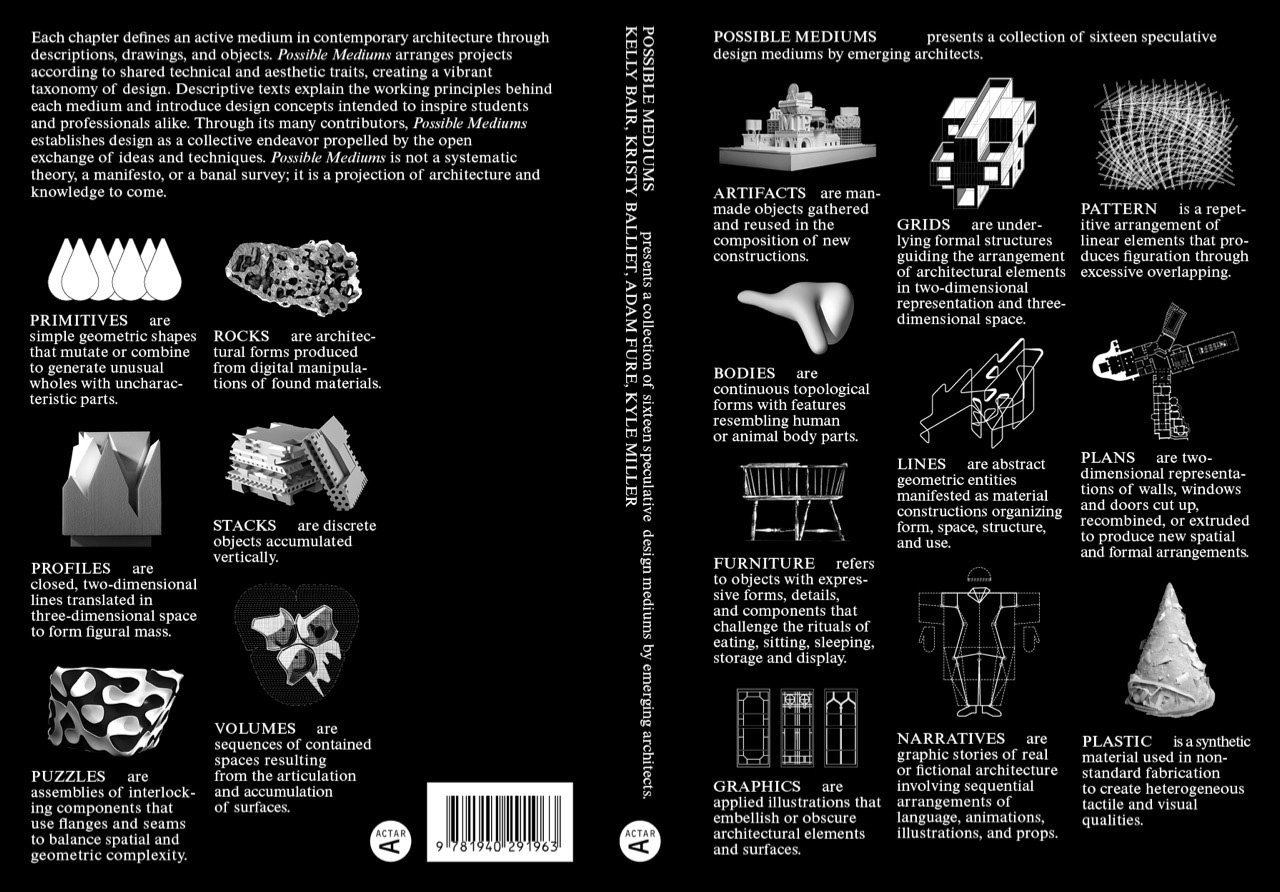
Is the medium the message in post-digital architecture? Archpaper.com, By MAX KUO • February 15, 2019

Possible Mediums
Edited by Kelly Bair, Kristy Balliet, Adam Fure, and Kyle Miller
Actar
$34.95 MSRP

Possible Mediums, a volume edited by four xennial American architecture professors, documents the formal experimentation of the recent post-digital turn in architecture. The book glimpses a generation paradoxically invested in using obscure methods to make charismatic forms. Unlike other postmodern camps (pomo, deconstructivism, parametricism), this generation eschews stylistic cohesion, instead claiming diversity and eclecticism as its hallmark. Inspired by philosopher Michel Foucault’s reading of a fictional Chinese encyclopedia in The Order of Things (the incoherence of which undermines Western epistemology itself), Possible Mediums’ preface essay, “Notes from the Middle,” relishes pluralism and how “the delightfully weird work of…colleagues challenged preconceived notions of order.” However, by deliberately withholding a theoretical framework, the editors leave their uninitiated readers to wonder whether the volume marks a new architectural movement or is simply a yearbook filled with the signatures of well-wishing friends. Whether Possible Mediums is a yearbook or Oriental arcana, the book’s format is infectious and invites casual, nonlinear, and occasional reading. In the same spirit of the volume’s meandering musings, this review will proceed as a loose collection of entries.

[…]

Gary P. Radford, “Torture is Putting it Too Strongly, Boredom is Putting it Too Mildly”: The Courage to Tell the Truth in the Late Lectures of Michel Foucault, Human Studies: A Journal for Philosophy and the Social Sciences, First Online: 18 February 2019

DOI: 10.1007/s10746-019-09494-7

Abstract
The name of Michel Foucault is most commonly associated with words such as power, knowledge, discourse, archaeology, and genealogy. However, in his final public lectures delivered prior to his death in June 1984 at the Collège de France from 1981 to 1984 and at the University of California at Berkeley in 1983, Foucault turned his focus to another word, parrhesia, a Greek term ordinarily translated into English by “candor, frankness; outspokenness or boldness of speech” (“Parrhesia” in Oxford English Dictionary, 2017. http://www.oed.com). The parrhesiastes is the one who uses parrhesia, i.e., the one who speaks the truth. This paper is about Foucault’s choice of parrhesia as the topic of his final lectures and what the articulation of these lectures tells us about truth telling in a specific academic context. It will consider Foucault’s treatment of parrhesia with respect to the specific practice of Foucault’s articulation of this work in the specific formal settings in which it occurred at the Collège de France and the University of California at Berkeley. The objective here is to consider Foucault’s lectures as potential examples of parrhesia and address the question of whether or not is possible to “speak the truth,” in the Greek sense of the term, within the institutional constraints of academic discourse.

Keywords
Michel Foucault Parrhesia Academic discourse