
Foucault News

News and resources on French thinker Michel Foucault (1926-1984)

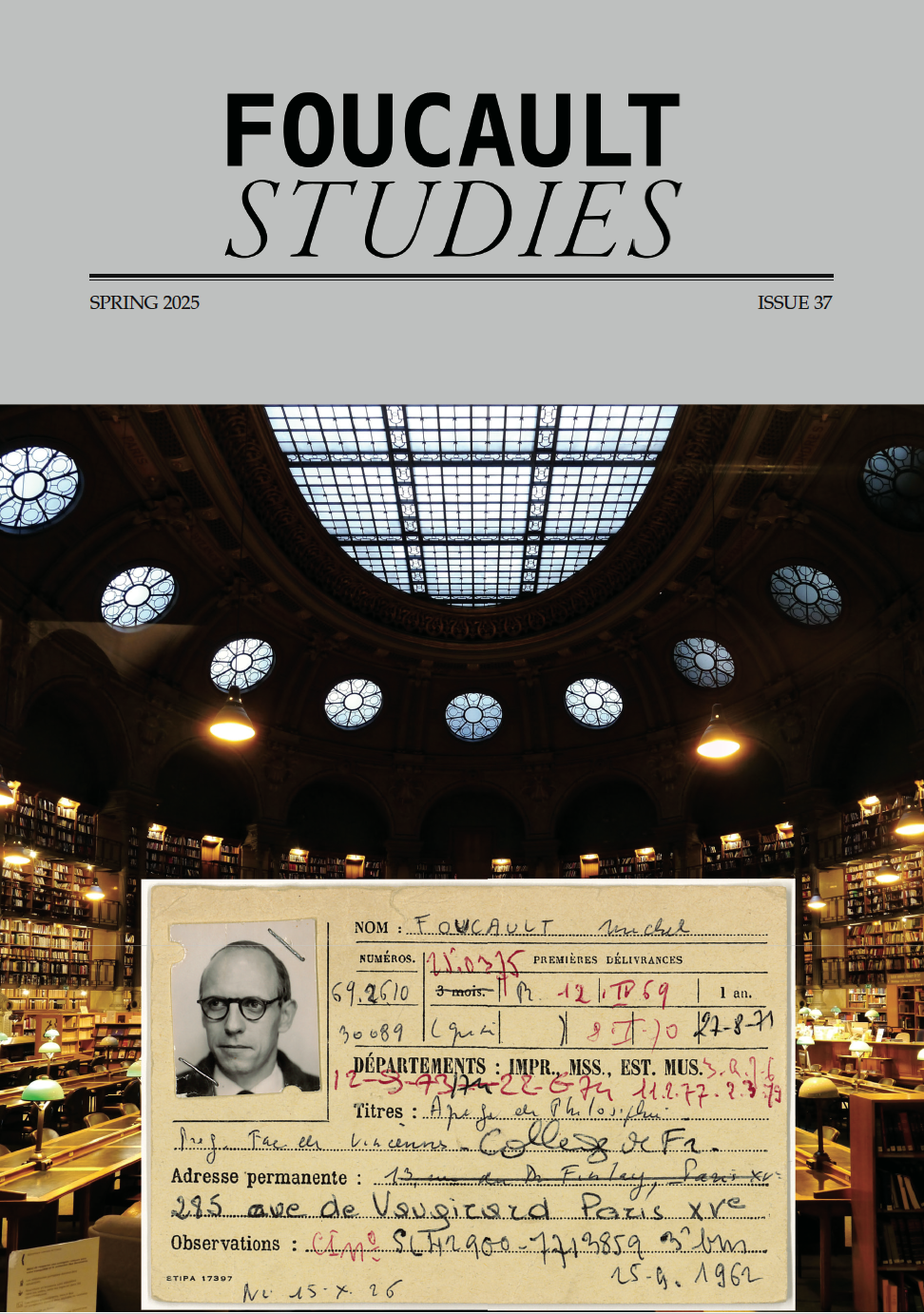
Foucault Studies, Issue 37, Spring 2025

Open access

Table of Contents

Editorial
pp. iii-v
DOI: https://doi.org/10.1353/fou.00001

Special Section: Contributions from the Foucault Circle
Lauren Guilmette, Ege Selin Islekel
pp. 1-4
DOI: https://doi.org/10.1353/fou.00002

black Foucault: An Intellectual Reparations Project
Taryn D. Jordan, Haylee Christine Harrell
pp. 5-34
DOI: https://doi.org/10.1353/fou.00003

On COVID and Racism as “Twin Pandemics”: Foucault, Anti-Racism, and Inoculation
Eyo Ewara
pp. 35-54
DOI: https://doi.org/10.1353/fou.00004

Legopolitics
Robert S. Leib
pp. 55-74
DOI: https://doi.org/10.1353/fou.00005

Strategic Matters: Apparatuses, Sub-Individuals, and Anthropological Slumber
Daniel Perlman
pp. 75-102
DOI: https://doi.org/10.1353/fou.00006

Reviews

Dispositif: A Cartography ed. by Greg Bird and Giovanbattista Tusa (review)
Sebastián Rodríguez Cárdenas
pp. 103-105
DOI: https://doi.org/10.1353/fou.00007

Foucault in Brazil: Dictatorship, Resistance, and Solidarity by Marcelo Hoffman (review)
Stephen Shapiro
pp. 106-108
DOI: https://doi.org/10.1353/fou.00008

The Limits of Scientific Reason: Habermas, Foucault, and Science as a Social Institution by John McIntyre (review)
Evangelia Sembou
pp. 109-113
DOI: https://doi.org/10.1353/fou.00009
I’m pleased to announce that Foucault Studies is now published by Penn Press. Foucault Studies is the only international journal in the English language devoted to the work and influence of Michel Foucault. The journal remains open access. Future issues will be hosted on Project MUSE, while back issues will continue to be available on the journal’s website.

The journal is edited by Knut Ove Eliassen, Robert Harvey, Daniele Lorenzini, Clare O’Farrell, Sverre Raffnsøe, and Dianna Taylor. Led by an international editorial board of renowned Foucault scholars, Foucault Studies provides a platform for interdisciplinary scholarship engaging with Foucault’s thought across the humanities and social sciences. In keeping with Foucault’s wide-ranging theoretical and political commitments, past contributions have spanned philosophy, comparative literature, political theory, art, anthropology, sociology, geography, and law. The journal is committed to preserving and extending Foucault’s legacy by supporting rigorous contemporary engagement with his work.

Foucault Studies is online-only and published biannually. To submit or learn more, visit https://fs.pennpress.org.

Alex Taek-Gwang Lee, Encoding Plasticity: The Rise of Molecular Biopolitics and Human Capital, University of Toronto Quarterly 2025 94:2, 257-275

Abstract
This article explores the fundamental concept of plasticity in living organisms and its complex relationship with capitalism and its datafication of life. Plasticity is presented as a crucial adaptive mechanism allowing organisms to respond to environmental changes. I examine how capitalism has uniquely developed methods to exploit this biological plasticity for economic growth, transforming adaptive processes into commodifiable resources, and the paradoxical nature of this relationship, where capitalist systems simultaneously depend on, and potentially undermine, the adaptive capacities of living systems. My focus is on how this exploitation ranges from genetic modification of crops to the manipulation of consumer behaviour through neuroplasticity-based marketing strategies. Furthermore, my discussion traces the historical roots of this dynamic, referencing Adam Smith’s and Karl Marx’s observations on the mechanization of labour and its connection to the division of tasks. It then expands on this by introducing Michel Foucault’s concept of disciplinary power and its role in shaping and restricting the plasticity of life within industrialized societies. The article details how this form of power operates through surveillance, normalization, and the meticulous control of bodies, as exemplified by Taylorism in factory settings. My argument goes on to explore the transition from disciplinary power to biopower, a more expansive form of control that regulates life processes on a population scale. It also recounts Foucault’s analysis of neoliberalism as a pervasive form of governmentality that shapes human conduct and subjectivity in alignment with market-oriented principles. In conclusion, this work provides an analysis of the connections between biological adaptability, economic systems, and power mechanisms.

Xenia Chiaramonte, Bio-story. Michel Foucault and the history of social medicine. In Eds. Marta-Laura Cenedese, Clio Nicastro, Violence, Care, Cure. Self/perceptions within the Medical Encounter, Routledge, 2025

Abstract
In October 1974, Foucault gave three lectures in Rio de Janeiro on the archaeology of the cure. This piece will comment on the first two, published a few years later in France with the original titles ‘Crise de la médicine ou crise de l’antimédicine?’ and ‘La naissance de la médicine sociale’. Bio-history is the term Michel Foucault initially uses – in the second lecture – to refer to the effect of the strong medical intervention at the biological level, which started in the eighteenth century and has left a trace that is still visible in our society. It is on this occasion that Foucault introduces the concept, or rather the prefix, ‘bio’ in his analysis, and it is here – as my reflections intend to demonstrate – that we may trace the original meaning of a term that today seems rather abused, in order to find a valuable analytical framework for a cogent approach to the relationship between medicine and power dynamics.

Paolo Vernaglione Berardi, Per una storia della verità, Archeologia del presente blog, 2 Aprile 2025

Michel Foucault nella prima lezione dell’ultimo corso al Collège de France, Il coraggio della verità, riprende la nozione di parresia e definisce diversi modi del dir vero. le strutture caratteristiche dei differenti discorsi che vengono accetatati come veri si riferiscono a campi del sapere e a pratiche di verità che costituiscono eventi storico-politici.

Diversi modi di produrre il discorso vero delimitano lo spazio in cui si producono i rapporti tra soggetto e verità e attraverso l’insieme delle relazioni di verità il soggetto riconosce sè stesso ed è riconosciuto come colui che dive la verità. «Il soggetto che dive la verità si manifesta». La circoscrizione di questo insieme di relazioni alla verità si può chiamare aleturgia. Le forme aleturgiche riferiscono i modi in cui un soggetto manifesta a sè e agli altri la verità del proprio discorso e le aleturgie sono anche i modi in cui il soggetto si lega alla verità. Il doppio vincolo alla verità del discorso e del soggetto nel manifestarsi genera il riconoscimento del soggetto come colui che dice il vero.

[…]

Shahidullah, A. K. M., & Mohiuddin, H. (2025). Indoctrinated Developmentalism and Local Sustainability: A Social–Ecological Model for Community-Based Enterprises. Sustainability, 17(9), 4181.

https://doi.org/10.3390/su17094181

Abstract
Developmental approaches over time have been largely economistic and overlooked local sustainability preconditions. They were greatly influenced by a host of doctrines, theories, and strategies argued through macro-level, macro-scale policies. This research retrospectively views these approaches as they have evolved post-WWII and their effect on sustainability at a community level. It eventually focuses on a specific community-level developmental strategy, i.e., “microfinance”, which has led to the establishment of millions of microenterprises. In recent decades, community-based enterprise (CBE) development has been a widely practiced mode of developmental intervention to develop underdeveloped communities in developing countries. The primary goal of CBEs is to generate profit for people’s livelihood. This research indicates that CBEs offer potential. They can be ecologically sustainable and socially responsible too. A shift in the present model to encourage CBEs’ pursuit of ecological principles is tenable. Foucault’s notion of “dispositif” allows such a shift with incorporation of environmental alongside economic and social goals as a new strategic disposition (model). Therefore, this study presents a social–ecological model of CBE and asserts that it embeds the necessary components to bring about sustainability at a community level.

Keywords:
developmentalism; community-based enterprise; sustainability; dispositif; microfinance

Michel Senellart, Oikonomia et regimen. À propos d’une critique de M. Foucault par G. Agamben, Laval théologique et philosophique, Volume 79, Number 3, 2023, p. 355–368

https://id.erudit.org/iderudit/1107500ar
https://doi.org/10.7202/1107500ar

Résumé
Cet article propose une réponse à la critique adressée par G. Agamben, dans Le Règne et la Gloire (2008), à la généalogie foucaldienne de la gouvernementalité. En cherchant dans la pensée chrétienne des premiers siècles la matrice d’une conception nouvelle du pouvoir comme gouvernement des hommes — « économie » ou conduite des âmes —, Foucault aurait méconnu la signification proprement théologique, au sein du dispositif trinitaire, du mot oikonomia. Nous voudrions montrer, à partir d’une relecture du 2e Discours (362) de Grégoire de Nazianze (329-390), dont Foucault tire le concept d’une « économie des âmes », que cette idée ne présuppose nullement la référence au schéma trinitaire et renvoie bien davantage au modèle du « patronage » romain, couplé à la figure sacerdotale du bon berger. Cette analyse conduira, en outre, à rappeler le lien de la « direction des âmes » avec le paradigme médical.

Abstract
This article proposes a response to the criticism addressed by G. Agamben, in Le Règne et la Gloire (2008), to the Foucaldian genealogy of governmentality. In seeking in the Christian thought of the first centuries the matrix of a new conception of power as the government of men — “economy” or the guidance of souls —, Foucault would have ignored the properly theological meaning, within the Trinitarian system, of the word oikonomia. We would like to show, from a re-reading of the 2nd Discourse (362) of Gregory of Nazianzus (329-390), from which Foucault derives the concept of an “economy of souls”, that this idea does not presuppose any reference to the Trinitarian scheme and refers much more to the model of Roman “patronage”, coupled with the priestly figure of the good shepherd. This analysis will lead, moreover, to recall the link of the “direction of souls” with the medical paradigm.

With thanks to Colin Gordon for this reference

Tom Nicholas, Postmodernism is dead. This is Who Killed It. Apr 25, 2025

Written, directed, and presented by Tom Nicholas.
Filmed and edited by Georgia Burrows.

Remember postmodernism? Just under a decade ago, the term “postmodernism” seemed to be everywhere.

To slightly nerdier commentators on the political right (including Jordan Peterson, James Lindsay, Gad Saad, Dave Rubin, Ben Shapiro, and others), it was a way of warning of the dangers of the so-called “identity politics”: feminism, anti-racism, disability activism. To just-as-nerdy folks on the political left, it was a way if describing the sheer bizarreness of the first Trump presidency: a new world of “fake news” and “alternative facts”.

But, at some point in the intervening period, postmodernism kind of just vanished from the political conversation. So… is postmodernism dead? And, if so, who killed it?

[Editor: Includes discussion of the straw man attacks on Foucault, amongst others, in the “Culture wars”]

Andreas Elpidorou, Josefa Ros Velasco, Eds. The History and Philosophy of Boredom, Routledge, 2025

Description
From Lucretius’s horror loci and Buddhist drowsiness to the religious boredom of acedia and the philosophical explorations of Kant, Schopenhauer, Kierkegaard, and Heidegger, boredom has long been a subject of philosophical fascination. Its story, unfolding through millennia, encompasses apathy, weariness, disaffection, melancholy, ennui, tedium, and monotony. Today, boredom assumes new forms: the drudgery of precarious work, the alienation of neoliberalism, the emptiness of leisure, and the overstimulation of our hyperconnected, technologically saturated lives.

The History and Philosophy of Boredom is an outstanding collection, exploring boredom’s intellectual history from its early origins in classical thought to its contemporary manifestations. Containing eighteen specially commissioned chapters by an international team of contributors, the volume is organized into four thematic parts:

-Ancient Philosophical Perspectives
-Religious and Medieval Explorations
-Modern Philosophical Investigations
-Critical and Interdisciplinary Approaches

Topics include boredom in Socratic dialogue, Daoist and Buddhist traditions, Stoicism, and Cynicism; the religious significance of boredom in Judaism and early Christianity; boredom’s role in the works of Kant, Kierkegaard, Schopenhauer, Mill, and Nietzsche; philosophical pessimism; phenomenological approaches; boredom as a political phenomenon; and boredom’s intersections with capitalism, socialism, racial identity, and transhumanism.

The History and Philosophy of Boredom is indispensable for students and researchers in the history of philosophy, emotion studies, phenomenology, and moral psychology. It will also interest scholars in religion, classics, sociology, and the history of psychology.

Prozorov, S. (2023). Foucault and Agamben on Augustine, Paradise and the Politics of Human Nature. Theory, Culture & Society, 41(1), 23-37.

https://doi.org/10.1177/02632764221140811 (Original work published 2024)

Abstract
This article focuses on Foucault’s and Agamben’s readings of Augustine’s account of human nature and original sin. Foucault’s analysis of Augustine’s account of sexual acts in paradise, subordinated to will and devoid of lust, highlights the way it constitutes the model for the married couple, whose sexual acts are only acceptable if diverted by the will away from desire and towards the tasks of procreation. While Agamben rejects Augustine’s doctrine of original sin and reclaims paradise as the original homeland of humanity, his reappropriation of paradise remains conditioned by our turn towards our true nature, from which we have been estranged by sin. Agamben’s politics of reclaiming paradise necessarily involves the demand for obedience to this originary model of human nature. It therefore follows to the letter Augustine’s description of paradisiacal sex, in which the will prevails over desire by applying itself to and curtailing itself.