Foucault News

News and resources on French thinker Michel Foucault (1926-1984)

M G Hamner, The Order of Things: The difference of the Analysis of Wealth, affecognitive ~ religion, film, affect, academia blog, 10 July 2025

In chapter six of The Order of Things/Les mots et les choses, Michel Foucault marks, twice, a difference between the analysis of wealth and both general grammar and natural history (the three intellectual pursuits that shift in the 19th century, with the rise of the human sciences, to political economy, linguistics, and biology). The first marking of difference notes that the analysis of wealth is attached to “a practice and to institutions” (English text 168). The second differentiation seems rather to emphasize the different–that is, slower–temporality involved in the “emergence of a domain of ‘wealth’ than that involved in the emergence of natural history and general grammar, a slowness that yields “a much higher degree of historic viscosity” (English text 180).

Read more

Call for Papers
Discipline Filosofiche, XXXVI, 2, 2026: Foucault’s Archaeology: Sources, Questions and Legacy, ed. by Elisabetta Basso and Andrea Cavazzini

In Michel Foucault’s published and unpublished writings, between Naissance de la Clinique (1963) and L’archeologie du savoir (1969), the recurrence of the term “archaeology” marks the centrality of this notion in the period when the philosopher’s research stood out in the “structuralist” intellectual landscape for its binding together of philosophical reflection and historical research.

Following an analogy that Freud applies to psychoanalysis, archaeology emerges as a historiography of the unthought: that is, as an attempt to reconstruct how what from the past arrives to constitute the present in which we live, without ever having been present in the explicit consciousness of historical agents. Archaeology therefore starts from what is given in the present – in Foucault’s work, the objects or practices of knowledge – and traces back the layers of historicity that remain imperceptible to the immediate gaze of those whose actions are shaped through these objects and practices of knowledge.

However, the title of the chair at the Collège de France that Foucault came to hold in 1970 – Histoire des systèmes de pensée – suggests a more traditional history of philosophy or ideas. And from 1970 onwards, Foucault largely abandons “archaeology”, rendering the term somewhat enigmatic and, in any case, not fully explored in its implications.

The hypothesis animating this special issue is that archaeology, far from being reduced to a stylistic device, constitutes a philosophical concept in its own right, whose meanings and possible developments are not limited to Foucault’s direct reference to it in his works. A decisive factor in the reconfiguration of the relationship between philosophy and historiography (which is far from any philosophy of history in which becoming is crushed under the weight of retrospective awareness), archaeology also implies – as Enzo Melandri suggested as early as 1968 (La linea e il circolo) – an intention to recover what remains unexpressed or repressed from the past. While in the historical field, this entails the distinction in principle between res gestae and historia rerum gestarum (between actual events and their appearance in explicit awareness), in the philosophical field the effect of archaeology seems to consist in a therapeutic posture aimed at dissolving the painful “cramps” in the self-consciousness of an epoch or a society.

On the occasion of the centenary of Michel Foucault’s birth and in light of the posthumous publication of numerous unpublished works by the philosopher, this special issue of Discipline Filosofiche aims to offer a reflection on the “archaeological” method in philosophy and the history of thought. With this in mind, contributions addressing the following topics are encouraged:

1) the relationship between archaeology and historiography;
2) Foucauldian archaeology and its sources;
3) the archaeological method and phenomenology;
4) archaeology and psychoanalysis;
5) archaeology and structuralism;
6) archaeology and language analysis;
7) archaeology and archives;
8) archaeology and genealogy;
9) the philosophical legacy of Foucault’s concept of archaeology.

Guidelines for the authors:
Submissions should not exceed 9,000 words including abstract, refer-ences and footnotes. Manuscripts may be submitted in Italian, English, French, German, or Spanish. They must be sent as an email attachment in .doc or .docx format, along with a .pdf version, to Elisabetta Basso (elisabetta.basso@unipv.it) and to Andrea Cavazzini (andreacavazzini78@gmail.com).

Submitted manuscripts will be sent to two independent reviewers, following a double-blind peer review process. The reviewers may ask authors to make changes or improvements to their contributions in view of publication. Authors are kindly requested to attach both an anonymous version of their contribution entitled “Manuscript” and a separate “Cover Page” stating their name, academic affiliation and contact details. Manuscripts must include an English abstract of less than 150 words and 5 keywords. Any property of the file that might identify the author must be removed to ensure anonymity during the review process. A notification of receipt will be issued for each submission. In drafting their text, authors can adopt any clear and coherent style, but should the text be accepted for publication, they will be required to send a final version in keeping with the style guidelines of the journal (please refer to the style guidelines at https://www.disciplinefilosofiche.it/en/norme-redazionali/).

Submission of a manuscript is understood to imply that the paper has not been published before and that it is not being considered for publication by any other journal. Should the manuscript be accepted for publication, the author will be required to transfer copyrights to the University of Bologna. Requests to republish the article may be made to the Editorial Board of the Journal.

Deadline for the submission of manuscripts: June 15, 2026
Notification of acceptance, conditional acceptance, or rejection: August 31, 2026
Deadline for the submission of the final draft: October 15, 2026

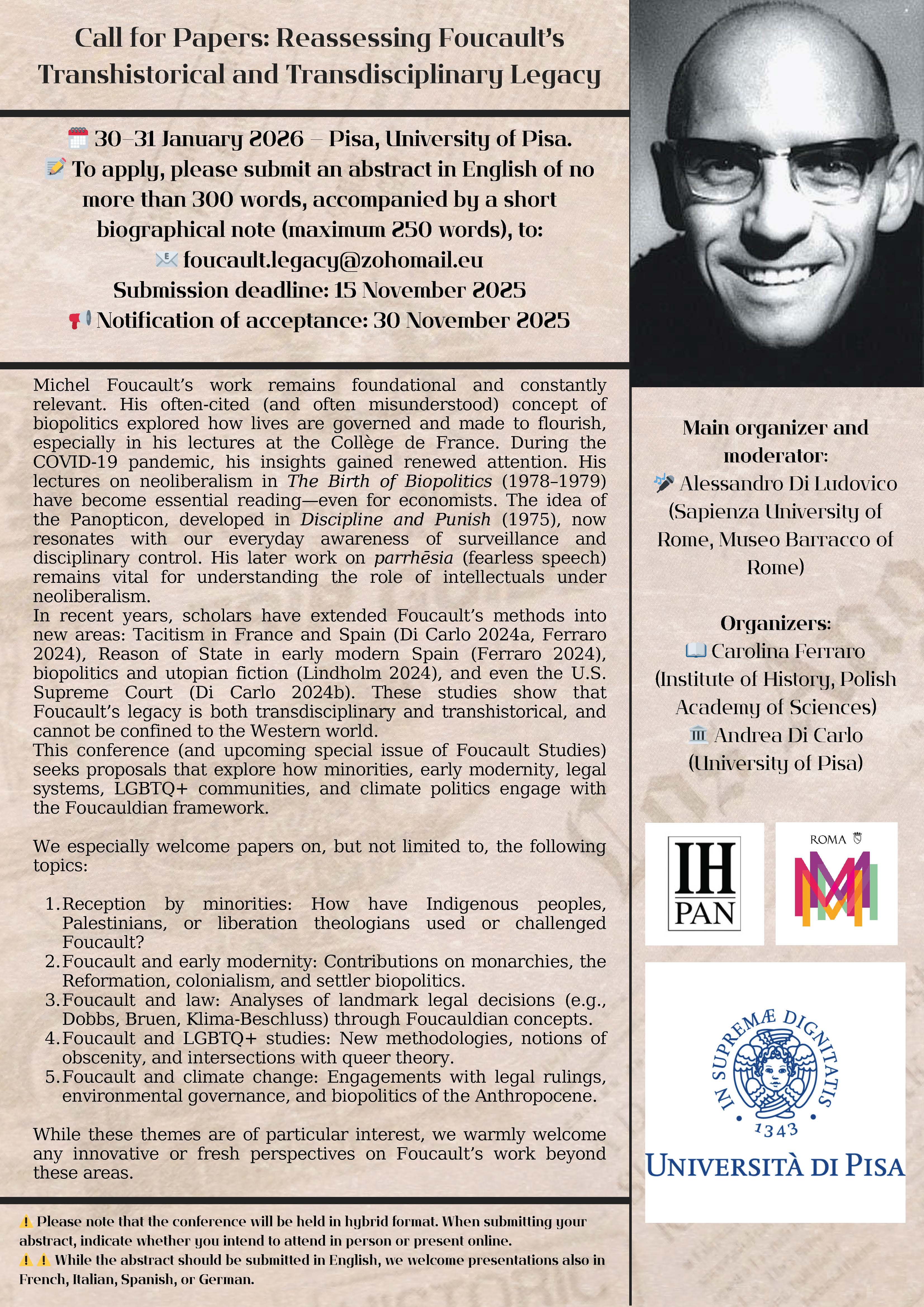
CFP-Pisa 2026

Atkinson-Ross, C., & Wu, W. (2025). Inside the Chinese heterosexual matrix: lesbian and gay middle leaders’ experiences in Chinese schools. Gender and Education, 1–18.
https://doi.org/10.1080/09540253.2025.2506356

ABSTRACT
This paper employs feminist poststructuralist and queer theory to analyze the experiences of three gay and lesbian middle leaders in Chinese schools. Drawing on Butler’s heterosexual matrix, and Foucault’s concepts of governmentality and disciplinary power, we propose the concept of a distinctly Chinese heterosexual matrix to theorize the particular ways in which the gender-sexuality order is policed in Chinese schools, wherein Confucianist and Party-state ideologies combine to form a distinctive system of (hetero)normative surveillance and control. We argue that this matrix is defined and upheld through the overlapping mechanisms of silence and surveillance, and that the close relation between Party-state and school leadership makes it so that adherence to the matrix is uniquely institutionalized. In so doing, this paper both addresses the gap in existing research regarding the experiences of LGBT teachers and leaders in China and extends queer and poststructuralist thinking to explore its particularities in the Chinese context.

KEYWORDS:
Heteronormativity, queer theory, middle leaders, teachers, China

Xenofontos, C. (2025). Mathematical heterotopias: lessons from other-ed spaces for the mainstream classroom. Pedagogy, Culture & Society, 1–20.
https://doi.org/10.1080/14681366.2025.2508715

ABSTRACT
Many mathematics classrooms worldwide often adhere to rigid, traditional practices that may serve some students effectively but risk disengaging others. In this paper, I draw on Michel Foucault’s concept of heterotopia to introduce the notion of mathematical heterotopias, encompassing alternative educational spaces such as special needs classrooms, gifted programmes, homeschooling, and prison education. While recognising the various limitations of these heterotopic spaces, I focus on the valuable lessons they offer for mainstream mathematics classrooms. These environments can challenge conventional teaching methods, providing significant insights into flexibility, personalised support, emotional care, and practical learning, all of which can enhance student autonomy and engagement. Such methods are not confined to mathematical heterotopias; they are frequently highlighted as effective practices in research concerning the mainstream mathematics classroom. Rather than advocating for radical changes, this article endorses these practices found in both mathematical heterotopias and mainstream classrooms, concluding with a call for the systematic promotion of these practices.

KEYWORDS:

Mathematical heterotopias, other-ed learning environments, mainstream mathematics, classroom, Michel Foucault; conceptual analysis

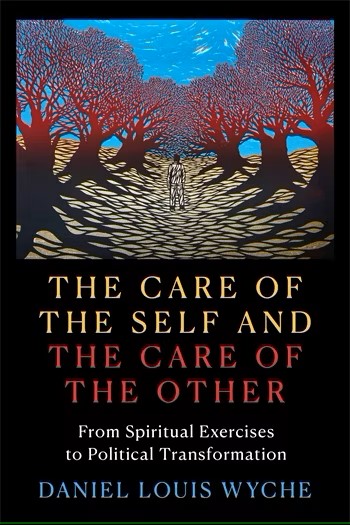
Daniel Louis Wyche, The Care of the Self and the Care of the Other. From Spiritual Exercises to Political Transformation, Columbia University Press, 2025

Interview with the author in Columbia News, June 25, 2025
Interview with the author on the New Books Network, Jan 17, 2026

What is the relationship between the ethical transformation of the self and the political transformation of the world? This book explores the ways several twentieth-century thinkers can help us relate the “care of the self” to the “care of the other,” tracing their accounts of how and why practices intended to change an individual can help spur social and political change, just as collective political action can produce a transformation of the self.

Daniel Louis Wyche examines the political implications of what he calls practices of ethical self-change. These include Pierre Hadot’s notion of “spiritual exercises”; what the French sociologist of labor Georges Friedmann calls the “interior effort”; Michel Foucault’s ethics of the “care of the self”; what Martin Luther King Jr. refers to as the work of “self-purification” integral to direct action; and Audre Lorde’s claim that caring for herself constitutes a form of “political warfare.” Wyche argues that these concepts can collectively provide an understanding that effaces distinctions between the care of the self, the other, and the community in a way that avoids reducing the political to the ethical. Ambitious and nuanced, The Care of the Self and the Care of the Other offers a framework for unifying individual moral action and collective political life.

About the Author
Daniel Louis Wyche is a senior fellow at the Columbia Center for Contemporary Critical Thought.

Essien, Essien Oku. 2025. “Climate Change Disinformation on Social Media: A Meta-Synthesis on Epistemic Welfare in the Post-Truth Era” Social Sciences 14, no. 5: 304.

https://doi.org/10.3390/socsci14050304

Abstract
Climate change disinformation has emerged as a substantial issue in the internet age, affecting public perceptions, policy response, and climate actions. This study, grounded on the theoretical frameworks of social epistemology, Habermas’s theory of communicative action, post-truth, and Foucault’s theory of power-knowledge, examines the effect of digital infrastructures, ideological forces, and epistemic power dynamics on climate change disinformation. The meta-synthesis approach in the study reveals the mechanics of climate change disinformation on social media, the erosion of epistemic welfare influenced by post-truth dynamics, and the ideological and algorithmic amplification of disinformation, shedding light on climate change misinformation as well. The findings show that climate change disinformation represents not only a collection of false claims but also a broader epistemic issue sustained by digital environments, power structures, and fossil corporations. Right-wing populist movements, corporate interests, and algorithmic recommendation systems substantially enhance climate skepticism, intensifying political differences and public distrust in scientific authority. The study highlights the necessity of addressing climate change disinformation through improved scientific communication, algorithmic openness, and digital literacy initiatives. Resolving this conundrum requires systemic activities that go beyond fact-checking, emphasizing epistemic justice and legal reforms.

Keywords:
climate change; disinformation and misinformation; epistemic harm; ideological polarization; post-truth; algorithmic amplification; social media

Joakim Slinning Lange, “Stemmen som fortsetter etter døden (om Henri-Paul Fruchaud (red.), Michel Foucault, Entretiens radiophoniques 1961-1983). In Agora. Journal for metafysisk spekulasjon, nr. 1-2, 2025 “Judith Butler”, 265-89

DOI: https://doi.org/10.18261/agora.43.1-2.12

40 år etter forfatterens død fortsetter det han sa og skrev, å snakke til oss. På tampen av en lang rekke posthume utgivelser fra Centre Michel Foucault, som har hatt som effekt både å tilgjengeliggjøre og transformere Michel Foucaults «œuvre», utkom høsten 2024 en samling som lenge har glimret med sitt fravær: Forlagene Flammarion og J. Vrin utga i samarbeid med Institut National de l’Audiovisuel (INA) boka Michel Foucault, Entretiens radiophoniques. Utgivelsen er redigert av Henri-Paul Fruchaud, Foucaults nevø og redaktør av flere posthume utgivelser, som sammen med Frédéric Gros, tidligere leder for Centre Michel Foucault, også har skrevet en innledning. Boka for øvrig består av 900 sider med transkripsjoner av i alt 63 radioprogrammer som Foucault deltok i fra 1961 til 1983. I likhet med tekstene samlet i Dits et écrits, dukker Foucault opp i intervjuer om bøkene sine, han holder forelesninger og deltar i debatter. Kanskje mer overraskende er involveringen i radiodokumentarer som Recherche de notre temps (april 1963), hvor Foucault presenterer sju sosiologiske programmer om rollen til «smerte og lidelse» i samtiden, og hvor han blant annet intervjuer filosofen Gilles Deleuze og historikeren Jacques Le Goff.

Utgivelsen av Entretiens radiophoniques (heretter forkortet ER) gir anledning til å reflektere over hvordan Foucaults posthume forfatterskap er konstruert, nærmere bestemt over den spesifikke rollen den audiovisuelle delen av verket har fått. Samlingen representerer nemlig et klart brudd med den implisitte redaksjonelle linjen som har fulgt i utgivelsen av Foucaults verker, der man har skilt mellom de audiovisuelle og de tekstlige arbeider. ER gir derfor et viktig tillegg til de posthume bokutgivelsene som til nå har utkommet. Samlingen involverer også, i likhet med Senterets tidligere utgivelser, et redaksjonelt arbeid som, gjennom utvalg, utelatelse, presentasjon og kontekstualisering av kilder, fungerer som en viktig minnehandling, som bidrar til å skape en bestemt forestilling, ikke bare om Foucault, men også om hans samtid og samtidige.

English
The article contains a list of 5 pages of additional audiovisual material that was not included in Entretiens radiophoniques

Speech that continues after death
40 years after the death of the author, what he said and wrote continues to speak to us. On the eve of a long series of posthumous publications from the Centre Michel Foucault, which have had the effect of both making Michel Foucault’s “œuvre” accessible and transforming it, a collection was published in the Autumn of 2024 that has long been conspicuous by its absence: the publishers Flammarion and J. Vrin, in collaboration with the Institut National de l’Audiovisuel (INA), published the book Michel Foucault, Entretiens radiophoniques. The publication is edited by Henri-Paul Fruchaud, Foucault’s nephew and editor of several posthumous publications, who, together with Frédéric Gros, former director of the Centre Michel Foucault, has also written an introduction. The book consists of 900 pages of transcriptions of a total of 63 radio programs that Foucault participated in from 1961 to 1983. Like the texts collected in Dits et écrits, Foucault appears in interviews about his books, gives lectures and participates in debates. Perhaps more surprising is his involvement in radio documentaries such as Recherche de notre temps (April 1963), in which Foucault presents seven sociological programs on the role of “pain and suffering” in the present, and in which he interviews, among others, the philosopher Gilles Deleuze and the historian Jacques Le Goff.

The publication of Entretiens radiophoniques (hereinafter abbreviated ER) provides an opportunity to reflect on how Foucault’s posthumous writings are constructed, more specifically on the specific role that the audiovisual part of the work has been given. The collection represents a clear break with the implicit editorial line that has been followed in the publication of Foucault’s works, where a distinction has been made between the audiovisual and the textual works. ER therefore provides an important addition to the posthumous book publications that have been published to date. The collection also involves, like the Centre’s previous publications, an editorial work that, through selection, omission, presentation and contextualisation of sources, functions as an important act of memory construction, which contributes to the creation of a specific idea, not only of Foucault, but also of his time and contemporaries.

Summary
In brief, the text provides a critical perspective/introduction to the collection, which highlights some of its shortcomings (in terms of the promise of presenting “Foucault on the radio” implied by the collection): situating it in relation to the relative absence of radio and TV material among previous posthumous (print) publications; showing some of the material that has been left out (knowingly or unknowingly) by ER; as well as discussing some of the contexts that have been omitted, and which could be explored further. Without wanting to take away from the importance of the text, the article points towards some important contexts, as well as highlighting the need and the opportunities for further exploring the audiovisual aspects of Michel Foucault’s multifaceted work.