Foucault News

News and resources on French thinker Michel Foucault (1926-1984)

Art and craft: Sinquefield Prize winner combines history with theory and simplicity By Elena K. Cruz, Columbia Daily Tribune
Posted Dec 21, 2018

[…]
Schroeder won for his composition “genealogy I.” Although he has a history with rock ‘n’ roll, the piece’s restraint made it stand out, said Jacob Gotlib, Mizzou New Music managing director and a judge for the first of two rounds of submissions.

“We were very impressed by the level of detail in the music and the way he focused on the quality of the instrumental sounds and the sensitivity that he had toward the individual sounds of each instrument and how they combined with each other,” Gotlib said.

“He had a very detailed and sensitive ear, I thought particularly, and so we thought that was very strong and very sophisticated.”

Schroeder’s piece was written for piano, violin and cello, and took influence from folk music, philosopher Michel Foucault and an observation of colonialism’s impact on history, Schroeder said.

“What he was doing was challenging the norms of the power structures of history, which is something that Foucault loved to do. But he proposed a problem but not a solution because it’s so unviable to do these sorts of things,” Schroeder said. “What the piece aims to do is try to start from these points of little blips of history that come into history, these unconnected events, and merge them into some sort of narrative that’s not linear or directional or all these things that are problematic about archaeology.”
[…]

Rosie Hastie: Pendulous, Art Guide Australia, 16 January 2019

Bett Gallery
18 January—9 February 2019

Tasmanian artist Rosie Hastie exploits the photographic medium like an illusionist. To create her work, Hastie combines skillfully placed lighting with wads of crumpled paper to produce the impression of a fantastical landscape. Conjuring lo-fi special effects made with a mixture of bicarb and dry ice to add atmosphere and depth, Hastie’s landscapes challenge our sense of what is reality and what is imagined.
[…]

Pendulous is loosely based on the ideas behind Michel Foucault’s Heterotopia, a theory investigating parallel spaces and worlds within worlds.

Is the medium the message in post-digital architecture? Archpaper.com, By MAX KUO • February 15, 2019

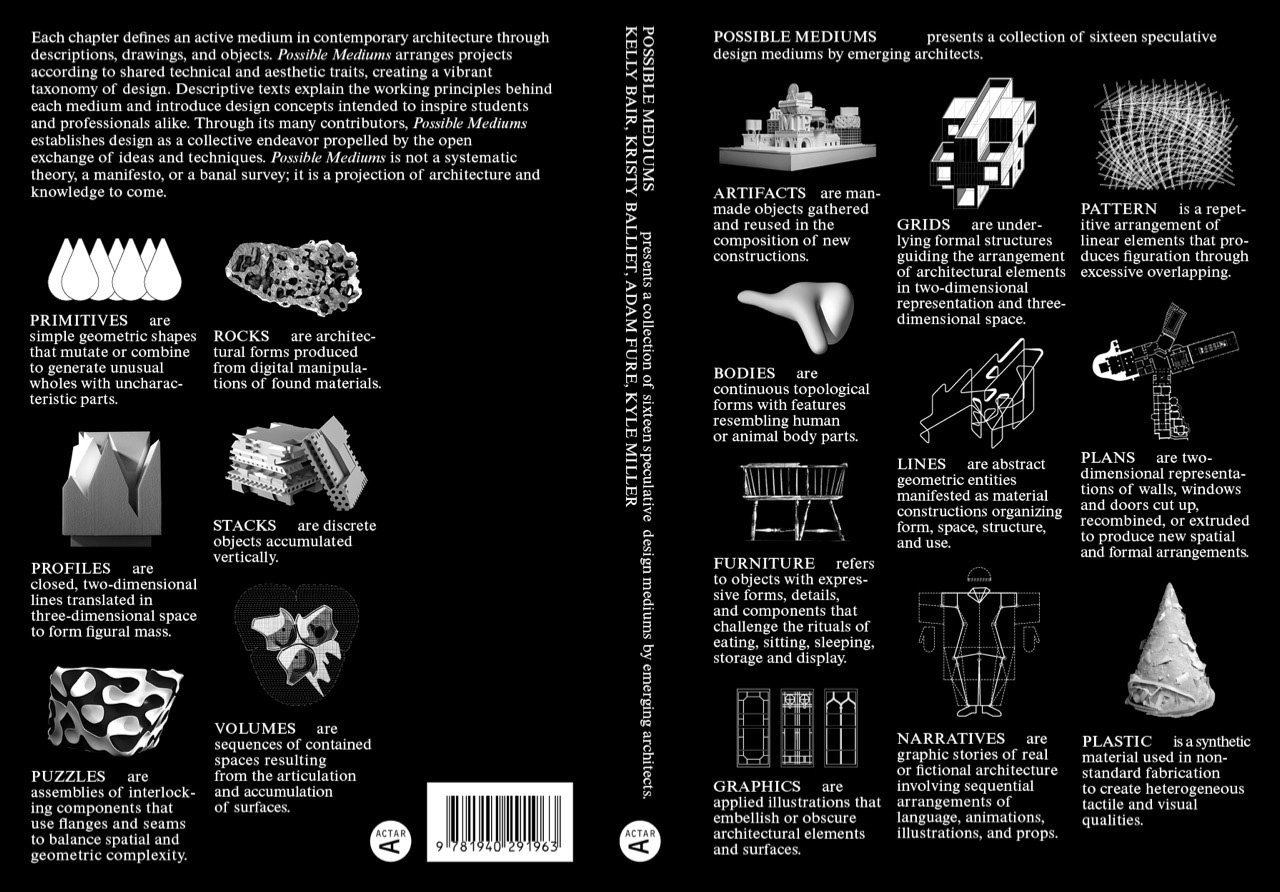
Possible Mediums
Edited by Kelly Bair, Kristy Balliet, Adam Fure, and Kyle Miller
Actar
$34.95 MSRP

Possible Mediums, a volume edited by four xennial American architecture professors, documents the formal experimentation of the recent post-digital turn in architecture. The book glimpses a generation paradoxically invested in using obscure methods to make charismatic forms. Unlike other postmodern camps (pomo, deconstructivism, parametricism), this generation eschews stylistic cohesion, instead claiming diversity and eclecticism as its hallmark. Inspired by philosopher Michel Foucault’s reading of a fictional Chinese encyclopedia in The Order of Things (the incoherence of which undermines Western epistemology itself), Possible Mediums’ preface essay, “Notes from the Middle,” relishes pluralism and how “the delightfully weird work of…colleagues challenged preconceived notions of order.” However, by deliberately withholding a theoretical framework, the editors leave their uninitiated readers to wonder whether the volume marks a new architectural movement or is simply a yearbook filled with the signatures of well-wishing friends. Whether Possible Mediums is a yearbook or Oriental arcana, the book’s format is infectious and invites casual, nonlinear, and occasional reading. In the same spirit of the volume’s meandering musings, this review will proceed as a loose collection of entries.

[…]

Gary P. Radford, “Torture is Putting it Too Strongly, Boredom is Putting it Too Mildly”: The Courage to Tell the Truth in the Late Lectures of Michel Foucault, Human Studies: A Journal for Philosophy and the Social Sciences, First Online: 18 February 2019

DOI: 10.1007/s10746-019-09494-7

Abstract
The name of Michel Foucault is most commonly associated with words such as power, knowledge, discourse, archaeology, and genealogy. However, in his final public lectures delivered prior to his death in June 1984 at the Collège de France from 1981 to 1984 and at the University of California at Berkeley in 1983, Foucault turned his focus to another word, parrhesia, a Greek term ordinarily translated into English by “candor, frankness; outspokenness or boldness of speech” (“Parrhesia” in Oxford English Dictionary, 2017. http://www.oed.com). The parrhesiastes is the one who uses parrhesia, i.e., the one who speaks the truth. This paper is about Foucault’s choice of parrhesia as the topic of his final lectures and what the articulation of these lectures tells us about truth telling in a specific academic context. It will consider Foucault’s treatment of parrhesia with respect to the specific practice of Foucault’s articulation of this work in the specific formal settings in which it occurred at the Collège de France and the University of California at Berkeley. The objective here is to consider Foucault’s lectures as potential examples of parrhesia and address the question of whether or not is possible to “speak the truth,” in the Greek sense of the term, within the institutional constraints of academic discourse.

Keywords
Michel Foucault Parrhesia Academic discourse

Matt McManus, Michel Foucault: Arch-Leftist or Subversive Conservative?  Areo magazine, 25 February 2019

Michel Foucault is one of the great thinkers of (post) modern thought, and arguably the most influential figure in the humanities and social science from the second half of the twentieth century. He is also widely regarded as a beacon of leftist thought—hailed by outlets such as the Guardian and Aeon; and reviled by pundits, such as Jordan Peterson and Stephen Hicks, and right wing magazines such as the National Review. Foucault has been characterized as everything from a genius to a nihilistic pedant, the heir to Kant and Nietzsche and a largely uninteresting bore. In the pages of this magazine, too, he has received a fair amount of attention: he has been accused of ruining the West, on the one hand, and, on the other, defended as a figure who can help us understand our troubled age.

But understanding the underlying message of Foucault’s thinking remains a serious challenge. One of the most interesting recent accusations to be resurrected is that—despite the vitriol directed against him by the Right—Foucault was actually a closet conservative. These accusations have been around since the 1960s, when he was ridiculed by Marxists for his lack of dedication to—or interest in—the cause of class conflict, and persist to the current day, when Foucault is accused—not entirely unfairly—of providing intellectual support for the project of neoliberalism. Perhaps the most classic accusation was made by seminal critical theorist Jürgen Habermas in a series of scathing articles and books published in the 1980s. In his 1981 paper “Modernity versus Postmodernity,” Habermas accuses Foucault and other postmodern writers of being “young conservatives,” who abandoned the modernist project of emancipation and equality in favor of aestheticizing cultural and political concepts and traditions. As he puts it at the climax of the paper:

[…]

From Marx to Foucault, via Althusser
By Gordon Hull, New APPS: Art, Politics, Philosophy, Science, 06 March 2019

As is well-known, Foucault pretty-much detested orthodox Marxism and the PCF. At the same time, his relation to Marx’s own thought, and that of Marx’s better commentators, is more complex. One way to approach this topic is via primitive accumulation (recall here). Another is by way of intermediaries. Here I’d like to consider what is, as far as I know, an undiscussed connection in a late essay of Althusser’s (as always, I welcome references). In a paper in the recent Marx & Foucault anthology, Julien Pallotta outlines what he takes to be evidence that Foucault is responding to Althusser’s “Ideology and Ideological State Apparatuses” (1970) in his Punitive Society lectures (1973). In particular, Foucault wants to argue that: Althusser doesn’t realize power is constitutive rather than reproductive/productive; that you need to look at more than wage relations to understand the reproduction of capital, and what you’ll discover is a whole process of moralization and control of the worker so that he’s reproduced and ready to work (capital thus needs workers to save against unemployment or disease etc., even as it works to “free” the worker); and there’s thus a process of subjectification which Foucault pursues in a lot more detail than Althusser.

read more

Call for papers: Warwick Continental Philosophy Conference (WCPC)
What is Philosophy?: Present, Past, Future
26th-28th June 2019

Deadline for submissions is the 22nd March 2019

For as long as philosophical questions have been asked, the nature and task of philosophy itself has posed a problem to which various and often conflicting solutions have arisen. Today it seems that the idea (or practice) of philosophy is as controversial as ever – for philosophers and non-philosophers alike, though the questions have been rephrased. What is the place of philosophy in an increasingly specialised academia? How does society perceive philosophy and how can philosophy itself impact society? Has philosophy progressed, or simply adapted to the political and social world in which it is found? Is a single foundation possible, or must we always ‘begin again’, seeking new philosophical tools in pursuit of the problems we encounter?

This year, the Warwick Conference of Continental Philosophy (WCPC) wants to reflect on these issues, and thus invites papers of Continental or European philosophy focusing upon the purpose and scope of philosophical discourse and practice. Suggested topics might include, but are not limited to:

  • The nature and task of philosophy: What is philosophy today? What is the role of the philosopher? Does philosophy or its subdisciplines have set functions? What are the problems that philosophy addresses and why? What characterises continental philosophy? Is philosophy possible (only) within academia?
  • The identities of philosophy: Philosophy and gender, philosophy and social class, philosophy and language. Who is the philosopher? Who are the female philosophers to be rediscovered in the history of philosophy? Who are those excluded from philosophy? Is philosophy a ‘luxury’? How do non-philosophers think of philosophers and vice-versa? Is there a single language and style of philosophy?
  • The geography of philosophy: Dialogues and misunderstandings between Western and non-Western traditions. Is there a difference between Western and non-Western conceptions and modes of philosophising? What are the reciprocal influences? What is non-Western philosophy? Is there a defining feature of Western philosophy?
  • The interplay between philosophy and other disciplines: Philosophy and science, technology, the arts, psychology & psychoanalysis, the social sciences, religion, etc. What are the boundaries and intersections between philosophy and these other disciplines?
  • The histories of philosophy: Different conceptions and practises of philosophy in Antiquity, the Middle Ages, the Renaissance and Modernity. What are the differences and similarities across epochs and traditions? What can past conceptions tell us?

We are also pleased to announce the following keynote presentations:

The 26th June will open with a roundtable discussion on Foucault, philosophy and problematisation, featuring Claudia Stein (Warwick), Amadeo Policante (Warwick), Stuart Elden (Warwick), Daniele Lorenzini (Saint-Louis – Bruxelles) and Martina Tazzioli (Swansea).

The 27th will then feature a roundtable discussion of crisis in philosophy and other disciplines, chaired by Miguel de Beistegui (Warwick) and in association with the Philosophy in a Time of Crisis project (philosophyx.co.uk).

The conference will then close with a presentation from Andrew Benjamin (Kingston/University of Technology, Sydney).

—————————————————————————————————-

The Warwick Continental Philosophy Conference welcomes the following proposals:

  • Papers: Each paper will be allotted 20 minutes for presentation and 10 minutes for discussion.
  • Panels: We also invite suggestions for panels consisting of 3-4 papers organised around a common theme (paper abstracts of 250-500 words & panel abstract 250-300 words); the panel as a whole cannot exceed one and a half hours.
  • Roundtables: We will also consider suggestions for roundtable discussions to discuss a single theme, idea or topic, moderated by a chair (abstract of 250-500 words).

If you wish to submit a proposal in any of the formats above, please send an email to wcpc@warwick.ac.uk. The deadline for submissions is the 22nd March 2019, and we aim to make bursaries available following the acquisition of more funding, so please indicate on your application if you would like to be considered. For more information, please see the conference website at https://warwickcontinentalphilosophyconference.wordpress.com/.



Thomas Lemke, Foucault’s Immanent Contradictions, Verso Blog, 22 February 2019

From Habermas to Honneth, critics have been keen to portray Foucault as a paradox-prone thinker. Thomas Lemke argues that we should embrace the recurring contradictions in Foucault’s thought as symptoms rather than inherent problems.

This is an excerpt from the introduction to Thomas Lemke’s Foucault’s Analysis of Modern Governmentality: A Critique of Political Reason which is currently 30% off on the Verso website

Were not Foucault’s critics right to fault him for the contradictions immanent in his work? Did they not accurately describe the theoretical incoherence of calling for political resistance on the basis of a neutral conception of power? Was it not necessary to dissolve these aporias, contradictions and paradoxes in one direction or another? It seems Foucault had only two possibilities. According to the first line of reasoning, he overcame the problem and affirmed the validity of his neutral conception of power by giving up on critical ambitions: he came to advocate theoretical relativism, no longer seeking to distinguish between better or worse, greater or lesser freedom, or more or less just forms of power. Alternatively, Foucault made his political motives and normative value judgements clear – that is, he gave up on the neutrality he had professed – so that the critical standards of his theoretical engagement became manifest and available for political mobilization. Either-or.

read more

Ariel Handel, What’s in a home? Toward a critical theory of housing/dwelling (2019) Environment and Planning C: Politics and Space, 37(6), 1045-1062.
https://doi.org/10.1177/2399654418819104

Abstract
What is a home/house? How can we bridge between the concepts of a house, as a physical structure, and a home, with its symbolic and human meanings? The paper suggests an outline for a theory of housing/dwelling that considers the multiple facets of homes/houses: a top-down manufactured object, an ideal representation of ontological security, and a site of everyday lives and complex social relations. Combining several philosophical backgrounds—phenomenological dwelling, actor-network theory, Foucault’s dispositive, and Illich’s vernacularity—the home/house is investigated along three layers: (1) housing regime, that is the home/house as part of a broader system of planning, economy, or national goals; (2) critical phenomenology, aimed at finding and describing the gaps between the ideal-home image characterizing a given society and the home/house’s actual behavior; and (3) active dwelling, which regarded this gap as an engine for home-making as a political and agentic process. The theoretical arguments are briefly demonstrated through the case study of Palestinian homes/houses in the Occupied Territories, as political sites of both vulnerability and agency. © The Author(s) 2019.

Author Keywords
actor-network theory; dwelling; Foucault; Home/house; theory of housing

Which edition of Foucault’s Birth of the Clinic did Alan Sheridan actually translate?

9 March 2019


stuartelden's avatarProgressive Geographies

Foucault’s Naissance de la clinique was published in two editions in his lifetime. The first appeared in 1963 as the first volume in Georges Canguilhem’s ‘Galien’ series with Presses Universitaires de France. The second appeared in the same series in 1972. There are a number of changes between the first and second editions, notably the removal of a lot of the overtly structuralist language, but also some quite large additions.

There have been several reprints of that second edition in the Quadrige series. But unhelpfully, sometime between the 3rd Quadrige edition (1993) and the 9th (2015) the text was reset, and the pagination changed – the preface was incorporated into the main page running order. I’ve made dual references below.

Alan Sheridan’s English translation as The Birth of the Clinic appeared in 1973, shortly after the second edition. But because the structuralist language of the first edition appears…

View original post 1,048 more words