Michel Foucault on “Les aveux de la chair” (2019)
Theoretical Puppets
Published on Jun 3, 2018
Foucault speaks about his new book and the avowals of a chair…

Michel Foucault on “Les aveux de la chair” (2019)
Theoretical Puppets
Published on Jun 3, 2018
Foucault speaks about his new book and the avowals of a chair…
Stephen J Ball (2019). A horizon of freedom: Using Foucault to think differently about education and learning. Power and Education.
https://doi.org/10.1177/1757743819838289
Abstract
Building on the work of others, this article sketches out what a Foucauldian ‘education’ might look like in practice, considers some of the challenges, paradoxes and (im)possibilities with which such an ‘education’ would face us, and indicates some of the cherished conceits and reiterated necessities that we must give up if we take seriously the need for an education that fosters an orientation to critique and curiosity. Three elements of Foucault’s ‘philosophical ethos’ that might be translated into educational practices are addressed: first, fostering a learning environment that encourages experimentation; second, enabling the development of an awareness of one’s current condition as defined and constructed by the given culture and historical moment; and, third, encouraging an attitude or disposition to critique – a focus on the production of particular sorts of dispositions that would be valued and fostered. All of this raises issues about ‘the teacher’.
Keywords: Foucault, self-formation, critique, refusal
Eric Bulson, Tripping his brains out. Eric Bulson on Michel Foucault and LSD, Times Literary Supplement, 14 May 2019
Review of
Simeon Wade, FOUCAULT IN CALIFORNIA
Olaf Nicolai, FOUCAULT IN [205 WORDS FROM SIMEON WADE’S MANUSCRIPT ‘FOUCAULT IN CALIFORNIA’]
Michel Foucault
HISTOIRE DE LA SEXUALITÉ IV, Les Aveux de la chair
In May 1975, Michel Foucault watched Venus rise over Zabriskie Point while Karlheinz Stockhausen’s Gesang der Jünglinge (Song of the Youths) blared from the speakers of a nearby tape recorder. Just a few hours earlier he had ingested LSD for the first time and was in the process of undergoing what he saw as “one of the most important experiences” of his life. And he wasn’t alone. Two newly acquired companions had brought Foucault to Death Valley for this carefully choreographed trip complete with a soundtrack, some marijuana to jump start the effects, and cold drinks to combat the dry mouth. It was all spurred on by the hope that Foucault’s visit to “the Valley of Death”, as he called it, would elicit “gnomic utterances of such power that he would unleash a veritable revolution in consciousness”.
[…]
See Stuart Elden’s comments on his blog in relation to chronology here:
The piece generously quotes my work in Foucault’s Last Decade. But there is one key problem to the idea that this experience changed the course of Foucault’s History of Sexuality – these events occurred in May 1975, 15 months before Foucault finished the first volume. There is a story about how the series changed, which I’ve tried to tell, and which can doubtless be told in other ways, but chronology remains significant.
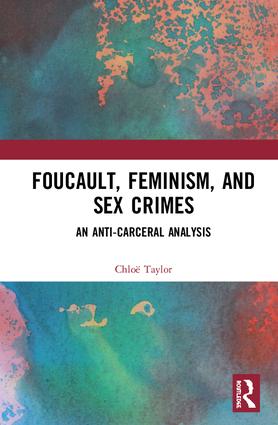 Chloë Taylor, Foucault, Feminism, and Sex Crimes. An Anti-Carceral Analysis, Routledge, 2019
See also Review by Jemima Repo, Notre Dame Philosophical Reviews, 13 May 2019
Description
This book brings together Foucault’s writings on crime and delinquency, on the one hand, and sexuality, on the other, to argue for an anti-carceral feminist Foucauldian approach to sex crimes. The author expands on Foucault’s writings through intersectional explorations of the critical race, decolonial, critical disability, queer and critical trans studies literatures on the prison that have emerged since the publication of Discipline and Punish and The History of Sexuality.
Drawing on Foucault’s insights from his genealogical period, the book argues that those labeled as sex offenders will today be constructed to re-offend twice over, once in virtue of the delinquency with which they are inculcated through criminological discourses and in the criminal punishment system, and second in virtue of the manners in which their sexual offense is taken up as an identity through psychological and sexological discourses. The book includes a discussion of non-retributive responses to crime, including preventative, redistributive, restorative, and transformative justice. It concludes with two appendixes: the original 19th-century medico-legal report on Charles Jouy and its English translation by the author.
Foucault, Feminism, and Sex Crimes will be of interest to feminist philosophers, Continental philosophers, Women’s and Gender Studies scholars, social and political theorists, as well as social scientists and social justice activists.
Contents
Introduction
Part I: “Bucolic Pleasures”? Feminist Readings of Foucault
1. The Case of Charles Jouy and Sophie Adam
2. Revising Sex Crime Law
3. Infamous Men and Dangerous Individuals
Part II: Disciplining and Punishing Sex Offenders
4. Feminism, Crime, and Punishment
5. Foucault’s Prison Abolitionism
6. Criminal Queers
Part III: Perverse Implantations
7. The Perverse Implantation and Sex Work
8. Zoosexuality and Interspecies Sexual Assault
9. The Social Construction of the Serial Sex Killer
Conclusion: Transforming Justice
Appendixes
Emerson Maione, Thiago Rodrigues, Genealogia e Agonismo: uma analítica do poder na Justiça de Transição, Carta Internacional. Revista da Associação Brasileira de Relações Internacionaisv, 14 n. 1 (2019)
https://doi.org/10.21530/ci.v14n1.2019.821
Resumo
Este artigo baseia-se em sugestões teórico-metodológicas de Michel Foucault. Em especial,focaremos a analítica das relações de poder/saber, a genealogia, o agonismo, e as visõesdesse autor sobre justiça, veridicção e constituição dos sujeitos. Para sugerir como trabalha ametodologia genealógica, trazemos breves ilustrações sobre justiça de transição. Daí emergeuma sugestão de análise da justiça de transição que visa enxergá-la não como algo queapenas busque romanticamente a “verdade” e a “justiça”, mas também como uma verdadeirafrente de batalha cujo resultado dependerá das variações das relações de força em embateslocalizados. Sugere-se, portanto, que a genealogia é uma metodologia capaz de gerar análisesque fujam do maniqueísmo que estabelece, rigidamente, o “certo” e o “errado”, o “justo” eo “injusto”. E uma vez que a genealogia é, em si mesma, uma abordagem altamente política, parcial, ela busca questionar discursos que, ao contrário, se apresentam como neutros euniversais. Por isso ela se foca não em “objetos” rígidos e supostamente isoláveis do conjuntode acontecimentos sociais, mas interpela os acontecimentos, discursos e práticas de poder,interessada em identificar quais relações de poder e saber moldaram tal objeto.
Reflecting upon Genealogical and Agonistic Methodologies in International Relations: The case of Transitional Justice.
Abstract
This is article is based on theoretical-methodological suggestions by Michel Foucault. It focuses on the analytics of power/knowledges relations, on genealogy, on agonism and on his visions on justice, veridiction and the constitution of subjects. To suggest how the genealogic methodology works we bring brief illustrations form Transitional Justice. From this, it emerges an analysis of Transitional Justice that sees it not just as a romantic search for “truth” and “justice” but also as a battle front whose results will depend on the variations of force relations in localized struggles. Therefore, we suggest that genealogy is a methodology capable of produce analyses that skip rigid dichotomies such as “right” and “wrong”, “just” and “unjust”. And since genealogy is, in itself, a highly political and partial approach it seeks to question discourses that, on the other side, presents itself as neutral and universal. Hence it do not focus on rigid research “objects” that supposedly could be isolated from the set of social events but questions the events, discourses and practices of power with the aim of identify which relations of power and knowledge has shaped this object.
Keywords: Transitional Justice; Genealogy; Michel Foucault.
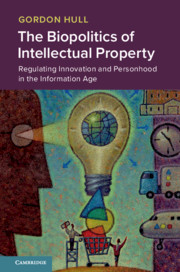 Gordon Hull, The Biopolitics of Intellectual Property: Regulating Innovation and Personhood in the Information Age, Cambridge University Press, 2018
As a central part of the regulation of contemporary economies, intellectual property (IP) is central to all aspects of our lives. It matters for the works we create, the brands we identify and the medicines we consume. But if IP is power, what kind of power is it, and what does it do? Building on the work of Michel Foucault, Gordon Hull examines different ways of understanding power in copyright, trademark and patent policy: as law, as promotion of public welfare, and as promotion of neoliberal privatization. He argues that intellectual property policy is moving toward neoliberalism, even as that move is broadly contested in everything from resistance movements to Supreme Court decisions. This work should be read by anyone interested in understanding why the struggle to conceptualize IP matters.
LaMothe, R.
Pebbles in the Shoe: Acts of Compassion as Subversion in a Market Society
(2019) Pastoral Psychology, 68 (3), pp. 285-301.
DOI: 10.1007/s11089-018-0833-1
Abstract
This article considers how compassion can be subversive to political-economic orders, whether these orders are found in church or society. Compassion is explained in terms of John Macmurray’s and Alex Honneth’s notion of recognition, the psychoanalytic concept of identification, and Michel Foucault’s views of knowledge and power. To illustrate how compassion can be subversive, the author turns to the realities of a market society—a society dominated by a culture of neoliberalism and neoliberal capitalism—and concludes with two case illustrations. © 2018, Springer Science+Business Media, LLC, part of Springer Nature.
Author Keywords
Capitalism; Compassion; Empathy; Identification; Neoliberalism; Power; Subversion
Index Keywords
article, capitalism, empathy, human, market, religion
Son, K.-M.
The making of the neoliberal subject: Response to Whyte
(2019) Political Theory, 47 (2), pp. 185-193.
Abstract
In her recent essay, Jessica Whyte has challenged the tendency to repurpose Friedrich Hayek’s thought for a progressive and participatory politics. Objecting to such thinkers as Michel Foucault and William Connolly who find inspiration in Hayek’s critique of the monolithic political sovereign and his defense of spontaneous order, Whyte contends that his neoliberalism is actually predicated on the cultivation of politically submissive subjectivity and the curtailment of democratic politics. While agreeing with her substantive conclusions, I suggest that her conceptual frame centered on the themes of invisibility and providentialism is limited in explaining Hayek’s ideas and, more generally, the operation of neoliberalism. Pace Whyte, I argue that Hayek’s neoliberalism does not simply stave off political challenges by obfuscation, but wages an active and highly visible campaign to recruit and interpellate individuals as market subjects. © The Author(s) 2018.
Author Keywords
Friedrich Hayek; Neoliberalism; Political theory; Spontaneous order; Subjectivity
Theoretical Puppets
Published on May 19, 2019
Michel Foucault from A to Z. Foucault talks about Power and Freedom and the Liberty of Puppets…
Hildegunn Sundal, Karin Anna Petersen & Jeanne Boge, Exclusion and inclusion of parents of hospitalized children in Norway in the period 1877–2017 (2019) BMC Nursing, 18 (1), art. no. 6.
https://doi.org/10.1186/s12912-019-0330-6
Abstract
Background: Today, Norwegian parents have the right to stay with their children when they are in hospital. This right is relatively new. The purpose of this article is to examine the nursing profession’s ideas on how parents should be included/excluded when their children are in hospital, and to examine the social and ideological conditions that made the nursing profession’s ideas on inclusion/exclusion practices possible.
Methods: The analyses are done in the tradition of the French philosopher Michel Foucault’s writings on how different kinds of knowledge have been used to discipline citizens. Such studies include analyses of descriptive and normative material and analyses of the ideological and social conditions that made the practices possible. The analyses are based on Norwegian textbooks on nursing.
Results: Parents are rarely mentioned in Norwegian nursing textbooks from the period 1877-1940, and they are not present in photos from hospitals. The exclusion of parents may be due to the absence of welfare services and the fear of parents transmitting diseases from the hospitals to the general population. The first Norwegian nursing textbook that argued for the importance of letting parents visit their children in hospital was published in 1941. In 1968, nursing textbooks started to argue for parents’ participation in the care. Since 1987, nursing textbooks have advocated full parental participation. The inclusion of parents was in accordance with humanistic ideology. The inclusion of parents occurred in a period of great nursing shortage. In this situation, it would have been of interest to entrust as much as possible of the nurse’s work to the family.
Conclusions: Our conclusion is that ideas break through when they are in line with social conditions. From 1877 to 1940 social and economic conditions made it difficult for parents to be with their children in hospital, and hygiene ideology/theory contributed to legitimization of the exclusion of the parents in the care. During the period 1941-2017 it has been economically advantageous for the hospitals that parents care for their children. Ideas on the vulnerable child and self-help ideology have contributed to legitimization of the inclusion of the parents. © 2019 The Author(s).
Author Keywords
Children; Discipline; Exclusion; Hospital; Inclusion; Michel Foucault; Parents
 Foucault News