Jonas Čeika, A Critique of Stephen Hicks’ 2011 book Explaining Postmodernism: Skepticism and Socialism from Rousseau to Foucault (2018)
Hick’s book is published by Ockham’s Razor an outlet for objectivist and Randian perspectives.

Jonas Čeika, A Critique of Stephen Hicks’ 2011 book Explaining Postmodernism: Skepticism and Socialism from Rousseau to Foucault (2018)
Hick’s book is published by Ockham’s Razor an outlet for objectivist and Randian perspectives.
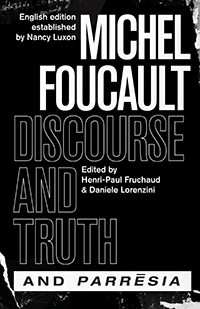 Michel Foucault, “Discourse and Truth” and “Parresia”, Chicago University Press, 2019
Edited by Henri-Paul Fruchaud and Daniele Lorenzini
With an Introduction by Frédéric Gros
English edition established by Nancy Luxon
The Chicago Foucault Project
This volume collects a series of lectures given by the renowned French thinker Michel Foucault late in his career. The book is composed of two parts: a talk, Parrēsia, delivered at the University of Grenoble in 1982, and a series of lectures entitled “Discourse and Truth,” given at the University of California, Berkeley in 1983, which appears here for the first time in its full and correct form. Together, they provide an unprecedented account of Foucault’s reading of the Greek concept of parrēsia, often translated as “truth-telling” or “frank speech.” The lectures trace the transformation of this concept across Greek, Roman, and early Christian thought, from its origins in pre-Socratic Greece to its role as a central element of the relationship between teacher and student. In mapping the concept’s history, Foucault’s concern is not to advocate for free speech; rather, his aim is to explore the moral and political position one must occupy in order to take the risk to speak truthfully.
These lectures—carefully edited and including notes and introductory material to fully illuminate Foucault’s insights—are a major addition to Foucault’s English language corpus.
Reviews
Miguel de Beistegui, University of Warwick
“Foucault’s lectures, interviews, and occasional pieces have long been recognized by Foucault scholars to be especially valuable in their clarity and value as supplements to Foucault’s major works. . . .This is an important book for Foucault studies, and, given Foucault’s influence, more broadly, for the academy.”
Bernard E. Harcourt, editor of Michel Foucault, The Punitive Society
“‘Who is able to tell the truth? About what topic is it important to tell the truth? What are the relations between this activity of telling the truth and exercising power?’ These are the questions that Foucault brilliantly addresses in these formative lectures. Today, when the questions of truth and truth-telling could not be more urgent, this compendium is an indispensable resource, tracing the problems back to the fifth century BCE and recovering the birth of the very notion of the truth-teller. These lectures are unique in offering a concentrated and sharp presentation of Foucault’s history of truth-telling. Expertly edited in English by Nancy Luxon, with a brilliant critical apparatus prepared by Henri-Paul Fruchaud and Daniele Lorenzini, this volume is a necessary companion to Foucault’s final lectures.”
James Porter, University of California, Berkeley
“A meticulously curated and definitive edition of Foucault’s Grenoble lecture and of his legendary Berkeley seminars on the courageous practice of free speech, ‘Discourse and Truth’ provides an intimate, often moving glimpse into Foucault’s thought and person at the end of his extraordinary career. Rounding out his writings on the culture of the self in antiquity, and containing his most sustained reflections on the Cynics, the book in fact offers an unexpected genealogy of critique—of the ‘critical attitude’ and the critical bios, or form of life—in the spheres of ethics, politics, and culture, thereby mapping out a tradition that stretches from Greece and Rome to Kant and Nietzsche. The work will be seminal for generations to come. But its lessons could not be more timely, more inspiring, or more urgently needed than at our present moment.”
David Owen, co-author of Prospects for Citizenship
“Parrēsia was Foucault’s last great topic and marks one of his most vital contributions to contemporary philosophical thought. This definitive critical edition of Foucault’s lectures at Grenoble and Berkeley provides an essential guide to the development of his thinking on parrēsia that will be required reading not only for Foucault scholars but for any philosopher concerned with the relationship of ethics, truth, and power. Fruchaud and Lorenzini, ably supported for this English edition by Nancy Luxon, are owed a debt of gratitude for this superb accomplishment.”
Gonzalez Rey, F.
Subjectivity in debate: Some reconstructed philosophical premises to advance its discussion in psychology
(2019) Journal for the Theory of Social Behaviour, 49 (2), pp. 212-234.
DOI: 10.1111/jtsb.12200
Abstract
The topic of subjectivity has been treated peripherally by philosophy. It has appeared in philosophy not as a specific human phenomenon, but attached to other concepts without specifying its ontological definition, such as intersubjectivity, the place of the Other in the emergence of the self, consciousness and so forth. This paper reconstructs some of the overlooked moments and ideas of several classical philosophers, such as Marx, Dewey, Merleau Ponty, Cassirer and Foucault, in order to identify in their works important antecedents to advance a different concept of subjectivity. The concepts and questions which are raised by those philosophers and which are revived in this paper have remained overlooked both by philosophy and psychology because of the lack of any representation of subjectivity capable of making them more visible. The ontological monopoly of language and discourse in explaining all human phenomena, taken together with the critique of theoretical systems and of epistemology, has found in social constructionism its strongest expression in psychology. The value of theoretical systems in generating intelligibility about complex and configurational phenomena is recovered, along with the need to develop new epistemologies capable of generating intelligibility on such systems. Finally, I argue that a new theoretical and epistemological avenue is opened up for the development of psychological thought. © 2019 John Wiley & Sons Ltd
Author Keywords
cultural-historical approach; philosophy; psychology; subjectivity; symbolical realities
Index Keywords
article, epistemology, human, human experiment, language, psychology, speech intelligibility, theoretical study
Gaus, N.
Philosophy and politics in higher education: What are the roles of intellectual academics in Indonesian higher education?
(2019) Qualitative Research Journal, 19 (3), pp. 294-306.
Abstract
Purpose: The purpose of this paper, which is drawn on Indonesian academic women’s experiences, is to examine the extent to which the aesthetics of existence or true life of women academics in relation to the truth telling, played out within the interaction between philosophy and politics, is affected by the application of NPM in research and publication productivities, and the way in which women academics are voicing their opinions toward this issue.
Design/methodology/approach: In total, 30 women academics across two geographical region (east and west) universities took part in this research, sharing their perceptions and the way they criticize this policy to the audiences (Indonesian government), framed within the concept of parrhesia (truth telling), parrhesiastes (truth teller) of Foucault and the pariah of Arendt.
Findings: Using semi-structured interviews, this research finds that women academics in Indonesian universities have shown discursive voices and stances to the extent to which they agree and oppose this policy, showing the patterns similar to those of parhesiastes and pariah. The implication of this study is addressed in this paper.
Originality/value: This research, via the lenses of Parrhesia and Pariah, finds several kinds of philosopher roles of women academics in Indonesian universities, such as apathetic philosophers or depraved orators and Schlemihl figure of Pariah, and Parrhesiastic philosophers of Socrates and a conscious figure of Pariah. © 2019, Emerald Publishing Limited.
Author Keywords
Higher education; NPM; Parhesiastes; Pariah; Parrhesia; Philosophy; Politics; Women academics
Low, R.
Mindfulness for teachers: notes toward a discursive cartography
(2019) History of Education Review, 48 (1), pp. 91-108.
Abstract
Purpose: For the interested teacher, teacher educator and educational researcher seeking an entry point into how mindfulness relates to teachers’ work, the burgeoning and divergent appeals for the relevance of mindfulness to teachers can be bewildering. The purpose of this paper is to offer teachers, teacher educators and educational researchers a conceptual framework for understanding the different orientations and sources of mindfulness as it has been recommended to teachers.
Design/methodology/approach: Using Foucault’s (1972) concept of “discursive formations” as a heuristic device, this paper argues that mindfulness as pitched to teachers can be helpfully understood as arising from three distinct orientations.
Findings: Statements about mindfulness and its relevance to teachers emerge from three distinct discursive formations – traditional, psychological and engaged – that each constitute the “problem” faced by teachers respectively as suffering, stress or alienation. Specific conceptions of mindfulness are then advanced as a solution to these problems by certain authoritative subjects and institutions in ways that are taken as legitimate within each discursive formation.
Originality/value: Apart from offering a historical and discursive mapping of the different discursive formations from which mindfulness is pitched to teachers, this paper also highlights how each of these orientations implies a normative view of what a teacher should be. Suggestions for further historical research are also offered along the lines of genealogy, epistemology and ontology. © 2019, Emerald Publishing Limited.
Author Keywords
Buddhism; Critical pedagogy; Discourse; Mindfulness; Psychology; Teachers’ work
McDonald, B., Burke, M.
Coaching pedagogy and athlete autonomy with Japanese university rowers
(2019) Sport in Society, 22 (8), pp. 1433-1448.
DOI: 10.1080/17430437.2019.1621842
Open access
Abstract
It has been suggested by some authors that, given the relationship between dependence and vulnerability to exploitation, a shift in coaching away from surveillance and control and towards autonomy-supportive behaviours by coaches will be conducive to athlete welfare. This paper utilizes an ethnographic approach, underpinned by the theoretical position of the later writings of Foucault, to understand the autonomous practices of athletes in a Japanese university rowing club. Of particular interest are the ways in which the relative absence of the coach contributes to athlete autonomy. The long-term sport-education of these Japanese university rowers results in an enduring subjectification that no longer requires the intervention of any coach. At the same time, these Japanese rowers still actively and autonomously engage in practices of the self, expressed in non-strategic, interactional ways. © 2019, © 2019 Informa UK Limited, trading as Taylor & Francis Group.
Author Keywords
bukatsudo; civic education; Foucault; Japan; rowing
Index Keywords
article, athlete, education, human, human experiment, Japan, pedagogics, rowing, theoretical study, writing
Foucault’s time in Hamburg has been commemorated with a plaque on the building he worked in.
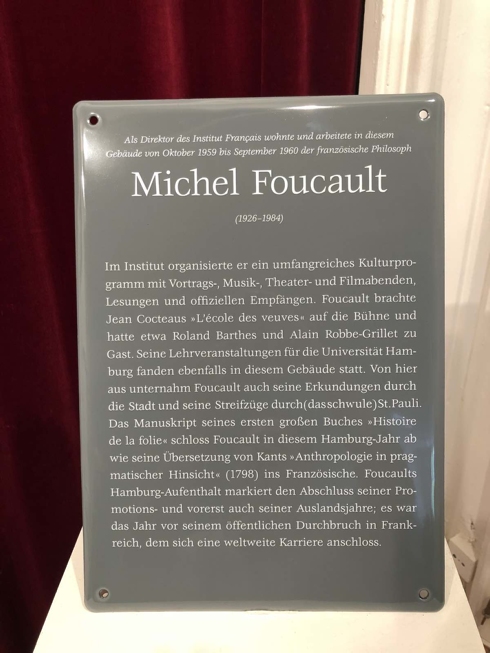
It’s reproduced and discussed in this newsletter, sent to me by Melissa Pawelski. Melissa has also provided this translation of the plaque and the comment, which I share here with her permission.
As Director of the Institut Français lived and worked in this building from October 1959 until September 1960 the French philosopher
Michel Foucault
(1926-1984)
He organised for the Institute a wide-ranging cultural programme with lectures, film, theatre and music nights, readings and official receptions. Foucault brought “L’école des veuves” by Jean Cocteau to the stage, received amongst others Roland Barthes and Alain Robbe-Grillet as his guests. His courses for the University of Hamburg took place in this building too. Foucault also started his explorations of the city and his wanderings through the (gay) district of St. Pauli. He finished the manuscript…
View original post 222 more words
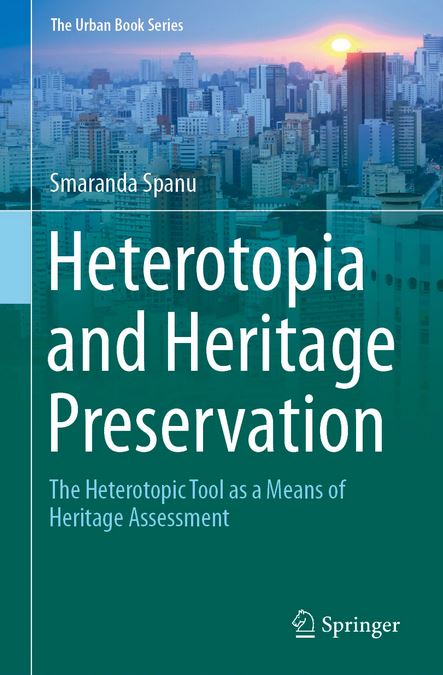 Smaranda Spanu, Architecture and the heterotopic concept (2020) In: Heterotopia and Heritage Preservation. The Heterotopic Tool as a Means of Heritage Assessment. The Urban Book Series. Springer, Cham. pp. 239-386.
https://doi.org/10.1007/978-3-030-18259-5_4
Abstract
The present chapter proposes the outlining and identification of the main instances of the concept of heterotopia as it has been employed and observed in the field of architecture and urban planning, or in other words, the conceptualisation of alterity and the methods in which it is employed. Thus, whether it is a design methodology or an architectural composition technique, it is deliberately employed so as to create alterity; it can also operate as a device for compatibility or interconnectivity, as a centralizing formula, or simply not only as a go-to solution for creating iconic objects, but also as a mnemonic dispositif. The attempts to identify an architectural heterotopic profile have managed to pinpoint as heterotopic either architectural typologies, specific architectural languages or certain functions, either have led to the condensation of specific design methodologies (deliberate creation of alterity), engaging numerous advocates (Porphyrios, Jencks, Teyssot, Tafuri). From a strictly formal reading of heterotopia, as a deliberately created architectural discontinuity (volumetric, spatial)—as seen in Porphyrios—the approaches gradually steer towards a more nuanced interpretation—as seen in Jencks, the heterotopia as an organism (architectural and urban form as well as functioning).
The annulment of alterity is discussed in the context of urban planning. Throughout the chapter, the relations developed by the heritage space as well as by the heritage object have been steadily observed, be it a built object, built ensemble of the area and recognized or not within the official heritage frame. The heterotopic spaces are finally identified in the stance of the heritage object. These approaches reflect different degrees of relating to and intervening in the historic fabric, yet all sharing the necessity of its conservation, for its capacity to act as a reference point, as a source for its own postmodern expressions (local/regional typologies) and as the already crystallized context in which the postmodern intervention must be accommodated. Shifting the focus onto heritage, the issue of authenticity is discussed, in relation to the postmodern architectural search and expression of traditional types. Assimilated and similar until indiscernible, the intervention in the heritage built fabric, the very context it values and it invokes as model and source. This sensitive issue of the heritage object and fabric is discussed in relation to the architectural production and the discourse of postmodern architecture (Quinlan Terry, Christopher Alexander and others) as well as through the connected issue of authenticity or reconstruction.
Based on these, the research has pursued the identification of the heterotopic character of the heritage space, along Foucault’s coordinates and through the restoration intervention—which ultimately reflects the perception and conceptualisation of heritage. The analysis of the various interpretations of alterity and of the concept of heterotopia unfolded in this chapter, focus on the identification of a space-oriented and heritage-oriented reading. The evolution of the attitudes towards heritage as well as its perceptions—given its transition towards a more objective “gaze”, the accumulation of meanings, the creation of and the relationship with the heritage ideal, the impact of the official status previously analysed—can explain the way in which the heritage object and the heritage space acquire heterotopic coordinates. © Springer Nature Switzerland AG 2020.
Author Keywords
Architectural heterotopias; Heritage as heterotopia; Historicist language; Intentional alterity; Other spaces; Philosophy of conservation; Reconstruction

Samuel R. Talcott, Georges Canguilhem and the Problem of Error (Palgrave Macmillan, 2019)
About this book
Examining Georges Canguilhem’s enduring attention to the problem of error, from his early writings to Michel Foucault’s first major responses to his work, this pathbreaking book shows that the historian of science was also a centrally important philosopher in postwar France. Samuel Talcott elucidates Canguilhem’s contributions by drawing on previously neglected publications and archival sources to trace the continuity of commitment that led him to alter his early anti-vitalist, pacifist positions in the face of political catastrophe and concrete human problems. Talcott shows how Canguilhem critically appropriated the philosophical work of Alain, Bergson, Bachelard, and many others while developing his own distinct writings on medicine, experimentation, and scientific concepts in an ethical and political endeavor to resist alienation and injustice. And, while suggesting Canguilhem’s sometimes surprising philosophical importance for a range of younger thinkers, the book demonstrates Foucault’s own critical allegiance to Canguilhem’s spirit, techniques, and investigations.
Samuel R. Talcott is Associate Professor of Philosophy at University of the Sciences in Philadelphia, USA.
Endorsements:
“Samuel Talcott’s study of Canguilhem’s thought is a groundbreaking study of the entire breadth of this titan of French post-war intellectual life that will set the benchmark for all future research into this rich source for thinking about science, power, norms, the art of medicine, and the role of rationality in our contemporary world. Deftly making use of published and newly available archival materials, Talcott demonstrates the profound ways in which Canguilhem’s line of thought was always driven by a core set of ethical and political concerns.” (Kevin Thompson, Associate Professor of Philosophy, DePaul University, co-editor of Intolerable: Writings from Michel Foucault and the Prisons Information Group)
“Fascinating, original and important, this study provides a sorely needed intellectual history of Georges Canguilhem’s thought. Taking the reader on a journey to understand Canguilhem’s intellectual development, political activism, medical view, and attitude to science, this book is a significant contribution to history and philosophy of medicine and science.” (Havi Carel, Professor of Philosophy, University of Bristol, UK)
“Despite Foucault’s effusive celebration of it, Georges Canguilhem has yet to have the impact that his startling and innovative work merits. The fruit of years of meticulous and creative research and analysis, Samuel Talcott’s book is likely the definitive English language study of Canguilhem for our generation. This marvelous and captivating work brings the entire arc of his thinking to life.” (Jason M. Wirth, Seattle University, author of Nietzsche and Other Buddhas: Philosophy after Comparative Philosophy)
“In the Anglophone world, Canguilhem’s work has mainly been studied looking back from Foucault. Georges Canguilhem and the Problem of Error, however, presents Canguilhem’s thought on its own, and in all of its complexity. Talcott’s book is essential reading for anyone interested in the philosophy of biology and in the development of 20th century French philosophy.” (Leonard Lawlor, Sparks Professor of Philosophy, Penn State University)
“This book, dedicated to one of the last century’s most original and influential thinkers, is the first in-depth analysis presented to English readers. The discussion of Canguilhem’s intellectual itinerary and impact, using some rare documents, is exemplary. Samuel Talcott brilliantly undermines our usual conception of error!” (Alain Beaulieu, Laurentian University, Canada)
“In this important book, philosopher Samuel Talcott lucidly tracks the political, physiological, and epistemological ramifications of the notion of error in Georges Canguilhem’s writings through to the 1960s. Canguilhem’s philosophy emerges as a creative, principled confrontation with history and thought— from fascism to Algerian independence, from Bernard and Bergson to Sartre and Foucault. Clear, engaging, and essential for understanding Canguilhem’s vital contributions to the history and philosophy of biology, environments, medicine, technology, and life.” (John Tresch, Warburg Institute, University of London, author of The Romantic Machine: Utopian Science and Technology after Napoleon)
“Samuel Talcott’s book on Canguilhem provides a rich tapestry for understanding the intersection of medicine and politics. He masterfully shows how Canguilhem’s views on colonialism intertwine with his key philosophical insight on error in life. In addition to his contribution on Canguilhem scholarship, Talcott shows how Canguilhem influenced Foucault’s political analysis of medical fields.” (Sokthan Yeng, Associate Professor of Philosophy, Adelphi University, USA)
Christiaens, T.
Financial Neoliberalism and Exclusion with and beyond Foucault
(2019) Theory, Culture and Society, 36 (4), pp. 95-116.
Abstract
In the beginning of the 1970s Michel Foucault dismissed the terminology of ‘exclusion’ for his projected analytics of modern power. This rejection has had major repercussions on the theory of neoliberal subject-formation. Many researchers disproportionately stress how neoliberal dispositifs produce entrepreneurial subjects, albeit in different ways, while minimizing how these dispositifs sometimes emphatically refuse to produce neoliberal subjects. Relying on Saskia Sassen’s work on financialization, I argue that neoliberal dispositifs not only apply entrepreneurial norms, but also suspend their application for groups that threaten to harm the population’s profitability. Neoliberal dispositifs not only produce entrepreneurial subjects but also surplus populations that are expelled from the overall population to maintain its productivity. Here, the concept of ‘exclusion’ is appropriate if understood in Agamben’s sense of an inclusive exclusion. The surplus population is part of neoliberal dispositifs, but only as the element to be abandoned. © The Author(s) 2018.
Author Keywords
exclusion; finance; Foucault; neoliberal subjectivity; neoliberalism; Sassen

 Foucault News