Foucault News

News and resources on French thinker Michel Foucault (1926-1984)

Performance | The Disorder of Discourse: Restaging a Michel Foucault Lecture

Tuesday, September 17, 2019, 7:00 pm
Free

Because of the radical nature of his work, Michel Foucault’s 1969 appointment to a chair at the prestigious College de France was a watershed moment in French intellectual life. With actor Guillaume Bailliart, Fanny de Chaille proposes a restaging of his inaugural lecture, “L’Ordre du discours (The Order of Discourse),” which was later published as a book but never recorded. In doing so, she re-imagines a historical moment while continuing Foucault’s investigation of the relations between power and language.

Dancer, choreographer, and theater director Fanny de Chaille likes to separate text from movement, allowing the two modes of expression to rediscover each other and work within the context of that separation. After studying aesthetics at the Sorbonne, Fanny de Chaille worked with Daniel Larrieu at the Centre choregraphique national in Tours, France, where she collaborated with Rachid Ouramdane, and participated in projects by artists Thomas Hirschhorn and Pierre Huyghe. Beginning in 1995, she has created her own installations and performances, while continuing a rich series of collaborations, in particular with writer Pierre Alferi.

Paul-Michel Foucault (1926 – 1984), generally known as Michel Foucault, was a French philosopher, historian of ideas, social theorist, and literary critic. Foucault’s theories primarily address the relationship between power and knowledge, and how they are used as a form of social control through societal institutions.
This event takes place at:
New York City ( NYC )
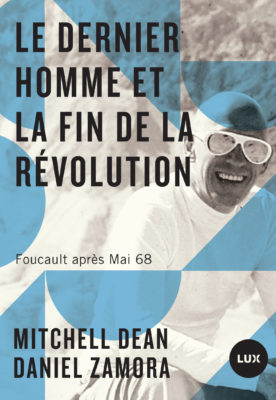
Un essai relance la querelle sur Foucault et le néolibéralisme, Entretien avec Daniel Zamora et Mitchell Dean par Mathieu Dejean, Les inrockuptibles, 22 août 2019

Cet article est réservé aux abonnés

Les sociologues Mitchell Dean et Daniel Zamora poursuivent le débat sur Michel Foucault et le néolibéralisme dans un essai critique, “Le dernier homme et la fin de la révolution” (éd. Lux). Ils reviennent sur les dix dernières années de sa vie et de son œuvre, quand dans sa quête d’une “gouvernementalité de gauche”, il s’intéressa à ce courant de pensée.

Au milieu des années 1970, le rêve d’une société sans classe, rendu incandescent par Mai 68 partout dans le monde, a du plomb dans l’aile. Alors que cet idéal s’éloigne, et que les “nouveaux philosophes” passés “du col mao au Rotary” (pour reprendre le titre d’un livre fameux de Guy Hocquenghem) annoncent la fin des utopies, Michel Foucault commence à s’intéresser au néolibéralisme. Cette école de pensée en plein essor sonne chez lui comme une promesse d’autonomie et de marges de liberté plus grandes pour les pratiques minoritaires (sexe, drogues, refus de travailler…). Alors qu’il juge la gauche de tradition marxiste dans l’impasse, son regard se décentre : la question des inégalités n’est plus prioritaire, celle du pouvoir le devient. Dans Le dernier homme et la fin de la révolution. Foucault après Mai 68 (Lux), les sociologues Mitchell Dean et Daniel Zamora examinent méticuleusement ce tournant pour porter un regard critique sur l’héritage politique de Foucault, et relancer le débat sur sa relation à cette école de pensée. Entretien.

[…]

How Michel Foucault Got Neoliberalism So Wrong, An Interview With Daniel Zamora. Interview by Kévin Boucaud-Victoire. Translation By Seth Ackerman, Jacobin, 09.06.2019

In the emerging neoliberalism of the 1970s, Michel Foucault saw the promise of a new social order, more open to individual autonomy and experimental ways of living. That’s not how things turned out.

n a new book coming out in English next year from Verso, sociologist Daniel Zamora and philosopher Mitchell Dean retrace Michel Foucault’s post-1968 intellectual journey, in which a flirtation with leftist radicalism gave way to a fascination for neoliberalism.

In this interview with the French website Le Comptoir, Zamora reflects on the intellectual turmoil of 1970s France and how Foucault’s response to it prefigured so much of our political world today.

KBV
The self-proclaimed heirs of Foucault are highly diverse; they range from left-libertarians to Chamber of Commerce officials, and include social democrats and the vestiges of the French “second left.” How do we explain this? How do we situate Foucault?

DZ
First of all, I think some intellectuals have a questionable habit of imposing their own agenda on certain philosophers. Placing yourself under the authority of some great figure of intellectual life to legitimize your own ideas is a common practice, but it has been pushed to a particularly bizarre degree in the case of Foucault.

read more

Daniel Zamora : « La résistance chez Foucault ne prend plus vraiment le visage de la lutte des classes »
Par Kévin “L’impertinent” Boucaud-Victoire Le 5 Septembre 2019, Le Comptoir

English translation in Jacobin

Dans « Le dernier homme et la fin de la révolution : Foucault après Mai 68 » (Lux, 2019), co-écrit avec Mitchell Dean, Daniel Zamora revient sur l’analyse de Michel Foucault sur le néolibéralisme, notamment dans ses cours au Collège de France en 1977 et 1979, publiés dans « Naissance de la biopolitique ». Le sociologue était-il un néolibéral de gauche ? Les choses sont un peu plus complexes semble-t-il.

Le Comptoir : Les héritiers auto-proclamés de Foucault sont très divers, ils vont de libertaires de gauche à des cadres du Medef, en passant par des socio-démocrates ou les reliquats de la “deuxième gauche”. Comment l’expliquer ? Comment situer Foucault ?

Daniel Zamora : Je pense qu’il y a tout d’abord le réflexe peu orthodoxe d’un certain nombre d’intellectuels d’adosser au philosophe leur propre agenda politique. Se placer sous l’autorité d’une grande figure de la vie intellectuelle pour légitimer son propos est une pratique courante. Elle a cependant atteint un degré particulièrement délirant dans le cas de Foucault.

[…]

stuartelden's avatarProgressive Geographies

Kathryn Medien, ‘Foucault in Tunisia: The encounter with intolerable power‘, The Sociological Review, 2019, https://doi.org/10.1177/0038026119870107 (requires subscription)

In September 1966, 10 years after Tunisia officially gained independence from French colonial rule, Michel Foucault took up a three-year secondment, teaching philosophy at the University of Tunis. This article offers an account of the time that Foucault spent in Tunisia, documenting his involvement in the anti-imperial, anti-authoritarian struggles that were taking place, and detailing his organizing against the carceral Tunisian state. Through this account, it is argued that Foucault’s entrance into political activism, and his associated work in developing a new analytic of power, was fundamentally motivated by his encounter with the neocolonial operatives of power that he witnessed and resisted while in Tunisia. In tracing the anti-colonial and anti-imperial struggles taking place concurrent to Foucault’s development of his analytic of power, albeit struggles that are shown to not take…

View original post 29 more words

Sabina F. Vaccarino Bremner, (2019) Anthropology as critique: Foucault, Kant and the metacritical tradition, British Journal for the History of Philosophy,
DOI: 10.1080/09608788.2019.1650250

ABSTRACT
While increasing attention has been paid in recent years to the relation between Foucault’s conception of critique and Kant’s, much controversy remains over whether Foucault’s most sustained early engagement with Kant, his dissertation on Kant’s Anthropology, should be read as a wholesale rejection of Kant’s views or as the source of Foucault’s late return to ethics and critique. In this paper, I propose a new reading of the dissertation, considering it alongside 1950s-era archival materials of which I advance the first scholarly appraisal. I argue that Foucault manifests a fundamental ambivalence to Kantian anthropology, rejecting it in theoretical terms while embracing its practical (‘pragmatic’) conception of the subject. Furthermore, I take these texts to collectively evidence Foucault’s attempt to situate himself within the anthropological-critical tradition rather than extricating himself from it. If we interpret Foucault to reject this tradition’s appeal to an essentialized, theoretical conception of subjectivity, what remains of anthropology is its inherent practical reflexivity in structure. Thus, I situate Foucault’s conception of ethics as one’s relation to oneself in continuity with this tradition.

KEYWORDS: Foucault, Kant, anthropology, critique, pragmatic

Michel Foucault et la force des mots,, Phantasia, Volume 8 – 2019
Dirigé par Daniele Lorenzini

Daniele Lorenzini
Foucault et la force des mots : de l’extralinguistique à la subjectivation

Philippe Sabot
Le langage au pouvoir. Foucault, lecteur de Brisset

Emmanuel Salanskis
Une fidélité de Foucault à Nietzsche : le langage comme fil conducteur généalogique

Isabelle Galichon
L’éthopoïétique de l’écriture de soi

Arianna Sforzini
La vérité aux limites du discours : la « performance » politique des cyniques

Audrey Benoit
Assujettissement et subversion dans le langage. Judith Butler et la critique foucaldienne de la souveraineté

Varia : Claire pages
Image ou événement ? Quelques destins français de la psychanalyse

Special feature: The government of life. Economy and Society (2015), Volume 44, issue 1, 2015

The government of life: managing populations, health and scarcity
Kaspar Villadsen & Ayo Wahlberg

The Malthus Effect: population and the liberal government of life
Mitchell Dean

Real-time biopolitics: the actuary and the sentinel in global public health
Andrew Lakoff

The governmentalization of living: calculating global health
Ayo Wahlberg & Nikolas Rose

Davis, C.S., Snider, M.J., King, L., Shukraft, A., Sonda, J.D., Hicks, L., Irvin, L.
A Time to Live and a Time to Die: Heterotopian Spatialities and Temporalities in a Pediatric Palliative Care Team
(2019) Health Communication, 34 (9), pp. 931-941.

DOI: 10.1080/10410236.2018.1443262

Abstract
The death of a child creates especially poignant feelings and extreme stress, distress, and devastation for family members and healthcare providers. In addition, serious or long-term illness forces a reconstruction of our experiences with time and space. In this paper, we report on a long-term ethnographic study of a Pediatric Palliative Care Team (PPCT). Using the concepts of spatiality and temporality; Deleuze’s concepts of smooth and striated spaces; Innis’s concepts of space and time biases; Foucault’s concept of heterotopian space—places with multiple layers of meaning; and a related concept of heterokairoi—moments in time with multiple possibilities—we consider how the PPCT constructs and reconstructs meaning in the midst of chaos, ethical dilemmas, and heartbreaking choices. © 2018, © 2018 Taylor & Francis Group, LLC.

Index Keywords
article, child, human, palliative therapy, death

Johannes Rytzler, Turning the gaze to the self and away from the self–Foucault and Weil on the matter of education as attention formation (2019) Ethics and Education, 14 (3), pp. 285-297.
https://doi.org/10.1080/17449642.2019.1617452

Abstract
Through writings of Simone Weil and Michel Foucault, the article explores the notion of education as the formation of the attending and attentive subjects. Both writers have in different ways acknowledged the important relation between attention and the self. While Weil develops a spiritual form of attention, an attention which can be trained in any form of serious studying, aiming at dissolving the illusion of the self, Foucault understands attention as an important aspect in the Greek notion of the care of the self, which was developed outside of and due to the limitations of pedagogy aiming at a self-attentive self-formation. Both non-egotistic notions of attention address ethical and educational dimensions of human subjectivity. Foucault’s notion is anti-institutional and Weil’s notion is non-formative. As such, both perspectives inform educational thinking and practice by highlighting attention as a crucial aspect of both the active and the contemplative subject. © 2019, © 2019 The Author(s).

Author Keywords
attention; education; Michel Foucault; Simone Weil