Foucault News

News and resources on French thinker Michel Foucault (1926-1984)

Michael, K.S.
Wearing your heart on your sleeve: the surveillance of women’s souls in evangelical Christian modesty culture
(2018) Feminist Media Studies, pp. 1-15. Article in Press.

DOI: 10.1080/14680777.2018.1490915

Abstract
A few years ago, a rash of online debates over whether Christian women should wear yoga pants spread across white evangelical blogs and social media. These were followed by conversations about the meaning of “modesty” more broadly, including who has the ability or authority to “read” women’s piety, or their very souls, through their dress. Drawing on media interface theories and close analyses of these debates, this article examines how some evangelical women resist the surveillant male gaze in their religious communities by implying that their modesty resides not in signs that are legible to others but in their own embodied experiences of pleasure and care. The article argues further that the case of white evangelical modesty culture offers an example of Foucault’s concept of the “soul” and the micro-physics of power that produce it, something that has been overlooked by the literature’s focus on the role of the state and corporations in surveillance. Moreover, absent a more capacious understanding of the sociality of surveillance, current approaches to biometric surveillance have also neglected important limits to surveillance that are suggested by evangelical women’s tactical resistance to the gendered politics of surveillance in their communities.

Author Keywords
clothing; Gender; media; religion; surveillance

Michael Clarke, Governmentality and the politics of exclusion in Xinjiang, East Asia Forum: Economics, Politics and Public Policy in East Asia and the Pacific, 17 September 2019

China is undertaking a program of mass incarceration of the Uyghur population in its far north-western province of Xinjiang (East Turkestan to Uyghurs) in a system of region-wide detention in re-education or vocational training centres. Central to the operation of what some observers have termed a ‘carceral state’ in Xinjiang has been the fusion of governmentality and a Schmittian politics of exclusion with 21st century technological innovation.

[…]
An examination of the operation of this system of mass repression reveals that the CCP’s treatment of the Uyghur population in Xinjiang is animated by governmentality, the politics of exclusion and new surveillance technologies.

Governmentality, as Michel Foucault argued, concerns the problem of government in its broadest sense. For Foucault ‘to govern … is to control the possible field of action of others’. The CCP has long sought to direct the conduct of its citizens in a manner that manages and controls their ‘possible field of action’.

more

Hay, J.
The automated states, automated government, and self-automation of the ‘smart’ appliance: three questions about refrigerators
(2018) Media International Australia, 166 (1), pp. 57-69.

DOI: 10.1177/1329878X17739014

Abstract
This essay considers the automation of the everyday through ‘smart’ domestic appliance, specifically the current regime of smart refrigerators. The essay revisits and rethinks perspectives about media by McLuhan, focusing particularly on his discussion of clothing, cars, clocks, light bulbs, and highways as ‘media’. The essay outlines a critical practice (a ‘critical refrigerator studies’), as a means of rethinking ‘media power’, through perspectives by Foucault about technologies of government and through perspectives by Otter about Liberal objects. © 2017, © The Author(s) 2017.

Author Keywords
automation; governmentality; Liberal objects; media; smart appliance

Jeihouni, M., Hooti, N.
“Because it is my name!”: Miller, Proctor, and Parrhesia in The Crucible
(2018) Orbis Litterarum, 73 (2), pp. 103-126.

DOI: 10.1111/oli.12158

Abstract
This article offers a Foucauldian reading of Arthur Miller’s The Crucible. Employing Foucault’s concept of parrhesia, we argue that John Proctor holds truth-telling as a moral virtue and accordingly his behavior qualifies as parrhesiastic based on the five elements Foucault outlines for parrhesia: frankness, truth, danger, criticism, and duty. First we shall provide a thorough account of the concept in Foucault’s work. Second, and on the basis of that account, we shall explore the relations of power in Miller’s play, arguing that Proctor deconstructs the self-celebrating dogmatism of his Puritan context with a razor-sharp honesty. We shall conclude that Proctor meets his death because of his parrhesiastic courage. © 2018 John Wiley & Sons A/S. Published by John Wiley & Sons Ltd

Author Keywords
Foucault; Miller; parrhesia; Proctor; The Crucible

THINKING THROUGH THE AFTERLIFE
Instructor: Kristof K. P. Vanhoutte

Editor: Update 12 February 2026. Link above is to the page archived on the Wayback Machine.

The Paris Institute for Critical Thinking

Monday, Tuesday 19:00-22:00
14,15 October – 11,12 November – 9,10 December, 2019
18 hours (3 weeks)

The Red Wheelbarrow Bookstore
9, rue de Médicis
75006, Paris

Death, and especially the dead, make modern man highly uneasy. Death mainly remains of interest in the attempt to overcome it. The dead, meanwhile, have been completely banished, with survivors becoming the focus of attention in the attempt to remove this macabre fact from our society. It would appear that the Reformation has succeeded in convincing the West of the biblical injunction to “let the dead bury the dead.” However, this was not always the case: From Antiquity well into the late Middle Ages, death was omnipresent, and the dead continued to play an active role in the society they had left behind. The border between the here and the hereafter was a rather porous one; Heaven and Hell and its respective inhabitants often came to visit; and if it hadn’t been for quite mundane sociopolitical changes in the 11th and 12th century, Purgatory and Limbo would never have come into existence.

In this course, we propose an “immanentized” reading of the five spheres of the beyond. Staging a Foucauldian Archeology of political theology, we will approach our sources historically and hermeneutically. Our focus will be on (a) the creation and signification of the realms of the beyond, (b) the frequent intermingling of the living and the dead, and (c) the possible implications and applications of these (historical) realms of life after death. While we will mainly deal with the West, we will also turn to other parts of the world to test how applicable our findings may be. And although our main playing field will be the past, we will consult thinkers such as Hannah Arendt and Giorgio Agamben to see how categories of the beyond have been used to critique contemporary society. All throughout, our main question will be: How can the afterlife help us better understand the world we live in today?
 
KRISTOF K.P. VANHOUTTE is a Belgian philosopher with an interest in continental philosophy—particularly the works of Michel Foucault, Jacques Derrida, and Giorgio Agamben—and Church History, with a focus on the Early Church Fathers and Medieval concepts of the Afterlife.

Bourse de recherche. Centre Michel Foucault

Dossier et fiche de candidature

L’IMEC et le Centre Michel Foucault lancent un appel à chercheur pour l’attribution de la deuxième Bourse IMEC/Centre Michel Foucault

L’Institut Mémoires de l’édition contemporaine (IMEC) préserve et met en valeur une collection exceptionnelle d’archives dédiée à l’histoire de la pensée et de la création contemporaine. Depuis sa fondation, l’IMEC contribue au rayonnement de la recherche sur la vie littéraire, éditoriale, artistique et intellectuelle. Dans ce cadre, l’IMEC souhaite renforcer sa politique de coopération professionnelle et scientifique avec le monde de la recherche, et en particulier auprès des chercheurs internationaux.

Objet de la bourse
Ouverte prioritairement à un.e doctorant.e/PhD candidate, fondée sur une invitation en résidence et dotée de 2.000 euros, cette première « Bourse IMEC/Centre Michel Foucault » sera dédiée à une recherche originale portant sur la pensée de Michel Foucault, ses influences et son rayonnement.

L’œuvre foucaldienne permet d’interroger l’ensemble du champ des sciences humaines et sociales. Dans le cadre magnifique de l’Abbaye d’Ardenne, les collections de l’IMEC proposent de nombreuses ressources au premier rang desquelles les archives et la bibliothèque du Centre Michel Foucault, les archives de maisons d’édition, de revues et d’auteurs en dialogue avec la pensée de l’auteur des Mots et des choses.

Suite

Bjelić, D.I.
Toward a Genealogy of the Balkan Discourses on Race
(2018) Interventions, 20 (6), pp. 906-929.

DOI: 10.1080/1369801X.2018.1492955

Abstract
The ongoing racist reception of immigrants by post-communist states previously known to be class conscious, internationalist, and egalitarian naturally raises the question: how is racism possible in societies with no colonial or interracial experience? It is fair to state that the critical discourse on race barely exists and is historically and theoretically alien to postsocialist historiography on the grounds that Eastern Europe and the Balkans did not have and never were colonies. An attempt to engage the postsocialist presence with postcolonial analysis and to introduce race into the postsocialist context remains for the most part foreclosed by postsocialist historiographies. And yet every one of these postsocialist countries had racial laws during World War II and readily shipped Jews to concentration camps; as soon as real socialism collapsed, class consciousness morphed overnight into rabid nationalism coupled with racist practices. So, race must have always been–in some capacity–part of Eastern European, and particularly of Balkan, history. Informed primarily by Michel Foucault’s genealogy of race discourses, I will interrogate the ways in which the Balkans instrumentalized class and ethnicity as race in the struggle over sovereign space. This essay examines the Balkans “racial formations” in relation to war, revolution, the science of eugenics, the serology of “blood type,” procreation, and the Marxist discourse on race. Rather than a “thing” of nature, the Balkan “race” is a “thing” of discourse. © 2018, © 2018 Informa UK Limited, trading as Taylor & Francis Group.

Author Keywords
class; ethnicity; Foucault; Michel; race; war

stuartelden's avatarProgressive Geographies

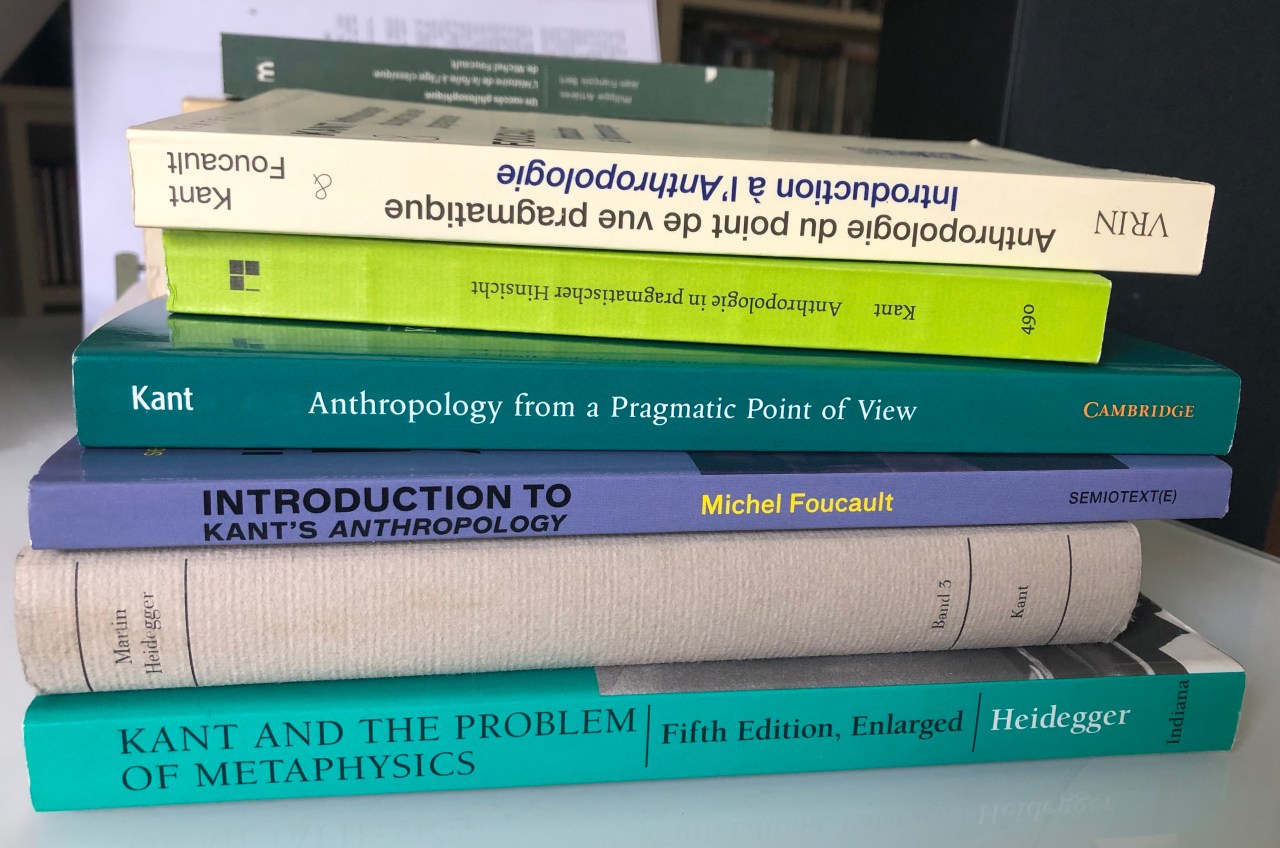
Kant.jpgThankfully, this book manuscript has been the main focus again of work over the past month.

I’ve been continuing to work on Foucault’s relation to Dumézil, on Foucault’s time in Warsaw and Hamburg, and other things in the later 1950s. I had a couple of days in Paris where I was able to resolve a lot of small issues with texts that I can’t access in the UK, as well as return to a box of materials at the archive. Work included rechecking material on microfilm and newspapers, tiny details that perhaps cumulatively add up to something. Following up a reference in one of Didier Eribon’s studies led me to a text that isn’t in any of the Foucault anthologies and which I’d previously not known about. No UK libraries seem to have a copy, but I found a second-hand copy online, so that’s on the way.

For the last…

View original post 941 more words

Marianna Papastephanou, Michel Foucault’s limit-experience limited (2018) Educational Philosophy and Theory, 50 (4), pp. 390-403.
https://doi.org/10.1080/00131857.2017.1367661

Abstract
Educational philosophy has not discussed Foucault’s publications on the Iranian Revolution and the related controversy. Foucauldian concepts are applied to education, though his only writings which ‘sidetracked’ him from exploring power within the state, namely, his journalistic accounts of his visits to Iran, remain unexplored in our field. Against moralist accusations of Foucault’s views on Iran as ‘singularly uncritical’, and beyond standard postcolonial charges of Foucault with exoticism and orientalism, I examine how the writings in question reveal ambivalences and limits of Foucauldian philosophy and complicate the glorification of limit-experience in educational theory. © 2017 Philosophy of Education Society of Australasia.

Author Keywords
Islamophobia; knowledge; power; resistance; Utopia

A look at just some of the work displayed at the inaugural Toronto Biennial of Art, Toronto Life, Jean Grant | Photography By Gabby Frank | September 25, 2019

Editor: Update 12 February 2026. Link above is to the page archived on the Wayback Machine.

The Toronto Biennial of Art is a brand-new, totally free contemporary art exhibit that’s running at various waterfront venues, from now until the beginning of December.

Neon sign, from Parisian artist Laurent Grasso