
Foucault News

News and resources on French thinker Michel Foucault (1926-1984)


Foucault Studies, Vol 1 No 28 (2020): Number 28, September 2020

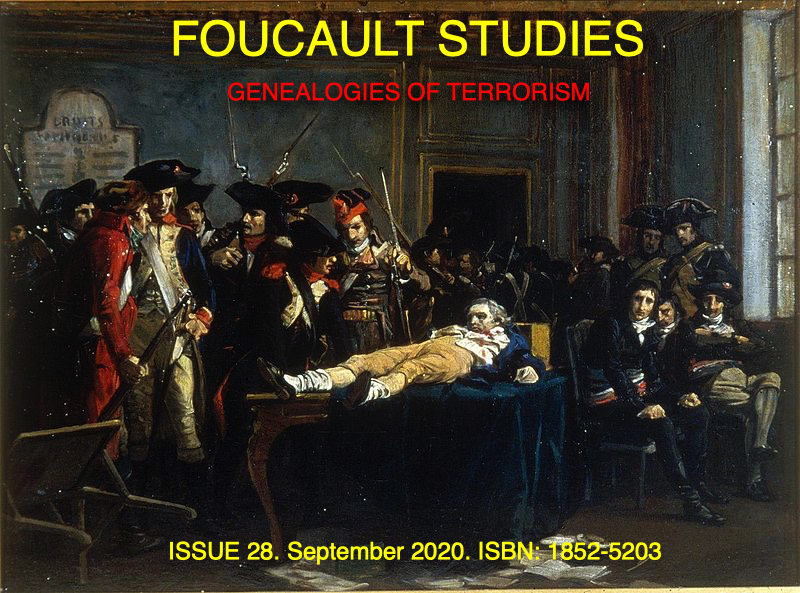
The editors of Foucault Studies are pleased to publish this issue containing a review symposium of Verena Erlenbusch-Anderson’s “Genealogies of Terrorism” as well as four original articles and three book reviews.

Editorial
Sverre Raffnsøe et al.

Review Symposium
Preface to Symposium on Verena Erlenbusch-Anderson’s “Genealogies of Terrorism”
Colin Koopman

Examining Genealogy as Engaged Critique
Samir Haddad

Genealogy, Terrorism, and the “Relays” of Thought
Sarah K. Hansen

Situating Genealogies of Terrorism
Cressida J. Heyes

Genealogy as Multiplicity, Contestation, and Relay: Response to Samir Haddad, Sarah Hansen, and Cressida Heyes
Verena Erlenbusch-Anderson

Articles
The carceral existence of social work academics: a Foucauldian analysis of social work education in English universities
Diane Simpson, Sarah Amsler

On the Ways of Writing the History of the State
Eli B. Lichtenstein

Foucault On Psychoanalysis: Missed Encounter or Gordian Knot?
Mark G. E. Kelly

Parrhesia and the ethics of public service – towards a genealogy of the bureaucrat as frank counsellor
Edward Barratt

Review Essay
Foucault on Drugs: The Personal, the Ethical and the Political in Foucault in California
Kurt Borg

Book Reviews
Marcelo Hoffman (special ed.), Foucault and the Politics of Resistance in Brazil. The Carceral Notebooks 13. (2017-2018). pp. 230. http://www.thecarceral.org/journal-vol13.html.
Pedro Mauricio Garcia Dotto

C. Heike Schotten, Queer Terror: Life, Death, and Desire in the Settler Colony. (New York: Columbia University Press, 2018). 272 pp. ISBN: 9780231187473.
Yin-An Chen
Tom Bentley, Settler state apologies and the elusiveness of forgiveness: The purification ritual that does not purify (2020) Contemporary Political Theory, 19 (3), pp. 381-403.
https://doi.org/10.1057/s41296-019-00356-6

Open access

Abstract
Focusing on Australian Prime Minister Kevin Rudd’s 2008 apology to the Stolen Generations, this article asks: can colonial-settler states obtain forgiveness through political apologies? The article first defends Jacques Derrida’s observation that political apologies resemble the Christian practice of confession. In doing so, it subsequently draws on Michel Foucault’s (1979) detailed treatise on confession in order to assess the potential for absolution. For Foucault, the process of engaging in exhaustive truth-telling of sin before a demarcated authority provides a route to such atonement. By contrast, any potential unburdening of sin is lost when there is either no adequate authority to coax the confession or if the confession is less than full. The problem for the settler state is that it is predisposed to re-evoking the imaginary of the settler nation and Westphalian sovereignty in the very process of apologising. Consequently, there is no scope to submit before a higher sovereign body and any truth-telling is necessarily partial. As such, the central argument is that forgiveness for the settler state must remain elusive. The political opportunities arising from this for Indigenous peoples are discussed in the final section. © 2019, Springer Nature Limited.

Author Keywords
Australia; confession; forgiveness; political apology; settler colonialism; Stolen Generations

Kathryn Gomersall, Imposition to agonism: Voluntary poverty alleviation resettlement in rural China (2020) Political Geography, 82, art. no. 102250.
https://doi.org/10.1016/j.polgeo.2020.102250

Abstract
Implementation of voluntary Poverty Alleviation Resettlement (PAR) in Shanxi Province, rural China is a function of the democratic processes of village governance under the Organic Law of Villages Committees and Assemblies. Villages consult with their constituent households on the decision to resettle and aspects of the process of rebuilding homes and livelihood adaptations. This article analyses the participatory process through an analytic of government that exposes the contingency of local governance as liberal techniques are negotiated amongst historical illiberal governance norms. Processes of subjection during resettlement decision making and implementation defy a liberal/illiberal binary as the effects of power during governance can have a duel nature. These effects produce dialectical tensions that the local Party-state draws on to smooth consent for their political economic goals. Villagers in response draw on multiple political and economic subjectivities to reposition themselves and contest intersubjective norms that define relations between governor and governed. Contestation is most aptly defined as agonism which represents the permanent provocation (Foucault, 1982) between liberal and illiberal governance and the potential for equitable resettlement outcomes. © 2020 Elsevier Ltd

Author Keywords
Agonism; China; Democratic governance; Dialectics; Governmentality; Resettlement

Index Keywords
local government, political economy, poverty alleviation, rural area; China, Shanxi

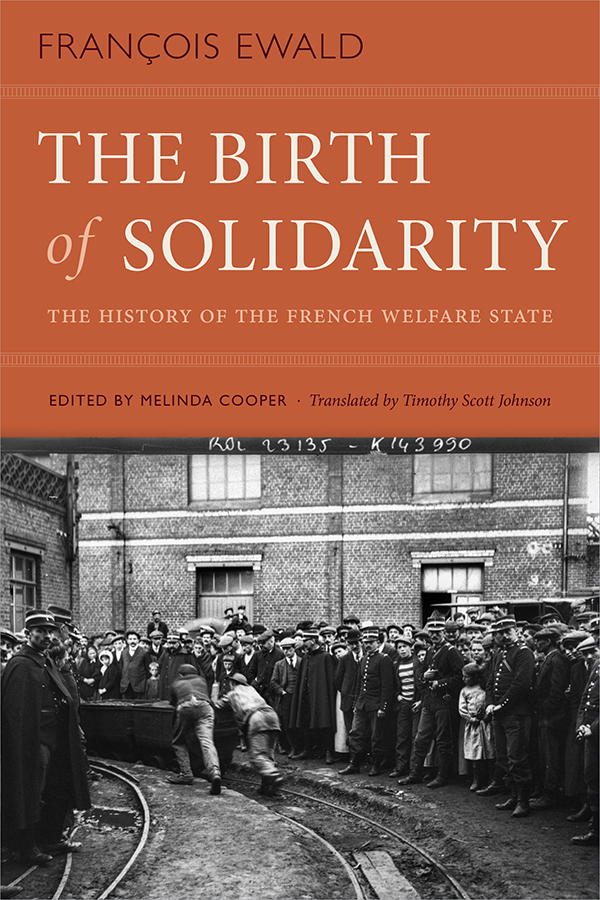
François Ewald, The Birth of Solidarity. The History of the French Welfare State, Duke University Press, Editor: Melinda Cooper, Translator: Timothy Scott Johnson, 2020

François Ewald’s landmark The Birth of Solidarity—first published in French in 1986, revised in 1996, with the revised edition appearing here in English for the first time—is one of the most important historical and philosophical studies of the rise of the welfare state. Theorizing the origins of social insurance, Ewald shows how the growing problem of industrial accidents in France throughout the nineteenth century tested the limits of classical liberalism and its notions of individual responsibility. As workers and capitalists confronted each other over the problem of workplace accidents, they transformed the older practice of commercial insurance into an instrument of state intervention, thereby creating an entirely new conception of law, the state, and social solidarity. What emerged was a new system of social insurance guaranteed by the state. The Birth of Solidarity is a classic work of social and political theory that will appeal to all those interested in labor power, the making and dismantling of the welfare state, and Foucauldian notions of governmentality, security, risk, and the limits of liberalism.

François Ewald is International Research Fellow at the University of Connecticut School of Law, chair of the Scientific Committee of the Université de l’Assurance, and the author and coeditor of several books in French.

Melinda Cooper is Professor of Sociology at the Australian National University.

Timothy Scott Johnson is Visiting Assistant Professor of History at Texas A&M University, Corpus Christi.

Michel Foucault, Political Spirituality as the Will for Alterity: An Interview with the Nouvel Observateur. Critical Inquiry Volume 47, Number 1, 2020. Translated and introduced by Sabina Vaccarino Bremner.

Abstract
An interview with Michel Foucault in 1979 that was never published during his lifetime and was recently rediscovered in the archives. The interview, appearing for the first time in English and in its complete form, marks one of Foucault’s final public discussions of the contentious topic of the Iranian Revolution. In particular, Foucault clarifies what he means by “political spirituality” and addresses the respective relations between religion, revolution, and self-transformation.

Scheel, S.
Biopolitical bordering: Enacting populations as intelligible objects of government (2020) European Journal of Social Theory, 23 (4), pp. 571-590.

DOI: 10.1177/1368431019900096

Open access

Abstract
Since Foucault introduced the notion of biopolitics, it has been fiercely debated—usually in highly generalized terms—how to interpret and use this concept. This article argues that these discussions need to be situated, as biopolitics have features that do not travel from one site to the next. This becomes apparent if we attend to an aspect of biopolitics that has only received scant attention so far: the knowledge practices required to constitute populations as intelligible objects of government. To illustrate this point, the article focuses on processes of biopolitical bordering: the delineation of the target population that is to be known via statistical practices. Drawing on the example of Estonia I show that methodological decisions involved in this work have important biopolitical implications as they affect the size and composition of the population, thus shaping the design of programmes of government aiming at its regulation. © The Author(s) 2020.

Author Keywords
Biopolitics; governmentality; performativity; politics of method; statistics

Kovács, G.
“I’m all that stands between them and chaos:” A monstrous way of ruling in A Song of Ice and Fire (2020) Humanities and Social Sciences Communications, 7 (1), art. no. 70.

DOI: 10.1057/s41599-020-00562-3

Open access

Abstract
The article explores Tyrion Lannister’s rule in King’s Landing in the second volume of A Song of Ice and Fire books, A Clash of Kings. In the reception of ASOIAF and the TV show Game of Thrones, Tyrion was considered one of the best rulers, and the TV show ended by making him Hand to a king who delegated the greatest part of ruling to him. The analysis is based on Foucault’s notion of monstrosity in power, which is characterized by a monstrous conduct and includes the excess and potential abuse of power. The article argues that monstrosity in his rule reveals deeper layers in Tyrion’s personality, which is initially suggested to be defined by morality. The article also comes to the conclusion that his morality limits the scope of his monstrous methods, which eventually leads to his fall from power. © 2020, The Author(s).

Sandset, T.
The ethical and epistemological pitfalls of translating phylogenetic HIV testing: from patient-centered care to surveillance (2020) Humanities and Social Sciences Communications, 7 (1), art. no. 19.

DOI: 10.1057/s41599-020-0522-4

Abstract
In both HIV science and public health policy, efforts to end the HIV epidemic are increasingly focusing on molecular HIV surveillance as a helpful tool for identifying, intervening in and controlling the disease. HIV surveillance is meant to identify clusters of genetically similar viral strains in near real-time in communities and areas where transmissions occur, and then to intervene by means of enhanced public health approaches. This article critically engages with how molecular HIV surveillance—a practice and technology portrayed as a benign public health intervention—empties and purifies many of the social and political contexts of HIV transmissions. McClelland et al. (Crit Public Health 1–7, 2019) see the rise of molecular HIV surveillance as a form of “repurposing” of clinical phylogenetic testing done in the context of HIV care. In this article, I argue that this so-called repurposing can be understood as a form of “translation”. Looking at how phylogenetic HIV testing has been translated from clinical, patient-centered use to a form of molecular HIV surveillance, I seek to map some of the potential ethical and epistemological pitfalls of such a translational process. More specifically, I look at the unintended consequences of translating a particular evidence-based practice—phylogenetic HIV testing—from one usage to another. To this end, I engage with Michel Foucault and his work on the biopower of medicine, exploring how such power disciplines subjects into undergoing a form of medical surveillance that influences norms and behaviors. Ultimately, I argue that the translation of phylogenetic testing from patient-centered care in the clinic to a form of epidemiological surveillance needs to be critically examined in order to avoid ethical and potentially detrimental consequences for HIV-affected communities. © 2020, The Author(s).

Jan Krasni, How to hijack a discourse? Reflections on the concepts of post-truth and fake news (2020) Humanities and Social Sciences Communications, 7 (1), art. no. 32.
https://doi.org/10.1057/s41599-020-0527-z

Abstract
The aim of this paper is threefold: to perform a (meta)discursive archaeology of the concepts post-truth and fake news, to critically reflect on the change in the application of these concepts between the various domains of discourse such as public intellectual field or academic research and mainstream media, and finally to show how the concept of post-truth is now used against the very intellectual milieu it originates from. Whereas the first objective deals with the historical reconceptualization process, the second shows—drawing on the case of social networks—how the concept of fake news infects topics of public relevance, while the third demonstrates how ubiquitous the critique of the left and postmodern intellectual tradition is. This paper combines Foucault’s and Agamben’s approaches to reconstruct the changes and evolution of the concept and the knowledge that defines it. It considers various sources in which this discourse exists regardless of their ideological background—from intellectual discussions on its formation and critiques of the phenomenon it stands for, to journalistic materials which constitute the body of post-truth and fake news discourse today.

Antonelli, V., Bigoni, M., Cafaro, E.M., D’Alessio, R.
Railway systems and the ‘Universal Good of the State’: Technologies of government in the nineteenth-century Papal State (2020) Accounting History, 25 (3), pp. 375-402.

DOI: 10.1177/1032373219862615

Abstract
Informed by Foucault’s concept of governmentality, the article focuses on the nineteenth-century General Commissariat for the Railroad Industry in the Papal State. Unlike in liberal States, where government intervention in the affairs of railway companies was limited, the pressing need to reinforce the Pope’s pastoral power, strengthen the bond between the believers and the Holy See and ensure equity and the efficiency of the new infrastructure meant that the Commissariat acted as a governmental centre of calculation. Accounting technologies in the form of budgets, cost accounting systems and penetrating audits enabled the government to intervene in the operations of private railway companies. The study analyses the role of accounting and auditing practices in the pursuit of non-liberal goals in an industry which is traditionally perceived as critical to the development of a liberal economy, and when accounting was traditionally used to maintain investors’ confidence in the capitalist system. © The Author(s) 2019.

Author Keywords
calculative devices; centre of calculation; governmentality; nineteenth century; Papal State; railroad industry