Foucault News

News and resources on French thinker Michel Foucault (1926-1984)

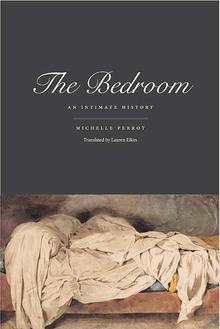
The Bedroom by Michelle Perrot review – an intimate history by Kathryn Hughes, The Guardian,
Tue 11 Dec 2018

Details for book

The bedroom, says French superstar historian Michelle Perrot, is the place where everything important has already happened. From the days when early man first rolled a boulder in front of his cave and told neighbours to knock first, to hospital rooms, ladies’ boudoirs, prison cells and Proust’s cork-lined grime box, the bedroom is the place where we are most authentically, and explosively, ourselves. Perrot sets out to locate what she calls the “multiple genealogies” of the bedroom, “the melodic lines where religion and power, health and illness, body and spirit, love and sex interweave”. This sounds so dreamy and yet so thrilling – thanks in part to Lauren Elkin’s exquisite translation – that you can’t wait to push open the door and get cracking on this search for God, love, rest and death.
[…]

Foucault’s Confessions,
May 4-June 3 2021
Tuesdays and Thursdays at 11 a.m.,
free and open to the public.
For more information and to register, visit foucaultsconfessions.org.

(See also this news item on the Rice University site)

Over five weeks in the month of May and the beginning of June, an international group of scholars will engage the work of Michel Foucault at the intersection of ethics, power, and Christianity in the context of the 2018 Éditions Gallimard publication of Les Aveux de la chair and its 2021 translation as Confessions of the Flesh. Foucault’s work and biography are not without controversy and we invite both critical and charitable engagement from speakers and audience members.

This series of virtual talks will take place on Tuesdays and Thursdays at 11:00 Houston/12:00 NYC/18:00 Paris & Johannesburg. Each session will last one hour, featuring a speaker’s paper for 30-45 minutes, and followed by discussion. These twice-a-week talks will promote continuity as a series, without the constraints of a virtual marathon. Many of these talks will be recorded and will constitute an ongoing resource for viewers around the world.

We are particularly enthusiastic about the conversations between speakers on Foucault’s “last decade” (1974-1984) rethinking bodies, sexuality, and biopolitics, historical forms of ethics as care of the self and of the other, possibilities for resistance to oppressive norms, and theoretical challenges “to think differently, instead of legitimating what is already known.” Contextualizing Foucault’s Confessions of the Flesh is vital for the reading of this book and the general understanding of its relation to his developing theories of subjectivity, sexual ethics, and truth-telling. Les Aveux de la chair includes research from his 1978-1982 lectures, is based on the draft manuscript submitted to Gallimard in 1982, and includes Foucault’s handwritten edits in 1984.

Four decades after Foucault drafted this History of Sexuality, Volume IV, we can appreciate his formidable influence on the production of discourses in both academic scholarship and cultural formations as well as apply pressure to some of his historical and theoretical claims. We can also level necessary critiques of his own abuses of power and the conceptual limitations of his theorizations of subjectivity on the basis of gender, race, ethnicity, age, and class. This series on Foucault’s Confessions of the Flesh takes up this charge critically, charitably, and in a committed manner.

This series is hosted by the Department of Religion at Rice University, with the support of the Rockwell Fund and through the assistance of Marcie Newton and Diana Heard. We thank the Humanities Research Center at Rice University for their invaluable support. We look forward to seeing how this conversation continues over time.

– Niki Kasumi Clements & James Faubion

Program

Tuesday, May 4
James Bernauer: “Fascinating Flesh: Revealing the Spiritual Foucault”

Thursday, May 6
Peter Brown: In Conversation

Tuesday, May 11
Philippe Chevallier: “The Birth of Confessions of the Flesh”

Thursday, May 13
Mark Jordan: “Lust in Paradise: On the Origin of Sexualized Selves”

Tuesday, May 18
Lynne Huffer: “Foucault’s Queer Virgins”

Wednesday, May 19
Niki Kasumi Clements: “Foucault’s Christianities”

Thursday, May 20
Elizabeth A. Clark: “Contextualizing Foucault’s Augustine”

Tuesday, May 25
Arianna Sforzini: “Rebellious Flesh: Virgins, Consecrated Women, and the Radicality of Conversion”

Thursday, May 27
Daniele Lorenzini: “Foucault’s Genealogy of Modern Knowledge About Sexuality: From São Paulo to Confessions of the Flesh”

Tuesday, June 1
Martina Tazzioli: “‘If the Truth is Turned Against the Colonised’: Exhaustive Verbalisation and the Impossibility of Truth-Telling”

Thursday, June 3
Achille Mbembe: In Conversation
Followed by series commentary from James D. Faubion

Luis de Miranda's avatarCREALECTICS

Call for Chapters for a collective book (including a symposium)

Possibility, (Re)Generation, Care: Perspectives on Philosophical Health

Edited by Luis de Miranda[1]and Elisabetta Basso

This book is the first of its kind to explore the emerging concept of philosophical health in contemporary contexts of care as distinct from, yet complementary to physical and psychological forms of health.We envisiona prioriphilosophical healthasa state of fruitful coherence between a person’s ways of thinking and speaking and their ways of acting, such that the possibilities for a good life are increased and the needs for self- and intersubjective flourishing satisfied.This is however an open, emerging concept, and the present book is dedicated to exploring its full potential.

The question of care has today become a central philosophical issue. Most researchers have emphasized the relational and intersubjective character of the experience of care (care can be defined as a relationship with…

View original post 2,159 more words

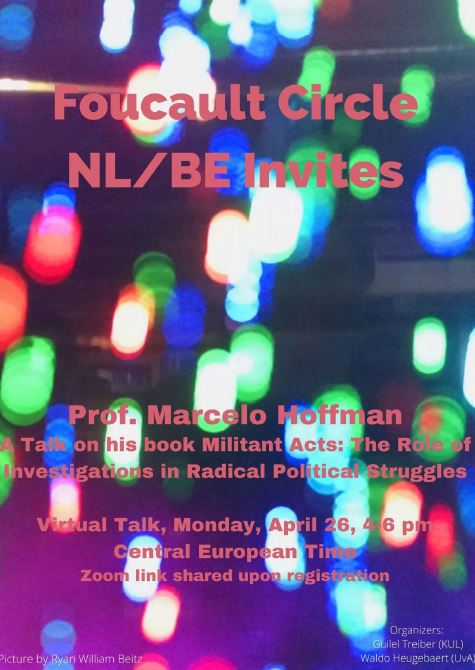
The Foucault Circle NL/BE invites you to join
Professor Marcelo Hoffman for a talk on his latest book
Date: April 26 2021
Time: 16:00 – 18:00 Central European Time
Location: Online (Zoom link shared upon registration)
Registration via this form on Google forms

Marcelo Hoffman, Militant Acts: The Role of Investigations in Radical Political Struggles In this book, Foucault’s work on investigations in the early seventies is highlighted.

Professor Hoffman is also the author of Foucault and Power: The Influence of Political Engagement on Theories of Power (Bloomsbury, 2014).

The event will take place on Zoom and will be moderated by Dr. Guilel Treiber (RIPPLE, KU Leuven). The event will be in English.

You are kindly asked to register via the following Google Forms link: https://forms.gle/pranjwSdkRLMtjGu6. For any question or inquiry please use our mail: foucaultcirclenlbe@gmail.com

Murphy, Brendon. “Against wellbeing: The problem of resources, metrics and care of the self.” Alternative Law Journal (2021). Published 8 April 2021

10.1177/1037969X211007580

Abstract
This article critically engages with the concept and practice of ‘wellbeing’. Over the last decade, managerial practices have broadly introduced ‘wellbeing’ policies into the workplace, including the legal workplace. While these practices, in principle, can offer important forms of support for staff under professional stress, they can also be counterproductive, and have the effect of escalating stress and isolation. Drawing on Foucault, this article turns wellbeing on its head and identifies the dark side of what has become a widely practised form of control. It concludes by advocating for employee dialogue and genuine care rather than responsibilising employees for systemic failings.

Keywords
Foucault, wellbeing, social theory, criminal justice, industrial relations

Byung-Chul Han, The Tiredness Virus. The Nation, April 12, 2021
Covid-19 has driven us into a collective fatigue.

Covid-19 is a mirror that reflects back to us the crises in our society. It renders more visible the pathological symptoms that already existed before the pandemic. One of these symptoms is tiredness. We all somehow feel very tired. This is a fundamental tiredness that accompanies us everywhere and all the time, like our own shadows. During the pandemic we have felt even more tired. The idleness imposed on us during lockdown has made us tired. Some people claim that we might rediscover the beauty of leisure, that life might decelerate. In fact, time during the pandemic is ruled not by leisure and deceleration but by tiredness and depression.

Why do we feel so tired? Today, tiredness seems to be a global phenomenon. Ten years ago, I published a book, The Burnout Society, in which I described tiredness as an illness afflicting the neoliberal achievement society. The tiredness experienced during the pandemic has forced me to think about the subject again.
[…]

The neoliberal achievement society makes exploitation possible even without domination. The disciplinary society with its commandments and prohibitions, as analyzed by Michel Foucault in his Discipline and Punish, does not describe today’s achievement society. The achievement society exploits freedom itself. Self-exploitation is more efficient than exploitation by others because it goes hand in hand with a feeling of freedom.
[…]

Byung-Chul Han is a Korean-born German philosopher. His most recent book, Capitalism and the Death Drive, is published by Polity. A professor of Philosophy and Cultural Studies at the University of the Arts in Berlin, Han’s books include The Burnout Society, The Expulsion of the Other, and The Disappearance of Rituals. The Guardian has described him as “a wunderkind of a newly resurgent and unprecedentedly readable German philosophy,” and El País has called him “the most widely read living German philosopher in the world.”

stuartelden's avatarProgressive Geographies

Michel Foucault and the Social Contract, Chris Watkin with Stuart Elden and Mark Kelly – video of Monash discussion, 13 April 2021. Youtube video above, also available as a podcast.

My talk was entitled ‘The Yoke of Law and the Lustre of Glory’; Mark’s ‘Social Contract as Norm’.

Internationally renowned Foucault scholars Stuart Elden (Warwick University, UK) and Mark Kelly (Western Sydney University, Australia) discuss Michel Foucault’s relationship to the modern social contract idea. Followed by questions and discussion.

The seminar took place on 13 April 2021, and was hosted by Christopher Watkin (Monash University, Australia), as part of the Australian Research Council funded Future Fellowship project “Rewriting the Social Contract: Technology, Ecology, Extremism”.

To find out more about the Social Contract Research Network, please visit https://www.monash.edu/arts/languages…​

Subscribe to the Social Contract Research Podcast at https://anchor.fm/social-contract-res…​

Abstracts:

Stuart Elden (Warwick University), ‘The Yoke of Law and the…

View original post 328 more words

Falch, L.A.
A career open to the talents—Nurses’ doing and focus during the history
(2021) Nursing Philosophy, 22 (1).

DOI: 10.1111/nup.12336

Abstract
Based on a historical and a contemporary fieldwork at a Danish hospital, this article offers a genealogical and philosophical exploration of the development of nurses’ doing and focus within a hospital setting from the 1800 s to the present day. This exploration finds that nurses’ doing has changed during history, which is reflected in their focus. Thus, nurses’ focus has developed from, what the Danish philosopher Uffe Juul Jensen refers to as a situation-oriented, to a disease-oriented practice, and while new values are established, the conception of care as a core value in nursing seems to have receded. This article also argues that today’s nurses are doing what doctors did in the 19th century. The French philosopher Michel Foucault discusses how things repeat themselves in new ways and new contexts. The nursing profession has become ‘a career open to the talents’ where nurses with the appropriate skills and talents are able to build a career, within which they provide status, position and legitimacy. The conclusion of the article discusses the significance of this development for patients and the nursing profession. © 2020 John Wiley & Sons Ltd

Author Keywords
genealogy; ideas in nursing; nursing practice; nursing profession; philosophy; values in nursing

D. Lemus-Delgado,
China and the battle to win the scientific narrative about the origin of COVID-19
(2020) Journal of Science Communication, 19 (5), pp. 1-16.

DOI: 10.22323/2.19050206

Abstract
The emergence of COVID-19 represented a critical problem for the legitimacy and prestige of the Chinese Communist Party. The Chinese authorities had to fight not only to contain the spread of the virus but also to create a favorable public opinion about how they managed the crisis. Based on Foucault’s approach to the “Regime of Truth”, this article analyzes the narrative surrounding the origin of the virus and how science was employed to lend it legitimacy. The article concludes by reviewing how the idea of science as a truth knowledge is used to construct a particular viewpoint, one focused on legitimizing the outbreak containment measures taken by the Chinese government. © 2020

Author Keywords
Public perception of science and technology; Representations of science and technology; Science and media

Chambers, S.A.
Subject positions and seriality in the good wife, In
Hudelet, Ariane, and Anne Crémieux, eds. Exploring Seriality on Screen: Audiovisual Narratives in Film and Television. Routledge, 2020., pp. 233-258.

DOI: 10.4324/9781003044772-17

Abstract
This chapter explores the cultural politics of the US network drama The Good Wife (2009-2016). By reading the idea of “the good wife” through Michel Foucault’s understanding of subject positions, the chapter considers the extent to which the initial setup and development of the series make possible a subtle exploration of norms, subjectivity, and agency, ultimately staging a powerful subversion of certain dominant norms of gender and sexuality. Anchoring this analysis is the central role of the unique and intentional seriality of the show, manifest in both the fundamental idea of “the good wife” as subject position and in a variety of explicit techniques used by the showrunners. © 2021 Taylor & Francis.