Foucault News

News and resources on French thinker Michel Foucault (1926-1984)

Bandiera, R.
Marx, Foucault, and state–corporate harm: a case study of regulatory failure in Australian non-prescription medicine regulation
(2021) Crime, Law and Social Change

DOI: 10.1007/s10611-021-09953-2

Abstract
Risk-based regulation has underpinned Australian prescription and non-prescription medicine regulation for over three decades. However, data consistently demonstrate high rates of non-compliance among non-prescription medicine sponsors, with most breaches a result of inappropriate labelling and advertising, a lack of evidence to substantiate therapeutic claims, and product formulation and manufacturing. This paper seeks to understand why the regime fails to achieve compliance from non-prescription medicine sponsors. Using a state–corporate harm lens, and Marxist and Foucauldian perspectives, it is argued that regulatory failure is the product of the regime’s congruence with neoliberal governmentality. This governmentality is inextricably linked to a neoliberal market hegemony that attempts to minimize forms of market intervention detrimental to the accumulation of capital.

Agustin Colombo (UCLouvain, centre CERPhiCO) et Paul Slama (UNamur) ont le plaisir de vous annoncer la troisième séance du séminaire interdisciplinaire “Subjectivité et religion“. Elle aura lieu le jeudi 24 juin 2021, de 15h00 à 17h00 et accueillera Jacob Schmutz (UCLouvain).
Il présentera une communication intitulée “Conscience moderne et désobéissance civile. Quelques leçons de la théologie moderne, XVIe-XVIIIe siècles”.


Pour participer à cette session, veuillez vous inscrire en ligne.
Pour toute demande d’information, contacter Agustin Colombo (agustin.colombo@uclouvain.be) ou Paul Slama (paul.slama@unamur.be)


Résumé :

A l’époque moderne, deux concepts différents de conscience entrent en concurrence, que la langue française ne différencie pas depuis le choix funeste de Coste de rendre l’un par l’autre : d’une part, le concept théologique traditionnel, la conscience-conscience (en anglais)-Gewissen (en allemand), héritage de la synderesis patristique et scolastique, principe de discernement inné du bien et du mal ; d’autre part, un nouveau concept de conscience-consciousness (en anglais)-Bewusstsein (en allemand), qui s’impose comme un concept proprement philosophique pour décrire la présence à soi de l’âme, immédiate ou réflexive, et qui devient la marque propre d’une subjectivité ordonnatrice du réel à partir de ses propres perceptions ou certitudes innées. De Hegel à Foucault, en passant par Heidegger ou Blumenberg, les défenseurs du paradigme de la modernité comme « âge de la subjectivité » et de l’autonomie ont tous insisté d’une manière ou d’une autre sur le rôle fondamental de cette « découverte » moderne de la conscience-consciousness comme condition de possibilité d’un âge moderne de la science délivrée de la religion. Dans ce séminaire, je voudrais proposer une généalogie alternative, et interroger la validité de ce récit. En étudiant les transformations spécifiquement moderne du concept théologique traditionnel de conscience-conscience, je voudrai suggérer qu’elles sont au principe de formes spécifiquement modernes de soumission à l’autorité, d’abord ecclésiale puis étatique. Loin de suggérer une victoire de l’autonomie, les théories religieuses modernes de la conscience insistent au contraire sur une dépendance indépassable du sujet à l’égard de normes dont il ou elle n’est pas l’auteur. Dans le monde chrétien occidental, cette nouvelle hétéronomie se décline toutefois selon deux formes radicalement différentes : d’un côté les conceptions catholiques contre-réformées de la conscience dans la tradition casuistique, où s’élabore une fine nomenclature des conditions auxquelles l’homme doit « déposer » sa conscience et la mettre entre les mains de l’autorité ; de l’autre côté, les conceptions réformées, en particulier puritaines, où la conscience devient un principe normatif propre qui conduit ultimement au rejet des autorités autres que celle de la parole divine transmise dans l’Écriture. Ces deux conceptions se traduisent politiquement dans les débats du XVIIe siècle autour de la désobéissance civile, et structurent encore largement le rapport que les individus entretiennent aujourd’hui vis-à-vis de l’État et de l’autorité des experts qui ont remplacé les directeurs de conscience d’autrefois.

Joynt, C., Rosskama, J.
Toward a trans method, or reciprocity as a way of life
(2021) Feminist Media Histories, 7 (1), pp. 11-20.

DOI: 10.1525/fmh.2021.7.1.11

Abstract
It is reductive yet accurate to assert that Chase Joynt and Jules Rosskam first met because they are both trans people who make documentary films. While the alignment of these affinities does not necessarily prefigure a friendship – in fact, many would argue and experience the opposite – they have found kinship in their shared approach to positions as institutionally embedded academics who are also publicly exhibiting artists. Inspired by Michel Foucault’s “Friendship as a Way of Life”(1997) and the cross-disciplinary, conversational theory making of Lisa Duggan and José Munõz, James Baldwin and Audre Lorde, and Lauren Berlant and Lee Edelman, they use dialogue to extend the intimate interdisciplinary legacies and potentials of thinkers collaboratively discussing social issues. Together, they ask what might be possible in envisioning, theorizing, and enacting a trans cinematic method-a praxis for artists and scholars alike to be in meaningful, mutually supportive, world-sustaining relationships.

Author Keywords
Collaboration; Dialogue; Filmmakers; Reciprocity; Transgender

Un ouvrage dédié au philosophe Michel Foucault, La Nouvelle République, 14/05/2021

See also this site
Publisher’s site

Book brochure

L’association Le jardin de Michel Foucault à Vendeuvre-du-Poitou vient de publier en avril 2021 un livre intitulé Michel Foucault, Côté jardin, Paroles. Cet ouvrage est un recueil de témoignages de personnes qui l’ont connu à Vendeuvre et à Poitiers. Ils dressent un portrait sensible de l’intellectuel en permettant de replacer ses travaux dans son temps, vus de province.

[…]

van der Drift, M. Management and rights amidst plural worlds
(2021) Journal of Speculative Philosophy, 35 (1), pp. 93-115.

DOI: 10.5325/jspecphil.35.1.0093

Abstract
Sylvia Wynter discusses Eurocentric thought as a closed cognitive order. In this article, Mijke van der Drift interrogates this cognitive closure as a style of thought that is intertwined with institutions. By inverting the attention Foucault gives to the subjects under scrutiny, van der Drift shows that the focus on those that maintain the institution, the managerial class, reveals how power and knowledge confgure this contraction of perception. Van der Drift argues that institutions are central to this process because it offers alignment of purpose and understanding by means of rights and discipline. Consequently, this alignment leads to an indifference to other ways of worlding that Philomena Essed and Isabel Hoving describe as “smug ignorance.” Van der Drift argues that this fnds root in the institution, rather than being a harmful side effect that needs to be addressed. To contrast institutional alignment, the author sketches a pluralist ethics that offers an alternative mode of relationality and collective organization. © 2021 The Pennsylvania State University, University Park, PA

Author Keywords
Colonialism; Ethics; Institution; Managerial control; Plural ontology

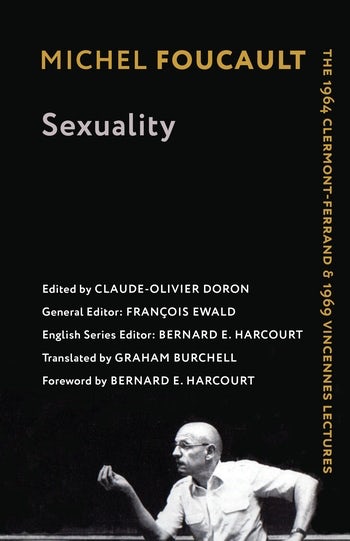
Michel Foucault. Sexuality. The 1964 Clermont-Ferrand and 1969 Vincennes Lectures
Edited by Claude-Olivier Doron. General Editor: François Ewald. English Series Editor: Bernard E. Harcourt. Translated by Graham Burchell. Foreword by Bernard E. Harcourt. Columbia University Press 2021

Michel Foucault’s The History of Sexuality—the first volume of which was published in 1976—exerts a vast influence across the humanities and social sciences. However, Foucault’s interest in the history of sexuality began as early as the 1960s, when he taught two courses on the subject. These lectures offer crucial insight into the development of Foucault’s thought yet have remained unpublished until recently.

This book presents Foucault’s lectures on sexuality for the first time in English. In the first series, held at the University of Clermont-Ferrand in 1964, Foucault asks how sexuality comes to be constituted as a scientific body of knowledge within Western culture and why it derived from the analysis of “perversions”—morbidity, homosexuality, fetishism. The subsequent course, held at the experimental university at Vincennes in 1969, shows how Foucault’s theories were reoriented by the events of May 1968; he refocuses on the regulatory nature of the discourse of sexuality and how it serves economic, social, and political ends. Examining creators of political and literary utopias in the nineteenth and twentieth centuries, from Sade to Fourier to Marcuse, who attempted to integrate “natural” sexualities, including transgressive forms, into social and economic life, Foucault elaborates a double critique of the naturalization and the liberation of sexuality. Together, the lectures span a range of interests, from abnormality to heterotopias to ideology, and they offer an unprecedented glimpse into the evolution of Foucault’s transformative thinking on sexuality.

Michel Foucault (1926-1984), a French philosopher, historian, and social theorist, was one of the most important figures in twentieth-century thought.

Claude-Olivier Doron is a professor of history and philosophy of science at the University of Paris and an editor of the works of Foucault.

François Ewald is a political philosopher and historian, and oversaw, with Alessandro Fontana, the publication of Foucault’s lectures at the Collège de France.

Bernard E. Harcourt is a chaired professor at Columbia University and the École des hautes études en sciences sociales in Paris and has edited a range of works by Foucault in French and English.

Graham Burchell is coeditor of The Foucault Effect: Studies in Governmentality (1991) and has translated a range of works by Foucault, including his lectures at the Collège de France.

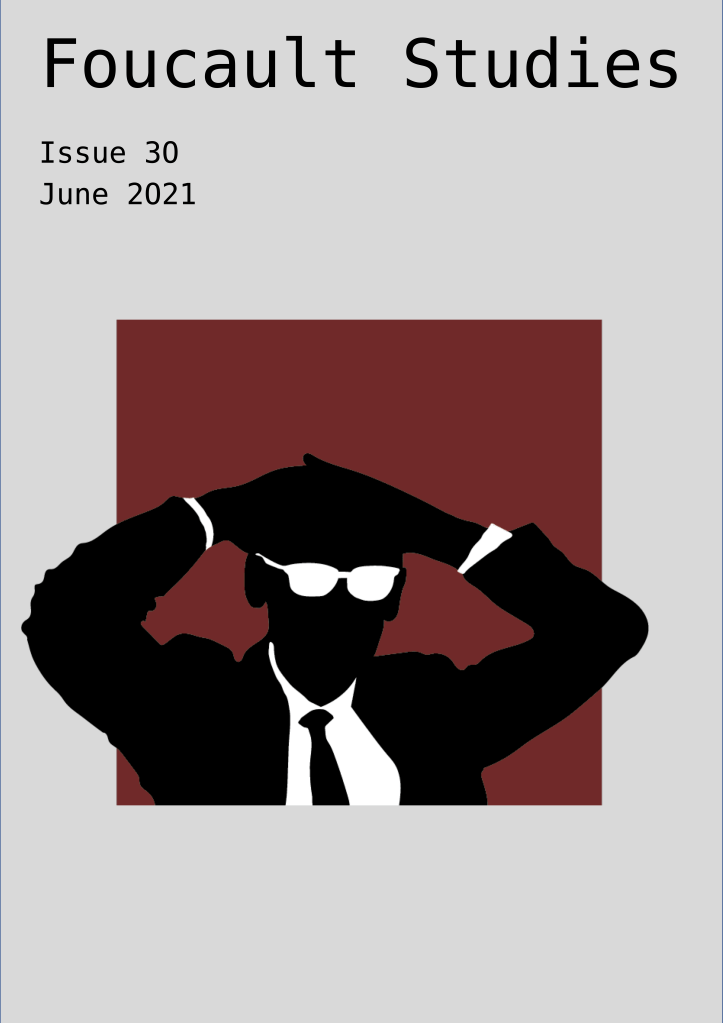
Foucault Studies, Number 30, June 2021
Articles

Resistance: An Arendtian Reading of Solidarity and Friendship in Foucault
Liesbeth Schoonheim

Avowing Unemployment: Confessional Jobseeker Interviews and Professional CVs
Tom Boland

The Carnival of the Mad: Foucault’s Window into the Origin of Psychology
Hannah Lyn Venable

Book Reviews
Nancy Luxon (ed.), Archives of Infamy: Foucault on State Power in the Lives of Ordinary Citizens. Minneapolis: University of Minnesota Press, 2019. 400 pp.
ISBN 9781517901110 (paperback)
Julian Molina

Thomas Lemke, Foucault’s Analysis of Modern Governmentality: A Critique of Political Reason. Translation Erik Butler. London: Verso, 2019. 445 pp.
ISBN-13: 978-1-78663-645-4
Paul Gorby

Patrick G. Stefan, The Power of Resurrection: Foucault, Discipline, and Early Christian Resistance. Lanham, MD: Rowman and Littlefield, 2020. 277pp.
ISBN978-1-9787-0462-6 (hardback), ISBN 978-1-9787-0463-3 (ebook)
Bianca Maria Esposito

Stephen W. Sawyer and Daniel Steinmetz-Jenkins (ed.), Foucault, Neoliberalism, and Beyond. London: Rowman & Littlefield, 2019. 227 pp.
ISBN 978-1-78660-376-0
Rick Mitcham

Stuart Elden, Canguilhem. Cambridge: Polity Press, 2019. 215 pp. + Samuel Talcott, Georges Canguilhem and the Problem of Error. Cham: Palgrave MacMillan, 2019. 294 pp.
ISBN 9781509528783; ISBN 3030007782
Codrin Tăut

Michael Ure, Nietzsche’s The Gay Science: An Introduction. Cambridge Introductions to Key Philosophical Texts. Cambridge: Cambridge University Press, 2019. 273 pp.
ISBN 9780521760904 (hardback), ISBN 9780521144834 (paperback)
Stephanie B. Martens

Review Essay
Critique in Truth: Bernard Harcourt’s Critique & Praxis
Colin Koopman

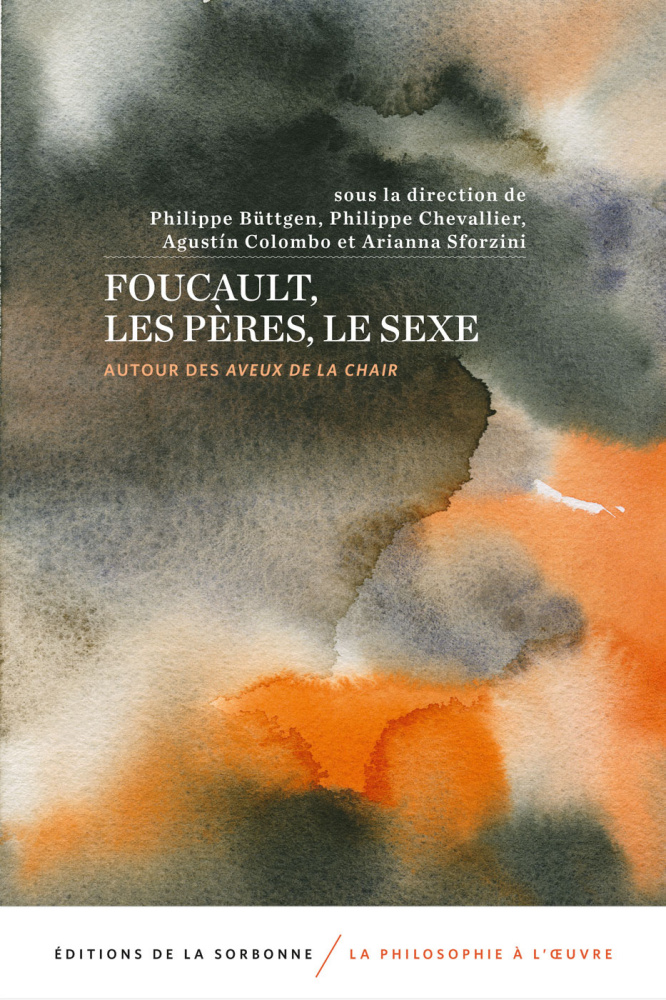
Foucault, les Pères, le sexe. Autour des Aveux de la chair
Edited by Philippe Büttgen, Philippe Chevallier, Agustín Colombo, Arianna Sforzini, Éditions de la Sorbonne, 2021

Description in English below
Flyer in English

Les aveux de La chair, dernier volume de l’Histoire de la sexualité, fruit de près de huit ans de travail sur le christianisme ancien, est le livre auquel Foucault aura consacré le plus de temps, sans parvenir à l’achever complètement. Le détour par les Pères de l’Église (Tertullien, Augustin, Cassien, etc.) devait contribuer à éclairer le rapport que l’Occident entretient au corps et à ses plaisirs, au croisement de la subjectivité et de la vérité. Publiés posthumément en 2018, déjà traduits en plusieurs langues, Les aveux de la chair révèlent l’étendue des recherches conduites par Foucault sur les premiers siècles chrétiens, que les textes et les cours jusqu’ici connus laissaient à peine deviner.

Le présent ouvrage organise une rencontre inédite : les lectures « chrétiennes » de Foucault sont ici interrogées par seize historiens, philosophes et théologiens internationaux, spécialistes de cette période ainsi que de la pensée de Foucault. En quoi l’approche de Foucault renouvelle-t-elle la manière de lire les Pères ? Permet-elle d’aborder autrement la question de la nouveauté apportée par le christianisme dans la culture antique ? Et comment cette nouveauté peut-elle faire sens en philosophie aujourd’hui ? Questions cruciales, non seulement pour l’histoire des idées, mais d’abord et avant tout pour la compréhension de notre actualité.

English
Les aveux de La chair, the last volume of the Histoire de la sexualité, the fruit of nearly eight years of work on ancient Christianity, is the book to which Foucault devoted the most time, without managing to finish it completely. The diversions through the Fathers of the Church (Tertullian, Augustine, Cassian, etc.) was to contribute to shedding light on the relationship that the West has with the body and its pleasures, at the intersection of subjectivity and truth. Published posthumously in 2018 and already translated into several languages, Les aveux de la chair reveals the extent of Foucault’s research on the early Christian centuries, which the texts and courses previously known barely hinted at.

The present book organises a new encounter: Foucault’s «Christian» readings are here questioned by sixteen international historians, philosophers and theologians, specialists of this period as well as of Foucault’s thought. How does Foucault’s approach renew the way of reading the Fathers? Does it allow for a different approach to the question of the novelty brought by Christianity to ancient culture? And how can this novelty make sense in philosophy today? These are crucial questions, not only for the history of ideas, but first and foremost for the understanding of our current situation.

Mitchell Dean and Daniel Zamora, Today, the self is the battlefield of politics. Blame Michel Foucault, The Guardian, 15 June 2021

The rise of confessional politics has its origins in the left’s post-60s turn away from structures and towards the individual

“We are perhaps living at the end of politics,” Michel Foucault wrote in the late 1970s. With the exhaustion of utopias and radical alternatives to capitalism, what was now at stake, he memorably wrote, was to develop “new types, new kinds of relations to ourselves”. Political advancement is not delivered through “parties, trade unions, bureaucracy and politics any more”, he wrote. Instead, politics has become “an individual, moral concern”.

In this new definition of politics – in which “everything is political” and “the personal is political” – the self was thought to have become the battlefield of contemporary politics. At that time, many intellectuals, including Foucault, announced the “end of the age of revolution”, opening an era where transforming oneself became the most popular conception of social change. With the collapse of collective “grand narratives”, they argued, we had now to look inwards. Beginning in the late 60s, political change would be reframed as a struggle against oneself, against our “inner enemy”. One had to confront the “fascist within”.
[…]

Despite what Foucault had hoped for, we have not seen a retreat from confession but an intensification and multiplication of it in the public domain.
[…]

Davis, D.S., Buffa, D., Rasolondrainy, T., Creswell, E., Anyanwu, C., Ibirogba, A., Randolph, C., Ouarghidi, A., Phelps, L.N., Lahiniriko, F., Chrisostome, Z.M., Manahira, G., Douglass, K.
The aerial panopticon and the ethics of archaeological remote sensing in sacred cultural spaces
(2021) Archaeological Prospection

DOI: 10.1002/arp.1819

Abstract
Remote sensing technology has become a standard tool for archaeological prospecting. Yet the ethical guidelines associated with the use of these technologies are not well established and are even less-often discussed in published literature. With a nearly unobstructed view of large geographic spaces, aerial and spaceborne remote sensing technology creates an asymmetrical power dynamic between observers and the observed. Here, we explore the power dynamics involved with aerial and spaceborne remote sensing, using Foucault’s notion of power and the panopticon. In many other areas of archaeological practice, such power imbalances have been actively confronted by collaborative approaches and community engagement, but remote sensing archaeology has been largely absent from such interventions. We discuss how aerial and spaceborne imagery is perceived by local communities in southwest Madagascar and advocate for a more collaborative approach to remote sensing archaeology that includes local stakeholders and researchers in all levels of data acquisition, analysis, and dissemination. © 2021 John Wiley & Sons, Ltd.

Author Keywords
community archaeology; ethics; Madagascar; remote sensing; surveillance