Foucault News

News and resources on French thinker Michel Foucault (1926-1984)

Kahan, Benjamin. The Book of Minor Perverts: Sexology, Etiology, and the Emergences of Sexuality. University of Chicago Press, 2019.

Statue-fondlers, wanderlusters, sex magicians, and nymphomaniacs: the story of these forgotten sexualities—what Michel Foucault deemed “minor perverts”—has never before been told. In The Book of Minor Perverts, Benjamin Kahan sets out to chart the proliferation of sexual classification that arose with the advent of nineteenth-century sexology. The book narrates the shift from Foucault’s “thousand aberrant sexualities” to one: homosexuality. The focus here is less on the effects of queer identity and more on the lines of causation behind a surprising array of minor perverts who refuse to fit neatly into our familiar sexual frameworks. The result stands at the intersection of history, queer studies, and the medical humanities to offer us a new way of feeling our way into the past.

Contents
1 The Walk-in Closet: Situational Homosexuality and the Always of Desire
2 Anthropologia Sexualis, Universalism, and the Macro Environments of Sex
3 Magia Sexualis, Sexual Subjectivity, and the Willfulness of Sexual Aim
4 Sex in the Age of Fordism: The Standardization of Sexual Objects
5 Volitional Etiologies: Toward a Weak Theory of Etiology
After Sedgwick: The Gordian Knot of the Great Paradigm Shift

Javaid, Aliraza. Masculinities, sexualities and love. Routledge, 2018.

Book Description
It can be said that societies today know little of how gender, sexuality and love interconnect in dissimilar contexts, and how they are collectively shaped by social structures.

Underpinned by the theoretical writings of Michel Foucault, Masculinities, Sexualities and Love examines a range of empirical data, including interviews with gay and bisexual men, to understand the ways in which love is constructed and conceptualized. Clearly written, the book is grounded in personal narratives and intimate stories of love, hurt, pain and heartbreak, including the author’s own experiences; and analysed using theoretical frameworks such as hegemonic masculinity, heteronormativity, and post-structuralism. Furthermore, the reader will also find insightful discourse analysis of popular films, such as Fifty Shades of Grey and The Girl on the Train, to examine the construction of love through film.

Forming a timely intervention, Masculinities, Sexualities and Love offers a fresh perspective on the sociology of love and will appeal to students and researchers interested in fields such as Gender and Sexuality Studies, Cultural Studies and Sociology.

Michel Foucault, Confessions of the Flesh. The history of sexuality, Volume 4, Edited by Frederic Gros, Translated by Robert Hurley. Pantheon 2021.

ABOUT CONFESSIONS OF THE FLESH
The fourth and final volume in Michel Foucault’s acclaimed History of Sexuality, completed just before his death in 1984 and finally available to the public

One of the most influential thinkers of the twentieth century, Michel Foucault made an indelible impact on Western thought. The first three volumes in his History of Sexuality—which trace cultural and intellectual notions of sexuality, arguing that it has been profoundly shaped by the power structures applied to it—constitute some of Foucault’s most important work. This fourth volume posits that the origins of totalitarian self-surveillance began with the Christian practice of confession. The manuscript had long been secreted away, in accordance with Foucault’s stated wish that there be no posthumous publication of his unpublished work.

With the sale of the Foucault archives in 2013, Foucault’s nephew felt that the time had come to publish this final volume in Foucault’s seminal history. Philosophically, it is a chapter in his hermeneutics of the desiring subject. Historically, it focuses on the remodeling of subjectivity carried out by the early Christian Fathers, who set out to transform the classical Logos of truthful human discourse into a theologos—the divine Word of a pure sovereign.

What did God will in the matter of righteous sexual practice? Foucault parses out the logic of the various responses proffered by theologians over the centuries, culminating with Saint Augustine’s fascinating discussion of the libido. Sweeping and deeply personal, Confessions of the Flesh is a tour de force from a philosophical master

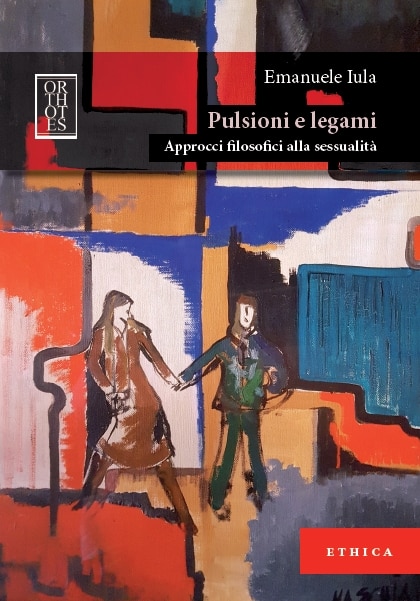
Emanuele Iula, Pulsioni e legami. Approcci filosofici alla sessualità, Orthotes Editrice, 2021

Fornire una comprensione adeguata della sessualità umana significa accettare la sfida della complessità, che si esprime non solo facendo ricorso a vari ambiti disciplinari, ma anche accogliendone il differenziarsi delle pratiche. Al giorno d’oggi non esiste autore, né scuola di pensiero, né indirizzo scientifico, che possa vantarsi di aver compreso appieno tale ambito dell’esperienza umana, che presenta ancora tratti di oscurità. Numerosi sono stati tuttavia i tentativi di confrontarsi a viso aperto con tale tema. Tentativi che sono andati oltre la formulazione di buone ipotesi di lavoro, fornendo alla comunità scientifica determinanti indicazioni per proseguire la ricerca. Pulsioni e legami. Approcci filosofici alla sessualità si presenta come uno strumento di lavoro dal duplice obiettivo. Da un lato, si propone un’ampia ermeneutica con cui viene ricostruito l’approccio di tre tra gli autori che più hanno influenzato gli studi sulla sessualità: Sigmund Freud, Michel Foucault e Judith Butler. Dall’altro lato, si coglie l’occasione per fornire una visione della sessualità incentrata sull’approccio generativo. Grazie a quest’ultimo, verrà non solo descritta la genesi e il modo d’essere di un legame sessuale generativo, ma saranno anche fornite alcune linee per un’etica sessuale capace di confrontarsi con gli interrogativi e le problematiche della modernità.

English
A better comprehension of human sexuality can only be achieved by taking into account different disciplinary approaches to this theme. Despite this, none of these approaches has actually arrived at a complete view. The aim of “Pulsioni e legami. Approcci filosofici alla sessualità” is to make a contribution to the debate by presenting the point of view of the generative approach, by situating itself in a philosophical perspective. The author develops with particular care the concepts of bond, time and renewal.

The first chapter is dedicated to Sigmund Freud and the psychoanalytic approach, with special attention to the concepts of libido and the Oedipus complex. The following chapter is dedicated to Michel Foucault. The notion of historical sexuality is the junction that allows the reader to enter into the idea that sexuality relates to discourse, truth and power. The next step is consecrated to the work of Judith Butler. After considering the Foucauldian heritage of her philosophy, the author introduces the dialectic between performativity and normativity, which allows a different understanding of what it is to be human and consequently, of the idea of social justice.

Author
Emanuele Iula is an Italian Jesuit, associate professor of moral philosophy and conflict mediation at the Pontifical Faculty of Theology of San Luigi (Naples). His research is mainly focused on generative theory, conflict mediation and social ontology.

II encontro nacional e I internacional de biopolítica

O II Encontro Nacional e I Encontro Internacional de Bipolítica: Os desafios da Atualidade acontece no intuito de dar continuidade, e agora visando sua internacionalização, do I Encontro Nacional de Bipolítica: origens e consequências que foi realizado na Universidade Estadual de Londrina no ano de 2018. Evento que teve como produto a organização de um livro sobre a temática do evento e que será publicado ainda neste ano de 2021.

Também com o intuito de promover a divulgação e experimentação em forma de vento dos trabalhos vem sendo realizado a alguns anos pelo Grupo de Pesquisa “(Des)Leitura: Filosofia, Ciência e Arte”, existente desde 2004, vem desenvolvendo na Universidade Estadual de Londrina (UEL-PR), instituição a qual está vinculado. Desde então, o Grupo vem intensificando sua atuação formativa, desde Iniciação Científica, Mestrado e Doutorado na área de Filosofia e Iniciação Científica e Mestrado na área de Psicologia.

Ademais, seus membros têm atuado constantemente em participação em eventos outros, em nível nacional e internacional, bem como em publicações. Neste sentido, vale notar que em 2000 foi realizado o evento “2011”, cujo resultado mais interessante foi a publicação em livro dos resultados obtidos durante aquele evento, a saber Michel Foucault em múltiplas perspectivas (Londrina: EDUEL, 2013), tendo, inclusive, ganhado apoio financeiro da Fundação Araucária do Paraná (FAP-PR) para a sua publicação.

En français

C’est avec un grand plaisir que le Groupe de Recherche (Des)Leitura [(Dé)Lecture], lié à l’École Doctorale et au Master en Philosophie à l’Université d’État de Londrina (Brésil), annonce e invite le II Colloque Nationale et Première Colloque Internationale de Biopolitique : « Les défis de l’actualité » )

Le Colloque aura des conférences de Philippe Sabot (Université de Lille et président du Centre Michel Foucault – France), Hélène L’Heuillet (Université Paris Sorbonne et Psychanalyste – France), Borxa Colmenero (Universidad de Galizia – Espagne), Marcelo Raffin (Universidad de Buenos Aires – Argentine), André Yazbek (Universidade Federal Fluminense – Brésil), Cesar Candiotto (Pontifícia Universidade Católica do Paraná – Brésil), Pedro de Souza (Universidade Federal de Santa Catarina – Brésil) et ailleurs, avec l’équipe du Groupe (Des)Leitura.
Le Colloque sera ente les 08 et 12 mars, avec la diffusion en direct à la page du Groupe au Youtube (des LEITURA Filosofia, Ciência e Arte).

Sylvain Lafleur (ed), Foucault à Montréal réflexions pour une criminologie critique Les éditions de la rue Dorion (2021)

En 1976, Michel Foucault participe à une conférence organisée par l’Office des droits des détenus de concert avec l’École de criminologie de l’Université de Montréal. Il y présente ses réflexions sur l’usage des peines de substitution à l’incarcération qui, pour plusieurs, témoignent d’une tendance à l’adoucissement des punitions et présagent la disparition de la prison. Doutant que les sociétés qui y ont recours soient plus tolérantes, Foucault croit, au contraire, que l’utilisation des peines alternatives est symptomatique de l’extension d’une « société policière » qui ne ménage pas les efforts pour fabriquer des délinquant·s et punir les personnes faisant l’objet d’un ressentiment politique et populiste, qu’elles soient pauvres, migrant·es ou marginales.

Dans « Alternatives » à la prison : diffusion ou décroissance du contrôle social – allocution méconnue et longtemps oubliée enfin restituée ici –, Foucault s’interroge sur la logique soutenant la surveillance accrue des personnes et annonce la transformation de la société en prison ouverte. L’auteur de de Surveiller et punir doute que l’imposition de sanctions non carcérales témoigne qu’une rupture avec l’emprisonnement est survenue et suppose que le recours aux mesures probatoires et à la surveillance policière s’intensifiera avec le temps.

Près d’un demi-siècle plus tard, qu’en est-il des perceptions de Foucault ? L’imposition de peines de substitution participe-t-elle à dématérialiser l’architecture pénale ? Vivons-nous dans une société moins tolérante aux « inconduites » ? Quelle raison pénale marque notre contemporanéité ? Comment fabrique-t-on des délinquant·es aujourd’hui ?

Constitué d’entretiens avec les organisateurs de la conférence de Michel Foucault, Jean-Claude Bernheim et André Normandeau, et de spécialistes du contrôle social et de la criminalité, Jade Bourdages, Tony Ferri et Anthony Amicelle, Foucault à Montréal répond à ces interrogations et porte un regard critique sur la judiciarisation croissante des rapports sociaux.

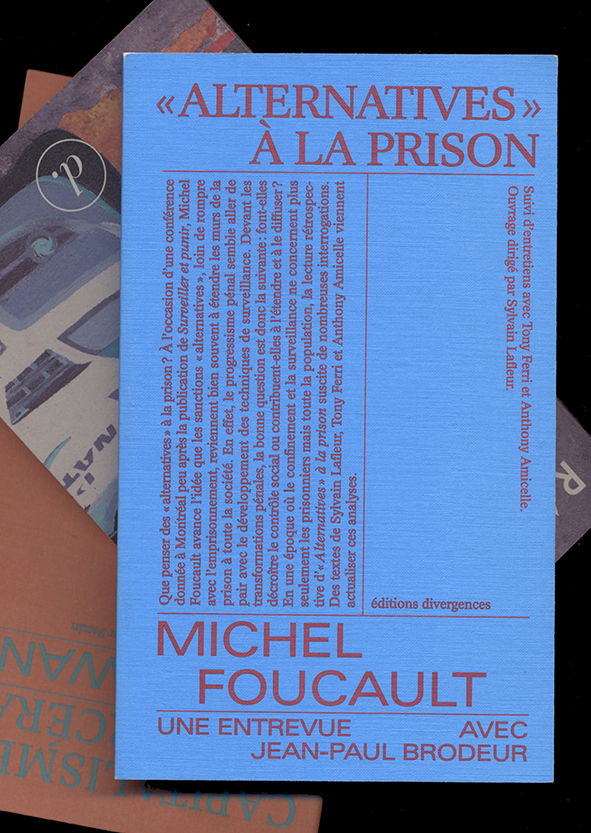
Also published in a shorter version « Alternatives » à la prison Éditions Divergences (Paris), 2020

Que penser des «alternatives» à la prison? À l’occasion d’une conférence donnée à Montréal peu après la publication de Surveiller et punir, Michel Foucault avance l’idée que les sanctions «alternatives», loin de rompre avec l’emprisonnement, reviennent bien souvent à étendre les murs de la prison à toute la société. En effet, le progressisme pénal semble aller de pair avec le développement des techniques de surveillance. Devant les transformations pénales, la bonne question est donc la suivante : font-elles décroître le contrôle social ou contribuent-elles à l’étendre et à le diffuser ? En une époque où le confinement et la surveillance ne concernent plus seulement les prisonniers mais toute la population, la lecture rétrospective d’« Alternatives » à la prison suscite de nombreuses interrogations. Des textes de Sylvain Lafleur, Tony Ferri et Anthony Amicelle viennent actualiser ces analyses. Un ouvrage dirigé par Sylvain Lafleur.


Tomassini, L., Lamond, I., Burrai, E.
Global Citizenship & Parrhesia in Small Values-Based Tourism Firms (2021) Leisure Sciences

DOI: 10.1080/01490400.2021.1874574

Abstract
In this paper we focus on the relationship between justice and tourism and the tension between consumerism and citizenship within the context of small values-based tourism firms. We combine Foucault’s concept of parrhesia, the speaking of “truth to power”, with Latour’s Actor-Network Theory to show how those businesses are situated in an interconnected world, where the global/local distinction is flattened. This qualitative study adopts a narrative approach which consists of in-depth, unstructured interviews with owner-managers of small Italian tour operators. This research suggests that small firms largely make sense of themselves as global citizens; ‘truth-tellers’, pursuing justice in response to the 21st Century’s crises and challenges. In this scenario, alternative tourism forms of production and consumption centered on human beings and their roles in society become central. Thus, we advocate for the emergence of ways to resist capitalist forms of tourism through collective acts of activism. © 2021 Taylor & Francis Group, LLC.

Author Keywords
citizenship; narrative approach; parrhesia; Small tourism firms; values

Caraus, T. The horizon of another world: Foucault’s Cynics and the birth of radical cosmopolitics
(2021) Philosophy and Social Criticism

DOI: 10.1177/0191453720987867

Abstract
The ancient Cynic Diogenes was the first to declare ‘I am a citizen of the world (kosmopolitês)’ and the other Cynics followed him. In The Courage of the Truth, Michel Foucault analyses the Cynic mode of parrhēsia and living in truth, however, his text expands the cosmopolitical amplitude of Cynics since the Cynics’ true life contains an inherent cosmopolitan logic. Identifying the core of the Cynic true life in the care for the self that leads to the care for the others within the horizon of the possibility of another life and another world, Foucault shows how the Cynic establishes ‘an intense bond with the whole of humankind’, cares ‘for all mankind’ and for the whole world as a ‘functionary of humanity’ and, as ‘the scout of humanity’, the Cynic prefigures the future and exercises the ‘government of the universe’. This article argues that Foucault’s account on Cynics maps the very first moments of becoming cosmopolitan and offers an insightful perspective on the process of achieving a cosmopolitan subjectivity, a process displayed by different expressions of cosmopolitanism, and especially the ‘insurgent cosmopolitanism’ from the bottom up. © The Author(s) 2021.

Author Keywords
cosmopolitanism; Cynics; Foucault; parrhēsia; radical cosmopolitics

Emmanuel Chamorro. “Disciplina y capitalismo en la genealogía foucaultiana de la modernidad (1973-1975)”. Revista de Estudios Sociales, no. 75 (2021): 2-14.
DOI: 10.7440/res75.2021.02

Open access

Abstract
Este trabajo se propone reconstruir las reflexiones foucaultianas acerca del nacimiento de la modernidad, con especial atención al papel que en ella desempeñan capitalismo y disciplina. La tesis que defenderemos es que en la obra que Foucault desarrolla en la primera mitad de la década de 1970 —especialmente entre 1973 y 1975— ambas dimensiones aparecen como dos caras de un mismo proceso, lo que establece entre ellas un vínculo necesario. Así, este acercamiento, que polemiza con determinadas posiciones marxistas, trata finalmente de mostrar que las investigaciones acerca del poder disciplinario se pueden concebir como un complemento, y no una corrección, de los análisis desplegados por Marx en El capital.

PALABRAS CLAVE: Capitalismo, disciplina, Foucault, Marx, modernidad

Discipline and Capitalism in Foucault’s Genealogy of Modernity (1973-1975)

The purpose of this paper is to reconstruct Foucault’s reflections on the birth of modernity, paying particular attention to the role of capitalism and discipline within it. The thesis we will defend is that in Foucault’s work in the first half of the 1970s—especially between 1973 and 1975—both dimensions appear as two aspects of the same continuum, thus establishing a necessary link between them. This approach, which contests certain Marxist positions, attempts to reveal that the research on disciplinary power can be conceived as a complement, and not a correction, of the analyses deployed by Marx in Das Kapital.

KEYWORDS: Capitalism, discipline, Foucault, Marx, modernity

Foucault Studies is looking for book reviewers. The list of books that haven’t been assigned a reviewer as yet can be found here.

If you are interested in reviewing one of the books listed, or you wish to suggest or send books for review to the journal, please contact for English-language publications Book Reviews Editor Alan Rosenberg at foucnietz@nyc.rr.com. For non-English language publications contact Reviews Editor Marius Gudmand-Høyer at mgh.lpf@cbs.dk. If you have any questions please contact managing editor Signe Macholm Müller smmu.mpp@cbs.dk.

Book reviews should be between 1,000 and 2,000 words.