Foucault News

News and resources on French thinker Michel Foucault (1926-1984)

S. Walby,
The COVID pandemic and social theory: Social democracy and public health in the crisis
(2021) European Journal of Social Theory, 24 (1), pp. 22-43.

DOI: 10.1177/1368431020970127

Abstract
Social theory is developing in response to the coronavirus (COVID) crisis. Fundamental questions about social justice in the relationship of individuals to society are raised by Delanty in his review of political philosophy, including Agamben, Foucault and Žižek. However, the focus on the libertarian critique of authoritarianism is not enough. The social democratic critique of neoliberalism lies at the centre of the contesting responses to the COVID crisis. A social democratic perspective on public health, democracy and state action is contrasted with the anti-statists of left and right. This is addressed in debates on the relationship between science and governance, the place of crisis in theories of change and the conceptualisation of alternative forms of social formation. The crisis initiated by the pandemic, cascading through society, from health to economy, to polity and into violence, includes a contestation between social democratic and neoliberal visions of alternative forms of society. © The Author(s) 2020.

Author Keywords
Agamben; COVID; crisis; pandemic; public health; social democracy; social theory

Maximilian Brichta, Juxtaposing Foucault: Towards an incorporation of the phenomenological subject in prison analysis
To Sense. 28 Mar 2021

If one wishes to analyze prisons from the communication perspective, they will inevitably grapple with Foucault. His 1975 book Discipline and Punish: The Birth of the Prison has become a canonical assessment of power relations in houses of punishment and myriad other neoliberal institutions in modern society. While this original assessment continues to be highly generative, it is worth stopping and assessing its strengths and highlighting its limitations. Need we be tethered to the Foucauldian framework for analyzing prisons? The question goes beyond direct engagement, for countless other works have extended his framework into the realms of public discourse, race relations, interpersonal interactions, and beyond. In the following pages I trace the work of Foucault through various authors to offer a survey of his impact on contemporary prison scholarship.
[…]

Sabrina Corbellini and Margriet Hoogvliet (eds.): “Medieval and Early Modern Places and Spaces of Knowledge,” in: Le foucaldien, 7/1 (2021),

Collection launched: 29 Mar 2021
This special collection welcomes articles discussing places and spaces connected to knowledge and its practices in the premodern period. In order to be fully understood and investigated, knowledge should be spatialized and studied in relation to the spaces, either physical or conceptual, in which it is produced, transformed, and disseminated. In addition, practices of knowledge are spatially determined and create social and discursive spaces as such, through the dialogical relationship between the participants. Ideally the contributions will address lieux de savoir (Christian Jacob) and situated knowledge in the premodern world, with a special attention to micro-historical approaches and urban contexts, including cartographic representations.

See also
Corbellini, S., & Hoogvliet, M. (2021). Introduction: lieux de savoir and archéologie du savoir. Le Foucaldien, 7(1), 3. DOI: http://doi.org/10.16995/lefou.94

Abstract
The introduction to this special collection addresses a fundamental issue: the link between savoir/knowledge and the spatial turn in the humanities. This point, which will be the connecting thread of the articles to be published in the collection, is addressed and discussed through an analysis of two books that have significantly influenced theoretical reflection in the mentioned field: Michel Foucault’s L’Archéologie du savoir (1969) and Christian Jacob’s Qu’est-ce qu’un lieu de savoir? (2014). Keeping in mind the theoretical developments of the past half century, the introduction will look back on Foucault’s concepts in order to see how they can be re-read in the light of recent developments in the spatial humanities and in particular in connection with the concept of lieux de savoir and the history of (religious) reading and knowledge transfer in medieval and early modern culture.

Keywords: spatial turn, knowledge, lieux de savoir, history of reading, medieval and early modern culture

Dodd, S.
The pleasure of dark places: heterotopia in Mishima Yukio’s Inochi urimasu (Life for Sale)
(2020) Japan Forum.

DOI: 10.1080/09555803.2020.1791229

Abstract
While utopia implies an ideal space, and dystopia a site of dysfunction, Michel Foucault coined the word heterotopia to depict a space containing multiple, overlapping and sometimes conflicting layers of meaning. This article first considers Mishima Yukio (1925–1970) himself as a heterotopian body, both physical and textual, and then goes on to examine how his novel, Inochi urimasu (Life for Sale, 1968), employs a range of heterotopian tropes as a means to critique post-war Japanese society. The novel, which was first serialized in the Japanese Weekly Playboy Magazine, is one of Mishima’s many popular novels that have not attracted much attention to date because it was not considered ‘serious’ enough: it may be described as trashy, kitsch, camp, shallow and sexy. However, I argue that Inochi urimasu conveys a serious intent by employing those very qualities in order to analyse critically a breakdown in human relations that emerged from the ashes of Japan’s wartime defeat. Moreover, beneath the novel’s fast-paced and humorous veneer, there lurks a bleak nihilism–represented through themes such as prostitution, vampirism, violence, and sadomasochism–that provided Mishima with the opportunity to construct alternative and what he considered to be more positive paradigms in the face of an unbearably bourgeois and anodyne lived experience in post-war consumerist Japan. © Copyright © 2020 BAJS.

Author Keywords
Foucault; heterotopia; Inochi urimasu; Life for Sale; LSD; Mishima; Star; Sutaa; television; vampire

Federico Soldani, ‘Psyspeak’ on PsyPolitics and ‘therapy-speak’ on The New Yorker (2021) – 30th Mar 2021

[…]
Among others, Columbia University economist Jeffrey Sachs, in a volume written by 37 contributors titled “The Dangerous Case of Donald Trump” (2nd Edition, 2019), asserted explicitly: “Those who pretend that we are in the realm of politics when we are really in the realm of psychopathology make the situation even more dangerous, because they will not be prepared while the future of the planet and the human race are at stake.”

Former DSM-IV chief Allen Frances, in his essay “Twilight of American Sanity: A Psychiatrist Analyzes the Age of Trump” (2017) argued: “Trump isn’t crazy. We are.”

Michel Foucault, in his 1973-74 lecture series on “Psychiatric Power” at the Collège de France, pointed to the madness of King George III of England, monarch of a global British empire, as reported by Philippe Pinel in the seminal “Traité médico-philosophique sur l’aliénation mentale; ou la manie,” published in 1800 in Paris. According to Foucault, such emblematic scene of madness marked the birth of psychiatry as well as the passage from sovereign to disciplinary power in the modern world.
[…]

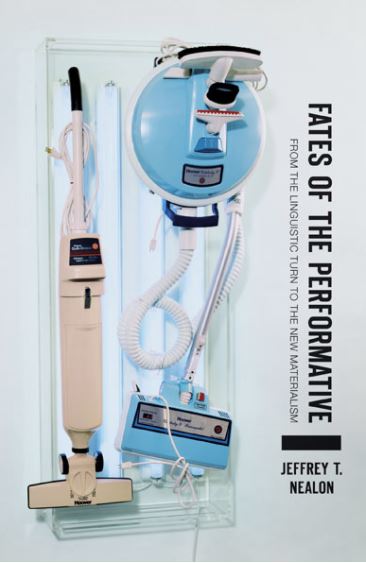
Jeffrey T. Nealon, Fates of the Performative. From the Linguistic Turn to the New Materialism, University of Minnesota Press, 2021

From its humble origins in J. L. Austin’s speech-act theory of the 1950s, the performative has grown to permeate wildly diverse scholarly fields, ranging from deconstruction and feminism to legal theory and even theories about the structure of matter. Here Jeffrey T. Nealon discovers how the performative will remain vital in the twenty-first century, arguing that it was never merely concerned with linguistic meaning but rather constitutes an insight into the workings of immaterial force.

Fates of the Performative takes a deep dive into this “performative force” to think about the continued power and relevance of this wide-ranging concept. Offering both a history of the performative’s mutations and a diagnosis of its present state, Nealon traces how it has been deployed by key writers in the past sixty years, including foundational thinkers like Jacques Derrida, Eve Kosofsky Sedgewick, and Judith Butler; contemporary theorists such as Thomas Piketty and Antonio Negri; and the “conceptual poetry” of Kenneth Goldsmith.

Ultimately, Nealon’s inquiry is animated by one powerful question: what’s living and what’s dead in performative theory? In deconstructing the reaction against the performative in current humanist thought, Fates of the Performative opens up important conversations about systems theory, animal studies, object-oriented ontology, and the digital humanities. Nealon’s stirring appeal makes a necessary declaration of the performative’s continued power and relevance at a time of neoliberal ascendancy.

Contents

Preface: Why the Performative?

Part I. Genealogy of the Performative

1. The Truth Is a Joke? Performatives in Austin and Derrida

2. Two Paths You Can Go By: Judith Butler and Eve Kosofsky Sedgwick

3. The Bodacious Era: Thoreau and New Materialism; or, What’s Wrong with the Anthropocene?

Part II. Performativity and/as/into Biopolitics

4. Biopolitics, Marxism and Piketty’s Capital in the Twenty-First Century

5. What Is a Lecturer? Performative, Parrhesia, and the Author-Function in Foucault’s Lecture Courses

6. Literary RealFeel: Banality, Fatality, and Meaning in Kenneth Goldsmith’s The Weather

Conclusion: On the Returns of Realism and the (Supposed) Exhaustion of Critique

Jeffrey T. Nealon is Edwin Erle Sparks Professor of English and Philosophy at Penn State University. His most recent books are I’m Not Like Everybody Else: Biopolitics, Neoliberalism, and American Popular Music; Plant Theory: Biopower and Vegetable Life; and Post-Postmodernism; or, The Cultural Logic of Just-in-Time Capitalism.

Translator Kate Briggs among this year’s Windham-Campbell prize winners. The Guardian
Alison Flood
Tue 23 Mar 2021 06.15 AEDT

Editor: Kate Briggs translated Foucault’s Introduction to Kant’s Anthropology

One of the world’s richest literary awards, the Windham-Campbell prizes give an unrestricted grant of $165,000 to eight writers each year, celebrating “extraordinary literary achievement” by allowing them to “focus on their work independent of financial concerns”. This year’s recipients range from Briggs to the 85-year-old American memoirist Vivian Gornick. Organisers said the writers were all “pushing boundaries with brilliantly bold work, exploring deeply personal and political ideas around identity, race, sexuality and the immigrant experience”.

Briggs, who was born in the UK and now lives and teaches in Rotterdam, has published one book of her own, This Little Art, a mix of memoir and history about the art of literary translation, and has also translated writers including Roland Barthes and Michel Foucault. She described herself as “astonished by the news” of her win.
[…]

stuartelden's avatarProgressive Geographies

My 2019 Dialogues in Human Geography lecture, ‘Terrain, Politics, History‘ has been published online first (open access). The responses are beginning to appear too.

The ones available so far are

Gastón Gordillo, The power of terrain: The affective materiality of planet Earth in the age of revolution (open access)

Kimberley Peters, For theplaceof terrain and materialist‘re’-returns: Experience, life, force, and the importance of the socio-cultural

Deborah P. Dixon, Drift in an Anthropocene: On the work of terrain (open access)

Ones to come from Bruno Latour and Rachael Squire, and a reply from me – ‘The Limits of Territory and Terrain’.

https://journals.sagepub.com/toc/dhga/0/0

View original post

August, V.
Network concepts in social theory: Foucault and cybernetics
(2021) European Journal of Social Theory.

DOI: 10.1177/1368431021991046

Abstract
Network concepts are omnipresent in contemporary diagnoses (network society), management practices (network governance), social science methods (network analysis) and theories (network theory). Instigating a critical analysis of network concepts, this article explores the sources and relevance of networks in Foucault’s social theory. I argue that via Foucault we can trace network concepts back to cybernetics, a research programme that initiated a shift from ‘being’ to ‘doing’ and developed a new theory of regulation based on connectivity and codes, communication and circulation. This insight contributes to two debates: Firstly, it highlights a neglected influence on Foucault’s theory that travelled from cybernetics via structuralism and Canguilhem into his concept of power. Secondly, it suggests that network society and governance are neither a product of neoliberalism nor of technological artefacts, such as the Internet. They rather resulted from a distinct tradition of cybernetically inspired theories and practices. © The Author(s) 2021.

Author Keywords
Cybernetics; Foucault; neoliberalism; network society; power

Powell, D.
Critical ethnography in schools: reflections on power, positionality, and privilege
(2021) International Journal of Qualitative Studies in Education.

DOI: 10.1080/09518398.2021.1888160

Abstract
This paper is a critical reflection of a critical ethnography, a study focused on how ‘healthy lifestyle education’ programmes were implemented and experienced in two primary schools. In an attempt to disrupt the status quo I employed a range of ethnographic methods: ‘hanging out’ with children and adults; building trusting relationships; having research conversations with participants; observing children and adults; and, journaling. However, the messy assemblage of diverse organisations, people, relations of power, discourses, truths, and practices, resulted in the emergence of ethical and methodological conundrums, including how to represent children’s voices, whether (or not) to ‘intervene’ during problematic pedagogical moments, and how to ‘act’ as a critical ethnographic researcher in schools. Applying a critical lens to my own methodology helped to ensure that I embarked on a continuous, reflexive process; one that enabled a critique of research methods and a negotiation of issues of power, positionality, and privilege. © 2021 Informa UK Limited, trading as Taylor & Francis Group.

Author Keywords
corporations; Critical ethnography; Foucault; methods; power; primary schools