Foucault News

News and resources on French thinker Michel Foucault (1926-1984)

Crispin Sartwell, Michel Foucault Switches Sides, Splice Today, 7 June 2021

Neither the left nor the right can deal with an anti-authoritarian.

The French philosophe Michel Foucault (1926-1984) is currently up for re-assessment. In The New York Times, Ross Douthat writes that Foucault, usually thought of as a notorious postmodern neo-Marxist leftist relativist, has lately been associated with the Trumpian right. And an essay in The Point surveys the various attempts to make the French bad boy over into a neo-liberal, for heaven’s sake, and condemn him on that basis. (Neo-liberalism and Trumpian populism are also completely incompatible with one another.)

Right. Michel Foucault’s not on your side. But that doesn’t mean he’s on the other side.

In my opinion, the most important intellectual book of the late-20th century is Foucault’s Discipline and Punish: The Birth of the Prison.
[…]

There are games of truth in which truth is a construction and others in which it is not. One can have, for example, a game of truth that consists of describing things in such and such a way: a person giving an anthropological description of a society supplies not a construction but a description, which itself has a certain number of historically changing rules, so that one can say that it is to a certain extent a construction with respect to another description. This does not mean that there’s just a void, that everything is a figment of the imagination. On the basis of what can be said, for example, about this transformation of games of truth, some people conclude that I have said that nothing exists-I have been seen as saying that madness does not exist, whereas the problem is absolutely the converse: it was a question of knowing how madness, under the various definitions that have been given, was at a particular time integrated into an institutional field that constituted it as a mental illness occupying a specific place alongside other illnesses.

Michel Foucault (1997). The ethics of the concern of the self as a practice of freedom. In P. Rabinow (Ed.), R. Hurley and others (Trans.), The essential works of Michel Foucault, 1954– 1984: Vol. 1. Ethics: Subjectivity and truth. Harmondsworth, UK: Allen Lane, Penguin, p.297

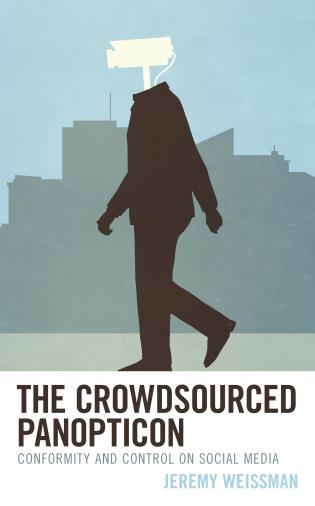
Jeremy Weissman, The Crowdsourced Panopticon. Conformity and Control on Social Media, Rowman & Littlefield, 2021

Review at LSE Review of Books

Behind the omnipresent screens of our laptops and smartphones, a digitally networked public has quickly grown larger than the population of any nation on Earth. On the flipside, in front of the ubiquitous recording devices that saturate our lives, individuals are hyper-exposed through a worldwide online broadcast that encourages the public to watch, judge, rate, and rank people’s lives. The interplay of these two forces – the invisibility of the anonymous crowd and the exposure of the individual before that crowd – is a central focus of this book. Informed by critiques of conformity and mass media by some of the greatest philosophers of the past two centuries, as well as by a wide range of historical and empirical studies, Weissman helps shed light on what may happen when our lives are increasingly broadcast online for everyone all the time, to be judged by the global community.

Table of contents

Introduction
Part I: Conformity

1. The Human Animal in Civilized Society
2. Social Media as an Escape from Freedom
3. Meaninglessness in the Present Age

Part II: Control
4. The Spectacular Power of the Public
5. ‘P2P’ Surveillance and Control

6. The Net of Noramlization

Part III: Resistance

7. Freedom from the Public Eye

8. Strategies of Resistance
Bibliography

The Early Foucault | 10-Minute Talks | The British Academy

In this talk Stuart Elden discusses his new book, ‘The Early Foucault’ and the research he did on the first period of Michel Foucault’s career. In particular, he highlights what Foucault did before the History of Madness in 1961 and how he came to write that book as well as the way newly available archival materials help to make sense of the period.

His book, ‘The Early Foucault’, was published in June 2021.

Speaker: Professor Stuart Elden FBA, Professor of Political Theory and Geography, University of Warwick

10-Minute Talks are a series of pre-recorded talks from Fellows of the British Academy screened each Wednesday on YouTube and also available on Apple Podcasts.

Geoff Shullenberger,The Violence of Institutions, or Girard avec Foucault, Outsider Theory, June 2, 2021

René Girard and Michel Foucault, two of the most ambitious interdisciplinary thinkers of the twentieth century, shared an abiding interest in the violence embedded in institutions, but their names are rarely mentioned together. My modest goal here is to outline a few intellectual convergences between them and to consider what we might learn from this theoretical encounter, with a view to developing a more extensive comparison of their bodies of work.

To begin, a few biographical observations. They were born three years apart (Girard in 1923, Foucault in 1926) in mid-sized provincial French cities known for their medieval architecture (Avignon and Poitiers, respectively). Their intellectual trajectories were parallel at several key points. Girard’s breakthrough book, Mensonge romantique et vérité romanesque, appeared in France in the same year (1961) as Foucault’s: Folie et déraison. Both were published in English, to considerable acclaim, in 1965 and 1964, respectively. The next decade, the first volume of Foucault’s most ambitious work, The History of Sexuality, appeared in 1976, two years before Girard’s magnum opus, Things Hidden Since the Foundation of the World. By the early 1980s, they were teaching on opposite sides of the San Francisco Bay, at Stanford and Berkeley; though Girard, unlike Foucault, had spent nearly his entire career in US academia.

[…]

Società Filosofica Italiana
Società Filosofica Italiana – sezione di Lucca

SEMINARIO TELEMATICO SU

“Eccezione pandemica e tanatopolitica affermativa”

Relatore
Francescomaria Tedesco
(Università di Camerino)

Presenta
Giovanna Miglio
(Società Filosofica Italiana, Lucca)

MERCOLEDÌ 9 GIUGNO 2021
H. 17:00-19:30
LINK:
(PIATTAFORMA MEET)
HTTPS://MEET.GOOGLE.COM/XJN-SECH-PUI

La Morte e le Parole – Immagini e corpi dell’ultimo nemico – Seminario on-line (2021)

Event by Laboratorio Archeologia filosofica
Online event
Price: free
Public · Anyone on or off Facebook

Cosa cambia nel modo in cui si muore? maschere, iconografie, letteratura, filosofia hanno codificato i modi del morire la cui lingua risulta di difficile ascolto nell’assordante rumore di fondo dell’informazione e delle prescrizioni, delle parole scambiate intorno alla malattia, alla degenza, alla rianimazione del corpo individuale e politico, al dispositivo di governo della “nuda vita”.
La collusione storica della devastazione del pianeta, della fine delle democrazie e di una inesorabile crisi energetica ed economica, si è risolta nel fatto che la nostra civiltà è già morta da tempo. Asssistiamo oggi alla mobilitazione dell’insieme dei dispositivi di emergenza che dovrebbero far fronte al presente: la morte nella “giusta maniera di vivere”.

Questa immagine vogliamo resusicitare attraverso i diversi intenti di questi incontri: sentire come parla la morte, quali figure sono all’opera. Si tratta di indagare i linguaggi del morire in contesti fatti di frammenti, estratti, “materiali” e di scoprire che le lingue sepolte non sono quelle di un’altra maniera di vivere.

Karen Bennett, Foucault in English, The politics of exoticization, In Translation in times of technocapitalism, Edited by Stefan Baumgarten and Jordi Cornellà-Detrell [Target 29:2] 2017, pp. 222–243, Published online: 29 June 2017
DOI: https://doi.org/10.1075/target.29.2.02ben

Abstract
It is something of a cliché to affirm that translations into English are almost always domestications, privileging fluency and naturalness over fidelity to the source text. However, back in the 1970s, many of Michel Foucault’s major texts, which were introduced to the English-speaking public for the first time through Alan Sheridan Smith’s translations for Tavistock Publications, were not domesticated at all. Despite the fact that the originals are grounded in a non-empiricist theory of knowledge and use terms drawn from a universe of discourse that would have been completely alien in the English-speaking world, these translations closely follow the patterns of the French, with few or no concessions to the target reader’s knowledge and expectations. This paper analyses passages from Sheridan Smith’s English translations of Les Mots et les choses and L’Archéologie du savoir in order to discuss the long-term effects of this translation strategy. It then goes on to compare and assess two very different translations of Foucault’s lecture L’ Ordre du discours (1970), an early one by Rupert Swyer (1971), which brings the text to the English reader, and a later one by Ian McLeod (1981), which obliges the reader to go to the text. The paper concludes by reiterating the need for Anglophone academic culture to open up to foreign perspectives, and suggests, following Goethe (Book of West and East, 1819) that new epistemes are best introduced gradually in order to avoid alienating or confusing a public that might not be ready for them.

Keywords: Michel Foucault, English translation, French theory, continental philosophy, poststructuralism

“Do Not Ask Me Who I Am” Foucault and neoliberalism, The Point Magazine, June 2 2021

We just can’t seem to shake Foucault. The French philosopher, loathed or loved, has not dimmed in significance since his death of AIDS in 1984. In many ways the patron saint of contemporary humanistic inquiry, Michel Foucault’s work remains a source of both inspiration and frustration to scholars today. Conservatives, in turn, have long enjoyed propping him up as a left-wing bogeyman. In a delightfully vitriolic review for The New Criterion in 1993, Roger Kimball seethed, “the celebration of [Foucault’s] intellectual perversions by academics continues to be a public scandal.” More recently, Liz Truss, the U.K. international trade secretary and minister for women and inequalities, caused a stir when she claimed that since the 1980s, schools have made “no space for evidence” because they instead teach ideas with “roots in postmodernist philosophy—pioneered by Foucault” in which “truth and morality are all relative.”

But not everyone on the left is rushing to defend the thinker. In spite of his reputation as a progressive icon, Foucault has always had an at best contentious relationship with leftist politics. Jürgen Habermas, another philosophical great of his generation, once called Foucault a “young conservative,” attacking what he perceived to be Foucault’s rejection of modernity. Jean-Paul Sartre pilloried him as “the last barricade the bourgeoisie can still erect against Marx.”

[…]

Calbérac, Y. (2021). Close Reading Michel Foucault’s and Yves Lacoste’s Concepts of Space Through Spatial Metaphors. Le Foucaldien, 7(1), 6. DOI: http://doi.org/10.16995/lefou.90

Abstract
Based on a close reading of the interview that Michel Foucault gave Hérodote, the geography journal newly established and managed by Yves Lacoste in 1976, this article—through the study of spatial metaphors—unfolds the concepts and functions of space used by the philosopher and by geographers. The article proposes an archaeological approach—inspired by Foucault’s thinking—in writing the history of the spatial turn and understanding the role played by geography and geographers in this “reassertion of space in critical social theory.”

Keywords: geopolitics, space, power, spatial metaphor, scale, discontinuity, map, archive