Foucault News

News and resources on French thinker Michel Foucault (1926-1984)

stuartelden's avatarProgressive Geographies

Foucault’s text on René Magritte, “Ceci n’est pas une pipe”, was published first in French in 1968 (reprinted inDits et écritsas text 53), and then in a revised and expanded form as a book in 1973. The 1973 book was translated asThis is not a Pipe by James Harkness in 1981. When theEssential Workscollection translated selections from Dits et écrits in volume 2, the Harkness text was used as the basis, even though it was a translation of the 1968 version. This made sense – the texts were similar enough. But theEssential Workstranslation follows the Harkness too closely, and while it recognises the major edits, it misses several smaller points where the two French texts differ.

It is perhaps especially problematic when the revised text changes some instances ofsimilitudetoressemblance, or vice versa, with Foucault writing a new paragraph which…

View original post 624 more words

The Politics of Time: Beyond Spatial Issues of Politics in MOS (Management and Organisation Studies)

Discussion starts at 5 minutes 50
ESSEC Business School
Panel I: “The Politics of Time: Beyond Spatial Issues of Politics in MOS”
Politics and power are much more explored in and through space than time. Is it a Foucauldian legacy? We want to explore here more temporal perspectives on politics and power for MOS.
Coordinator: Pr François-Xavier de Vaujany (Université Paris Dauphine-PSL)
With Pr Robin Holt (CBS), Dr Aurélie Leclercq-Vandelanoitte (CNRS, LEM) and Ian Munro (New Castle University)

Michel Foucault from A to Z. Foucault talks about his mentor Georges Canguilhem (1904-1995).

Oxana Timofeeva
Rathole: Beyond the Rituals of Handwashing, e-flux, #119 – June 2021

In the spring of 2020, when the World Health Organization formally announced the beginning of the Covid-19 pandemic and governments began introducing new restrictions, some philosophers looked to Michel Foucault, who created tools for analyzing mass disease in relation to discourses and strategies of power. Exploring the places where power and the body intersect—in prisons, hospitals, schools, menageries, and so forth—Foucault’s political history of illness points to the continuity between diverse discursive practices that shape our experience of infection, pathology, mental illness, or sexual perversion.

In his 1978 lecture course “Security, Territory, Population,” Foucault identifies three regimes of power relating to epidemics: a regime of sovereignty based in exclusion (as in the case of leprosy); a disciplinary power that introduces quarantine restrictions (as in the case of the plague); and finally, a more recent politics of security introducing new practices such as vaccination and prophylaxis, which have been used since the eighteenth century to control, for example, smallpox. Foucault arranges these regimes chronologically, but emphasizes that they do not so much replace each other as evolve into one another, so that each subsequent regime retains elements of the previous ones.
[…]

Life Arts 7/3/2021, OEN, OpEdNews
Celebrating the Fourth of July 2021 (REVIEW ESSAY)
By Thomas Farrell

[…]
Now, in fairness to Foucault, he turns to the nineteenth-century German classicist and philosopher Friedrich Nietzsche (1844-1901) in his inaugural lecture course (see the “Index of Names” [pages 292-293] for specific page references to Nietzsche) – a source that neither Lonergan nor Ong happens to advert to explicitly as Foucault does in his 1970-1971 lecture series.

For example, in Foucault’s lecture on December 9, 1970, he says, “Next week, I would like to show how Nietzsche was the first to release the desire to know [discussed by Aristotle] from the sovereignty of knowledge (connaissance) itself: to re-establish the distance and exteriority that Aristotle cancelled, a cancellation that has been maintained by all [Western] philosophy” (page 5).

In addition, Foucault says, “In order to fix the vocabulary, let us say that we will call knowledge-connaissance that system that allows desire and knowledge-savoir to be given a prior unity, reciprocal belonging, and co-naturalness. And we will call knowledge-savoir that which we have to drag from the interiority of knowledge-connassance in order to rediscover in it the object of a willing, the end of desire, the instrument of a domination, the stake of a struggle” (page 17).

[…]

Marco Checchi, The Primacy of Resistance. Power, Opposition and Becoming, Bloomsbury, 2021

Review in Foucault Studies

Description
What is at the heart of political resistance?

Whilst traditional accounts often conceptualise it as a reaction to power, this volume (prioritising remarks by Michel Foucault) invites us to think of resistance as primary. The author proposes a strategic analysis that highlights how our efforts need to be redirected towards a horizon of creation and change.

Checchi first establishes a genealogy of two main trajectories of the history of our present: the liberal subject of rights and the neoliberal ideas of human capital and bio-financialisation. The former emerges as a reactive closure of Etienne de la Boétie’s discourse on human nature and natural companionship. The other forecloses the creative potential of Autonomist Marxist conceptions of labour, first elaborated by Mario Tronti. The focus of this text then shifts towards contemporary openings. Initially, Checchi proposes an inverted reading of Jacques Rancière’s concept of politics as interruption that resonates with Antonio Negri’s emphasis on Baruch Spinoza’s potential qua resistance. Finally, the author stages a virtual encounter between Gilles Deleuze’s ontology of matter and Foucault’s account of the primacy of resistance with which the text begins.

Through this series of explorations, The Primacy of Resistance: Power, Opposition and Becoming traces a conceptual trajectory with and beyond Foucault by affirming the affinity between resistance and creation.

Diaz-Bone, R.
Economics of convention meets Canguilhem (2021) Historical Social Research, 46 (1), pp. 285-311.

DOI: 10.12759/hsr.46.2021.1.285-311

Abstract
»Economics of Convention Meets Canguilhem«. The neopragmatist institutionalist approach of economics of convention (in short EC) still is in need of a conception of health that enables EC to work out a critical standpoint in the analysis of health care institutions. French historical epistemology is an early critique of Comtian positivism in the philosophy of science. The work of the historical epistemologist Georges Canguilhem is the most im-portant approach for a non-reductionist, pluralist conception of health and for the anti-positivist critique of medical concepts of the “normal.” This critique has become an influential basis for the critical analysis of quantification in health care. Canguilhem introduced the notions of biological normativity and social normativity, which govern the relation of organisms and their mi-lieus and can be regarded as original sources for value and normative orders. In this contribution, the anti-positivist critique of Canguilhem is presented. Then the link between scientific concepts, knowledge production in the health care system, and health institutions is discussed, which was later on continued by Michel Foucault as a successor of Canguilhem in the field of historical epistemology. It is pointed to the affinities of Canguilhem’s approach to pragmatism but also to the capability approach of Amartya Sen. Conse-quences of Canguilhem’s work for EC and links to EC’s concepts are worked out. Finally, the relevance of Canguilhem’s work to the ongoing digitalization of health care is sketched. © 2021, GESIS – Leibniz Institute for the Social Sciences. All rights reserved.

Author Keywords
Bachelard; Biological normativity; Canguilhem; Digitalization; Economics of convention; Foucault; Health economics; Quantification; Sen; Social normativity; Sociology of health

Camille Robcis, Disalienation. Politics, Philosophy, And Radical Psychiatry In Postwar France, University of Chicago Press, 2021

See also interview with the author on the New Books Network

From 1940 to 1945, forty thousand patients died in French psychiatric hospitals. The Vichy regime’s “soft extermination” let patients die of cold, starvation, or lack of care. But in Saint-Alban-sur-Limagnole, a small village in central France, one psychiatric hospital attempted to resist. Hoarding food with the help of the local population, the staff not only worked to keep patients alive but began to rethink the practical and theoretical bases of psychiatric care. The movement that began at Saint-Alban came to be known as institutional psychotherapy and would go on to have a profound influence on postwar French thought.

In Disalienation, Camille Robcis grapples with the historical, intellectual, and psychiatric meaning of the ethics articulated at Saint-Alban by exploring the movement’s key thinkers, including François Tosquelles, Frantz Fanon, Félix Guattari, and Michel Foucault. Anchored in the history of one hospital, Robcis’s study draws on a wide geographic context—revolutionary Spain, occupied France, colonial Algeria, and beyond—and charts the movement’s place within a broad political-economic landscape, from fascism to Stalinism to postwar capitalism.

Contents

Introduction: A Politics of Madness

1—François Tosquelles, Saint-Alban, and the Invention of Institutional Psychotherapy

2—Frantz Fanon, the Pathologies of Freedom, and the Decolonization of Institutional Psychotherapy

3—Félix Guattari, La Borde, and the Search for Anti-oedipal Politics

4—Michel Foucault, Psychiatry, Antipsychiatry, and Power

Epilogue: The Hospital as a Laboratory of Political Invention

E is for Epistemology (Michel Foucault) (2021)
Michel Foucault from A to Z. — Does epistemology has anything to do with epidemiology? An epic conversation about philosophy, knowledge, history, and viruses, including references to Canguilhem and Bachelard as well as Laurie Anderson and William Burroughs…

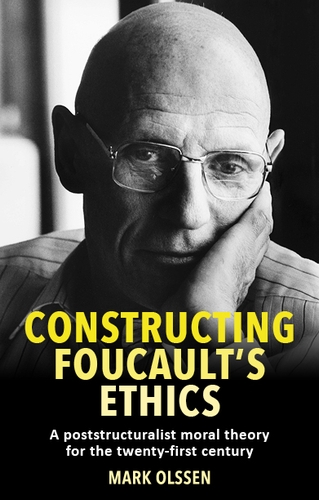
Mark Olssen, Constructing Foucault’s ethics. A poststructuralist moral theory for the twenty-first century, Manchester University Press, 2021

DESCRIPTION
In popularizing the term ‘speaking truth to power’, now widely used throughout the world, Michel Foucault established the basis upon which a new ethics can be constructed. This is the thesis that Mark Olssen advances in Constructing Foucault’s ethics. Olssen not only ‘speaks truth’ to existing moral and ethical theories that have dominated western philosophy since Plato, but also shows how, by using Foucault’s insights, an alternative ethical and moral theory can be established that both avoids the pitfalls of postmodern relativism and simultaneously grounds ethical, moral, and political discourse for the present age.

Taking the late ‘ethical turn’ in the philosopher’s thought as its starting point, this ambitious study seeks to construct an ethics beyond anything Foucault ever attempted while remaining consistent with his core postulates. In doing so it advances the concept of ‘life continuance’, which expresses a normative orientation to the future in terms of the quest for survival and well-being, giving rise to irreducible normative values as part of the discursive order of events. This approach is explored in contrast with a range of other, established systems, from the Kantian to the Marxist to contract ethics and utilitarianism.

AUTHOR
Mark Olssen is Emeritus Professor of Political Theory and Higher Education Policy in the Department of Politics at the University of Surrey