Foucault News

News and resources on French thinker Michel Foucault (1926-1984)

Alphin, C., Debrix, F. Biopolitics in the ‘Psychic Realm’: Han, Foucault and neoliberal psychopolitics, Philosophy and Social Criticism, (2021).

DOI: 10.1177/01914537211033011

Abstract
This article explores German Korean philosopher Byung-Chul Han’s notion of psychopolitics and his concept of the neoliberal subject. For Han, mental processes are now the primary target of power. This means that, according to Han, biopower must give way to what he calls psychopower since perspectives that critically seek to understand neoliberalism through a biopolitical lens are no longer adequate to contemporary regimes of neoliberal achievement. This article examines and evaluates Han’s argument that Foucauldian biopolitics is obsolete in today’s neoliberal age because of biopolitics’ primary focus on the body over mental processes. We suggest that, instead of emphasizing the need to move beyond biopolitics, Han’s theorization of psychopolitics could benefit from paying closer attention to some of Foucault’s insights on biopower and from identifying key connections between biopolitics and psychopolitics. By highlighting some important continuities between Foucault’s biopolitics and Han’s psychopolitics (instead of emphasizing the discontinuities between both theorists’ perspectives, as Han tends to privilege), this article seeks to move towards improved theorizations of concepts like achievement, subjectivity, otherness or optimization, concepts that are key to Han’s understanding of contemporary neoliberal practices.

Author Keywords
achievement; Big Data; biopolitics; Byung-Chul Han; Michel Foucault; neoliberalism/liberalism; psychopolitics

Miguel de Beistegui, The Government of Desire. A Genealogy of the Liberal Subject, University of Chicago Press, 2018

Liberalism, Miguel de Beistegui argues in The Government of Desire, is best described as a technique of government directed towards the self, with desire as its central mechanism. Whether as economic interest, sexual drive, or the basic longing for recognition, desire is accepted as a core component of our modern self-identities, and something we ought to cultivate. But this has not been true in all times and all places. For centuries, as far back as late antiquity and early Christianity, philosophers believed that desire was an impulse that needed to be suppressed in order for the good life, whether personal or collective, ethical or political, to flourish. Though we now take it for granted, desire as a constitutive dimension of human nature and a positive force required a radical transformation, which coincided with the emergence of liberalism.

By critically exploring Foucault’s claim that Western civilization is a civilization of desire, de Beistegui crafts a provocative and original genealogy of this shift in thinking. He shows how the relationship between identity, desire, and government has been harnessed and transformed in the modern world, shaping our relations with others and ourselves, and establishing desire as an essential driving force for the constitution of a new and better social order. But is it? The Government of Desire argues that this is precisely what a contemporary politics of resistance must seek to overcome. By questioning the supposed universality of a politics based on recognition and the economic satisfaction of desire, de Beistegui raises the crucial question of how we can manage to be less governed today, and explores contemporary forms of counter-conduct.

​Drawing on a host of thinkers from philosophy, political theory, and psychoanalysis, and concluding with a call for a sovereign and anarchic form of desire, The Government of Desire is a groundbreaking account of our freedom and unfreedom, of what makes us both governed and ungovernable.

Special section: Miguel De Beistegui, The Government Of Desire: A Genealogy Of The Liberal Subject, Philosophy Today: Volume > 65 > Issue: 4, 2021

Vilde Lid Aavitsland, The “Man of Desire” or the “Man of Labor”?: Comments on Miguel de Beistegui’s The Government of Desire

Kevin Thompson, Comments on Miguel De Beistegui’s The Government of Desire: A Genealogy of the Liberal Subject

Miguel de Beistegui, Desire in and Beyond Liberalism: From Normative to Algorithmic and Neuro-power

Patricio Lepe-Carrión (2021) Territorial Control and Subjectivities at Risk: Counter-Conducts for the Intercultural/Developmentalist/Extractivist Dispositive in Chile (1989–2018), Journal of Intercultural Studies, 42:5, 610-626,

DOI: 10.1080/07256868.2021.1971169

ABSTRACT
This article examines intercultural discourses in the Mapuche context of the Araucanía region of Chile, based on the material and enunciative conditions which sustain their circulation. These conditions shape an environment where, over the last 30 years, developmentalist rhetoric has defined the State’s intercultural project. This has criminalized ways of life that oppose extractivism as a model of development. The systematicity of violence continues to reproduce other types of systematicities, such as practices of resistance which adopt the specific form of ‘territorial control’. This article proposes that such practices, or counter-conducts to ethnodevelopment, are political technologies that produce new subjectivities and ways of life. They involve a strong commitment to the ‘truth’ of collective memory for individuals who are exposed to life-threatening or ‘borderline’ experiences caused by a militarized neoliberal rationale.

KEYWORDS:
Interculturality development ethnodevelopment territorial control subjectivation technologies of the self Mapuche extractivism

Telos 196 (Fall 2021): Thinking vs. Doing

From David Pan’s introduction

[…]
The dichotomy of thinking versus doing seems to arise out of our own sense of the difference between our minds and our bodies. On the one hand, the gap between mind and body is the basis of the perspective with which the mind can step back, criticize, and improve the world. Without this gap, we would be trapped in an eternal present, unable to imagine anything but what currently exists. On the other hand, the dichotomy can lead to a sense of detachment from the world. Such detachment can be negative if it leads to an isolation from the world, or to a sense of alienation if the world is such that its influence on the body becomes oppressive for the mind. The opposition between thinking and doing directs our attention toward this fundamental gap between the mind and the body within the human condition that is the source of both all human achievement as well as human debasement. As we focus on thinking, our detachment from our actions can allow us to make judgments about the wisdom of our actions, but such detachment can also lead us to bury ourselves in contemplation and ignore our responsibilities for acting, or even allow us to act with a kind of cruel coldness in trying to realize an abstract idea. This issue of Telos considers such different possibilities for the way in which we relate our thinking to our actions.

[…]

Our series of three essays on Michel Foucault approaches the problem of thinking and doing by analyzing the structures of subjectivity that lead to different stances regarding our actions in the world. Linus Recht describes how Foucault assumes the historical contingency of all conceptions of the self. The lack of an underlying objective truth of the subject leads Foucault to develop an ethics based on a subject who is constantly becoming rather than a subject who is and would have a stable set of desires. Because there is no underlying ultimate truth of the subject, Foucault focuses on the constantly transforming play of pleasure and the body. His promotion of a dissolution of the unity of the subject allows him to advocate for a continual freedom of invention and creativity in the subject’s relation to its own happiness. In the end, Recht argues that Foucault’s ideal of constant becoming has been realized in the structure of continually mutating gratification that has been enabled by smartphone technology and social media, suggesting that what seems like invention might in fact be the subordination to market forces. The resulting new forms of subjectivity in social media may have realized Foucault’s ideal of the dynamics of pleasure in a way that does not seem to result in happiness. Against the Foucauldian ethics of becoming, Recht suggests that the unity and harmony of the subject may in fact be psychologically more important for happiness and individual fulfillment than continual invention and creativity.

Kyle Baasch also addresses the way in which Foucault’s insight into the historical contingency of the structure of subjectivity leads to his embrace of an ever-changing self. Foucault criticizes the Marxist reduction of human activity to labor power because it leads to a single normative conception of human happiness that becomes oppressive. In this conception, the real culprit is not the capitalist economic system, which enables the continuing self-invention of the subject, but state structures of control that enforce upon the subject a single notion of what it should be. If Recht describes the ways in which smartphones manifest this Foucauldian dissolution of subjectivity, Baasch’s discussion focuses on a longer history of how the culture industry dissolves subjectivity into a set of commodifiable desires, revealing the apparent action of the subject to be in fact a product of its subjugation. Baasch sets Foucault’s notion of pleasure in opposition to Adorno’s critique of the way in which individual happiness has been undermined by the economic context of consumer culture. Where Foucault sees the freedom of the subject, Adorno descries a commodification of the subject’s impulses that turns pleasure into a function of the economic system. Adorno describes a notion of happiness that takes its measure from his own personal experience as a heartbroken lover, who can only discern happiness as the negative image of his own suffering. Adorno’s notion of harmony is not the positive conception that Foucault criticizes. Instead, it can only be discerned negatively, through a contemplation of the factors that prevent such harmony from realizing itself in the world.

Hammam Aldouri discusses Gabriel Rockhill’s recent critique of the political import of Foucault’s thinking. Aldouri identifies three fallacies in Rockhill’s argument. First, Rockhill equates Foucault’s personal politics with the political meaning of his theories. Second, while Rockhill dismisses Foucault’s idea of the episteme for simply giving a new name to ideology, Aldouri points out that the two can be clearly distinguished based on Foucault’s claim that the episteme is not a kind of false idea (and thus ideology in a Marxist sense) but rather forms the underlying conceptual framework that makes possible a specific scientific discourse. Third, while Rockhill contests Foucault’s radicalism by arguing that Foucault is not Marxist, Aldouri responds that Rockhill does not provide a definition of Marxism or a clear sense of what radicalism would mean. Nevertheless, Rockhill’s work is productive to the extent that it points to the way in which academia has created a Foucault “brand.” Aldouri argues that a focus on the institutional pressures that have made this branding possible would be more productive than an analysis of Foucault’s work itself as the source of this phenomenon.

[…]

After Desire: Foucault’s Ethical Critique of Psychological Man and the Foucauldian Ethos of the Internet Age
Linus Recht

Critical Theory in the Flesh: Adorno and Foucault in San Francisco
Kyle Baasch

A Genuine Refutation? A Response to Gabriel Rockhill’s “Foucault: The Faux Radical”
Hammam Aldouri

Review of Stuart Elden: The Early Foucault on Phenomenological Reviews 20 September 2021.

Stuart Elden’s The Early Foucault is the third of a four-volume study of the origins and development of Michel Foucault’s thought. This book is the first one regarding the period it covers, basically the 1950s, but it is the third to be published. It will be soon followed by a fourth and final book, that will cover the ‘archaeological’ period and Foucault’s forays into art history and literary criticism. External factors explain the disconnect between the order of production and the chronology. Elden’s first two books dealt with the publication of Foucault’s lectures at the Collège de France. The publication of the Lectures began in 1997, with the publication of the sixth lecture, Il faut défendre la société (1975-1876). Additional volumes followed it, released not in the order of their delivery by Foucault, but on the availability of audio recordings of the lectures. Foucault’s preparatory notes and other ancillary materials later supplemented and eventually displaced the recordings. Elden’s earlier books responded to the availability of the Lectures and the will to integrate the new material into a coherent picture. The First Foucault and the forthcoming book on Archaeology deal with the archive material made available to the public in recent years. This material includes reading and preparatory notes, lectures of the period before his appointment to The College de France, manuscripts in different degrees of development, philosophical diaries, bibliographies, etc.

read more

Mengmeng GAO Bibliothèque historique de la Ville de Paris (BHVP), 2 octobre 2021, Paris.

Date et horaire exacts : Le samedi 2 octobre 2021
de 19h à 2h
gratuit
Surveiller et Punir – Vidéo

Mengmeng GAO est originaire de Pékin (Chine), où elle est née en 1986. Elle vit et travaille à Paris.

L’œuvre Surveiller et punir prend source dans le livre du même nom de Michel Foucault. Le philosophe y énumère les mesures du XVIIe siècle pour intervenir dans les épidémies. Via une animation en noir et blanc dérivée de l’art des mangas comme des dessins animés de Kentridge, l’artiste part du constat que nos mesures actuelles de prévention des épidémies ne sont pas si différentes de celles-ci. Elles sont simplement plus humaines et plus douces. Cependant, le paradoxe est que plus les méthodes sont douces, plus elles sont déprimantes.

Bibliothèque historique de la Ville de Paris (BHVP) 24 rue Pavée Paris 75004
1 : Saint-Paul (227m) 8 : Chemin Vert (461m)

Five intellectual fashion statements from history that anticipated today’s dark academia trend, The Conversation, UK
September 17, 2021

Writing with a quill pen dipped in ink, sitting in the flickering of candlelight in a book-lined study, and vintage tweed paired with knitted jumpers and brogues have all become the height of fashion for autumn 2021.

Known as dark academia, this trend has brought the hallowed halls of ancient universities to the digital worlds of TikTok and Instagram. On Instagram, the tag #darkacademia now has over 1 million posts, and Grazia has named the aesthetic as autumn 2021’s biggest trend. The TikTok generation has keenly embraced the tweedy cosiness of scholarly life.
[…]

5) Philosophes
In the early 20th century, French philosophers and popular playwrights alike propelled the turtleneck into the spotlight as the anti-establishment, intellectual garment of the age. From Audrey Hepburn in Funny Face to philosopher and accidental style icon Michel Foucault, the turtleneck was the epitome of cerebral style.

[…]

read more

stuartelden's avatarProgressive Geographies

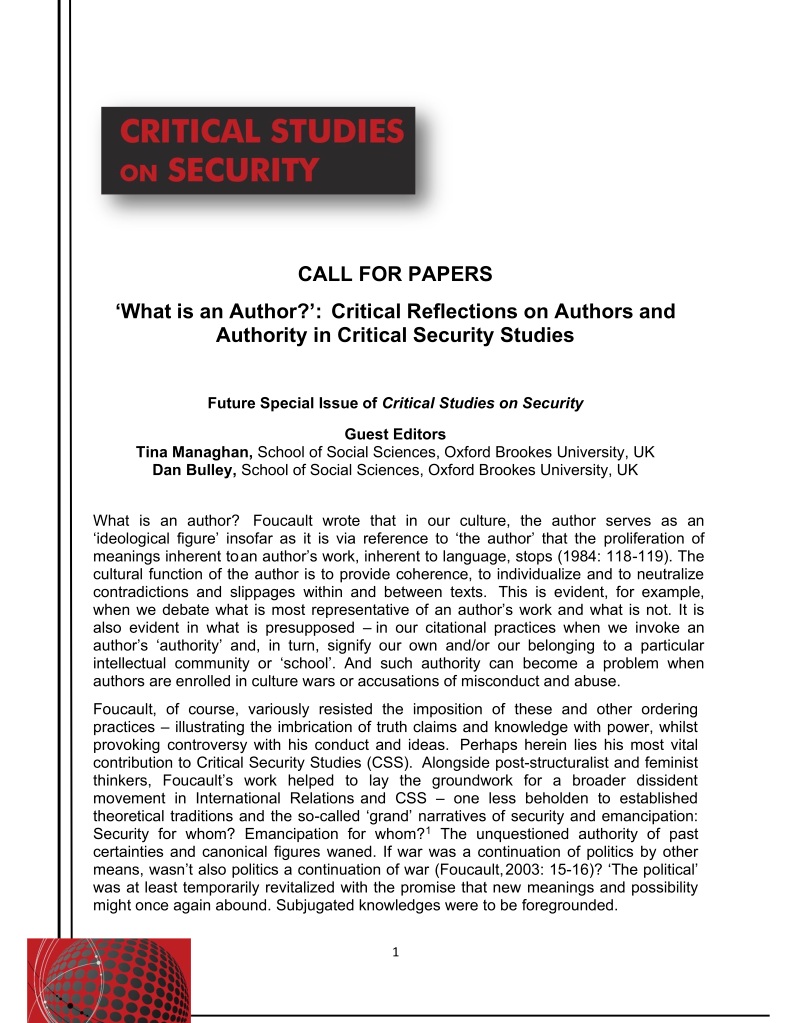
CFP: ‘Whatis anAuthor?’:Critical Reflections on Authors and Authority in Critical Security Studies

Full details in pdf – For enquiries and expressions of interestplease contact the guest editors Tina Managhan (tmanaghan@brookes.ac.uk) and/or Dan Bulley (dbulley@brookes.ac.uk).

View original post

ACCESS Vol 41 2021
IN MEMORIAM Jim Marshall
Nesta Devine, Elizabeth Gresson, Mark Olssen, Ruth Irwin, Eve Coxon, Ho-Chia Chueh & Richard Heraud

[…]
As the Dean of Education at the University of Auckland, Jim made a succession of excellent hires, building an extraordinary Faculty of Education that competed with Illinois for honours by producing world class research. During this period, he threw his weight behind the new Indigenous Research Institute, which Linda Tuhiwai Smith and Graeme Smith began in the Faculty of Education, and which eventually became its own independently funded institute attached to the Māori Department in the Faculty of Arts.

Following his close reading of Foucault and with attention to the relationship between power and policy, Jim developed his critique of the concept of busnocratic rationality which anticipated the development of New Public Management. He was very interested in how students internalise these banal operations of power through techniques such as physical and intellectual excellence, the gym, revealing the self through ‘reflection’ and ‘truth’.

“Technologies of domination act essentially on the body, and classify and objectify individuals. The key to technologies of the self is the belief, now common in Western culture, that it is possible to reveal the truth about one’s self. By telling the truth about one’s sexuality, where the “deepest” truth is embedded in the discourse and discursive practices of sexuality, individuals become objects of knowledge, both to themselves and to others. In telling the truth, one knows oneself and is known to others in a process which is both therapeutic and also controlling.” (Marshall, 1996, p. 271)
[…]

Collective obituary for James D. Marshall (1937–2021)

Michael A. Peters, Colin Lankshear, Lynda Stone, Paul Smeyers, Linda Tuhiwai Smith, Roger Dale, Graham Hingangaroa Smith, Nesta Devine, Robert Shaw, Nesta Devine, Bruce Haynes, Denis Philips, Kevin Harris, Marc Depaepe, David Aspin, Richard Smith, Hugh Lauder, Mark Olssen, Nicholas C. Burbules, Peter Roberts, Susan L Robertson, Ruth Irwin, Susanne Brighouse, & Tina Besley
Published online: 15 Jul 2021 , Educational Philosophy and Theory, DOI: 10.1080/00131857.2021.1948399

[…]
His work on ‘A Critical Theory of the Self ‘was intellectually outstanding: he focussed on Foucault and Wittgenstein – two of the greatest intellectuals of our times: one a deeply conservative Austrian counter-Enlightenment thinker; the other, a French intellectual, a Nietzschean ‘Communist’ who historized Marx. Actually, both of them were among the most brilliant thinkers of the century. It’s an interesting combination and Jim was one of the first to combine them in his work. Without being too academic can I say that Jim managed to embrace with consummate ease both sides of analytic and continental philosophy. It showed his flexibility as a thinker, his openness and his ability to embrace new ideas – from the heart of analytic philosophy inaugurated by Russell, Wittgenstein and Frege to Foucault, one of the most left-wing thinkers of his time. That’s a huge shift in thinking. He was a philosophical authority on moral education and the punishment of children. He wrote a prodigious amount on science and educational theory, on neoliberal reforms to education, on policy analysis, and on a whole range of philosophers including Dewey, Rorty, Wittgenstein, Foucault, R.S. Peters. The corpus of his work stretched over many themes in education and philosophy with both a practical and theoretical bent. I did a rough count: Jim produced some 27 books and over 200 academic papers, often for blue-ribbon journals. But this was far from Jim’s mind as he remarked, ‘It’s all runs on the board’. ‘We will leave the counting of our published papers to the officials once we are dead.’ He was consumed by the process of writing and regarded it very seriously but he was never one to push his own barrow. He was modest and self-effacing. He was a generous man when it came to authorship, more intent on mentoring others than grabbing the stage for himself. And he demonstrated his commitment to collegiality through the many collaborations and research partnerships he initiated and was part of, especially with junior colleagues. I published two papers with him and Miles Shepheard in 1981 when we were completing our Masters; Miles in Education and I in Philosophy.
[…]