Foucault News

News and resources on French thinker Michel Foucault (1926-1984)

Kwok, H., Singh, P., Heimans, S.
The regime of ‘post-truth’: COVID-19 and the politics of knowledge
(2021) Discourse

DOI: 10.1080/01596306.2021.1965544

Abstract
The emergence of ‘post-truth’ is often associated with the rise of conspiracy theories and the lack of trust in scientific knowledge. This article attempts to theorise the complex division of labour in this regime of ‘post-truth’, with reference to the COVID-19 pandemic/infodemic. First, we argue that the ‘post-truth’ condition mirrors what Foucault called the ‘will to truth’, and that this challenges the procedures and systems by which truth and knowledge are ordered. Second, through Basil Bernstein’s extension of Foucault’s work, we argue that the era of post-truth has two features regarding the condition of knowledge: (1) that conflicts in the field of knowledge recontextualisation, that is, the pedagogisation of knowledge, are becoming more intense and visible, and (2) that greater exposure to high-stakes, uncertain scientific knowledge, which grows at exponential rate, increases social anxieties and leads to biopoliticisation of neoliberal responsibilisation. © 2021 Informa UK Limited, trading as Taylor & Francis Group.

Author Keywords
Bernstein; COVID-19; Foucault; pedagogic device; politics of knowledge; Post-truth

Testini, F.
Genealogical Solutions to the Problem of Critical Distance: Political Theory, Contextualism and the case of Punishment in Transitional Scenarios
(2021) Res Publica

DOI: 10.1007/s11158-021-09515-2

Abstract
In this paper, I argue that one approach to normative political theory, namely contextualism, can benefit from a specific kind of historical inquiry, namely genealogy, because the latter provides a solution to a deep-seated problem for the former. This problem consists in a lack of critical distance and originates from the justificatory role that contextualist approaches attribute to contextual facts. I compare two approaches to genealogical reconstruction, namely the historiographical method pioneered by Foucault and the hybrid method of pragmatic genealogy as practiced by Bernard Williams, arguing that they both ensure an increase in critical distance while preserving contextualism’s distinctiveness. I also show, however, that only the latter provides normative action-guidance and can thus assist the contextualist theorist in the crucial task of discerning how far certain contextual facts deserve their justificatory role. I prove this point by showing how a pragmatic genealogy of the practice of punishment can inform the contextualist’s reflection about the role this practice should play in a transitional scenario, i.e. in the set of circumstances societies go through in the aftermath of large-scale violence and human rights violations. © 2021, The Author(s).

Author Keywords
Contextualism; Genealogy; Methodology; Political theory; Punishment; Transitional justice

Beugnet, M., Delanoë-Brun, E.
Raw becomings: Bodies, discipline and control in Julia Ducornau’s Grave
(2021) French Screen Studies, 21 (3), pp. 204-223.

DOI: 10.1080/26438941.2021.1920705

Abstract
Julia Ducournau’s Grave (2018) takes place within the confines of an isolated veterinary school, where humans and animals coexist as part of a highly codified environment. Against the backdrop of the school’s methodical and ritualised social regulation, disruptive bodily transformations take place, blurring the biological and behavioural categories that traditionally define species-based identities. Grave presents us with two irreconcilable yet complementary concepts of the body: one that is subject to the scientific pursuit of categorising, normalising and disciplining already in evidence in the proto-cinematic project of decomposing movement, and another corporeality based on fluidity and exchange, recalling Deleuze and Guattari’s notion of becoming. Following the stylistic conventions of a French horror cinema that foregrounds the materiality of the image, bodies, in Grave, appear as markers of subjection, adaptation or resistance to strategies of disciplining and normalisation. However, the film’s visual and narrative lines of flight, and its open-ended conclusion, raise the question of a move from one disciplining system to another, more diffuse model of control. © 2021 Informa UK Limited, trading as Taylor & Francis Group.

Author Keywords
becoming; Body horror; Deleuze and Guattari; Foucault; French horror; Muybridge

O’Callaghan, A.K.
‘The medical gaze’: Foucault, anthropology and contemporary psychiatry in Ireland
(2021) Irish Journal of Medical Science

DOI: 10.1007/s11845-021-02725-w

Open access

Abstract
Michel Foucault developed the concept of ‘the medical gaze’, describing how doctors fit a patient’s story into a ‘biomedical paradigm, filtering out what is deemed as irrelevant material’ (Misselbrook, 2013). Doctors are perceived within this model to focus on selecting the biomedical elements of patients’ problems only, filtering out all other elements of a person’s life story, but this paper argues that in the subspecialty of psychiatry, this is not the case, and such a filter is not so easily applied. © 2021, The Author(s).

Author Keywords
Foucault; Medical anthropology; Psychiatry

2nd Month of Historical Epistemology
November 3, 10, 17, 24 / 2021
17h-19h (Paris time GMT+1)

Link Zoom: unive.zoom.us/j/6569494316

Organizing Committee

Caroline Angleraux
Lucie Fabry
Ivan Moya Diez
Matteo Vagelli

Épistémologie Historique. Research Network on the History and the Methods of Historical Epistemology

with the support of 

IHPST (UMR 8590, Paris 1/CNRS)
République des Savoirs (USR 3608, ENS/ Collège de France/CNRS)
École doctorale Lettres, Arts, Sciences humaines et sociales (ED 540, ENS – EUR Translitteræ, PSL)
Centre Gilles Gaston Granger (UMR 7304)
Universidad Alberto Hurtado
Università Ca’ Foscari Venezia
European Commission  (This project has received funding from the European Union’s Horizon 2020
research and innovation programme under the Marie Skłodowska-Curie

grant agreement No 101030646, « EPISTYLE »)
PROGRAM (PDF / abstracts here)

Wednesday, November 3, 17h-19h (GMT +1)
« Biology and Medecine », Chair Matteo Vagelli

Samuel Talcott, University of the Sciences (Philadelphia)
« Methods and Events: François Delaporte on the 1832 Parisian Cholera and its Role in the Birth of Biosocieties »

Silvia De Cesare, Université de Genève
« L’idée de progrès entre organismes et artefacts techniques »

Wednesday, November 10, 17h-19h (GMT +1)

« Economics », Chair Iván Moya-Diez

Emmanuel PicavetUniversité Paris 1 Panthéon-Sorbonne
« Introduction »

Sina Badiei & Matteo Vagelli, Lausanne / Ca’Foscari
« Étudier la pensée économique par le prisme de l’épistémologie historique »

Clémence Thébaut, Université de Limoges
« L’évaluation économique en santé au prisme de la typologie des épistémès de Foucault »

Wednesday, November 17, 17h-19h (GMT+1)

« Social sciences and ecology », Chair Caroline Angleraux

Martín Bernales-Odino, Iván Moya-Diez, Mauricio Canals & Valentina Riberi, Universidad Alberto Hurtado
« The poor as a kind of people and epistemic objects. 1778-1854 »

Andrea Angelini, Centre Cavaillès
« Canguilhem dans le Capitalocène. L’épistémologie historique à l’épreuve de l’écologie »

Wednesday, November 24, 17h-19h (GMT+1)

« History of epistemology », Chair Lucie Fabry

Massimiliano Simons, Ghent University
« We Have Never Been Historical Epistemologists »

Gerardo IennaERC EarlyModernCosmology
« Italian Science Wars: une controverse dans l’épistémologie historique italienne »

For further info:

website episthist.hypotheses.org
e-mail epistemologiehistorique@gmail.com
Facebook episthist
Twitter @episthist
Instagram epistemologiehistorique

Häberlen, J.C.
Heterochronias: reflections on the temporal exceptionality of revolts
(2021) European Review of History, 28 (4), pp. 531-548.

DOI: 10.1080/13507486.2021.1897530

Abstract
Drawing on Michel Foucault’s concept of Heterotopias, the article explores how we can understand revolts and revolutions as ‘heterochronian’ moments. Revolts turn spaces of ordinary everyday life, streets and squares, factories and universities, into ‘absolutely different’ spaces, at least for a moment. But these are also times that radically differ from normal times. Revolts, the article suggests, fall outside the normalcy of time. As an empirical example, this article explores the urban revolts of 1980–81 in cities such as Zurich, Amsterdam, and, most famously, West Berlin, discussing how activists themselves interpreted their revolts as temporary disruptions for which the moment mattered, no matter the long-term outcomes.

Author Keywords
radical left; squatting; temporality; urban revolts; West Berlin

Gavin Rae, Poststructuralist Agency. The Subject in Twentieth-Century Theory, Edinburgh University Press, 2020
Does the poststructuralist decentring of the foundational subject permit a coherent account of agency?

  • Analyses poststructuralist thinking on ‘the subject’ in detail, tying it to the often-ignored question of agency
  • Expands the scope of ‘poststructuralism’ beyond Deleuze, Derrida, and Foucault by also engaging with psychoanalytically orientated poststructuralists including Butler, Castoriadis, Kristeva and Lacan
  • Draws out the complicated link between poststructuralism and Lacanian psychoanalysis

Gavin Rae shows that the problematic status of agency caused by the poststructuralist decentring of the subject is a prime concern for poststructuralist thinkers. First, Rae shows how this plays out in the thinking of Deleuze, Derrida and Foucault. He then demonstrates that it is with those poststructuralists associated with and influenced by Lacanian psychoanalysis that this issue most clearly comes to the fore. He goes on to reveal that the conceptual schema of Cornelius Castoriadis best explains how the founded subject is capable of agency.

Gavin Rae is Senior Visiting Research Professor at the Universidad Complutense de Madrid, Spain. He is the author of Critiquing Sovereign Violence (Edinburgh University Press, 2019), Evil in the Western Philosophical Tradition (Edinburgh University Press, 2019), The Problem of Political Foundations in Carl Schmitt and Emanuel Levinas (Palgrave, 2016), Ontology in Heidegger and Deleuze: A Comparative Analysis (Palgrave, 2014) and Realizing Freedom: Hegel, Sartre and the Alienation of Human Being (Palgrave, 2011). He is co-editor of Subjectivity and the Political: Contemporary Perspectives (Routledge, 2018) and The Meanings of Violence: From Critical Theory to Biopolitics (Routledge, 2019).

stuartelden's avatarProgressive Geographies

Michel Foucault, “Literature and Madness: Madness in the Baroque Theatre and the Theatre of Artaud”, Theory, Culture and Society (requires subscription)

A translation of a piece by Foucault, online first in Theory, Culture and Society – part of the special issue on ‘Foucault before the Collège de France’ I am co-editing with Orazio Irrera and Daniele Lorenzini. The translation is by Nancy Luxon, and the text appeared in French in Critique and then Folie, Langage, Littérature, edited by Henri-Paul Fruchaud, Daniele Lorenzini and Judith Revel, Paris: Vrin, 2019.

Literature and madness dominate Michel Foucault’s early writings in the 1960s, and indeed much of his career. In this text, Foucault considers the relation between madness, language, and silence; the difficult frontier between language and literary convention; and the experience of madness within language. He moves from a meditation on madness, to a rare commentary on theatre…

View original post 104 more words

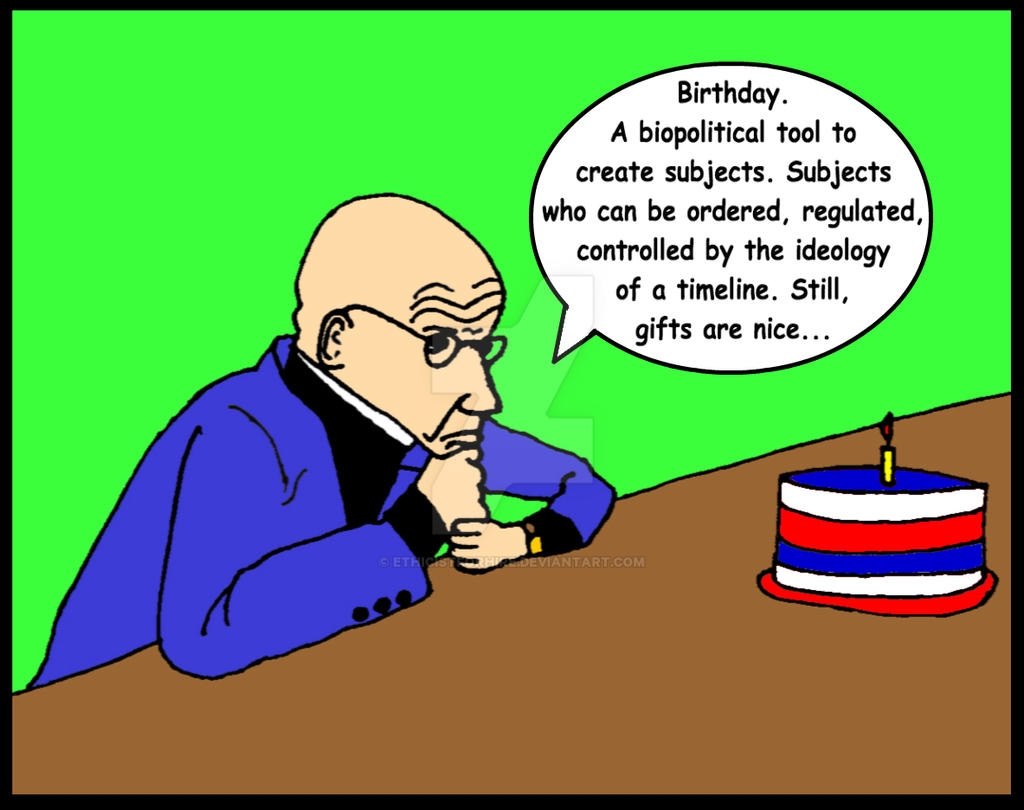
Michel Foucault, born 15 October 1926.
Image for sale by Ethicist for hire on the Deviant art site

Brady, D.
The circulatory panopticon: Real names, rail infrastructure and Foucault’s realist turn
(2021) Political Geography, 90, art. no. 102463

DOI: 10.1016/j.polgeo.2021.102463

Abstract
This article examines the contemporary Chinese rail system as a circulatory panopticon: an apparatus that uses the “natural” movements of the population to render them legible and safe. The panoptic effect of rail space has emerged only recently. The Chinese state’s introduction of the “real-name system” has made a state-legible identity an inextricable part of everyday life, and recent transformations in ticketing and station entry have placed it at the center of mobility practices as well. Synthesizing Foucault’s apparatus of security with Karen Barad’s realist conception of the apparatus, this article examines how the more-than-human elements of the rail system realize a panoptic assemblage out of the movements of passengers. Based on participant observation and interview data, this article examines three key elements of the rail system: the national identity card, the ticket, and the station entrance. Drawing on Barad’s account of diffraction, I analyze how the particular material characteristics of these things both function to realize the circulatory panopticon and also to introduce novel discontinuities and fractures. This paper makes two contributions. First, it argues for a greater attention to the question of reality in Foucault’s thinking: just as the art of government increasingly recognizes and calibrates itself against ‘reality,’ Foucault’s analysis of governmentality becomes increasingly realist. Second, it shows how infrastructure is simultaneously a font of state power and a source of problems for the state—a contradiction deeply relevant in China today. © 2021 Elsevier Ltd

Author Keywords
China; Citizenship; Infrastructure; Mobility; Panopticon