Foucault News

News and resources on French thinker Michel Foucault (1926-1984)

Theoretical Puppets Michel Foucault meets Walter Benjamin, Nov 2, 2020

Michele Spanò, Towards a juridical archaeology of primitive accumulation. A reading of Foucault’s Penal Theories and Institutions, Radical Philosophy, 2, 11, December 2021
Translated by Alberto Toscano

Open access

The virtual dimensions of a project
The implicit diptych formed by the two successive courses delivered by Michel Foucault at the Collège de France between 1971 and 1973 – Penal Theories and Institutions and The Punitive Society – has already been the object of substantial commentary. The principal gains arising from philological or speculative soundings of these courses can be easily placed under two very general rubrics: first, the relation – never so explicit nor seemingly so benevolent – that Foucault entertained with categories drawn from the Marxian workshop; second, the function – never as central but no less ambiguous for that – that he assigns to law. Two rubrics that seem to flaunt a decisively anti-Foucauldian character, if the run-of-the-mill and vague understanding of his genealogical project generally connects a description of power relations irreducible to relations of production, on the one hand, with a visceral and obsessive critique of the ‘juridical’ form of power itself, on the other.

[…]

Étienne Balibar, Human species as biopolitical concept, Radical Philosophy, 2.11 (December 2021)
Open access

I submit that the current situation created by the Covid-19 pandemic and its biopolitical consequences reveals something new in the ontological status of the human species which also involves an anthropological ‘revolution’. 1 This is something more than the fact that the combined tendencies called ‘globalisation’ (which, regardless of whether we assign them a recent or ancient origin, have clearly crossed a line at the end of the twentieth century) have resulted in relativising frontiers or distances, and subjected all human societies to a single system of economic interdependencies, thus realising something of the Marxian prediction (in the German Ideology) that every singular being would relate to every other, when the development of their ‘productive forces’ has reached ‘the stage of totality’. 2 It is also not the same as the fact that environmental consequences of global warming, of industrial waste and consumerist pollutions, plus the destruction of biodiversity are now affecting the whole planet and its populations. Of course the links of the Anthropocene with this type of pandemic do clearly exist. But what I want to discuss is something more directly linked to our self-definition as a ‘species’, working at a more elementary level.
[…]

Michael Quinn, Bentham, Polity, 2021

Jeremy Bentham – philosopher, theorist of law and of the art of government – was among the most influential figures of the early nineteenth century, and the approach he pioneered – utilitarianism – remains central to the modern world.

In this new introduction to his ideas, Michael Quinn shows how Bentham sought to be an engineer or architect of choices and to illuminate the methods of influencing human conduct to good ends, by focusing on how people react to the various physical, legal, institutional, normative and cultural factors that confront them as decision-makers. Quinn examines how Bentham adopted utility as the critical standard for the development and evaluation of government and public policy, and explains how he sought to apply this principle to a range of areas, from penal law to democratic reform, before concluding with an assessment of his contemporary relevance. He argues that Bentham simultaneously sought both to facilitate the implementation of governmental will and to expose misrule by rendering all exercises of public power transparent to the public on whose behalf it was exercised.

This book will be essential reading for any student or scholar of Bentham, as well as those interested in the history of political thought, philosophy, politics, ethics and utilitarianism.

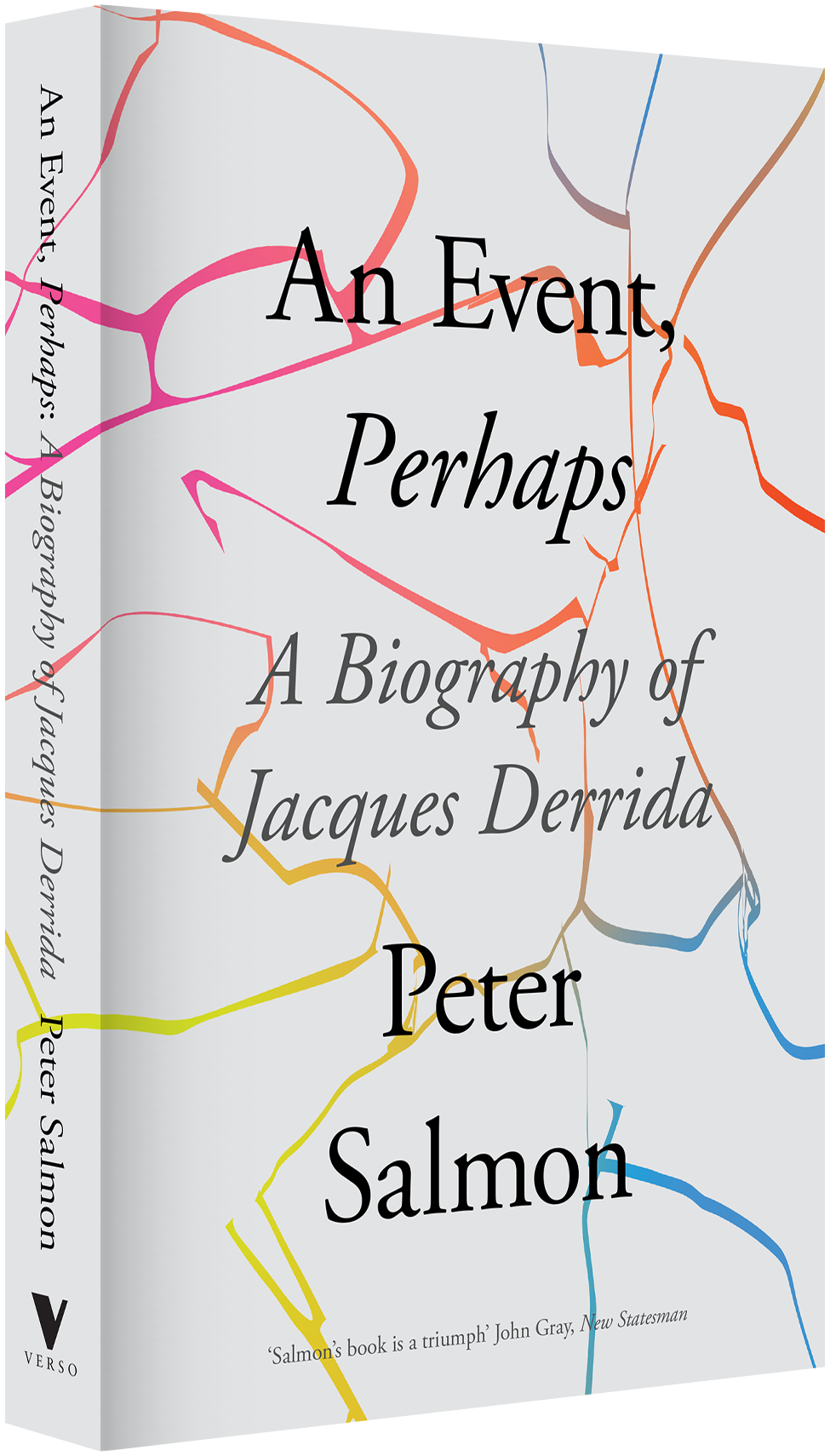
An Event, Perhaps: A Biography of Jacques Derrida by Peter Salmon
Omar Sabbagh on a biography of Jacques Derrida. Philosophy Now, 2021

Peter Salmon, An Event, Perhaps: A Biography of Jacques Derrida, Verso Books, 2020, 320 pages, £11.99 hb, ISBN 978-1788732802

Deciding to write a biog raphy of Jacques Derrida (1930-2004), even a predominantly intellectual biography like Peter Salmon’s, must, perhaps, involve a dilemma. As Salmon himself suggests in his Introduction, the temptation to mimic Derrida’s own ‘gnomic, allusive, elusive’ manner of writing can be overwhelming. Yet while saying that Salmon has written a superb intellectual biography that does a terrific job of humanizing a man and thinker often seen or imagined as arcanely inaccessible, we can also mention the more approachable way in which Salmon mirrors for his readers’ benefit some of the gnomic tics of his subject (or is it object?). If there really is, as Derrida says, ‘nothing outside the text’ – meaning that all meaning is text-based, and so susceptible to plural interpretations – then writing a biography in a predominantly plain-spoken manner might seem to be conceptually problematic, no? The book, however, hardly ever fails to intrigue, picking out and deploying moments of Derrida’s life and work, text and context, with a novelistic rhythm.

[…]
Michel Foucault, of course, is also a repeated presence. As one of Derrida’s doctoral examiners, he wonders whether, given the abstruseness (but brilliance) of Derrida’s work, he should be given an ‘F’ or an ‘A+’. This is the kind of paradox that typified Derrida’s public career. Later, Derrida, calling himself a ‘disciple’, critiques Foucault’s 1961 work Madness and Civilization ; but his criticisms are acknowledged by Foucault and duly applied by the early 1970s, by which time Derrida had already achieved wide fame.
[…]

Radford, G. P., Radford, M. L., & Lingel, J. (2015). The library as heterotopia: Michel Foucault and the experience of library space. Journal of Documentation, 71(4), 733-751.

doi:http://dx.doi.org/10.1108/JD-01-2014-0006

Abstract
Purpose
Using Michel Foucault’s notion of heterotopia as a guide, the purpose of this paper is to explore the implications of considering the library as place, and specifically as a place that has the “curious property of being in relation with all the other sites, but in such a way as to suspect, neutralize, or invent the set of relations that they happen to designate, mirror, or reflect” (Foucault, 1986a, p. 24).

Design/methodology/approach
The paper draws upon a range of literary examples and from biographical accounts of authors such as Alan Bennett, Michel Foucault, and Umberto Eco to show how the library space operates as a heterotopia.

Findings
The paper finds that drawing together the constructs of heterotopia and serendipity can enrich the understanding of how libraries are experienced as sites of play, creativity, and adventure.

Originality/value
Foucault’s concept of heterotopia is offered as an original and useful frame that can account for the range of experiences and associations uniquely attached to the library.

stuartelden's avatarProgressive Geographies

As thelast updateonthis booksaid, I was able to make a trip to Paris over reading week. I spent most of the time at the BNF working on archival materials related toThe Archaeology of Knowledge. There is a manuscript on philosophical discourse, probably written in 1966, which seems to be an abandoned book project; a complete early draft of what became the book; and substantial fragments of another draft. The record is incomplete, and there are a lot of question marks around dating and sequence, but this is more preparatory material than any other of Foucault’s published books, with the exception of the second and third volumes of theHistory of Sexuality. In that case, this seems to be because Foucault was in hospital and unable to destroy these draft materials. I discuss those inFoucault’s Last Decade.

Some parts of theArchaeology

View original post 1,327 more words

Deering, B. (2015). In the Dead of Night: A Nocturnal Exploration of Heterotopia in the Graveyard. In M.-J. Blanco & R. Vidal (Eds.), The Power of Death: Contemporary Reflections on Death in Western Society (1st ed., pp. 183–197). Berghahn Books.

http://www.jstor.org/stable/j.ctt9qd3qf.19

The photograph below shows a visitor to a Hallowe’en graveyard event.¹ Hundreds of flickering tealights lit up the tombstones, while storytellers enthralled the crowds with ghostly and ghastly tales. Having attended this annual event for several years I noticed that it attracted people from all over the city and beyond. On a night when there are myriad pop-up cultural events on offer, what could possibly be the lure of a dark and gloomy graveyard? This chapter explores the phenomenon of nocturnal graveyard visits and interrogates the motivations and experiences of the visitors. The study forms part of a larger PhD…

Sylvère Lotringer (1938–2021)
Art Forum, November 10, 2021

Renowned French thinker Sylvère Lotringer, a lodestar in the twin galaxies of literary criticism and cultural theory, died on November 8 at the age of eighty-three following an illness. Beginning in the 1970s, Lotringer reshaped the American literary scene through the journal Semiotext(e), which he began publishing while teaching at Columbia University. The journal evolved into an independent publishing house of the same name, which through its English translations of their texts introduced American readers to such French giants of philosophy as Jean Baudrillard, Gilles Deleuze and Félix Guattari, Michel Foucault, Jean-François Lyotard, and Paul Virilio.
[…]

Los Angeles Times

[…]

In November of 1975, a French literary scholar at Columbia University by the name of Sylvère Lotringer, along with a student, John Rajchman, organized a four-day colloquium that was intended to bring together a wave of avant-garde French theorists with various representatives of downtown New York City demimondes — presumably to discuss themes related to “prisons and madness.”
[…]
It remained delightfully eggheaded until the Village Voice featured the colloquium as its “pick of the week” and more than 2,000 people descended on Columbia for the event. Fights broke out. Panelists attacked each other. During Foucault’s presentation, an attendee stood up and accused him of being a paid agent of the CIA. (He was not.)
[…]
At the center of it all was the affable Lotringer. In the 2014 book, “Schizo Culture: The Book, The Event,” he recalled the chaos of the proceedings: “Foucault vented his furor and frustration at the conference. It was a scandal, he said; he had never seen a worse audience before; New Yorkers were horrible, the conference a sham.”
[…]

See also New York Times (paywall)

And Le Monde (paywall)

Un vrai passeur toujours s’efface devant ce qu’il fait passer ; il relie et fait converger tout en étant lui-même au bord de disparaître. Avec Sylvère Lotringer – qui pensait en ces termes, et est mort le 8 novembre dans sa résidence de Baja California, au Mexique – c’est un vrai passeur qui a disparu. Et quel passeur ! Le rayonnement nord-américain de la pensée française depuis un demi-siècle (dont cette « French Theory » qu’il rassembla, publia et baptisa même) lui doit beaucoup, de même que la popularité, dans certains milieux français, des avant-gardes culturelles américaines de la fin du XXe siècle. Et au-delà, il favorisa l’étonnante diffusion des théories philosophiques les plus subversives, ou les plus intempestives, dans des milieux connexes – artistiques, militants, universitaires, contre-culturels, qu’il aura contribué à inspirer et rapprocher les uns des autres.

Sylvère Lotringer est né à Paris le 15 octobre 1938, de parents juifs polonais émigrés de Varsovie en 1930. Confié par sa mère à des proches, il a passé la seconde guerre mondiale dans l’est parisien en « enfant caché » – comme beaucoup d’autres de sa génération, dont la philosophe Sarah Kofman et l’écrivain Georges Perec, avec lesquels il partagera le souvenir traumatique de cette enfance recluse.

Appréciation : Le Semiotext(e) de Sylvère Lotringer a changé de livre

Taşkale, Ali Rıza. “Thanatopolitics and Colonial Logics in Blade Runner 2049.” Thesis Eleven 166, no. 1 (October 2021): 109–17.
https://doi.org/10.1177/07255136211043944.

Abstract
This article critically engages with Denis Villeneuve’s Blade Runner 2049, focusing on the relationship between colonial logics and biological engineering that understands the natural world as property. First, it discusses the connections between the film and the shifting status of biopolitics becoming thanatopolitics, prompted by advances in synthetic biology. It argues that the film’s preoccupation with the reproductive capacity of its replicants retraces a racialized (post) colonialism and reconfigured slavery, or the voluntary labour of the occupied – as normalized in synthetic biology and the ongoing processes of devaluing of some lives over others for socioeconomic reasons. Second, and relatedly, the film reveals how deeply the thanatopolitics of a biopolitical economy is rooted in an intensification of racialized and colonial logics. The film thus doubles as a medium in which to grasp the centrality of colonial and racial logics to the ongoing real subsumption of life by capital, and the ways in which it continues to shape the present.

Keywords
bioeconomy, biopolitics, Blade Runner 2049, synthetic biology, thanatopolitics
Access Options