
Foucault News

News and resources on French thinker Michel Foucault (1926-1984)

Kate Wagner, Remembering Ricardo Bofill, Architect of Otherworldly Social Housing, Curbed, 28 Jnuary 2022

His buildings fill dystopic films, but function more like colorful utopias.

Noisy-le-Grand – Les Espaces d’Abraxas [photo Fred Romero] CC


[…]

For many people, their introduction to the work of Spanish architect Ricardo Bofill comes from the image of his grand social housing project, the monumental and colonnaded Espaces d’Abraxas, standing in as the dystopian headquarters in Brazil and The Hunger Games. For others, the pastel pink walls of La Muralla Roja serve as a frequent Instagram photo-shoot location, or more recently, as a visual reference for the interlocking stairs in Netflix’s Squid Game series. While the dystopian associations with Bofill’s work may be cemented by pop culture, there’s a lot of color and wonder that’s missing from that imagery, which is perhaps unfair to those projects that were intent on making great architecture for all (and, in many cases, were successful at it).

[…]

While Bofill’s work was explicitly ideological, he himself was no rigid ideologue, and his architecture reflected that sense of unrestrained experimentation. He borrowed heavily from psychology, behavioral analysis, and the work of Michel Foucault (all very un-Marxist). He didn’t just design socialist housing projects, but luxury commercial developments such as the sail-like W Hotel in Barcelona and the high-PoMo 70 West Wacker Drive in Chicago. When the times changed, stylistically speaking, he changed with them, integrating the modernist social project (although much of his work is too surreal for the starkness of modernism) with the postmodern aesthetic one (whose forms he made monumental to the point of distortion), most explicitly in Les Espaces d’Abraxas in Noisy-Le-Grand.
Jarryd Bartle, In defence of Michel Foucault, Unherd, January 27, 2022

Blaming French theory for the extremes of the American Left has been a popular line for that last few years. Public intellectual Jordan Peterson has blamed “postmodern neo-Marxism” for the rise of a hypersensitive yet coercive activism, connecting the term to everything from safe spaces, to cultural appropriation, to campus protests.
[…]

Let’s focus on the ultimate fall guy for ‘wokeism’, the French philosopher Michel Foucault. If you were to read anti-woke commentary about Foucault, you would be under the impression that his main insights are: nothing is true, all truth is power and all claims to truth are oppressive. This is a deliberately misleading.

Despite what you’ve been told, Foucault was not a rabid ‘activist’ bent on tearing down scientific institutions, but a historian of ideas. His work documents how knowledge changes over time, how some ideas become valorised whilst others get pushed to the margins, and how expertise shifts as a result of cultural and historical change.

He was not denying truth, but helping to place it within a broader historical context. Truth could not help being “a thing of this world”, he wrote. Every society had a regime of truth, and a “general politics” of truth. These are simply types of discourse which society “accepts and makes function as true; the mechanisms and instances which enable one to distinguish true and false statements, the means by which each is sanctioned; the techniques and procedures accorded value in the acquisition of truth; the status of those who are charged with saying what counts as true.”

read more

Jelena Radonjic, Office, What Office? How Our Concept Of Work Is Changing
Forbes, Dec 7, 2021,

Most of us have become well-versed in the ways of new work with Zoom routines in our neat home offices. While we are far from post-pandemic times, we are gradually stepping back into office spaces and the question is not only how much has the office changed but how much have we changed?
[…]
Supervision And Productivity
In its worst sense, the home office can become a sort of panopticon with supervision enforced on all sides. In the office, supervision was mostly limited to whether the set tasks were completed, combined with physical supervision in the shared space. Remove the worker from the office and there is no way to peep into the home and see how efficiently and productively the work is being done. Or is there?
[,,,]

Terms like supervision and discipline are not merely threats from dystopian corporate fiction, they are present in contemporary society. In his influential work Discipline and Punish, French theorist Michel Foucault digs deep into the mechanisms that shape our modern society and turn us into docile bodies, cogs in a machine. They can be societal or self-enforced.'[…]

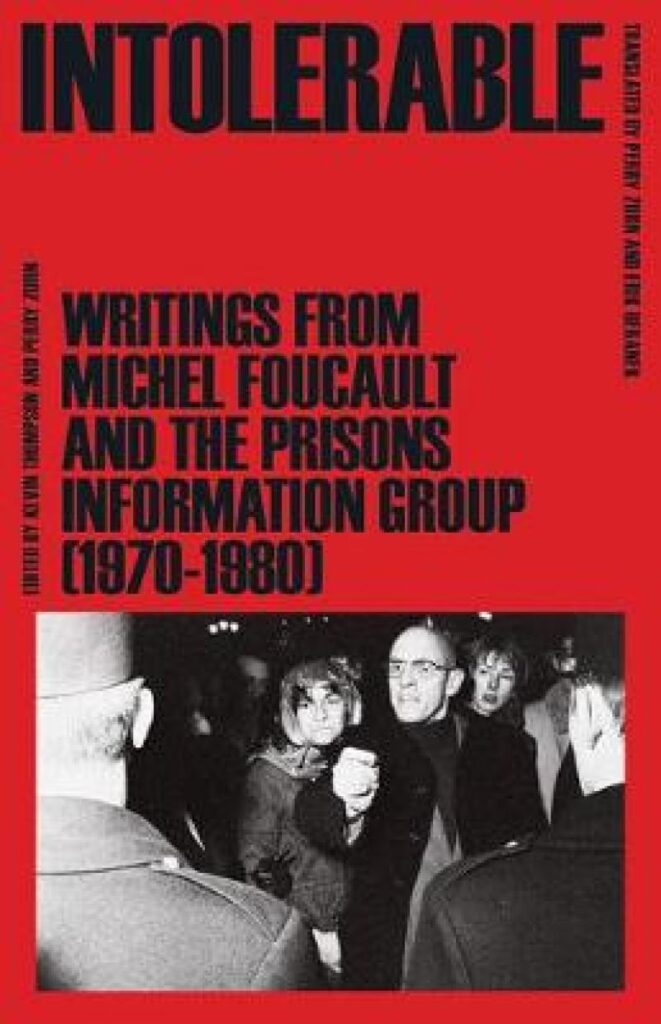
Discussions on Intolerable: Writings from Michel Foucault and the Prisons Information Group (U of Minnesota Press, 2021), eds. Kevin Thompson and Perry Zurn and trs. Perry Zurn and Erik Beranek.

**Conversations in Atlantic theory: Kevin Thompson and Perry Zurn on Intolerable: . Podcast (January 2022)

**Recorded Zoom Conversation with Kevin Thompson and Perry Zurn on Intolerable, Radical Philosophy hour, Radical Philosophy Association (2021)

**New Books in Politics and Polemics, Michel Foucault, “Intolerable: Writings from Michel Foucault and the Prisons Information Group (1970-1980)” (U of Minnesota Press, 2021) An interview with Perry Zurn and Kevin Thompson on the New Books network (2021)

**Archival Relations and Activist Intimacies: from the GIP to IntolerableA conversation between Perry Zurn and Erik Beranek. Hopscotch translation. Written discussion

**Symposium in Number 31 Foucault Studies , 9 items

Palti, E.J.
Deleuze’s Foucault: on the possibility of an outside of knowledge/power
(2021) History and Theory, 60 (4), pp. 20-35.

DOI: 10.1111/hith.12234

Abstract
During 1985 and 1986, Gilles Deleuze directed a seminar on Michel Foucault’s work at the University of Paris 8 at Vincennes/St. Denis. The course was divided into three parts, one dedicated to each of the three levels on which, according to Deleuze, Foucault’s concept of thinking unfolds: knowledge, power, and subjectivation. As I will show, Deleuze’s attempt to reconstruct Foucault’s perspective on the history of thought is highly enlightening, although, at some crucial points, it raises doubts regarding the plausibility of the hypotheses that Deleuze attributed to Foucault. In particular, in the third part, which focuses on subjectivation, it is not clear whether Deleuze was attempting to relate Foucault’s concept or to expose his own ideas on the topic. The displacements, which Deleuze introduced into Foucault’s perspective, are particularly interesting, since they are symptomatic of broader epistemological problems that philosophical thought currently faces in attempting to articulate a consistent perspective of the possibility of an “outside” of power or, in Foucault’s formulation, knowledge/power. © 2021 Wesleyan University

Author Keywords
Gilles Deleuze; knowledge/power; metaphilosophy; Michel Foucault; subjectivation

Boyle, C.
The (in)credible fiscal prize: A critical examination of the discourse of evidence in early childhood intervention
(2021) Contemporary Issues in Early Childhood

DOI: 10.1177/14639491211059164
Open access

Abstract
In playing with the concept of ‘credibility’, this article presents a critical examination of the discourse of evidence and the programming of upbringing in early intervention policy and practice. The truth claims of the evidence discourse in policy are explored through a single complex case study of an early intervention city in Northern Ireland. The framework for the study discussed uses Bourdieu’s thinking tools of habitus, capital and field alongside Foucauldian discourse analysis to explore the ways in which early intervention policy and practice impact on children, parents and communities. A key question is to consider how evidence is constructed within the discourse and how this can be considered as a Foucauldian regime of truth. Building from the emerging body of critique around scientism and parenting, the study extends this through a sociopolitical lens to the Northern Ireland context. Despite a strong tradition in Northern Ireland of community-based activism and political transition from direct rule to devolution, early intervention policy and programming have tended towards direct read across from Britain and the USA. The study documents that community-based practice struggles within the policy field for recognition, yet ‘home grown’ carries significant social capital within and across communities. The dominant policy discourse of the (in)credible ‘fiscal prize’, transformation through evidence-based interventions contrasts with the backdrop of worsening child poverty in communities. Contrary to the truth claims, this suggests the reproduction rather than transformation of social disadvantage. © The Author(s) 2021.

Author Keywords
Bourdieu; discourse; early intervention; evidence; Foucault

Le foucaldien relaunched as Genealogy + Critique (2022)

From 2022, the peer-reviewed, open-access journal Le foucaldien, published by the London-based Open Library of Humanities (OLH), and the affiliated foucaultblog appear under the new title GENEALOGY+CRITIQUE at genealogy-critique.net. The relaunch broadens the scope of the journal and its blog by including various approaches of historical-genealogical research and critical theory formation.

GENEALOGY+CRITIQUE focuses on genealogical scholarship and a broad conception of critical theory. Combining historical and systematic forms of inquiry, the interdisciplinary journal fosters critical analyses of the present written in English, German, or French. It also aims at confronting historical-genealogical and critical theory approaches with concepts and methods in more recent fields of knowledge such as media studies, digital humanities, science and technology studies, as well as postcolonial, gender, and race studies.

The journal’s publisher, the Open Library of Humanities, is a nonprofit organization financed by an international consortium of academic institutions. Due to its noncommercial orientation, the OLH does not charge any author fees. All articles published in GENEALOGY+CRITIQUE are peer-reviewed, available open access under the Creative Commons license CC BY 4.0, indexed in the Directory of Open Access Journals (among other databases), and archived for the long term in HTML, PDF, and XML.

The journal is published as a continuous volume and issue throughout the year. Articles go online as soon as they are ready to avoid unnecessary delays in making knowledge publicly available. Special collections are published as part of the normal volumes, but also on separate web pages. GENEALOGY+CRITIQUE is edited by Simon Ganahl, Maurice Erb, Stephanie Marx, Sergej Seitz, and Anna Wieder, who are supported by an advisory board of highly renowned scholars.

Succeeding the foucaultblog, the G+C Blog continues to post announcements related to the activities of GENEALOGY+CRITIQUE. It also keeps publishing shorter essays, interventions, and commentaries by guest authors. While GENEALOGY+CRITIQUE is positioned as a high-quality academic journal, the G+C Blog is an explicitly open platform providing a digital space for more experimental and subjective forms of writing.

Kurtulus, G., İnci, M. “Merkantilizminin Disiplinci İktidar Projesi: Büyük Kapatilma [The Disciplinary Power Project Of French Mercantilism:The Great Confinement]”. Marmara University Journal of Economics and Administrative Sciences 43 (2021): 253-265
https://dx.doi.org/10.14780/muiibd.1052065

Open access
An extended abstract in English can be found at the end of the paper.

Öz
Fransa, merkantilist doktrinin en önemli temsilcilerinden biriydi. Bu kadar önemli olmasında hiç şüphesiz dönemin maliye bakanı J.B. Colbert’in etkisi büyüktür. Öyle ki, Fransız merkantilizmi tarih boyunca Colbertizm olarak anılmıştır. Colbert döneminde ülkede ekonomik gelişmenin sağlanması amacıyla daha önce benzeri görülmemiş birtakım uygulamalar hayata geçirilmiştir. Bu uygulamalardan biri, verimli olarak görülmeyen kişilerin Colbert yönetimi tarafından bazı kurumlara kapatılması olmuştur. “Büyük Kapatılma” olarak adlandırılan bu sürecin en başından beri bilinçli bir proje olduğu savunulmaktadır. Buna göre projenin amacı, tek tip insanlardan oluşan bir toplum modeli yaratmaktı. Fransa’da devlet bu projenin kurgulanmasında ön planda olmuştur. Foucault on yedinci yüzyılda, iktidar kavramının ilişkisellikten öte somut bir yönetim sanatına dönüşerek farklı bir iktidar biçiminin ortaya çıktığını ileri sürmektedir. Çalışmanın amacı, Fransız merkantilizmi teorisini, Foucault’nun disiplinci iktidar kavramından hareketle eleştiriye açmaktır. Bu kapsamda, dönemin maliye bakanı J.B. Colbert tarafından yönetilen Fransa ekonomisi ile o dönemde yükselişe geçen kapatma kurumları arasındaki ilişki; Foucault’nun disiplinci iktidar kavramı çerçevesinde değerlendirilmiştir.
Anahtar Kelimeler: Büyük Kapatılma, Colbertizm, Disiplinci İktidar, Foucault
Jel Sınıflandırması: B11, B30, B59, Z13.

Abstract
France was one of the most important representatives of mercantilist doctrine. Undoubtedly, the Secretary of the Treasury at the time, J.B. Colbert’s influence was great. So, French mercantilism has been called Colbertism throughout history. In Colbert’s time, a number of unprecedented practices were implemented in provision of economic development in the country. One of these practices was the closure of people who were not seen as efficient to certain institutions by the Colbert administration. It has been argued that the process called “The Great Confinement” was a conscious project from the beginning. The aim of the project was to create a model of society consisting of one kind. In France, the state was at the forefront in the construction of this project. Foucault argues that in the seventeenth century, a different form of power emerged by transforming the concept of power into a concrete art of government rather than relationality. The aim of the study is to open the French mercantilism theory to criticism based on Foucault’s disciplinary power concept. In this context, the relationship between the French economy, which was managed by J.B. Colbert, the Secretary of the Treasury at the time, and the seclusion practices was examined within the scope of the literature. This review has been evaluated within the framework of Foucault’s disciplinary power concept.
Keywords: Colbertism, Disciplinary Power, Foucault, Great Confinement
JEL Classification: B11, B30, B59, Z13.

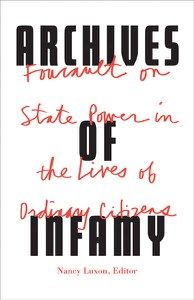
Nancy Luxon (Ed.) Archives of Infamy. Foucault on State Power in the Lives of Ordinary Citizens. Translated by Thomas Scott-Railton, University of Minnesota Press, 2019

What might it mean for ordinary people to intervene in the circulation of power between police and the streets, sovereigns and their subjects? How did the police come to understand themselves as responsible for the circulation of people as much as things—and to separate law and justice from the maintenance of a newly emergent civil order? These are among the many questions addressed in the interpretive essays in Archives of Infamy.

Crisscrossing the Atlantic to bring together unpublished radio broadcasts, book reviews, and essays by historians, geographers, and political theorists, Archives of Infamy provides historical and archival contexts to the recent translation of Disorderly Families by Arlette Farge and Michel Foucault. This volume includes new translations of key texts, including a radio address Foucault gave in 1983 that explains the writing process for Disorderly Families; two essays by Foucault not readily available in English; and a previously untranslated essay by Farge that describes how historians have appropriated Foucault.

Archives of Infamy pushes past old debates between philosophers and historians to offer a new perspective on the crystallization of ideas—of the family, gender relations, and political power—into social relationships and the regimes of power they engender.

Contributors: André Béjin, Centre national de recherche scientifique; Roger Chartier, Collège de France; Stuart Elden, U of Warwick; Arlette Farge, Centre national de recherche scientifique; Michel Foucault (1926–1984); Jean-Philippe Guinle, Catholic Institute of Paris; Michel Heurteaux; Lynne Huffer, Emory University; Pierre Nora, École des Hautes Études en Sciences Sociales; Michelle Perrot; Michel Rey (1953–1993); Elizabeth Wingrove, U of Michigan.

Contents
Preface and Acknowledgments
Introduction
Policing and Criminality in Disorderly Families
Nancy Luxon

PART I Archival Materials: Audiences and Contexts
1 Lives of Infamous Men (1977)
Michel Foucault

2 “All about the Lettres de Cachet” (1983)
André Béjin, Roger Chartier, Arlette Farge,
Michel Foucault, and Michelle Perrot

3 Review of Disorderly Families (1983)
Jean-Philippe Guinle

4 Denunciation, a Slow Poison (1983)
Michel Heurteaux

PART II Letters and Events: From Composition to Contestation
5 The Order of Discourse (1970)
Michel Foucault

6 The Public Sphere and Public Opinion (1990)
Roger Chartier

7 The Return of the Event (1972)
Pierre Nora

8 Thinking and Defining the Event in History (2002)
Arlette Farge

9 Home, Street, City: Farge, Foucault, and
the Spaces of the Lettres de Cachet
Stuart Elden

10 Parisian Homosexuals Create a Lifestyle,
1700–1750: The Police Archives (1985)
Michel Rey

11 Sovereign Address (2012)
Elizabeth Wingrove

12 Gender, Agency, and the Circulations of Power
Nancy Luxon

13 Foucault’s Rhythmic Hand
Lynne Huffer

PDF dépliant

Michèle COHEN-HALIMI et Orazio IRRERA 

Nietzsche, Foucault et la généalogie

Université Paris 8 | Semestre 2 | mardi 12h15-15h

(Les séances auront lieu sur Zoom et un lien sera transmis aux inscrits)

Inscriptions / contacts : orazio.irrera02@univ-paris8.fr | m.cohenhalimi@gmail.com

Séminaire organisé dans le cadre des activités pédagogiques et de recherche du Département de Philosophie de l’Université de Paris 8, du LLCP (EA, 4008), du GRAF (Groupe de Recherche sur les Archives Foucaldiennes), du Collège international de Philosophie, et du séminaire permanent « Foucault à Paris 8 ». Activité soutenue par le Centre Michel Foucault et la revue materiali foucaultiani.

La généalogie comprise comme méthode surgit tardivement dans le corpus nietzschéen, dans La Généalogie de la morale en 1887, et ne procède pas directement de l’élaboration du concept d’inactualité, ni de celui d’histoire, tels du moins qu’ils sont déployés dans la deuxième Considération inactuelle (1874). L’histoire de l’élaboration des concepts nietzschéens de « méthode généalogique », d’« inactualité », d’histoire (antiquaire, monumentale et critique), sera confrontée à l’usage qu’en fait Foucault et au contexte philosophique français de cet usage ainsi qu’aux transformations de cet usage à l’intérieur même du corpus foucaldien. Devraient ainsi se voir éclairées les perspectives, nietzschéenne et foucaldiennes, fort différentes sur l’historicité et se voir explicités certains enjeux de la lecture foucaldienne de Nietzsche, dont notamment celui qui gravite autour de la notion de diagnostic, celui aussi de l’inspiration nietzschéenne qui accompagne l’inscription par Foucault d’une perspective archéologique dans le discours philosophique, et enfin celui du rapport de l’archéologie avec l’actualité et l’histoire, à l’intérieur de la perspective généalogique.

La première partie du séminaire prévoit les interventions des membres du GRAF :

25 janvier – Khaïang FALVISANER (Université Paris 8 | GRAF)
La généalogie foucaldienne et le devenir philologique de la philosophie. Entre Nietzsche et la psychologie historique d’Ignace Meyerson.

1er février – Benjamin LARVOL (Université Paris 8 | GRAF)
Foucault au prisme de l’exaleiphein : la surcharge de l’oubli d’Athènes réinvesti par Nicole Loraux.

15 février – Camila GINÉS (Université Paris 8 | LLCP | GRAF)
Généalogie, alèthurgie et critique : le geste philosophique de l’Ecce Homo et les stratégies de la critique chez Foucault.

22 février – Alessandro FALCONIERI (Université Paris 8 | LLCP | GRAF)
Réceptions (anti)dialectiques de Nietzsche en France. Peut-on jouer le Nietzsche d’Henri Lefebvre contre Michel Foucault ?

8 mars – Andrea ANGELINI (Université Paris 8 | ENS/Centre Cavaillès | GRAF)
Généalogie et évolutionnismes :  Foucault, Nietzsche et nous.

15 mars – Gabriela JAQUET (Université Paris-Est Créteil | LIS | GRAF)
Deixologie, archéologie, généalogie : variations de l’événement chez Foucault à la lumière du structuralisme et de l’héritage nietzschéen.