Foucault News

News and resources on French thinker Michel Foucault (1926-1984)

Krzysztof Tyszka-Drozdowski, The failure of May 1968, Unherd, May 24, 2022

“What defines our public life today is boredom”. That was a Le Monde front-page headline in March 1968. Two months later, a revolution would erupt that would shake the foundations of the Fifth Republic, divide France, and alter its history forever.
[…]

In June, Michel Foucault watching France from a perch in Tunisia, wrote to one of his correspondents: “From here it looks like a great mystery.” More than half a century later, there is no consensus either on the causes or on the meaning of those events. Were the students motivated by economic anxieties? Or was this a cultural revolution? The question boils down to whether the underlying cause of the youth revolt was precarity or abundance.

Krishnan, A.R., Jha, S.
Writing bodies, wording illness and countering marginalization: graphic autopathographies as a genre
(2022) Journal of Graphic Novels and Comics

DOI: 10.1080/21504857.2022.2030381

Abstract
The hegemonic oppression by biomedical discourses and erroneous cultural assumptions of degeneracy doubly marginalise the chronically ill and exclude them from domains of productivity. Personal narratives of lived illness experience help to contest metanarratives of dominant discourses, counter the marginalisation occasioned by social and medical othering of diseased bodies, and act as co-discourses that supplement the understanding of illnesses. In this scenario, graphic autopathographies become performative tools through which the marginalised seeks redressal using verbal, spatial and temporal representations of self, body, and illness. Drawing theoretical insights from Arthur Frank, Carolyn R. Miller, Elisabeth El Refaie, Susan Sontag, and Michel Foucault, the article investigates how the chronically ill seek to overcome biomedical reduction and social exclusion by way of this hybrid narrative genre that helps engender participation and resuscitation of the patient’s voice and agency. For this end, the article examines select graphic memoirs and extends the resulting observations to understand autopathographies in general. © 2022 Informa UK Limited, trading as Taylor & Francis Group.

Author Keywords
chronic illness; genre; Graphic medicine; marginalisation; medical gaze; self; stigma

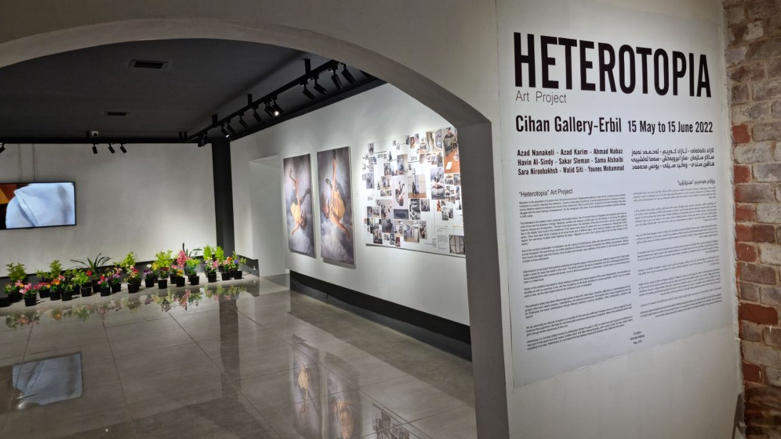
Heterotopia art exhibition in Erbil focuses on migration abroad
by Wladimir van Wilgenburg, Kurdistan 24, 2022/05/24

The art exhibition “Heterotopia” focuses on migration (Photo: Wladimir van Wilgenburg/Kurdistan 24)

ERBIL (Kurdistan 24) – The “Heterotopia” art exhibition began on May 15 in the Cihan art gallery at Cihan University in Erbil. It focuses on the culture of migration abroad and will continue until June 15.

Artist Ahmad Nabaz organized the exhibition with the help of the Cihan Cultural Centre and the Goete Institute of Iraq. It features work from nine artists. Seven of these artists are Kurdish, while the remaining two are Iranian and Palestinian.

“Each tried in their own language tried to be connected to the concept of heterotopia,” Nabaz said. “Some of them use their personal memory since they experienced migration themselves and moved to Europe.”
[…]

Heterotopia is a good title for the exhibition, Nabaz said, since it explains the lives of refugees when they live in between dystopia (in hell) and utopia (the place they aim to reach).

Heterotopia is a concept initially invented by philosopher Michel Foucault in 1967 in a discourse with a group of architects as a new type of mid-space term that means ‘another place’ that falls between utopia, where everything is an ideal, yet also dystopic, and a place of hell. Heterotopia is a non-space that lies between utopia and dystopia, often called the third space.
[…]


Li, S.
A Foucauldian Power Analysis of China’s Confucius Institute in Africa: Power, Knowledge and the Institutionalisation of China’s Foreign Policy
(2022) Journal of Asian and African Studies

DOI: 10.1177/00219096221086546

Abstract
The Confucius Institute (CI) was established in 2004 by China to disseminate its language, culture and other forms of positive knowledge to people of different nationalities. By critiquing existing analytical frameworks of the CI, this article draws on Foucault’s conception of power, which explains the role of language, culture, value and other non-material elements in the operation of power, to examine the case study of the CI in Africa. By investigating the CI’s power structure, its internal power operations and its power effects, this research seeks to ascertain the role of the CI in the institutionalisation of China’s foreign policy towards Africa. © The Author(s) 2022.

Author Keywords
Africa; China; Confucius Institute; foreign policy; institutionalisation; power/knowledge

Francesca Peruzzo, Stephen J Ball, Emiliano Grimaldi,
Peopling the crowded education state: Heterarchical spaces, EdTech markets and new modes of governing during the COVID-19 pandemic, International Journal of Educational Research, Volume 114, 2022

https://doi.org/10.1016/j.ijer.2022.102006

Abstract
In this paper, we examine a set of complexly related education policy issues that concern changes to the form and technologies of the state, and changing modalities of government and processes of policy and service delivery, and concomitantly, the re-agenting of education policy within extensive but exclusive policy networks. We also explore the role of the state in creating opportunities for business and social purpose organisations within the delivery and management of state education in response to the ambitions of EdTech (Education Technology) companies seeking to sell their products within the state system. The time is that of COVID-19 and lockdown (2020-2021) and the case is the English Oak National Academy (ONA) – a national platform for remote teaching and learning resources that was conceived and created in England in April 2020, with funding from government and various philanthropists, and designed and run by a team of third sector and business policy entrepreneurs. Alongside and in relation to the ONA we consider a series of UK government policy papers on EdTech, interrogate the membership of the EdTech Leadership Group (ELG) and of the EdTech Advisory Forum.

Zelinka, J. (2022). Subjects and Subjectivities of the (New) Geopolitics of Knowledge. In: Parreira do Amaral, M., Thompson, C. (eds) Geopolitical Transformations in Higher Education. Educational Governance Research, vol 17. Springer, Cham.
https://doi.org/10.1007/978-3-030-94415-5_15

Abstract
The educational processes worldwide are said to be shaped by neoliberal logic of knowledge-production. In a continuously globalised world, the competition over logics of knowledge-production is accompanied by epistemic and political changes as well as by power shifts. In context of the (new) Geopolitics of Knowledge and using the theoretical lenses of Michel Foucault, the chapter intends to provide a critical perspective on new and emerging forms of subjectivities that indicate the changes of power balance. To narrow down the scope of analysis, it particularly examines the so-called 21st century key skills and competencies discourse and unwraps discursive practices and technologies of subjectivation operating within. By compiling and critically assessing the worlds most popular frameworks of key skills and competencies it tries to address the production of subjectivities and understand their relation to the current geopolitical dynamic. The chapter starts with introducing the current state of research and theoretically embedding the forthcoming analysis. It then presents and analyses the 21st century skills and competencies discourse to carve out three central tension-pairs, within which subjectivities are produced. It ends with reflecting on the preliminary results in light of the (new) Geopolitics of Knowledge as a form of global governmentality. © 2022, The Author(s), under exclusive license to Springer Nature Switzerland AG.

Author Keywords
21st Century Skills; Geopolitics of knowledge; Governmentality; Higher education; Subjects and subjectivities

Šabec, K., Mencin, M., Perger, N.
A Dry Branch on the Nation’s Body: The Nation’s Biological Reproduction between Gender and Sexuality
(2021) Treatises and Documents, Journal of Ethnic Studies, 87, pp. 69-85.

DOI: 10.36144/RiG87.dec21.69-85

Abstract
The article proceeds from the thesis that discriminatory discourses in the field of gender and sexuality in Slovenia are based on ideas surrounding the nation’s biological reproduction and that increasing the fertility rate is crucial for the nation’s viability. The authors substantiate this thesis with Foucault’s biopolitical governmentality, Balibar’s concepts of nationalism and fictive ethnicity, and Yuval-Davis’ analysis of women’s roles in the construction of ethnic and national collectivities. The research question is how the assumption of the nation’s biological origin affects the understanding of the state and citizenship. We analyse political debates in Slovenia over a period of 30 years, focusing on those that expose any relation between gender and sexual norms and the understanding of the state as an ethnic rather than a civic category: the right to abortion, biomedically assisted reproduction, and the legal equality of intimate partnerships. © Inštitut za narodnostna vprašanja (Ljubljana), http://www.inv.si.

Author Keywords
abortion; biomedically assisted reproduction; equality of intimate partnerships; gender; nation-state; sexuality

Tanke, Joseph. “The Gentle Way in Governing: Foucault and the Question of Neoliberalism.” Philosophy & Social Criticism, (April 2022).
https://doi.org/10.1177/01914537221079673.

Abstract
This essay challenges some of the recent scholarship which claims that Michel Foucault was more sympathetic to neoliberalism than is typically acknowledged. Accordingly, it considers the possible motivations for Foucault’s 1978-1979 lecture course, The Birth of Biopolitics; the relationship between liberalism and the various forms of power identified by Foucault; and, finally, claims that Foucault’s account of the ‘care of the self’ was itself informed by the neoliberal theory of human capital. It finds that Foucault regarded neoliberalism as coercive social arrangement on par with the other forms of power/knowledge targeted by his work. And it concludes with some reflections on how Foucault’s account of the ‘aesthetics of existence’ might facilitate resistance to neoliberalism.

Keywords
neoliberalism, liberalism, governmentality, raison d’État, theory of human capital, aesthetics of existence, care of the self, homo oeconomicus

Friedrich, J.
Settling Accounts at the End of History: A Nonideal Approach to State Apologies
(2022) Political Theory

DOI: 10.1177/00905917211065064

Abstract
What are we to make of the fact that world leaders, such as Canada’s Justin Trudeau, have, within the last few decades, offered official apologies for a whole host of past injustices? Scholars have largely dealt with this phenomenon as a moral question, seeing in these expressions of contrition a radical disruption of contemporary neoliberal individualism, a promise of a more humane world. Focusing on Canadian apology politics, this essay instead proposes a nonideal approach to state apologies, sidestepping questions of what they ought to do and focusing instead on their actual functioning as political acts. Through a sociologically informed speech act theory and Foucault’s work on power, apology is conceptualized as a speech act with an essentially relational nature. The state, through apologizing, reaffirms the norms governing its relationship to its subjects at a moment when a past transgression threatens to destabilize this relation. From a Foucauldian point of view, the state’s power inheres in the very stability of the state–citizen relation, and we should therefore see apologies as defensive moves to protect state hegemony. In the context of Western liberal democracies, such as Canada, apologies embody, rather than challenge, the logic of neoliberal governmentality by suggesting that everything, including resentment against the state, can be managed within the current status quo. Nevertheless, total cynicism about apology politics is not warranted. In many indigenous apology campaigners’ demands for contrition we see another side of apologies: their potential to bring about change by enacting counterhegemonic relations to the state. © The Author(s) 2022.

Author Keywords
Canada; governmentality; historical injustice; reconciliation; state apologies