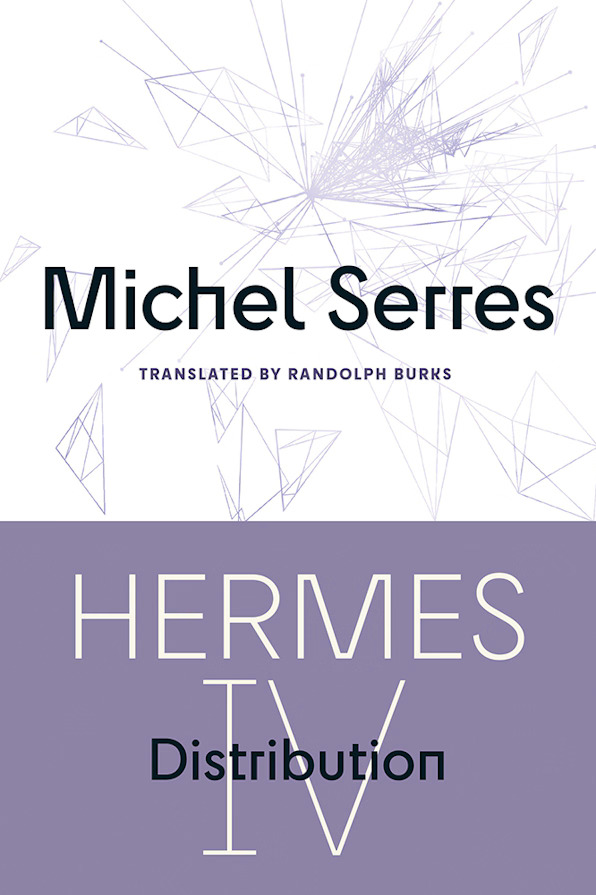
 Michel Serres, Hermes IV: Distribution. Translated by Randolph Burks. University of Minnesota Press, December 22, 2026
How order, meaning, and knowledge emerge from noise across science, literature, and philosophy
Description
Hermes IV: Distribution is the fourth and penultimate volume in Michel Serres’s landmark series on knowledge and communication across disciplines. This collection of essays investigates how order emerges from noise, using thermodynamics and information theory as structural models applicable to science, literature, and culture alike. Moving beyond the themes of interference and translation developed in earlier volumes, Serres focuses on distribution: the processes by which systems take shape, endure, and eventually disperse.
At the core of the book is a dynamic vision of knowledge as an unstable formation. Systems arise from chance encounters or deviations that, through repetition, harden into law. They resist entropy by remaining open to external inputs, forming temporary pockets of negentropy within a wider field of chaos. Space, time, energy, language, and meaning are all shown to emerge from such conditions of mixture and imbalance.
Serres develops his argument through a striking range of materials, including fables, myths, literary texts, philosophy, and the history of science. The result is an uncommon synthesis of hard science and the humanities that reveals shared structures across domains while affirming the irreducible plurality of their laws and methods.
Michel Serres (1930–2019) was author of more than sixty books, including Biogea, Variations on the Body, and The Parasite (all available in translation from Minnesota). He was widely known for his poetic prose and interdisciplinary form of thought.
Randolph Burks is an independent scholar who has translated many works by Michel Serres, including Biogea, Variations on the Body, Hermes II, and Hermes III, all published by the University of Minnesota Press.
From Wikipedia (19/10/26)
Serres taught philosophy from 1958 to 1968 at the University of Clermont-Ferrand. There, he notably associated with Michel Foucault and Jules Vuillemin. At Clermont-Ferrand Michel Serres regularly exchanged ideas and viewpoints with Michel Foucault on themes that would later take shape in Foucault’s book Les Mots et les Choses (The Order of Things).[6]
At the invitation of Foucault, Serres was appointed to University of Paris VIII, where he briefly took part in the Vincennes experiment in 1968–1969.

