
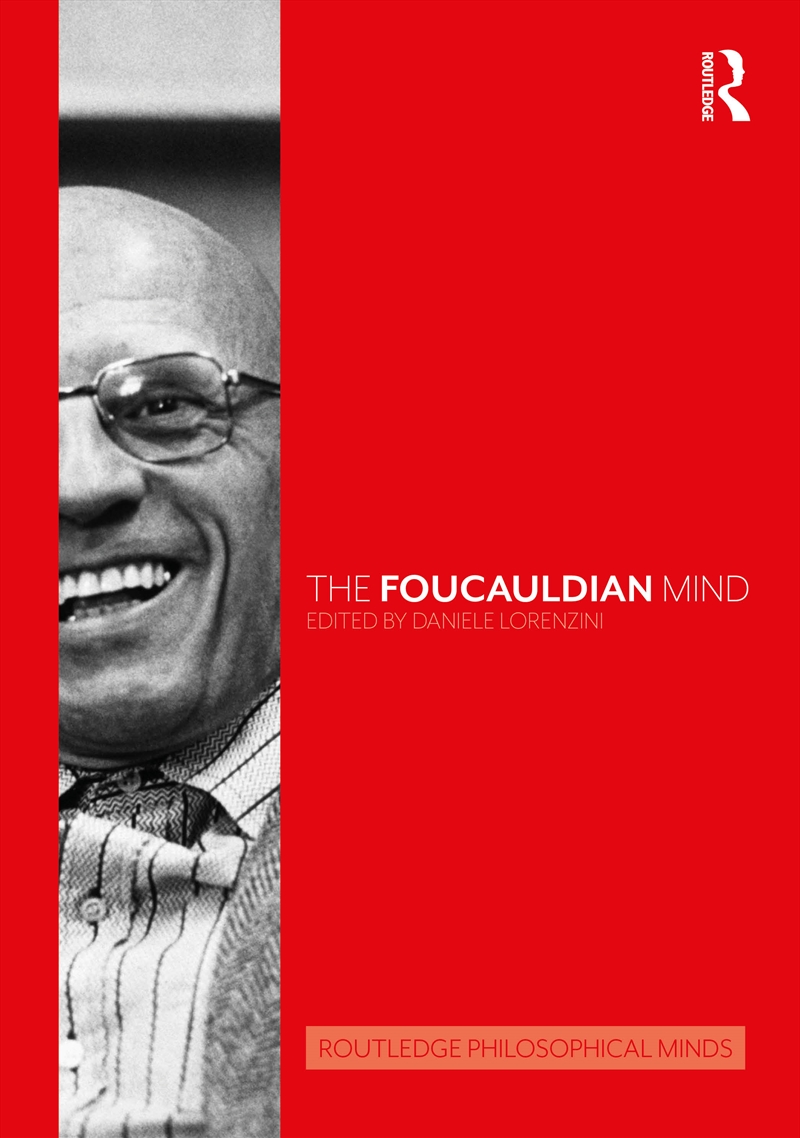
 Daniele Lorenzini, The Foucauldian Mind, Routledge, Forthcoming July 2026
Michel Foucault is one of the most influential, and controversial, thinkers of the twentieth century. His work has had a transformative effect on the study of the humanities and social sciences. His engagement with topics such as truth, power and language continues to exert significant influence on a huge range of disciplines, from philosophy, sociology and anthropology to history, politics, law, literature, religion and many others. Yet, paradoxically, Foucault’s work is rarely discussed systematically within philosophy in the Anglophone world.
The Foucauldian Mind is an outstanding exploration and assessment of Foucault’s thought, demonstrating its coherence, insight and continuing relevance to current debates in a multiplicity of fields within philosophy, and beyond. Comprising over forty chapters authored by an international team of expert contributors, it addresses the following topics and more:
- the formation of Foucault’s thought and his most important writings, from History of Madness and The Order of Things to Discipline and Punish, the History of Sexuality, and his later works on governmentality and the aesthetics of existence
- Foucault’s theoretical and methodological engagements, including with phenomenology, existentialism, structuralism, Marxism, psychoanalysis, critical theory, pragmatism and feminism
- Foucault’s contributions to ethics, political philosophy and law
- Foucault’s often misunderstood engagements with science, race and gender
- the legacy of Foucault’s thought, including for environmental studies, biopolitics, migration studies and philosophy of disability.
With its comprehensive analysis of Foucault’s work and its original discussion of both traditional and new topics, The Foucauldian Mind is a superb resource for anyone studying Foucault’s thought from a broadly philosophical standpoint.
Table of Contents
Introduction: One Hundred Years of Michel Foucault Daniele Lorenzini
Part 1: Mapping Foucault’s Thought
A: Before the Collège de France
1. Foucault on Absolute Knowing: Hegel, Transcendentality, and Historicity in the Diploma Thesis Kevin Thompson
2. Phenomenology and anthropology in Foucault’s early manuscripts Elisabetta Basso
3. History of Madness: Foucault’s Spatial Archaeology of Experience David Webb
4. Knowledge, History, Events: Archaeological Issues, between The Order of Things and The Archaeology of Knowledge Philippe Sabot
5. From São Paulo to Tunis: The Critical Role of Ethnology between Philosophical Discourse and the Episteme as General Cultural Function Orazio Irrera
6. Literary constraint, historical determination: a Foucauldian experiment Judith Revel
B: Genealogies of Power, Truth, and the Subject
7. The Development of Foucault’s Conception of Power Mark G. E. Kelly
8. Fragments of Truth: The Beginning of Foucault’s Project of a Genealogy of Truth-Telling Valentina Moro
9. Narrating the Self: Biography and the Politics of Life in Foucault’s Psychiatric Power Federico Testa
10. Foucault’s Genealogy of Scientia Sexualis Daniele Lorenzini and Arnold I. Davidson
C: The Government of Self and Others
11. From Governmentality to Algorithmic Power: Foucault’s Legacy and the Crises of Neoliberalism Laurence Barry
12. Political Spiritualities Sajjad Lhoi
13. The Late Ancient Christian Inauguration of the Modern Philosophy of the Subject Niki Kasumi Clements
14. The unsuspected power of the aphrodisia: Subjectivity and Truth, The Use of Pleasure, and The Care of the Self Sandra Boehringer
15. Rhetoric, Truth, and Philosophy in Foucault Paul Allen Miller
Part 2: Critical Encounters
16. Foucauldian Positivism: Archive, Clinic, Laboratory Peter Galison
17. Foucault and Structuralism Stuart Elden
18. Psychoanalysis: ‘Dispositif’ or ‘Counter-Science?’ Miguel de Beistegui
19. Heidegger, Foucault, and la Pensée Classique Taylor Carman
20. The Desire for Peace/The Will to Resist: Hobbes and Foucault on the exercise of power Hans Sluga
21. Impure Reason: Foucault and Critical Theory Martin Saar and Frieder Vogelmann
22. Foucault and Existentialism Liesbeth Schoonheim
23. Anachro-Subordination: Foucault’s Metaphors and Feminism’s Foucault Penelope Deutscher
Part 3: Critical Engagements
A: Theoretical Engagements
24. Foucault’s Methods: Archaeology, Genealogy, Empiricity Verena Erlenbusch-Anderson and Colin Koopman
25. Foucault and the Philosophy of Art Arianna Sforzini
26. Foucault’s Philosophy of Language Tuomo Tiisala
27. Late Foucault in the Early Foucault James I. Porter
28. The (Middle) Eastern Foucault: Genealogy and its Counter-Geographies Ege Selin Islekel
B: Ethical and Political Engagements
29. Foucault, Testimonial Injustice, and Power/Knowledge Catarina Dutilh Novaes, Solmu Anttila, and Merel Talbi
30. Foucault and the Ambivalences of Race Sabeen Ahmed
31. Foucault and Latin America: Colonial Formations of Biopolitics and Pastoral Power Don Thomas Deere
32. Religion and Revolutionary Subjectivity: Gerrard Winstanley, the Diggers, and Some Notes on a Foucauldian Philosophy of Religions Daniel Louis Wyche
33. Foucault’s Journey to Ethics Piergiorgio Donatelli
34. Does Critique Have a Future? David M. Halperin
Part 4: Foucault’s Legacies
35. Foucault and Feminism: A (Not Quite) Love Story Dianna Taylor
36. Foucault: The Premier Disabled Philosopher of Disability (My Love Letter to Foucault) Shelley Lynn Tremain
37. Michel Foucault, Discipline and Punish (1975): A Reader’s Companion for 2026 Bernard E. Harcourt
38. Foucault, Normativity and the Genealogy of Law Ben Golder
39. Situating the Biopolitics/Necropolitics Debate: A Discussion on Foucault’s Legacy André Duarte and Maria Rita de Assis César
40. Life’s Entanglement with Power: Michel Foucault, Biopolitics, and Eco-Governmentality Nicolae Morar
41. Geography’s Foucault Stephen Legg
42. Foucault and Critiques of Neoliberalism Johanna Oksala
43. Migrations with Foucault: Biopolitical Hold, Infamous Subjects and the Deadlocks of Critique Martina Tazzioli
44. Queer-Minded Lynne Huffer.
 Foucault News