
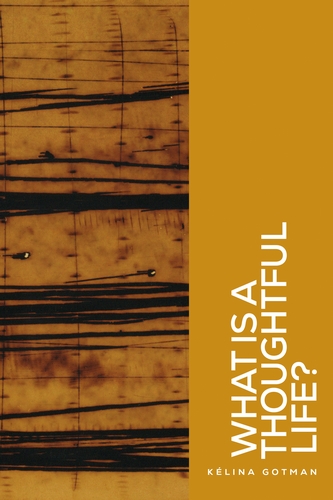
 Kélina Gotman, What is a thoughtful life?, Manchester University Press, forthcoming June 2026
In fresh readings of Theodor W. Adorno, Giorgio Agamben, Hannah Arendt, Judith Butler, Barbara Cassin, Michel Foucault, Werner Hamacher, Martin Heidegger, and many more, Gotman rearticulates the foundations of broadly western philosophical thinking to carve out a shadowy space of recalcitrant thought ‘in dark times’. At once indebted to the legacy of critique and enmeshed in affective and performative approaches to language, anti-theatricality, critical race theory and gender studies, she weaves a poetic mesh of intimate fragments, reflections on what it means to think and to write, as she puts it, after spectacle. Almost but not quite a straight work of philosophy, distinctly literary and performative in its anti-genre, this book twists and turns, swerves and cuts, to show the work of thinking as an intimate act – a theatre of angles and openings, adjacencies and reverberations.
Kélina Gotman is Professor of Performance and the Humanities at King’s College London
With thanks to Progressive Geographies for this news


Critical Comment on Kélina Gotman’s Forthcoming What is a thoughtful life?
Kélina Gotman’s forthcoming What is a thoughtful life? appears, from its description, to enter one of the most overburdened and yet unavoidable questions of the present: what does it mean to think, write, and remain intellectually alive when the conditions of thought have themselves become theatrical, spectacular, affectively managed, and institutionally formatted?
The announced constellation is impressive: Adorno, Agamben, Arendt, Butler, Cassin, Foucault, Hamacher, Heidegger, and others. It promises not a conventional philosophical treatise, but a literary-performative anti-genre, a work that turns thinking into a practice of fragments, angles, openings, adjacency, and intimate resistance. This is clearly not meant to be merely a book about thought. It is meant to perform thought under damaged conditions.
That ambition is serious. It also raises a problem.
The phrase “in dark times” has become almost too available. It now functions as a kind of academic atmosphere: morally grave, aesthetically charged, historically suggestive, but often insufficiently diagnostic. One must ask: when exactly were the times bright? For whom were they bright? Was brightness ever anything more than the stabilized visibility of a dominant order? The danger is that “dark times” becomes a literary and theoretical mood rather than an analysis of the mechanisms that decide what counts as light, obscurity, crisis, speech, silence, and thought.
This is not a minor objection. If one begins by assuming darkness as the horizon of the present, one may preserve, even unintentionally, a nostalgic image of prior intelligibility. The modern academy often mourns the loss of a shared world without asking whether that “shared world” was ever shared, or whether it merely possessed more efficient techniques of exclusion, classification, and managed clarity.
The second difficulty concerns intimacy. To define thinking as an intimate act is powerful, especially against spectacle. Yet intimacy is also dangerous as a philosophical refuge. If thought is moved too quickly into the intimate, the fragmentary, the literary, or the performative, one risks turning the crisis of thought into an aesthetic of survival. The question then becomes not whether the work is beautiful, sensitive, or formally inventive, but whether it can actually confront the apparatuses that determine the admissibility of thought today.
The issue is not whether one can still think after spectacle. The harder question is whether “after spectacle” is even a coherent position. We may not be after spectacle. We may be inside a deeper regime in which spectacle has become infrastructural: not something seen from the outside, but the very condition under which visibility, relevance, identity, and intellectual authority are produced. In that case, thought cannot simply retreat into fragments, turns, cuts, and intimate writing. It must ask how the field of appearance itself is organized.
This is where the Western philosophical archive becomes both indispensable and insufficient. Adorno, Arendt, Foucault, Butler, Heidegger, Cassin, Agamben and Hamacher provide powerful tools for thinking critique, language, appearance, performativity, plurality, power, violence, and the fragility of judgment. But the very phrase “broadly western philosophical thinking” should make us cautious. Does the book merely rearticulate that archive, or does it break its deepest grammar?
The Western question tends to remain attached to the subject: who thinks, who writes, who resists, who reflects, who appears, who speaks? Even when the subject is decentered, criticized, gendered, racialized, performed, exposed, or fragmented, the architecture often remains bound to a drama of selfhood and expression.
A non-Western intervention would begin elsewhere. In a Hebrew register, for example, the question would not first be: what is a thoughtful life? It would be: under what conditions can Life stand before a call without converting that call immediately into possession, concept, identity, or explanation? The word hineni does not mean “I reflect.” It means: here I am, before I know what this presence will require. It is not inwardness. It is threshold-presence.
That displacement matters. A thoughtful life is not necessarily a life enriched by reflection. It may be Life that has not yet been enclosed within the forms by which it is recognized, administered, biologized, and made current. In the present, the problem is not simply that life is distracted or spectacularized. The problem is that Life is increasingly forced to become legible as profile, function, health, identity, output, risk, position, and response.
From this angle, the question “What is a thoughtful life?” may still be too small. It may preserve the humanistic frame it wishes to complicate. The deeper question would be: what is thoughtful Life when Life itself begins to abandon the forms through which it has been made governable?
This is where the announced book could become genuinely important — if it does not merely aestheticize difficulty. Its promise lies in refusing straight philosophy, in letting writing become a scene of thought rather than a vessel for conclusions. Its risk lies in making that refusal itself into a recognizable academic style. The anti-genre can become a genre. The fragment can become credential. The shadowy space of recalcitrant thought can become another well-lit room in the university.
The decisive test, therefore, will be whether Gotman’s book merely performs recalcitrance or actually alters the terms under which thought becomes admissible. Does it open a space in which thought resists capture, or does it offer a refined literary theatre of resistance already intelligible to the institutions that will receive it?
This is not a dismissal. On the contrary, the project appears valuable precisely because it touches the right wound: the compromised conditions of thinking and writing now. But the wound must not be covered with the elegance of darkness. The present does not need more noble twilight. It needs a more exact account of the machinery that decides what becomes actual, what remains irrelevant, what appears as thought, and what is reduced to performance.
A truly thoughtful life is not simply one that thinks in dark times. It is one that questions the regime that defines darkness and light, actuality and irrelevance, visibility and disappearance.
If Gotman’s book reaches that level, it will matter. If it remains within the aestheticized melancholy of Western critique, it will still be intelligent, perhaps beautiful, perhaps formally compelling — but it will not yet have answered its own question.
Yochanan Schimmelpfennig
LikeLike