Foucault News

News and resources on French thinker Michel Foucault (1926-1984)

Mahama, H., Rana, T., Marjoribanks, T., Elbashir, M.Z.
Principles-based risk regulatory reforms and management control practices: a field study
(2022) Accounting, Auditing and Accountability Journal

DOI: 10.1108/AAAJ-10-2020-4983

Abstract
Purpose: Government reforms have seen shifts from rules-based to principles-based risk regulatory governance. This paper examines the effects of principles-based risk regulatory reforms on public sector risk management (RM) and management control practices in public sector organizations (PSOs).

Design/methodology/approach: The principles-based regulation focuses on providing autonomy to PSOs while maintaining control over their actions without direct intervention. This resonates with Foucault’s notion of how modern forms of governments operate. The research is informed by Foucault’s concept of governmentality. The authors conducted a qualitative field study of an Australian PSO, gathering and analysing data from interviews, focus groups, and archival documents.

Findings: The findings show the capillary modes by which principles-based risk regulatory regime penetrates and works with management control practices in pursuit of regulatory goals within the PSO the authors studied. In addition, the authors find that the principles-based approach (focusing on autonomy) and rules-based approach (focusing on control) are not opposites in kind and effect but rather, autonomy should be understood as a central pillar of control. Furthermore, the findings show how cultural controls and formal controls are not in conflict but are interconnected in RM practices, with cultural controls providing control architecture for RM and formal control translating the control architecture into routines. Finally, the study provides insights into how enterprise risk management (ERM) provides capabilities for and routinizes RM practices in a PSO and the management control systems (MCS) that enabled this to occur.

Originality/value: The paper provides novel insights into how MCS are infiltrated, mobilized and deployed to enact principles-based risk regulatory reforms. These insights are useful for regulators, practitioners and researchers. © 2022, Emerald Publishing Limited.

Author Keywords
Governmentality; Management control systems; Principles-based; Public sector; Regulatory reforms; Risk management

Special Issue – Call for papers: Foucault’s Legacy in Contemporary Thinking

Foucault Studies and special issue editors Valentina Antoniol and Stefano Marino invite authors to reflect on Foucault’s legacy forty years after his untimely death in 1984 and submit their manuscripts for this special issue.

Please see the following document for more details on the topic and submission details:

Call for Paper – Foucault’s Legacy in Contemporary Thinking

Please note that the referencing and footnotes must be in accordance with the Foucault Studies guidelines. Please see attached document for guidance:

Foucault Studies Author Guidelines footnotes references

Foucault’s Legacy in Contemporary Thinking: Forty Years Later (1984-2024)

Special issue editors
Valentina Antoniol, University of Bologna Stefano Marino, University of Bologna

Introduction
Michel Foucault has been undoubtedly one of the most important and most influential intel- lectuals of the 20th century. With such seminal works as Histoire de la folie à l’âge classique (1961), Naissance de la clinique (1963), Les mots et les choses (1966), L’archéologie du savoir (1969) L’ordre du discours (1971), Surveiller et punir (1975) and Histoire de la sexualité (vol. 1, 1976; vol. 2, 1984; vol. 3, 1984), as well as his significant lecture courses at the Collège de France (1970- 1984), Foucault has offered fundamental contributions on such concepts and topics as knowledge, language, reason, madness, power, society, ethics, politics, existence, enlighten- ment, sexuality and much more. In 2024, on the 40th anniversary of Foucault’s untimely and tragic death in 1984, the international journal Foucault Studies aims to celebrate his life with a special issue on not only Foucault’s work as such but also their “history of effects” (freely using here a famous hermeneutical concept) and hence their enduring relevance and effects right up until the present day. The special issue of Foucault Studies (n. 1/2024) will include selected contributions dedicated to the investigation of Foucault’s work and legacy.

The contributions included in the volume Foucault’s Legacy in Contemporary Thinking: Forty Years Later (1984-2024), edited by Valentina Antoniol and Stefano Marino, will offer not only accurate reconstructions and interpretations of Foucault’s thinking in itself but also reconstructions and interpretations of the relation of other leading philosophers and philosophical traditions of our time (critical theory, pragmatism, deconstruction, hermeneutics, etc.) to Foucault. Scholars from different disciplines and with different backgrounds are invited to submit contributions that deal with all aspects of Foucault’s philosophy and the main fields of his research. We welcome proposals addressing the intellectual legacy of Foucault’s thinking today and assessing the relevance and impact of his philosophical work.

Particularly welcome will also be articles attempting to evaluate the significance of Foucault’s thought in the context of strictly contemporary debates (feminism, post-humanism, ecology, climate change, social justice, the Anthropocene) through a critical comparison with the conceptions of leading thinkers of the present age who have addressed similar problems to Foucault’s, albeit with different approaches and different conceptual instruments.

We furthermore invite scholars to pay particular attention to the possibility of establishing and developing critical comparisons between Foucault and other fundamental figures of 20th-century philosophy, such as (to name just a few) Husserl, Heidegger, Gadamer, Merleau-Ponty, Sartre, Derrida, Ricoeur, Deleuze, Lyotard, Baudrillard, Adorno, Benjamin, Marcuse, Gehlen, Plessner, Schmitt, Dewey, Rorty and many others.

About this call
Proposals (full papers) must be sent to CfPFoucault2024@gmail.com and must include:

  • title
  • abstract (150 to 250 words)
  • 5-6 keywords
  • full article (min. 7,000 words, 12,000 words, footnotes included)
  • brief bio of the author
  • e-mail address of the

Papers should be set in 11.5-point Palatino Linotype, single-spaced with justified paragraphs. Regarding referencing, the journal uses an adaptation of the Chicago Manual of Style. Please see the Call for Papers announcement for our official referencing guidelines.

Foucault Studies accepts submissions written in English.

Deadline for submitting proposals September 31, 2023.
Notification of acceptance or refusal of the proposal after peer review process November 15, 2023.
Publication of the volume expected in May 2024.

All the contributions received, after a first general selection made by the editors (Valentina Antoniol and Stefano Marino), will undergo a double-blind review evaluation.

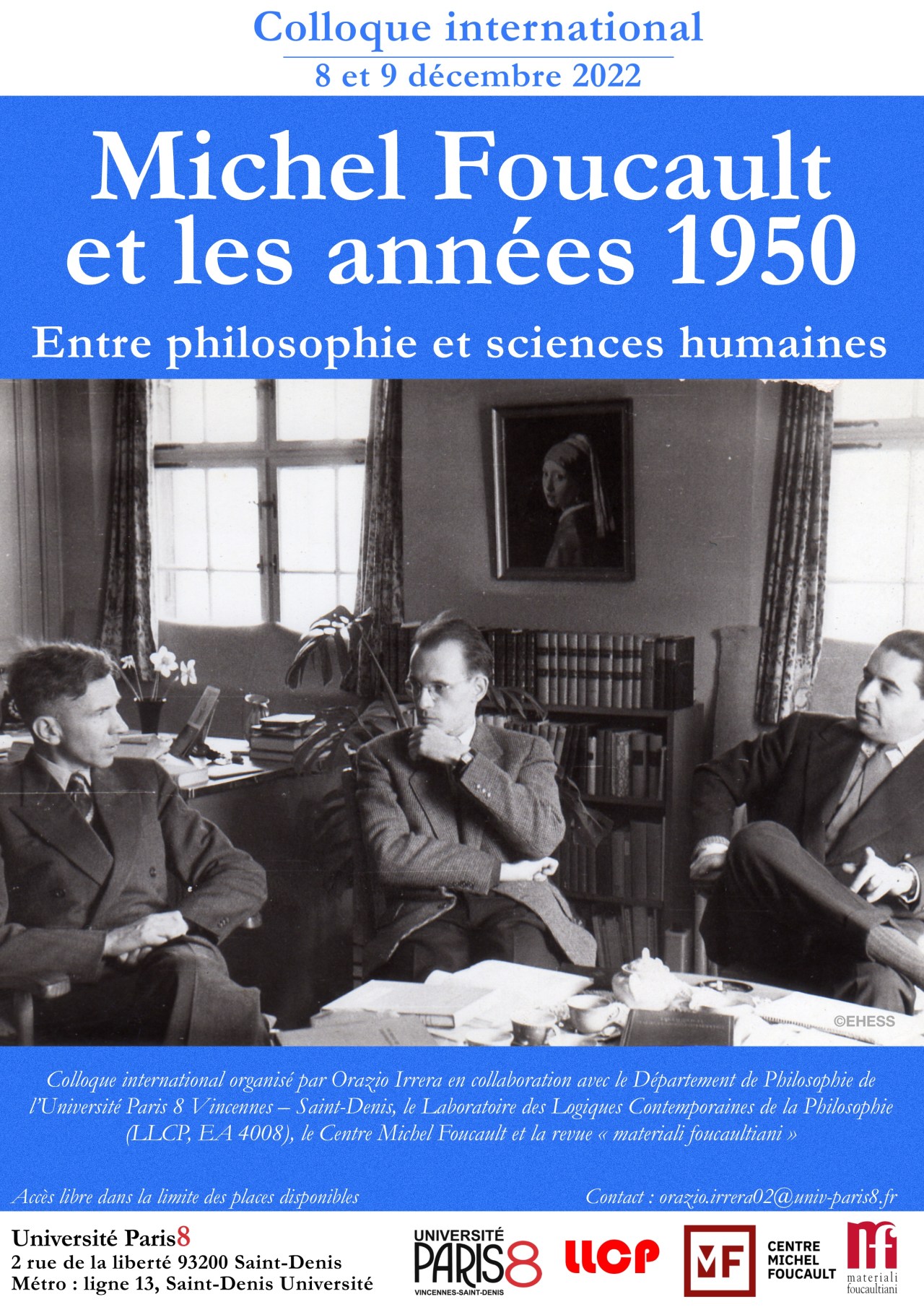
Colloque international
Michel Foucault et les années 1950
Entre philosophie et sciences humaines

8 et 9 décembre 2022 | Université Paris 8

Accès libre dans la limite des places disponibles.
Contact : orazio.irrera02@univ-paris8.fr

Programme PDF

Colloque international organisé par Orazio IRRERA en collaboration avec le Département de Philosophie de l’Université Paris 8 Vincennes – Saint-Denis, le Laboratoire des Logiques Contemporaines de la Philosophie (LLCP, EA 4008), le Centre Michel Foucault et la revue « materiali foucaultiani ».

La tout récente parution des trois volumes de la série « Cours et travaux de Michel Foucault avant le Collège de France » dans la collection « Hautes études » chez les éditeurs EHESS-Gallimard-Seuil, Binswanger et l’analyse existentielle (2021), Phénoménologie et psychologie (2021), La question anthropologique. Cours. 1954-1955 (2022), dont l’édition a été réalisée à partir des matériaux inédits du Fonds Michel Foucault déposé à la Bibliothèque nationale (NAF 28730), contribue à jeter une nouvelle lumière sur les premières étapes de l’itinéraire intellectuel du jeune philosophe dans la première moitié des années 1950. On y retrouve ce qui pourrait correspondre à des projets d’essai mentionnés dans des documents ou des lettres de l’époque, mais dont l’existence effective a longtemps semblé douteuse ; tout comme on y découvre les manuscrits des premiers cours d’un jeune agrégé de philosophie, spécialisé en psychologie et psychopathologie, dont l’enseignement se déroulait alors entre l’Université de Lille et l’École Normale Supérieure de la rue d’Ulm.

Ce matériel, désormais accessible à un large public, témoigne non seulement de la formation de Foucault, mais aussi d’une plus vaste conjoncture intellectuelle où la recherche et l’enseignement en psychologie et, plus généralement en sciences humaines, étaient encore inscrits dans le domaine de la philosophie. Depuis l’Après-guerre celle-ci était de plus en plus infléchie par l’effort d’articuler phénoménologie et marxisme autour de l’expérience de « l’homme concret » dont les formes existentielles, enracinées dans la conscience ou dans un corps irréductible à ses données biologiques, étaient censées donner un sens au monde et à l’histoire. Chacune à sa manière et à différents degrés, les sciences humaines, quant à elles, demeuraient le plus souvent solidaires de cette orientation, c’est pourquoi une réflexion sur l’homme leur apparaissait comme un point d’appui indispensable pour définir leurs objets et leurs méthodes. Par ce biais, elles contribuaient à reconfigurer autour de la question anthropologique les termes de leur voisinage avec la philosophie, l’histoire ou les sciences de la vie, dont les problèmes respectifs n’avaient de cesse de renvoyer les uns aux autres. Pendant les années 1950, ce nouage anthropologique ou humaniste, principalement assuré par la phénoménologie, n’échappait pourtant pas à une ligne de partage qui avait clivé sa réception en France dès les années 1930. Comme Foucault lui-même l’observera rétrospectivement : d’un côté une philosophie de l’expérience, du sens et du sujet qui aurait tenté d’infléchir la lecture de Husserl et ensuite de Heidegger comme chez Sartre et Merleau-Ponty ; de l’autre une philosophie du savoir, de la rationalité et du concept qui, par l’intermédiaire de Cavaillès, Bachelard, Koyré et Canguilhem aurait ramené la pensée husserlienne aux problèmes fondateurs du formalisme et de l’intuitionnisme.

En comptant sur la participation des éditeurs des trois volumes consacrés au Foucault des années 1950 et sur celle des chercheuses et chercheurs qui, en France comme à l’étranger, ont pour la plupart déjà eu l’opportunité de travailler sur ces manuscrits, soit avant leur publication, soit en vue de leurs traductions qui commencent déjà à paraitre en plusieurs langues, ce colloque vise à restituer la richesse des recherches et des enseignements du jeune philosophe. A travers les interventions et les échanges qui auront lieu, ce colloque se propose d’explorer les manières dont Foucault s’est saisi des enjeux antihumanistes qui lui ont permis de se situer par rapport à la philosophie et aux sciences humaines de l’époque, bien avant de les reprendre et les développer dans le cadre archéologique de la décennie suivante au moment où dans maints domaines le structuralisme touchait son apogée.

PROGRAMME

Jeudi 8 décembre
Salle de la recherche, Bibliothèque Universitaire Paris 8

10h | Accueil et Introduction | Frédéric RAMBEAU (Directeur du Département de Philosophie, Université Paris 8) et Orazio IRRERA (Université Paris 8)

10h10 | Henri-Paul FRUCHAUD – Foucault avant Foucault : quelques inédits des années 50

10h30-12h30 | Session 1 | Président de séance : Jean-Pierre MARCOS (Université Paris 8)

Elisabetta BASSO (Università di Pavia, Italie) – Le jeune Foucault entre philosophie et psychopathologie

Senda SFERCO (Universidad du Littoral/CONICET, Argentine) – Le jeune Foucault à la recherche d’une temporalité singulière : l’expérience de la maladie mentale

12h30-13h45 | Pause déjeuner

13h45-15h45 | Session 2 | Président de séance : Orazio IRRERA (Université Paris 8)

Philippe SABOT (Université de Lille) – Foucault, la phénoménologie, le monde

Jean-Claude MONOD (École Normale Supérieure, Ulm) – Entre analyse existentielle et histoire de la ratio : l’explication de Foucault avec les phénoménologies dans les années 1950

Bâtiment A, Salle A028

16h-16h30 | Pause-café

16h30-18h30 | Session 3 | Président de séance : Philippe BÜTTGEN (Université Paris 1 Panthéon-Sorbonne)

Arianna SFORZINI (Université Paris-Est Créteil / Sciences Po Paris) – Qu’est-ce qu’un cours sur l’anthropologie ? La mort de l’homme comme ethos critique

Alessandro FRANCISCO (Université d’État de São Paulo, Brésil / Collège international de philosophie) – Problèmes d’anthropologie / problèmes de psychologie

***

Vendredi 9 décembre
Salle de la recherche, Bibliothèque Universitaire Paris 8

10h-12h15 | Session 4 | Président de séance : Éric ALLIEZ (Université Paris 8)

Roberto NIGRO (Leuphana Universität, Allemagne) – Malaise dans la philosophie. Le défi de Foucault : du communisme nietzschéen à l’anarchéologie.

Frédéric GROS (Sciences Po Paris) – Lire Marx à Ulm en 1955

12h20-13h50 | Pause déjeuner

14h-16h | Session 5 | Président de séance : Andrea ANGELINI (Université Paris 8)

Frédéric FRUTEAU DE LACLOS (Université Paris 1 Panthéon-Sorbonne) – Quelle question anthropologique Foucault a-t-il posée ?

Florence HULAK (Université Paris 8) – La question anthropologique : aux sources philosophiques de la critique foucaldienne des sciences humaines

16h-16h30 | Pause-café

16h30-19h15 | Session 6 | Président de séance : Frédéric RAMBEAU (Université Paris 8)

Edgardo CASTRO (Universidad de San Martín/CONICET, Argentine) – Foucault et Derrida, lecteurs de Husserl [en visio-conférence]

Andrea ANGELINI (Université Paris 8) – La question biologique et le « dépassement de l’humanisme » chez le Foucault des années 1950.

Orazio IRRERA (Université Paris 8) – La volonté et ses infracassables noyaux de nuit

19h15-19h30 | Clôture du colloque

Byung-Chul Han, Non-things: Upheaval in the Lifeworld, Translated by Daniel Steuer, Polity (2022)

We no longer inhabit earth and dwell under the sky: these are being replaced by Google Earth and the Cloud. The terrestrial order is giving way to a digital order, the world of things is being replaced by a world of non-things – a constantly expanding ‘infosphere’ of information and communication which displaces objects and obliterates any stillness and calmness in our lives.Byung-Chul Han’s critique of the infosphere highlights the price we are paying for our growing preoccupation with information and communication. Today we search for more information without gaining any real knowledge. We communicate constantly without participating in a community. We save masses of data without keeping track of our memories. We accumulate friends and followers without encountering other people. This is how information develops a form of life that has no stability or duration. And as we become increasingly absorbed in the infosphere, we lose touch with the magic of things which provide a stable environment for dwelling and give continuity to human life. The infosphere may seem to grant us new freedoms but it creates new forms of control too, and it cuts us off from the kind of freedom that is tied to acting in the world.

Jane Tynan, Chapter 11. Michel Foucault. Fashioning the Body Politic. In Agnès Rocamora and Anneke Smelik (eds), Thinking through Fashion A Guide to Key Theorists, I.B. Tauris, 2016, pp. 184-199 (Bloomsbury Collections)
Chapter DOI10.5040/9780755694785.ch-011

Introduction
The French historian and philosopher Michel Foucault (1926–1984) has profoundly impacted disciplines in the social sciences and humanities. For Foucault, power lies not in political leadership, but in the productive forces of everyday life, which is why he has become, as it were, fashionable again. Foucault’s ideas have been used to describe the control modern institutions have over us, but in the aftermath of the global financial crisis, we are also witnessing remarkable displays of power from below.

In this chapter, I consider how Foucault’s work might frame the social, political and economic meanings arising from fashion as a cultural system, a discourse, a practice and an industry. More interested in the political significance of material reality than in who appears to be in charge, Foucault set out the various techniques of social control that characterize modern life. Its disciplines and practices were for him critical to the judgements we make about ourselves and each other. The medical procedures available to us, our systems of learning and justice, how we are housed, the treatment of prisoners, all contribute to our sense of what is wrong, of who is rightfully in charge and what kind of speech is permitted. Are these modern systems and technologies that promote surveillance far removed from the glamour of fashion? Possibly, but they are also clearly relevant to mass fashion. Foucault’s perspective on social structures directs our attention away from the spectacle of fashion to perhaps consider how it is constructed, to discover who is involved, to reflect on how fashion is articulated, who it benefits and whose concern it is thought to be. In other words, Foucault might ask what constitutes fashion as a social, 185cultural and economic practice. One thing is clear: most studies of fashion nod in Foucault’s direction, which suggests that writers on fashion, identity and the body recognize his influence and many feel compelled to at least mention him in passing (Craik, 1993: 125; Benstock and Ferriss, 1994: 8; Svendsen, 2006: 143; Finkelstein, 2007: 211; Kaiser, 2012: 20).
[…]

Byung-Chul Han, Infocracy: Digitization and the Crisis of Democracy, Translated by Daniel Steuer, Polity Press, 2022

The tsunami of information unleashed by digitization is threatening to overwhelm us, drowning us in a sea of frenzied communication and disrupting many spheres of social life, including politics. Election campaigns are now being waged as information wars with bots and troll armies, and democracy is degenerating into infocracy.In this new book, Byung-Chul Han argues that infocracy is the new form of rule characteristic of contemporary information capitalism. Whereas the disciplinary regime of industrial capitalism worked with compulsion and repression, this new information regime exploits freedom instead of repressing it. Surveillance and punishment give way to motivation and optimization: we imagine that we are free, but in reality our entire lives are recorded so that our behaviour might be psychopolitically controlled. Under the neoliberal information regime, mechanisms of power function not because people are aware of the fact of constant surveillance but because they perceive themselves to be free.This trenchant critique of politics in the information age will be of great interest to students and scholars in the humanities and social sciences and to anyone concerned about the fate of politics in our time.

Andrew Gibson (2021) Producing Historicity: Foucault, Joyce and European Art Cinema, 1955–1980, Textual Practice, 35:10, 1565-1585,

DOI: 10.1080/0950236X.2021.1965290

ABSTRACT
In recent years, it has become increasingly clear how damaging and virulent the obsessively ‘presentist’ orientation is that drives neoliberal and managerial ‘culture’. Its proponents abjure discourses of or on historicity, lest they encounter critical perspectives on our present situation. For that very reason we should be sustaining and promoting our historicisms as tenaciously as possible. This article argues that Foucault and Joyce, in their extremely different ways, did just that, attuned as they were to the subtleties of specificity and the vagaries of contingency. But there is a certain historicity of the body and affect that philosophy and literature, by their nature, cannot fully capture or communicate. We might rather turn, then, to European Art Cinema, approximately from 1955 onwards, and a range of cinéastes, from Godard and Melville to Varda and Huillet-Straub. The discussion brings out the highly nuanced ways in which they use cities and landscapes, and temporal and spatial anomalies, to construct both a historicity of affect and an aesthetic reflection or meditation on that historicity.

KEYWORDS:
historicity presentism the body managerialism neoliberal culture Joyce Foucault Godard [Jean-Pierre] Melville Antonioni Fellini Varda Huillet-Straub materiality affect the image European art cinema nouvelle vague neo-realism the European city

Nustad, K. G., & Swanson, H. (2022). Political ecology and the Foucault effect: A need to diversify disciplinary approaches to ecological management? Environment and Planning E: Nature and Space, 5(2), 924–946.
https://doi.org/10.1177/25148486211015044

Abstract
While explicitly Foucauldian analyses have declined in recent years in the social sciences, Foucault’s ideas continue to strongly influence scholars’ approaches to power, governance and the state. In this article, we explore how Foucauldian concepts shape the work of political ecologists and social scientists working on environmental management, multispecies ethnography and the Anthropocene – often in an unrecognized way. We argue that – regardless of whether or not Foucault’s work is explicitly cited – his legacy of linking scientific projects, population management and state control continues to have an outsized impact on thinking in these fields. It is time, we assert, to directly consider how such theoretical inheritances are affecting the shape of political ecology, in particular, and the social sciences, more generally. How, we ask, are Foucauldian traditions at once enabling and constraining more-than-human scholarship? In this article, we explore the contributions and limitations of Foucauldian approaches in environmental contexts through empirical attention to trout introduction and management efforts in South Africa. Our overall aim is to call for a deeper conversation about how scholars working on environmental topics engage the science-governance nexus. The article ends with proposing landscape, as a material enactment of more-than-human politics, as a useful analytical category to this end.

Impressões de Foucault: Entrevista com Roberto Machado
Sociologia & Antropologia. 7 (1) • Jan-Abr 2017 •

https://doi.org/10.1590/2238-38752017v711
Open access

Resumo
Nesta entrevista sobre Michel Foucault, Roberto Machado aborda sua atualidade e seu impacto nas ciências humanas; os tipos de estudo que caracterizam diferentes momentos de sua trajetória intelectual; as singularidades de seu pensamento – o método provisório, a dimensão instrumental do conhecimento e a atenção à atualidade teórica e política -; bem como o vínculo entre suas análises histórico-filosóficas e suas ações políticas. Relata a vinda de Foucault ao Brasil durante a ditadura militar, o encontro com o pensador francês e sua obra, a experiência em seus cursos e seminários no Collège de France. Comenta ainda o aprendizado da dimensão política dos saberes como um instrumento de luta e resistência.

Palavras-chave:
Michel Foucault; Roberto Machado; saber e poder; ação política; crítica do presente

Abstract
In this interview on Michel Foucault, Roberto Machado discusses his contemporary relevance and his impact on the human sciences; the types of study composing the different periods of his intellectual trajectory; the singular aspects of his thought – the provisional method, the instrumental dimension of knowledge and the attention to the theoretical and political present; as well as the link between his historical-philosophical analyses and his political actions. He recalls Foucault’s visit to Brazil during the military dictatorship, the encounter with the French thinker and his work, and the experience of his courses and seminars at the Collège de France. He also comments on learning about the political dimension of knowledge as a tool for struggle and resistance.

Keywords:
Michel Foucault; Roberto Machado; knowledge and power; political action; critique of the present

Making music out of human speech
GARETH BRANWYN. Boing Boing, 2:20 PM SUN SEP 11, 2022

I’ve written about the work of artist and composer, Noah Wall, on Boing Boing before (here and here). In his latest project, Speech Patterns, Noah derives music from the rhythm, tone, and timbre of the human voice using source material including the voices of Octavia Butler, Michel Foucault, a cattle auctioneer, people speaking in tongues, and ASMR.

Each limited edition LP and cassette features hand-stamped cover art using shapes derived from Speech Patterns notation.