Foucault News

News and resources on French thinker Michel Foucault (1926-1984)

stuartelden's avatarProgressive Geographies

Stuart Elden, The Archaeology of Foucault – Polity, December 2022

The fourth and final book in my series of studies of Foucault’s career is now published in the UK. US and rest of the world will follow in early 2023. Polity’s books are distributed by Wiley, and they should be able to deliver worldwide.
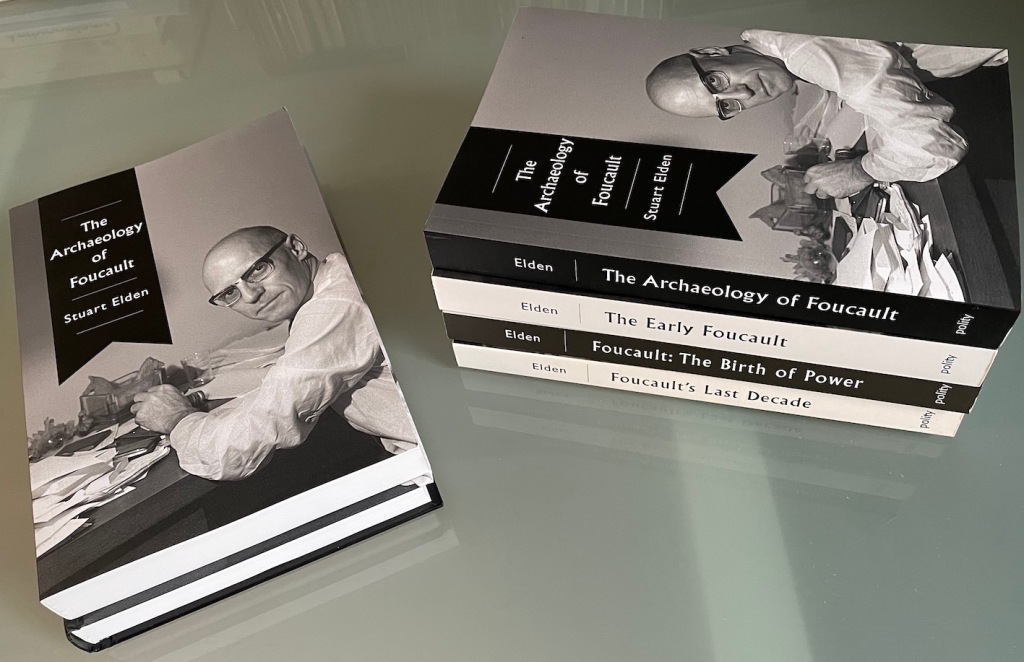
Here’s the back cover description of the book:

On 20 May 1961 Foucault defended his two doctoral theses; on 2 December 1970 he gave his inaugural lecture at the Collège de France. Between these dates, he published four books, travelled widely, and wrote extensively on literature, the visual arts, linguistics, and philosophy. He taught both psychology and philosophy, beginning his explorations of the question of sexuality.

Weaving together analyses of published and unpublished material, this is a comprehensive study of this crucial period. As well as Foucault’s major texts, it discusses his travels to Brazil…

View original post 489 more words
Aaron Zielinski (2022) The Imaginary Force of History: On images, the Imaginary, and Myths in Foucault’s Early Works, Critical Review, Published online: 09 Dec 2022

DOI: 10.1080/08913811.2022.2151709

ABSTRACT
In manuscripts and unpublished articles written in the 1950s, Foucault developed a notion of myth that was intimately linked to what he called “imaginary forces,” a notion that he framed as a new critical approach. Its most important functions lie in exposing how mythological narratives naturalize social processes, and in developing a skeptical stance towards the allegedly liberating function of truth. This notion of myth is central in History of Madness, but it features most prominently in a passage that was omitted from the first English translation. Here, Foucault criticizes the narrative that Enlightenment psychiatry told about its own origins, which naturalized social processes. The young Foucault’s notion of myth is strikingly similar to the Marxist notion of second nature.

Keywords:
Foucault, Hegel, Marx, image, myth, second nature, critical theory

Du, Y.
“Working the government” Poverty alleviation resettlement in two Yi villages, Sichuan, China
(2022) Geoforum, 136, pp. 153-160.

DOI: 10.1016/j.geoforum.2022.09.008

Abstract
Resettlement studies in China and globally draw upon Michel Foucault’s description of governmentality, classing resettlement programmes as power-laden activities, in which planning practices reorganise the built environment and life arrangements and redefine the identities of relocated populations to achieve political and economic objectives. However, few studies on resettlement in China have conducted an in-depth analysis of local resistance to the tactics of governmentality. This article builds on the literature on the governmentality of resettlement and develops a theoretical framework of resistance to governmentality, “working the government”, by combining insights from Michel Foucault and Erving Goffman, applying the framework to empirical evidence. This is achieved through analysis of the micro-politics of power in poverty alleviation resettlement (PAR) programmes in two Yi villages in Leshan and Liangshan Prefectures, Sichuan Province, and close examination of innovative tactics of resistance developed by local Yi minorities. The study shows that resettled households re-utilised and took advantage of elements of the resettlement programme, adapted those elements to their new ends and separated themselves from the subjectivities imposed by the programmes. © 2022 Elsevier Ltd

Author Keywords
China; Governmentality; Poverty alleviation; Resettlement; Resistance

Index Keywords
planning practice, poverty alleviation, resettlement policy, state role; China, Leshan, Liangshan, Sichuan

Deirdre McGowan, Foucault and the Limits of Identity Rights In Marshall, J. (Ed.). Personal identity and the European court of human rights. Routledge (2022).

Introduction
[…]
Foucault does not deny the materiality of human existence, but he does challenge the notion that it has a fixed essence to which specific identities or characteristics can be attributed, arguing that ‘[n]othing in man, not even his body is sufficiently stable to serve as a basis of self-recognition or for understanding other men.’3 He rejects a fixed identity for himself and throughout his work characterises the categorisation of individual subjectivity into identity categories as normative and exclusionary. He recognises that identity categories exist and have real meaning and impact in the world. His purpose is to unsettle the assumptions about human nature that underpin identity classifications and to create spaces of freedom within which individuals might shape their lives beyond the reach of normalising power.

These spaces of freedom are often what is at issue in contemporary identitybased human rights claims as plaintiffs seek to expand the limits of the right to an identity in order that it might better reflect their lived experience.4 In pushing the boundaries of what law recognises as a protected identity characteristic, progressive human rights lawyers seek to bring law to a place where it can recognise the inherent ‘messiness’ of human life.5 However, law rarely captures the full breadth of experience, always tending toward a unified subject that might be more easily categorised and understood. It is this unitary subject that Foucault views with suspicion, and understandably so.
[…]

‘[Raymond Roussel] said that after his first book he expected that the next morning there would be a kind of aura around his person and that everyone in the street would be able to see that he had written a book. This is the obscure desire harboured by everyone who writes. It is true that the first text one writes is neither written for others, nor because one is what one is: one writes to become other than what one is. One tries to modify one’s way of being through the act of writing.’ (trans. mod.)

Michel Foucault (1987) ‘An interview with Michel Foucault by Charles Ruas’. In Death and the Labyrinth: The World of Raymond Roussel. Tr. C. Ruas. London: The Athlone Press, p.182.

Zaini, A.
Ambivalent reading: Ambivalence as a reading practice in critical literacy
(2022) Language Teaching Research

DOI: 10.1177/13621688221126724

Abstract
While previous research has suggested there are dominantly two reading practices in critical literacy, namely, reading with and against texts, this study introduces the approach of ambivalence as a third way of reading texts critically. For the purpose of this study – establishing ambivalence as a reading practice in critical literacy – four international postgraduates at an Australian University volunteered to participate in a collective case study. They read four national and politico-religious texts and showed their agreement, disagreement, and ambivalence about the texts. They also partook in individual interviews and focus group discussions (FGDs). The data obtained from 16 rounds of reading texts, 40 interviews, and four FGDs were analysed using Foucault’s conceptualization of discourse, power relations, subjectivities, and technologies of the self. The findings advocate that the participants read texts ambivalently in three directions: spontaneously when reading texts, after the initial agreement with texts, and after an earlier disagreement with them. The conclusive data discuss that: (1) participants’ state of perception, which is ambivalence, is associated with their identities and subjectivities and is in the range of active critical engagement with the texts rather than indifference or passivity; (2) ambivalence is informed by participants’ technologies of the self as well as FGDs and reading opposing texts, which buttressed their arguments by attaching their interpretations to existing or non-existent topics in the texts; and (3) ambivalence is tied with participants’ understanding of truth, which helped them not only critique texts but also modify their presuppositions and earlier interpretations of texts. Relevant pedagogical implications including a concrete question set and the adoption of a new technical term, ambivalent reading, are proposed. © The Author(s) 2022.

Author Keywords
ambivalence; ambivalent reading; critical literacy; critical reading; discourse; identities and subjectivities; truth and power relations

Llewellyn, A.
“A Space Where Queer Is Normalized”: The Online World and Fanfictions as Heterotopias for WLW
(2022) Journal of Homosexuality, 69 (13), pp. 2348-2369.

DOI: 10.1080/00918369.2021.1940012

Abstract
In the current society, the online and fictional worlds are important spaces for both the identity construction and wellbeing of LGBTQ people. Connecting these spaces are fandoms (and fanfictions), which can operate as places of resistance for marginalized groups. Through the collection of survey data completed by 79 women loving women (WLW), this study therefore asks, in what ways does the online world, particularly in relation to fandoms, open up spaces for WLW. Employing a Foucauldian analysis, findings suggest communities online are crucial for affirmative support, and fanfictions are places where queerness is normalized. As such, through the displacement of time and space, online spaces (and particularly fanfictions) operate as heterotopias that significantly disrupt normative societal discourses. Accordingly, empathetic communities and the normal queer are notably absent from many WLW’s physical worlds. However, caution is urged as these results are less clear for women of color. © 2021 The Author(s). Published with license by Taylor & Francis Group, LLC.

Author Keywords
fandom studies; Fanfiction; Foucault; heterotopia; LGBTQ; online; WLW

Index Keywords
female, gender identity, human, lesbianism, sexual and gender minority; Female, Gender Identity, Homosexuality, Female, Humans, Sexual and Gender Minorities

Andrä, C.
Problematising war: Towards a reconstructive critique of war as a problem of deviance (2022) Review of International Studies, 48 (4), pp. 705-724.

DOI: 10.1017/S0260210522000274

Abstract
This article redirects extant critiques of the modern problem of war at this problem’s underlying logic of deviance. According to this logic, war constitutes a kind of international conduct that contravenes behavioural norms and that can be corrected through diagnostic and didactic means. Thereby, war is rendered into a problem falling within the scope of human agency. However, this agency rests on and reproduces this logic’s constitutive blind spots. Therefore, it seems imperative to develop ways of problematising war otherwise. The article provides two starting points for (critical) IR scholarship seeking to undertake such a project. Firstly, it combines two Foucaultian tools, the concept of problematisation and the method of genealogy, to direct critique at the logics underlying our evaluative-analytical, ethical, and political-judgements. Secondly, it uses these tools to trace the contingent emergence of the logic of deviance in a crucial example within the wider genealogy of the problem of war: The Carnegie Endowment’s commission of inquiry into the Balkan Wars of 1912 and 1913. Based on original archival research, I highlight different elements of this inquiry’s problematisation of war-its frames, assumptions, ways of knowing, and subjects of knowledge-to make them available for reconstruction.

Author Keywords
Balkan Wars; Critique; Foucault; Genealogy; Problematisation; War

Wright, L.
Erin’s sons and decent daughters: The biopolitics of rural masculinities in Patrick Kavanagh’s Tarry Flynn (1948) In Aida Rosende-Pérez, Rubén Jarazo-Álvarez (eds.) The Cultural Politics of In/Difference: Irish Texts and Contexts, Peter Lang (2022) pp. 28-47.

Abstract
In the years leading up to the foundation of the Irish Republic and the Irish Constitution in 1937, a series of legislations were passed leading to separatist gender dynamics between men and women. Many of the ideals promoted and culturally inculcated by de Valera through legislature presented paradoxical concepts of Irish manhood, of men as virile but chaste, and financially independent in an increasingly impoverished landscape. Patrick Kavanagh’s novel Tarry Flynn, published in 1948 and consequently banned until the 1960s for its obscenity, presents the realities of these state-sanctioned ideals of manhood. Kavanagh depicts the rural landscape of men perpetually striving to achieve these ideals and the consequences of these unattainable values. This chapter will interrogate Kavanagh’s depiction of manhood in Cavan in the 1930s and demonstrate to what extent, if any, these performances of manhood are moulded and shaped by attempts to conform to the state-sanctioned ideals of masculinity promulgated by Éamon de Valera and Archbishop John McQuaid. Drawing on R. W. Connell’s Masculinities and Michel Foucault’s work, I will investigate the hegemonic masculinities of the men in Cavan in the 1930s as well the relationship between Tarry and these ideas of manhood. By investigating Tarry’s perception of hegemonic masculinities, I will be analysing the correlation between the series of legislature passed in the preceding decade and the consequent cultures of rigid patriarchal dominance and in many cases, state-sanctioned misogyny.
Source: Scopus

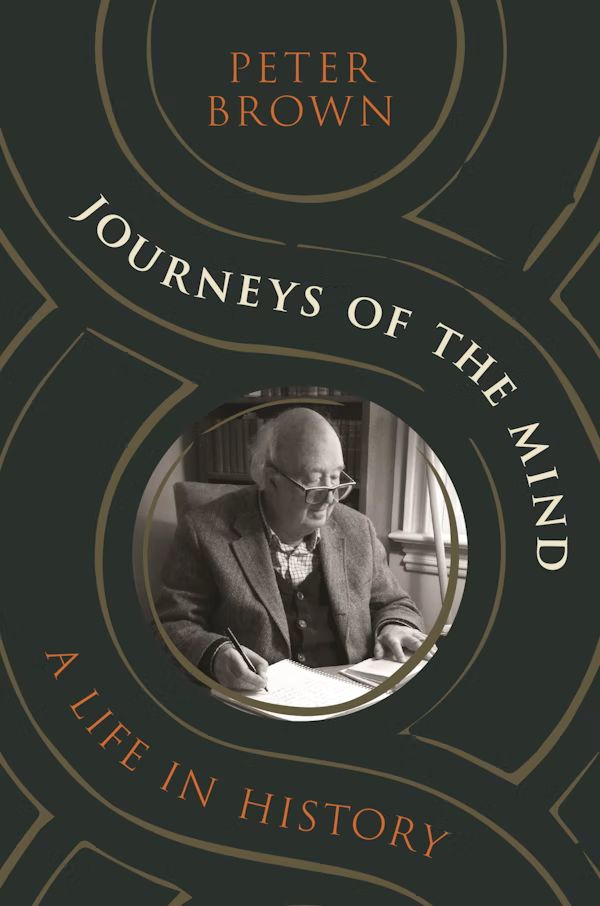
Peter Brown, Journeys of the Mind: A Life in History, Princeton University Press, 2023 (forthcoming)

A beautifully written personal account of the discovery of late antiquity by one of the world’s most influential and distinguished historians

The end of the ancient world was long regarded by historians as a time of decadence, decline, and fall. In his career-long engagement with this era, the widely acclaimed and pathbreaking historian Peter Brown has shown, however, that the “neglected half-millennium” now known as late antiquity was in fact crucial to the development of modern Europe and the Middle East. In Journeys of the Mind, Brown recounts his life and work, describing his efforts to recapture the spirit of an age. As he and other scholars opened up the history of the classical world in its last centuries to the wider world of Eurasia and northern Africa, they discovered previously overlooked areas of religious and cultural creativity as well as foundational institution-building. A respect for diversity and outreach to the non-European world, relatively recent concerns in other fields, have been a matter of course for decades among the leading scholars of late antiquity.

Documenting both his own intellectual development and the emergence of a new and influential field of study, Brown describes his childhood and education in Ireland, his university and academic training in England, and his extensive travels, particularly in the eastern Mediterranean and the Middle East. He discusses fruitful interactions with the work of scholars and colleagues that include the British anthropologist Mary Douglas and the French theorist Michel Foucault, and offers fascinating snapshots of such far-flung places as colonial Sudan, midcentury Oxford, and prerevolutionary Iran. With Journeys of the Mind, Brown offers an essential account of the “grand endeavor” to reimagine a decisive historical moment.