Foucault News

News and resources on French thinker Michel Foucault (1926-1984)

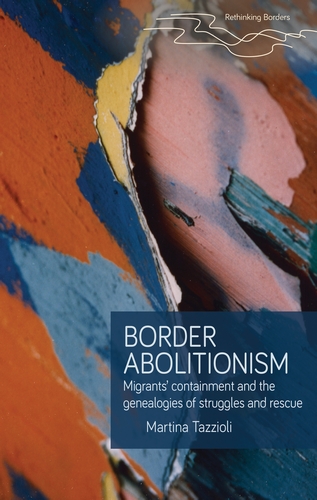
Martina Tazzioli, Border abolitionism. Migrants’ containment and the genealogies of struggles and rescue, Manchester University Press, 2023. Forthcoming July

Building on an abolitionist perspective, this book offers an essential critique of migration and border policies, unsettling the distinction between migrants and citizens. This is the only book that brings together carceral abolitionist debates and critical migration literature. It explores the multiplication of modes of migration confinement and detention in Europe, examining how these are justified in the name of migrants’ protection. It argues that the collective memory of past struggles has partly informed current solidarity movements in support of migrants. A grounded critique of migration policies involves challenging the idea that migrants’ rights go to the detriment of citizens. An abolitionist approach to borders entails situating the right to mobility as part of struggle for the commons.

Contents
Introduction
1 The zero-sum rights’ game: border abolitionism as an analytical gaze
2 ‘Confine to protect’: hybrid spaces of migration containment
3 Participatory confinement: extractive humanitarianism and asylum seekers’ unpaid labour
4 Towards a genealogy of migrant struggles and border violence
5 A history of mountain runaways and rescue: migrants at the Alpine border
Conclusion

Martina Tazzioli is Reader in Politics & Technology at Goldsmiths, University of London

In memoriam: Ian Hacking (1936-2023)
Published: May 10, 2023 Department of Philosophy, University of Toronto

See also the Daily Nous site

It is with deep sadness that the Department of Philosophy announces the passing of one of its most eminent members, Professor Emeritus Ian M. Hacking, CC, FRSC, FBA. The influential scholar, teacher, and prolific author—whose wide-ranging work probed foundational questions about the nature of concepts and who is credited with bringing a historical approach to the philosophy of science—passed away on May 10, 2023, after years of declining health.

Born in Vancouver in 1936, Hacking studied mathematics and physics at the University of British Columbia (BA, 1956) before moving on to the University of Cambridge, where he earned a bachelor’s degree (1958) and a PhD (1962) in Moral Sciences.
[…]

Hacking’s research achievements are legion: he has to his name 13 books translated into more than a dozen languages, as well as hundreds of articles. Uniquely, his work held sway outside of the discipline of philosophy as well. In addition to recognition in the social sciences and humanities, Hacking stood out as a philosopher who also attracted praise and respect in the sciences, seeing several of his essays included in annual collections of the best writing in mathematics. In addition, he found himself in constant demand as a public intellectual, penning pieces for newspapers and magazines such as the New York Review of Books.
[…]
A fuller obituary will be published on the Department of Philosophy site in the coming days.

M. Cecilia Oliveira, Leandro Siqueira, Digitalization between environmental activism and counter-activism: The case of satellite data on deforestation in the Brazilian Amazon, Earth System Governance, Volume 12, 2022.
https://doi.org/10.1016/j.esg.2022.100135.
(https://www.sciencedirect.com/science/article/pii/S2589811622000040)

Open access

Abstract:
This paper analyzes the uses of digital satellite data on deforestation in the Amazon region, drawing on poststructuralist studies of scientific knowledge practices and Science and Technology Studies (STS). Focusing on changes under the government of President Jair Bolsonaro, we argue that populist right-wing rhetoric, policies, and practices towards deforestation in the Amazon must be understood in the context of a broad and sophisticated effort to discredit and dismantle pre-existing knowledge infrastructures and transparency regime. These structures had developed over time with the aim of making deforestation visible and manageable. The dismantling of these structures is part of the effort to establish a competing alethurgy, i.e an assemblage of procedures and rituals that claim to manifest the “truth” about the Amazon. This new alethurgy depends, crucially, on a regime of hypertransparency which enables practices of environmental counter-activism. This new alethurgy promotes an extractivist use of the Amazon in which deforestation is an acceptable price to pay for economic development.

Keywords: Amazon; Satellite; Transparency; Truth regimes; Counter-activism; Alethurgy; Forest digitalization

Gordana Fontana-Giusti: Foucault and the language of architects, Listen Notes, April 20, 2023. Podcast.

In Season 2, Episode 28 of A is for Architecture, Gordana Fontana Giusti discusses her 2013 book, Foucault for Architects, published by Routledge, as part of the Thinkers for Architects series. Gordana is Professor of Architecture and Urban Design at Kent School of Architecture & Planning, University of Kent, where she also serves as Deputy Head of School.

Foucault for Architects ‘concentrates on a number of historical and theoretical issues often addressed by Foucault […] in order to examine and demonstrate their relevancy for architectural knowledge, its history and its practice’. In an AA Files 26 essay from 1993, Paul Hirst suggested Foucualt’s relevance to architecture lay in his breaking down ‘the barrier between the common-sense category of objects and that of discourse: words, explanations, programmes, etc., which are held to be about objects. In architecture this yields the stubborn and conclusive distinction between buildings as objects, and architectural theories, programmes and teaching that are about buildings. This installs a split between architecture and architectural discourse. The building is an object or non-discursive entity around which float the words of discourse.’

Listen to Prof Gordana, and get some answers.
Read more…

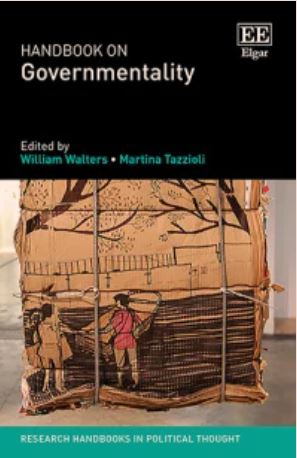
Handbook on Governmentality. Research Handbooks in Political Thought series
Edited by William Walters and Martina Tazzioli. Edward Elgar Publishing 2023

The Handbook on Governmentality discusses the development of an interdisciplinary field of research, focusing on Michel Foucault’s post-foundationalist concept of governmentality and the ways it has been used to write genealogies of modern states, the governance of societal problems and the governance of the self.

Bringing together an international group of contributors, the Handbook examines major developments in debates on governmentality, as well as encouraging further research in areas such as climate change, decolonial politics, logistics, and populism. Chapters explore how governmentality reshapes policy analysis as political practice, the relationship between Foucault’s ideas of government and postcolonial experiences, and how governmentality can illuminate discourse on the green economy and biopolitics. Analysing how contemporary socio-political issues including feminist politics, migration, and racialized medicine are interwoven with the concept of governmentality, this Handbook sheds light on the modern-day uses of Foucault’s work.

Providing a comprehensive overview of research on governmentality, this Handbook will be essential reading for students and scholars of development studies, geopolitics, political economy, organizational studies, political geography, postcolonial theory, and public policy. It will also be a key resource for policy makers in the field looking for a deeper theoretical understanding of the topic.

Keywords: Governmentality; Biopolitics; Neoliberalism; Foucault; Genealogy; Power

Part I: GOVERNMENTALITY: GENESIS, ENCOUNTER, TRANSFORMATION
Full access
Chapter 1: Foucault, governmentality, and the techniques of the self
Daniele Lorenzini

Chapter 2: The yoke of law and the lustre of glory: Foucault and Dumézil on sovereignty
Stuart Elden

Chapter 3: Governmentalizing ‘policy studies’
Carol Bacchi

Chapter 4: Governmentality and international relations: critiques, challenges, genealogies
Hans-Martin Jaeger

Chapter 5: Towards a postcolonial theory of crisis, neoliberal government, and biopolitics from below
Ranabir Samaddar

Part II: TALKING GOVERNMENTALITY

Chapter 6: Governmentality: a conversation with Wendy Brown, Partha Chatterjee and Nikolas Rose
Wendy Brown, Partha Chatterjee, Nikolas Rose, Martina Tazzioli, and William Walters

Chapter 7: Governmentality and beyond: an interview with Colin Gordon
Colin Gordon, Martina Tazzioli, and William Walters

Chapter 8: Governmentality in translation: an interview with Graham Burchell
Graham Burchell, Martina Tazzioli, and William Walters

Part III: GOVERNMENT AND ITS PROBLEMS

Chapter 9: The neoliberal welfare state
Ian Alexander Lovering, Sahil Jai Dutta, and Samuel Knafo

Chapter 10: Governmentality and security: governing life-in-motion
Jef Huysmans

Chapter 11: Secrecy beyond the state: governmentality, security and truth effects
Susanne Krasmann

Chapter 12: Governmentality and the subject of rights
Ben Golder

Chapter 13: Algorithmic governmentality: questions of method
Claudia Aradau

Chapter 14: Logistical power
Brett Neilson

Chapter 15: Governmentality and political ecology
Emanuele Leonardi and Luigi Pellizzoni

Part IV: GOVERNMENTALITY ACROSS NATIONS AND OTHER POLITICAL FORMATIONS

Chapter 16: Diminishing life: racialized medicine, neoliberalism, and precarity in the United States
Jonathan Xavier Inda

Chapter 17: French humanitarianism: governmentality and its limits
Miriam Ticktin

Chapter 18: EUrope’s border ensemble and the disorder of migrant multiplicities
Maurice Stierl

Chapter 19: Hukou and suzhi as technologies of governing citizenship and migration in China
Chenchen Zhang

Part V: GOVERNMENTALITY AND CONTESTATION

Chapter 20: Feminist politics and neoliberal governmentality: from co-option to counter-conduct
Srila Roy

Chapter 21: The practice of parrhēsia and the transformation of managerial governmentality
Richard Weiskopf

Chapter 22: Countering governmentality: enacting diverging territorialities by former enslaved people in Cauca, Colombia (1849-1886)
Cristina Rojas

Chapter 23: Insurgent politics: refugees, sans-papiers and deportees under asylum and migration laws
Clara Lecadet

Morales-Ladrón, M. On docile bodies: silence, control and surveillance as self-imposed disciplines in Anna Burns’ Milkman
(2023) Irish Studies Review

DOI: 10.1080/09670882.2023.2198081

Abstract
Anna Burns, the first Northern-Irish woman to have been awarded the Booker Prize for her novel Milkman in 2018 has been celebrated since then as a lucid and necessary voice in the contemporary panorama. Set in an unknown location in Northern Ireland, at a time when the Troubles were at its peak, the narrative defiantly targets at what appears to be sexual harassment, to further disclose layers of more subtle meanings related to sociopolitical (self-)control and surveillance, in an atmosphere of pathological silence. Informed by Michel Foucault’s theories, developed in his studies Discipline and Punish and The History of Sexuality, this article explores Burns’ novel in light of Foucault’s model of biopower, defined as a “technology of power centered on life,” within which the panopticon will be revisited. I will contend that silence, consequently, surfaces as both the voluntary alternative and the inevitable consequence of the imposition of regulatory practices on docile bodies, on a disempowered microstructure of inmates that facilitates the success of such technology of power. © 2023 Informa UK Limited, trading as Taylor & Francis Group.

Author Keywords
Anna Burns; docile bodies; Northern Ireland; panopticon; the Troubles

stuartelden's avatarProgressive Geographies

Mettre en ligne, annoter et exploiter les fiches de lecture de Michel Foucault – Archive ouverte HAL

Marie-Laure Massot, “Mettre en ligne, annoter et exploiter les fiches de lecture de Michel Foucault“. Master. Atelier autour des archives, Centre documentaire du CAPHES, France. 2023. ⟨hal-04057849⟩

Avec près de 20 000 feuillets numérisés et mis en ligne, la plateforme Eman a permis au projet Foucault fiches de lecture de diffuser très largement le fonds Foucault de la BnF. Nous verrons comment cet outil modulaire a pu être adapté, moins pour la production des données de description et d’indexation que pour leur exposition et exploitation. En particulier, nous présenterons la chaîne de traitement et l’articulation avec les autres outils du projet FFL, le prototype de plateforme collaborative et Transkribus, et les développements informatiques réalisés pour Eman au cours du projet.

View original post

Michel Foucault : qu’est-ce que la philosophie?, Actualité: l’univers du livre, 18/04/2023

The first 26 pages of the uncorrected proofs to the book are attached to this article.

Le Discours philosophique propose ainsi une nouvelle manière de faire l’histoire de la philosophie, qui la décentre du commentaire des grands philosophes. […]

Les éditions du Seuil nous en proposent les premières pages

Timothy Campbell and Grant Farred, The Comic Self: Toward Dispossession, University of Minnesota Press, 2023.

Challenging the contemporary notion of “self-care” and the Western mania for “self-possession,” The Comic Self deploys philosophical discourse and literary expression to propose an alternate and less toxic model for human aspiration: a comic self. Timothy Campbell and Grant Farred argue that the problem with the “care of the self,” from Foucault onward, is that it reinforces identity, strengthening the relation between I and mine. This assertion of self-possession raises a question vital for understanding how we are to live with each other and ourselves: How can you care for something that is truly not yours?

The answer lies in the unrepresentable comic self. Campbell and Farred range across philosophy, literature, and contemporary comedy—engaging with Socrates, Burke, Hume, Hegel, Marx, Nietzsche, Heidegger, Derrida, Deleuze, and Levinas; Shakespeare, Cervantes, Woolf, Kafka, and Pasolini; and Stephen Colbert, David Chappelle, and the cast of Saturday Night Live. They uncover spaces where the dispossession of self and, with it, the dismantling of the regime of self-care are possible. Arguing that the comic self always keeps a precarious closeness to the tragic self, while opposing the machinations of capital endemic to the logic of self-possession, they provide a powerful and provocative antidote to the tragic self that so dominates the tenor of our times.

Timothy Campbell is professor of Italian at Cornell University. He is the author of Improper Life: Technology and Biopolitics from Heidegger to Agamben and Wireless Writing in the Age of Marconi (both from Minnesota).

Grant Farred is author of several books, including An Essay for Ezra: Racial Terror in America, Martin Heidegger Saved My Life, and Only a Black Athlete Can Save Us Now (all from Minnesota).

PRAISE FOR THE COMIC SELF
“Intelligent, persuasive, and compelling, The Comic Self transcends disciplinary boundaries, hovering somewhere between philosophy, theory, and criticism. Timothy Campbell and Grant Farred offer a clear notion of the comic self that they then proceed to brilliantly embody in their own writing, ingeniously defining the comic self not in sheer opposition to the tragic self but in a kind of dialectical relation against it.” — Dimitris Vardoulakis, author of Spinoza, the Epicurean: Authority and Utility in Materialism

“A bracing and beguiling set of reflections, intense and playful, on the possibilities and parameters of the comic self. The authors make a passionate and principled plea for dispossession, with one eye trained on its genealogy and another on its charged present, real and virtual.” — Ian G. Balfour, York University

Alice Leal & Philip Wilson (2023) A tale of two disciplines? Philosophy in/on translation, Perspectives, 31:1, 1-15,
DOI: 10.1080/0907676X.2023.2148984

ABSTRACT
We describe the genesis of this special issue on ‘philosophy in/on translation’: a symposium led to the formation of a successful research group. The interface between philosophy and translation studies has become a fruitful research field, as evidenced by the growing number of conferences and publications. Research into translation and philosophy addresses three topics, as identified by Anthony Pym: what philosophers have said about translation; how translation theorists turn to philosophy to support their ideas; and the translation of philosophical texts. We argue for a fourth link: that, following Derrida, the implications of (un)translatability shape the very notion of philosophy. Five future research directions are mapped in detail: the move beyond the western canon, as the academy engages with the process of decolonisation; epistemic justice, as researchers interrogate and reject Anglophone models; substantive theories of translation that will complement analytical enquiry; the use of translation as a philosophical tool; and the new interface between translator studies and philosophy. We describe in detail the contents of the ten chapters of this special issue and show how the authors both investigate phenomena and provide ways of moving research forward. An exciting time lies ahead for those who work in this interdisciplinary field.

KEYWORDS: philosophy, translation, canon, epistemic justice, translation theory, translator studies