Foucault News

News and resources on French thinker Michel Foucault (1926-1984)

Mascaretti G.M.
Brothers in arms: Adorno and Foucault on resistance
(2023) Philosophy and Social Criticism,

DOI: 10.1177/01914537221150497

ABSTRACT:
This article offers a comparative exploration of the practices of resistance Theodor Adorno and Michel Foucault champion against the structures of modern power their enquiries have the merit to illuminate and contest. After a preliminary examination of their views about the relationship between theory and praxis, I shall pursue two goals: first, I shall illustrate the limitations of Adorno’s negativist portrait of an ethics of resistance and contrast it with Foucault’s more promising notion of resistance as strategic counter-conduct, which in his late ethico-political writings becomes the heart of a distinctive politics of the governed. Second, despite their dissimilarities, I shall argue that their ideas can be brought together to elaborate a ‘compounded’ account of resistance, where Adorno’s politics of suffering figures as the necessary pre-condition for the creative practices of freedom Foucault seeks to encourage. © The Author(s) 2023.

AUTHOR KEYWORDS: Adorno; critique; Foucault; resistance; suffering

Min Lin & Weili Zhao (2023) Untangling the making and governing of Hong Kong teachers through neoliberal, Confucian, and affective technologies: with and beyond Foucault, Asia-Pacific Journal of Teacher Education

DOI: 10.1080/1359866X.2023.2174074

ABSTRACT
This paper investigates the making and governing of Hong Kong teachers along and beyond a Foucauldian governmentality lens, untangling how the three technologies along neoliberalism, Confucian thesis, and affective dimensions play with and against one another in conducting the conduct of teachers. Through a discourse analysis of 27 local teachers’ interview texts, we find Hong Kong teachers are both morally divided and redeemed as an effect of the entangled governing dynamics. First, the neoliberalized technologies of performativity and accountability are turning teachers into “service providers” accountable for incessant evaluations from the institutions, students, and parents. Second, such neoliberal rationalities collide with a Confucian respect for teachers to the extent that teachers feel not-respected, sad, and disappointed. Last, some teachers, amidst such contested situations, turn to affective support, i.e., a family-like teacher-student relationship, that ends up redeeming them from a negative governing grid towards maintaining a congruent self-identification. With this finding, this paper further explicates Confucian affective teacher-student relationship as a foundational historical-cultural episteme that largely conditions today’s teaching and learning in Confucian context. This recognition enables us to re-ponder the theoretical-methodological-epistemological complexities in applying Foucault’s framework to an Asian context along a (de/anti/post)-colonial gesture.

KEYWORDS: Foucauldian governmentality performativity and accountability Confucian respect for teachers affective teacher-student relationship foundational episteme

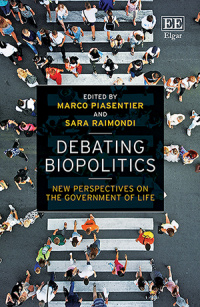
Marco Piasentier and Sara Raimondi, Debating Biopolitics. New Perspectives on the Government of Life. Edward Elgar, 2022

Emerging out of the theoretical and practical urge to reflect on key contemporary debates arising in biopolitical scholarship, this timely book launches an in-depth investigation into the concept and history of biopolitics. In light of tumultuous political dynamics across the globe and new developments in this continually evolving field, the book reconsiders and expands upon Michel Foucault’s input to biopolitical studies.

Featuring rigorously structured investigations into the genealogies, dimensions, and practices of biopolitics, this incisive book introduces novel voices and perspectives into the biopolitical corpus. Contributions from eminent scholars investigate core topics of governing populations, community, and sovereignty, as well as exploring areas that remain undertheorized in the field of biopolitics, including the political accounts of non-human entities, developments in sexual health policy, and the biopolitics of time. Broad in scope, the book draws from the foundations of the biopolitical canon to forge new horizons and create opportunities for novel theoretical and empirical analysis.

Debating Biopolitics will be an invaluable tool for scholars and postgraduate students of political science and political philosophy. Its empirically driven research will also benefit practitioners and policymakers interested in the biopolitical dimension of decision-making and policy analysis.

Contents

Foreword viii
Mika Ojakangas and Sergei Prozorov

Introduction 1
Marco Piasentier and Sara Raimondi

PART I GENEALOGIES
1 Subjectivity in Foucault and Agamben: the enigma of
sovereignty and biopolitics 12
Sara Dragišić

2 Fear, the sovereign, and authority: Roberto Esposito and
the escape from the Hobbesian State 30
Vappu Helmisaari

3 Governing according to nature: Jean Bodin on climates,
humours, and temperaments 49
Samuel Lindholm

PART II DIMENSIONS
4 Glenn Gould’s mastery of not-playing: style and manner in
the work of Giorgio Agamben 68
Katarina Sjöblom

5 Biopolitics of time in Foucault and Agamben 86
Jürgen Portschy

6 Identities on the border 109
Ott Puumeister

PART III PRACTICES
7 Governing by prevention: neoliberal management of
sexual health in France 129
Théo Sabadel

8 Biopolitics of authoritarianism. The case of Russia 151
Anastasya Manuilova

9 Biopolitics, New Materialism and Latin-American
constitutionalism: A linguistic encounter? 171
Gonzalo Bustamante-Kuschel

10 The two faces of biopolitical theory: genealogies and
current approaches 193
Marco Piasentier and Sara Raimondi

terenceblake's avatarAGENT SWARM

Publication of an unpublished book manuscript by Michel Foucault: PHILOSOPHICAL DISCOURSE. Text established by Daniele Lorenzini and Orazio Irrera, under the direction of François Ewald – to be published by Gallimard/Seuil/EHESS, in May 2023

The manuscript dates from 1966, it was written after THE ORDER OF THINGS, published in 1966, and before the publication of THE ARCHEOLOGY OF KNOWLEDGE in 1969.

As will be seen from the table of contents, and as the dating of the writing suggests, this book provides the perfect bridge between those two established works. Further, this posthumously published book is of far more than nostalgic value.

Foucault’s meditations are “untimely” and so may serve again today where we are confronted with a reactionary revision (Domenico Losurdo, Jan Rehmann) in Theory, trying yet again to liquidate the heritage of the great French post-Nietzschean thinkers.

What follows is my translation of the detailed Table of Contents that Daniele Lorenzini…

View original post 901 more words

Vito De Lucia, Beyond anthropocentrism and ecocentrism: a biopolitical reading of environmental law, Journal of Human Rights and the Environment, Vol. 8 No. 2, September 2017, pp. 181–202

https://doi.org/10.4337/jhre.2017.02.01

Abstract
The ‘rise of ecosystem regimes’ is increasingly seen as the key for the resolution of the unfolding ecological crises that are the mark of the Anthropocene. These ecosystem regimes are seen as a crucial passage in resolving environmental law’s internal contradictions and evident shortcomings. Indeed, ecosystem regimes are understood to signal a crucial step in a long progression from anthropocentric to ecocentric articulations of environmental law. This narrative, whether in normative or descriptive terms, informs much, and perhaps most, environmental legal scholarship. In this article I intend to problematize this linear narrative through an ‘analytics of biopolitics’. Situated within the critical space tentatively called ‘critical environmental law’, this approach aims at opening the field of inquiry rather than producing closures. Rather than a simplified, linear narrative of increasing interpenetration between law and ecology – a narrative where law becomes, or ought to become, increasingly ecocentric – an analytics of biopolitics transposed to the specific critical environmental legal terrain aims at outlining the slippages that intervene at the margins of intersection between law and ecology, and at articulating a biopolitical critique of both ‘anthropocentric’ and ‘ecocentric’ articulations of environmental law.

Keywords: environmental law, biopolitics, anthropocentrism, ecocentrism, critical legal theory

Garlen, J.C., Hembruff, S.L.
Children as ‘difference makers’: viral discourses of childhood innocence and activism in #Blacklivesmatter
(2022) Children’s Geographies, .

DOI: 10.1080/14733285.2022.2142037

Abstract
Viral images on social media during the Black Lives Matter protests of 2020 brought heightened attention to the debate over children’s political participation. Therefore, our inquiry sought to discover what the circulation of and response to viral images of children engaged in protest might tell us about the discursive landscapes of childhood in regard to children’s social and political participation. We describe the historical and discursive context that has positioned children’s agency in opposition to innocence. Informed by Foucault’s theory of discourse, we situate Internet virality as a social practice and analyze the videos and still images alongside the accompanying commentary from online news and social media. We ask what these viral image responses reveal about the socially and historically situated construct of childhood innocence and what implications these revelations might hold for adult perspectives on children as political actors and co-participants in social change. We explore themes of participation, privilege, and protection that emerged from a cross-comparison of the video commentary and consider how these themes could inform ongoing efforts to reframe childhood discourse in light of social justice. © 2022 Informa UK Limited, trading as Taylor & Francis Group.

Author Keywords
child activism; child agency; Childhood innocence; social media

Rana, T., Lowe, A., Azam, M.S.
Green governmentality and climate change risk management: the case of a regulatory reform in Bangladesh (2022) Accounting, Auditing and Accountability Journal

DOI: 10.1108/AAAJ-05-2021-5286

Abstract
Purpose:
This study examines green investment reforms carried out in Bangladesh. The reform process curated significant changes by promoting green investment and fostering the adoption of risk management (RM) rationalities. This study’s focus is on revealing changes in behaviour and explaining how RM can act as an effective generator of climate change mitigation practices.

Design/methodology/approach: Building on Foucault’s concept of governmentality, the authors apply a “green governmentality” interpretive lens to analyse interviews and documentary evidence, adopting a qualitative case study approach. The authors explore how green governmentality generates RM rationalities and techniques to induce policies and practices within banks and financial institutions (FIs) for climate change mitigation purposes.

Findings: The findings provide valuable insights into the reform process and influence of RM rationalities in the context of environmental concerns. The authors find that the reforms and creation of RM rationalities affect the management of climate mitigation practices within banks and FIs and identify the processes through which the RM techniques are transformed as climate concerns are emphasised. The authors illustrate green governmentality as persuasive strategies, which have generated specific ways of seeing climate change reality and new ways of inserting RM into organisational activities, through the green governmentality effects they created. These reforms made climate change actionable and governable through the production of RM rationalities, supported by accounting conceptualisations and processes.

Research limitations/implications: The insights from this study can assist with how we act upon questions of climate change from an RM perspective. Governments, policymakers and regulators who develop climate change-related laws, regulations and policies can draw on these insights to help foster green governmentality for climate change mitigation actions informed by RM practices. Originality/value: This study offers insights into how climate change is not simply a biophysical reality but a site of power-knowledge dynamics where RM rationalities are constructed, and accounting processes are transformed. The authors show the application of RM and accounting efforts to change investment practices and how changes were encouraged and promoted by using regulation as a persuasive force on knowledgeable subjects rather than a repressive or oppressive power. The analytic power of green governmentality can be applied to increase understanding of how RM rationality contribute to the creation of useful conceptualisations of climate change and provide insights into how organisations respond to green governmentality. © 2022, Emerald Publishing Limited.

Author Keywords
Accounting for climate change; Climate change; Green governmentality; Green investment; Regulatory reform; Risk management

Nesbet, Anne,
Discipline Made Visible: Abram Room’s The Ghost That Never Returns and the Fantastic Origins of Foucault’s Panopticon (2023) Russian Review,
DOI: 10.1111/russ.12397

ABSTRACT:
In 1967 Abram Room’s film, The Ghost That Never Returns (1929), traveled to the Cinémathèque de Toulouse (France) and was conspicuously featured in the following year at a major festival held in Perpignan. This essay suggests that Room’s film may have been part of what set the scene for the emergence of the “Panopticon”–Jeremy Bentham’s eighteenth-century design for a prison structure that would maximize visibility–in Michel Foucault’s 1975 Surveiller et punir. The film’s French reception (with reviews appearing in Les Lettres françaises and in Midi-Minuit Fantastique between 1968 and 1970) emphasized its status as an example of the boundary-blurring genre of the “fantastic.” It is this article’s suggestion that Abram Room’s prison film and the accompanying French debate about the nature of the fantastic are important facets underlying the Panopticon’s shift from relative obscurity into visibility (or even obviousness) in Michel Foucault’s writings of the 1970s. © 2023 The Russian Review.

Christofidou, A., Milioni, D.L.
Art heterotopias against hegemonic discourses: Dancing the Cyprus conflict
(2022) European Journal of Cultural Studies

DOI: 10.1177/13675494221118385

Abstract
We provide an analysis of dance as a practice and an ‘Other’ space; a counter-hegemonic ‘space’, which is affected by the existing social ordering, while simultaneously resisting it. We employ Foucault’s concept of ‘heterotopia’ to analyse dance’s potential to disrupt and deconstruct hegemonic discourses of the past in a conflict-ridden environment such as Cyprus. We analyse three dance works by choreographers who are living and working in Cyprus, and while we focus on the interrelated dimensions of time, space and the (choreographic) subject, we demonstrate how dance may (1) provide a space to problematize the past and recraft the present, (2) enable the re-signification of places of conflict into places of communication and peace and (3) invite artists to reflect on their subjectivities and transform into agents of peace. © The Author(s) 2022.

Author Keywords
Conflict; Cyprus; dance; heterotopia; peace; resistance

Jeff Justice, Biopolitics of Disasters: Hurricane Irma and Climate Change. Green European Journal, 3 November 2017

Recent hurricanes and natural disasters give rise to the question of how countries and people can recover and where they should get support from. French philosopher and historian Michel Foucault’s concept of biopolitics can reshape how to view human-aided natural disasters and their aftermath.
[…]

Michel Foucault, the 20th century French philosopher, turned theories of governance and human relations on their heads when he introduced his own concept – biopolitics – in the 1970s, one that continues to dominate much analytical discussion on these subjects. The scholarship following his own work offers a variety of interpretations as to what biopolitics actually means, and defining anything Foucauldian can take several chapters in philosophy texts.
[…]