
Foucault News

News and resources on French thinker Michel Foucault (1926-1984)

CALL FOR PAPERS
The twenty-second annual meeting of the Foucault Circle

Emerson College
Boston, MA, USA
May 17-19, 2024

PDF of Call for Papers

We seek submissions for papers on any aspect of Foucault’s work, as well as studies, critiques, and applications of Foucauldian thinking.

Paper submissions require an abstract of no more than 750 words. All submissions should be formatted as a “.doc” or “.docx” attachment, prepared for anonymous review, and sent via email to the attention of program committee chair Patrick Gamez (pgamez@nd.edu) on or before December 18, 2023. Indicate “Foucault Circle submission” in the subject heading. Program decisions will be announced during the week of January 22, 2024.

We expect that the conference will begin Friday afternoon and will conclude around lunch time on Sunday morning. Presenters will have approximately 40 minutes for paper presentation and discussion combined; papers should be a maximum of 3500 words (20-25 minutes reading time).

Logistical information about lodging, transportation, and other arrangements will be available after the program has been announced.

For more information about the Foucault Circle, please see our website:
http://www.foucaultcircle.org
or contact our Coordinator, Edward McGushin: emcgushin@stonehill.edu

Vatter, M. (2019). Liberal Governmentality and the Political Theology of Constitutionalism. In B. Leijssenaar & N. Walker (Eds.), Sovereignty in Action (pp. 115-143). Cambridge: Cambridge University Press. doi:10.1017/9781108692502.006

Summary
‘The king reigns but does not govern’. This formula, which according to Carl Schmitt was coined by Adolphe Thiers, a French liberal historian and politician, enemy of Bonapartism yet suppressor of the Paris Commune, has become today the most important formula in the study of liberalism. Michel Foucault and Giorgio Agamben both understand this formula as capturing something essential about liberalism as a form of governmentality that guides the conduct of individuals either in the absence, or beyond the reach, of the sovereign power and its legislation through normative and normalizing orders that escape democratic control. Although not discussed as such, this formula also underlies recent attempts by jurists and historians of political ideas such as Martin Loughlin and Richard Tuck to bolster the sovereignty of the state against new forms of governing without the state that emerge in neoliberalism. This chapter proposes a new reading of this formula by situating it on the terrain of constitutionalism, rather than on that of sovereignty. In so doing, it seeks to bring together in a meaningful exchange these two different critical approaches to neoliberalism, and the emerging debates they harbour. One debate is between those who advocate a Foucauldian and biopolitical and those who adopt an Agambenian and politico-theological analysis of neoliberal governmentality. The other is the one between advocates of a republican, constitutional approach to democracy and those who argue for the revival of popular sovereignty on the basis of new ‘democratic’ interpretations of Bodin and Hobbes.

Keywords
Sovereignty, Constitutionalism, Political Theology, Neoliberalism, Governmentality, Ernst Kantorowicz

Lemm, Vanessa, and Miguel Vatter. “Chapter 4: Michel Foucault’s perspective on biopolitics”. In Handbook of Biology and Politics, (Cheltenham, UK: Edward Elgar Publishing, 2017) accessed Jul 26, 2023, https://doi.org/10.4337/9781783476275.00012

Abstract
Foucault’s discussion of biopolitics, a term that he began using in the mid-1970s, is closely related to his new theories of power, which have since revolutionized our understanding of this concept. This chapter explains Foucault’s conception of biopolitics, which is now widely adopted in all social sciences and humanities when discussing the relation between politics and biology, from the perspective of his account of power. The chapter explains that biopolitics, for Foucault, describes a new way to govern citizens by considering individuals part of ‘populations’ whose biological lives (from birth to death) need to be managed in order to maximize their strength, well-being, and now ‘resilience’. The chapter also details how, for Foucault, such biological government entails the real peril that certain ‘sub-populations’ may be considered dispensable in order to ‘strengthen’ other sub-populations, a phenomenon which has led in the past centuries to state-based racism, colonialism, and eventually totalitarian forms of absolute domination. The chapter concludes by discussing a more ‘affirmative’ understanding of biopolitics, where biological life is understood as something that resists political domination.

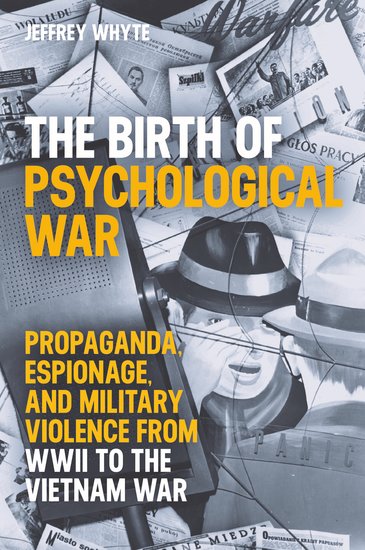
Jeffrey Whyte, The Birth of Psychological War. Propaganda, Espionage, and Military Violence from WWII to the Vietnam War. Oxford University Press, 2023

Open access

Description
The Birth of Psychological War explores the history, politics, and geography of United States psychological warfare in the 20th century against the backdrop of the contemporary ‘post-truth era’. From its origins in the Second World War, to the United States’ counterinsurgency campaigns in Vietnam, Whyte traces how the theory and practice of psychological warfare transformed the relationship between the home front and theatres of war. Whyte interrogates the broader political mythologies that animate popular conceptions of psychological war, such as its claim to make war more humane and less violent.On the contrary, The Birth of Psychological War demonstrates the role of psychological warfare in expanding the scope and scale of military violence amidst ostensible efforts to ‘win hearts and minds’. While casting a critical eye on psychological warfare, Whyte establishes its continued significance for the contemporary student of international relations.

This book makes use of both governmentality as a framework for thinking about psychological war in terms of the circulation of information, and also confession as a way of thinking about how US psychological warfare has constantly attempted to ‘make speak’ and tie individuals to the kinds of truths they are led to formulate about themselves.

Table of Contents
Introduction
1:’A New Geography of Defence’
2:Truth, Territory, Terror
3:Covert Crusade
4:Psywar in Vietnam

Dr Jeffrey Whyte is a Lecturer in International Relations at Lancaster University. He holds a PhD in Geography from the University of British Columbia, and an MA in Communications from Simon Fraser University. His work explores the political history of psychological warfare in the United States.

Gordon Hull, Signal or Noise? Foucault and Communication Theory (Part 1), New APPS: Art, Politics, Philosophy, Science, 13 July 2023

Last time, I offered a quick synopsis of Bernard Dionysius Geoghegan’s excellent new book Code. Here, I’d like to track one specific Foucault reference in it. Geoghegan takes Lévi-Strauss’s Savage Mind as a central text in the ambivalence French theorists came to feel about American communication theories, and he notes that the book “occasioned a broader reassessment of the human sciences marked by a new ascent of ‘coding’ as a key concept poised to dislocate and perhaps dissolve, existing scientific hierarchies” (152). He adds:

“Learning to code – that is, to cast cultural objects in terms of codes, relays, patterns, and systems – did more than reframe existing knowledge in cybernetic jargon. It also reflected a growing cynicism toward existing cultural and scientific nodes. From the 1960s onward, the semiotic task of deciphering obscure ‘codes’ in culture, politics, and science overtook the structuralist project. This crypto-structuralism shifted emphasis from the neutral connotations of ‘communication’ to antagonistic notions of code …. If these terms furthered the technocratic project of US foundations, they also set in motion a radical critique of scientific neutrality. Beneath the neutral science, something ‘savage’ lurked.” (152-3).

Geoghegan cites Lacan, Barthes and the Tel Quel group (on which see Danielle Marx-Scouras’s excellent study). He also quietly footnotes Foucault’s “Message ou bruit [message or noise]” “for a critical discussion of these same terms by Foucault” (215n81).
[…]

Sam Binkley, Against White Interiority. A Racial Critique of Therapeutic Reason, Palgrave Macmillan, 2023

About this book
This book presents a bold critique of the new racial sensibility that has attained global prominence following the police murder of George Floyd. Through a set of managerial and therapeutic discourses, this new sensibility describes the inner racial life of white subjects, inducing them to adopt a therapeutic attitude toward deeply interiorized white emotions and conflicts. In so doing, the new racial sensibility promises to remake whiteness in the image of the self-aware racial ally. However, such an appeal, it is argued, serves the subtle function of the preservation of white racial dispositions, and the reproduction of the very racism it sets out to transform. Adopting a critical lens derived from Michel Foucault’s analysis of sexuality, together with an engagement with sociological, psychoanalytic and phenomenological reflections on shame as a racial affect, a critique of white interiority considers alternative frames through which white anti-racist subjection might be imagined.

Table of Contents
White Secrets: An Uncomfortable Introduction
The New Racial Sensibility
White Shame and Racial Abandonment
Guilt’s Capture
Beyond the Confessing Animal

Giorgi Vachnadze, Mathematics as a Social Practice, Non, 16 July 2023.

[…]
Mathematics is performed.

But the performance is oftentimes an effect, or an unintended consequence of how much power has been delegated to its authority as an institution. The dictatorship of numbers has become a regime of truth and a type of governmentality by way of standardized testing and the contemporary undisputed faith in science that has indeed reached religious dimensions today. Let alone a corrective for common sense, mathematics seems to be a colonizer of common sense. Let us see then, whether Franz Fanon can offer us a way to decolonize mathematics. The first thing that needs to be recognized is that mathematics in its pure form (as opposed to the way it is applied for commercial or even scientific purposes) does not aim to secure wealth. We could at least say this much, that the privileged object of mathematical research is not profit, but Truth with a capital “T”. At the end of the day, most scientists, when hard-pressed with epistemic questions, will eventually rely on mathematics and common sense to account for a grounding or a firm starting point for any scientific method. Mathematicians therefore seem to be the de facto supporters of a very particular type of colonialism. One that is much more difficult to identify, expose, criticize and reform. A monopoly on truth.
[…]

Giorgi Vachnadze, The Algorithmic Unconscious: Psychoanalyzing Artificial Intelligence, Non, 15 July 2023

I recently came across an article that caught my attention. Written just last year. It draws a parallel between AI and psychoanalysis. Which seemed until now two completely divergent fields. It argues that we can psychoanalyze an AI. But how would that make sense? Machine Behavior, an emerging field in “psycho-robotics”, argues that it does.
“We need to study AI systems not merely as engineering artifacts, but as a class of social actors with particular behavioral patterns and ecology (Possati, L.M. 2020).”
[…]

An artificial creativity seems to be the basis for an artificial unconscious. Which in turn serves to allow us to speak meaningfully about a society of Artificial Intellects, or Artificial Actors, Subjects, Citizens etc. This brings us to the idea of a Biopolitics of Artificial Intelligence, a term that does not exist yet, but one that I wish to establish as part of my larger research project concerning Biopolitics. To repeat, this notion does not form any part of Possati’s research, at least not explicitly.
[…]

AI Biopolitics would be a study of the conditions of possibility as well as the social impact of AI on existing power-relations in a given society. How various AI systems would be used to promote class interests, privileged groups, powerful organizations, economic exploitation, warfare, minority exclusion, political agendas etc. The integration of Machine Learning into bureaucratic institutions, government surveillance systems and the police apparatus. Their role in criminality, questions of privacy and their overall function in supporting technocratic capitalism. If AI’s would be given the legal powers of an autonomous citizen, whilst following a set of hidden commands of ideologically biased algorithms, we would be dealing with yet another assault at human freedom and dignity.
[…]

Giorgi Vachnadze, Biometric Technology And The Theory Of Human Capital, Non, 8 July 2023

Authentication and Verification: Defining the Problem
Throughout his career, one of the central concerns for Foucault’s work was to investigate, analyze and offer a genealogical account of truth-telling as a mode of subjectivation. The notion of Biopolitics implies many different ways of conceiving the modern problem of truth-politics and its historical constitution. It is important to understand that truth can no longer be spelled with a capital “T”; it has now become the object of calculation, production and fabrication. Truth has become a consumer-product, it remains relevant only in so far as it can catalyze the accumulation of capital. The modern practices of truth-extraction take one of their more hideous forms, when they begin to operate on human subjects. Biometric technologies are beginning, or perhaps have already begun to play a role of increasing importance in this process. The old Marxist problem concerned with the commodification of human labor has now reached a new level when the body itself risks becoming another item on the menu. One that employers will soon be able to select, compare, assess through risk and purchase for profit. The anthropometric, medico-legal artefacts will allow for the conversion of persons into human-material, a series of bio-mass units with market-value attached to each one. The workers’ average life-expectancy i.e. their health, has a direct impact on the longevity of the firm. It will therefore be “in the interests of” both employees and managers that the company would have access to their medical files. And this is only one out of numerous similar possible scenarios.
[…]

La philosophie de Ian Hacking, avec Matteo Vagelli, July 18 2023