Foucault News

News and resources on French thinker Michel Foucault (1926-1984)

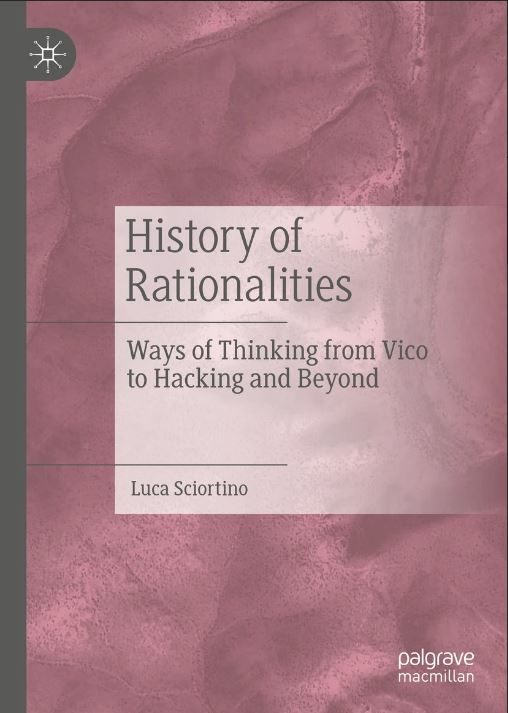
Luca Sciortino, History of Rationalities. Ways of Thinking from Vico to Hacking and Beyond, Palgrave Macmillan, 2023

About this book
Over time, philosophers and historians of science have introduced different notions of ‘ways of thinking’. This book presents, compares, and contrasts these different notions. It focuses primarily on Ian Hacking’s idea of ‘style of reasoning’ in order to assess and develop it into a more systematic theory of scientific thought, arguing that Hacking’s theory implies epistemic relativism. Luca Sciortino also discusses the implications of Hacking’s ideas for the study of the problem of contingency and inevitability in the development of scientific knowledge.

About the author
Luca Sciortino teaches history and philosophy of science at eCampus University (www.uniecampus.it/en) and at Unitreedu Milan. His research focuses primarily on historical epistemology.

McDaid, E., Andon, P., Free, C.
Algorithmic management and the politics of demand: Control and resistance at Uber (2023) Accounting, Organizations and Society

DOI: 10.1016/j.aos.2023.101465

Abstract
Arguably the world’s most iconic platform organization, Uber relies on a disaggregated labour force and a technology application accessible to users on mobile devices. The company contracts with over three million drivers worldwide and has curated an infrastructure of platform-based control characterized by algorithmic processes. The effects of this new wave of control on the driver-led workforce are unclear. Drawing on interviews with 36 Uber drivers, mainly from Australia and France, this research investigates how the ‘gig economy’ workforce engages with platform-based control. We find that the platform organization’s control algorithms operate with strong disciplinary effects. Drawing on Foucault’s concept of self-formation, we examine worker responses to the new order of work. We highlight the way workers engage in practices to ‘take care of oneself’, by enduring, subverting or exiting the conditions of algorithmic management. We find that these practices are related to the distance embedded in the field between management and the workforce. In this way, we argue that the gig economy operates differently upon the ‘governable self’ and urge caution in relation to the use of algorithms to control at a distance. © 2023 The Author(s)

Author Keywords
Algorithmic management; Algorithms; Governable self; Platform organizations; Self-formation; Uber

Sunendar, D., Adriany, V.
‘It’s all about the product’: doing research in neoliberal times in Indonesian higher education
(2023) Globalisation, Societies and Education

DOI: 10.1080/14767724.2023.2212438

Abstract
This article explores Indonesian academics’ experiences in navigating the research process amidst the pressure of neoliberal ideology in higher education institutions in the country. Using Foucault’s concept of governmentality, this study seeks to understand how research schemes in Indonesia operate to self-discipline academics. Hence, they become neoliberal individuals that serve the interest of the market. This research adopts a qualitative design with ten academics from a university in Indonesia participating in it. Using interviews and focus group discussion, the result yields the intersection between positivism, knowledge economy and neoliberalism in shaping the research agenda in Indonesia. The findings suggest how research schemes in Indonesia focus on the research product that can be measured and marketed to the industrial sector. The findings also demonstrate the pervasiveness of the audit regime that constantly monitors Indonesian academics to conform to the neoliberal agenda. This article serves as an invitation for policy makers and academics to rethink research beyond the neoliberal agenda. © 2023 Informa UK Limited, trading as Taylor & Francis Group.

Author Keywords
governmentality; higher education; knowledge economy; neoliberalism; positivism; Research

PhD Course: Foucault and Organization, Technology, and Subject-formation.
11th September – 14th September, 2023

Registration Deadline
Monday 7 August 2023 at 09:00

Organizer
Copenhagen Business School. PhD School
Nina Iversen
Phone: +45 3815 2475
ni.research@cbs.dk

Michel Foucault’s work continues to offer a major source of inspiration for PhD projects across a wide range of disciplinary domains. This PhD course explores how Foucault’s work speaks to three broad themes in contemporary business school research and beyond: Organization, technology, and subject-formation. The lecturers on the course have all pursued substantive research on these themes, drawing upon different parts of Foucault’s authorship, and they will base their teaching on this research experience. Overall, we will explore how Foucault’s thinking can help to inquire into the organizations, technologies and techniques of self-formation that make up the conditions of possibility for our contemporary experiences. A key aim of the course is that the participants acquire an effective overview of analytical possibilities in Foucault’s work, effective for selecting and deploying such analytics in their own research.

More information and registration: https://phdsupport.nemtilmeld.dk/38/

Course coordinator:
Kaspar Villadsen, Department of Business Humanities and Law (BHL)

Faculty

Professor Sverre Raffnsøe
Department of Business Humanities and Law, CBS

Associate Professor Marius Gudmand-Høyer
Department of Business Humanities and Law, CBS

Professor (mso) Kaspar Villadsen
Department of Business Humanities and Law, CBS

Prerequisites

Only PhD students can participate in the course.
Participation requires submission of a short paper (see more below). Papers must be in English and deadline is 1st September 2023.

It is a precondition for receiving the course diploma that the PhD student attends the whole course.

Aim

The course will provide the participants with:
a) An introduction to key analytical potentials reconstructed from Foucault’s wide-ranging authorship as well as the lecturers’ own research projects.

b) In particular, we will discuss different approaches to themes of organization, technology, and subject-formation as they are deployed in state-of-the-art Foucault-inspired scholarship.

c) The potentials and limits of the particular way Foucauldian analytics can be applied in the participant’s research will be discussed. Hence, a range of analytical resources and potentials will be explored and discussed in relation to the participants’ current research.

Wallrup, E.
On patheme: affective shifts and Gustavian culture
(2023) Journal of Aesthetics and Culture, 15 (1)

DOI: 10.1080/20004214.2023.2209945

Abstract
Despite the attention that the affective sphere has reached in the last decades, affectivity has generally been supposed to be a consequence of historical processes, not changing their direction. This article argues instead that affectivity can be a driving force in historical change, and it establishes the concept of “patheme” in relation to Michel Foucault’s “episteme”, Martin Heidegger’s “history of being” and the notion of regime in William Reddy, Jacques Rancière and Peter de Bolla. What is described as a pathemic change took place in the thoroughgoing affective transformation of European culture during the 18th century, a cultural change that in Sweden was condensed into much more compressed shifts during the Gustav III’s reign (1772–92). This latter period is bestowed an investigation grounded in an understanding of historical processes that considers the interplay between layers such as power relations, social conditions and modes of scientific thought along with affectivity. The interplay is described in terms of polyphony. © 2023 The Author(s). Published by Informa UK Limited, trading as Taylor & Francis Group.

Author Keywords
18th-century culture; affectivity; emotional regimes; episteme; historical processes; Patheme

Michael Ledger-Lomas, Tracing the Hard Edges of Religion: On Peter Brown’s “Journeys of the Mind” Los Angeles Review of Books, 6 June 2023

[…]
No historian has evoked more vividly the strange waltz between a transcendent faith and earthly powers in the centuries from Constantine to Muhammad (a period the book’s author named “late antiquity”) than Peter Brown. Journeys of the Mind: A Life in History is a gripping new memoir about how he came to do it.
[…]

In recovering the social and cosmic payoffs to self-abnegation, Brown posited the kind of paradoxes that had startled Michel Foucault’s readers. His sympathetic portrait of Foucault and his friend Paul Veyne cast them as allies in his quest to fissure the present’s easy identification with past persons. If he voices a criticism of Foucault’s History of Sexuality (first volume, 1976)—especially its final, long unpublished volume (2018)—it is that its philosophical commitments prevented its author from fully rendering the alien theologies that sculpted Christian flesh.
[…]

Rust, J.R.
Ad Salutem Publicam: public health and pastoral government in More’s Utopia (2023) Textual Practice

DOI: 10.1080/0950236X.2023.2205708

Abstract
Discourses of health and disease pervade More’s Utopia. The text insistently plays upon the ambiguities of salus, a term with a wide semantic range including spiritual salvation, the physical health of the individual body, and the wider welfare of the commonwealth. More’s text draws on this network of metaphors of health, disease and medicine to transfigure forms of Christian pastoral government in a radical experiment in state governmentality. The Utopian hospital is a microcosm of the Utopian project, yet its prominence in the spatial structure of the ideal republic reveals tensions between individual and collective forms of care. More’s text can be productively put into dialogue with Foucault’s analysis of the Christian pastorate as a significant precursor to liberal governmentality and modern medical institutions. More and Foucault illuminate the long pastoral legacy of medical institutions, including the hospital as a governmental space with utopian and dystopian possibilities. © 2023 Informa UK Limited, trading as Taylor & Francis Group.

Author Keywords
biopolitics; governmentality; medicine; pastoral; salvation; Utopia

Heylen, K.B.
Enforcing platform sovereignty: A case study of platform responses to Australia’s News Media Bargaining Code
(2023) New Media and Society

DOI: 10.1177/14614448231166057

Abstract
Australia’s News Media Bargaining Code requires Google and Facebook to negotiate payments with news publishers for news content appearing on the platforms. Facebook and Google lobbied against the code through a highly visible public-facing campaign which included a series of blogs, videos and pop-up communications across their interfaces including News Feeds, Google Search and Home Page, and You Tube, and culminated in Facebook banning Australian users from accessing Australian news and related content. This article presents the findings of a detailed study of platform discourse in response to the News Media Bargaining Code, using critical discourse analysis, and drawing on theoretical frameworks from Althusser, Foucault and Chun. It also investigates the role of the user interface in platform power, particularly how platform users are interpellated by digital platforms. The findings suggest Facebook and Google’s discursive strategies were deployed to protect, strengthen and enforce platform sovereignty. The case study offers lessons for platform regulation globally in understanding how platforms respond to legislation. © The Author(s) 2023.

Author Keywords
Digital platforms; Facebook; Google; news media bargaining code; platform regulation; platform sovereignty; user interface

Ashley, L., Perron, A.
Examining the role of nurse executives in homecare through the lens of the Sociology of Ignorance and Critical Management Studies
(2023) Nursing Philosophy

DOI: 10.1111/nup.12445

Abstract
This article presents a novel theoretical approach to explore nurse executives’ paradoxical identity and agency of executive and nurse in homecare organizations. This complex phenomenon has yet to be well theorized or analyzed. Through a synthesis of literature, we demonstrate that Critical Management Studies, as informed by Foucault, and the Sociology of Ignorance, can create a different understanding of the complex interplay between knowledge and nonknowledge (ignorance) that positions nurse executives in both influential and precarious ways in homecare organizations. This theoretical framework has the potential to allow for the explicit exploration of nurse executives’ strategic epistemic and discursive positioning and highlights hierarchal power structures within homecare organizations. We posit that this framework, that spans nursing, management and sociology disciplines, sets a different understanding of homecare organizations as epistemic landscapes, exposing institutional knowledge and ignorance dynamics that remain largely concealed and unchallenged, yet are integral to understanding nurse executives’ epistemic agency. © 2023 The Authors. Nursing Philosophy published by John Wiley & Sons Ltd.

Author Keywords
Critical Management Studies; homecare; ignorance; knowledge; nurse executive; Sociology of Ignorance

Index Keywords
article, conceptual framework, home care, human, nurse, nursing management, organization, sociology, synthesis

Harrahill, K., Macken-Walsh, Á., O’Neill, E.
Prospects for the bioeconomy in achieving a Just Transition: perspectives from Irish beef farmers on future pathways
(2023) Journal of Rural Studies, 100

DOI: 10.1016/j.jrurstud.2023.103020

Abstract
Many beef farm systems in Irish and some global contexts have economic and environmental traits that threaten their future sustainability. In this context, the concept of Just Transition for economically vulnerable agricultural sectors is of interest, and, in particular, the bioeconomy is identified as potentially providing new sustainable income streams for farmers. This paper presents an analysis of six case-study beef farmers in Ireland, undertaken using a biographic narrative method. It examines the subjective experiences of beef farmers and their perspectives towards the bioeconomy as an option for farm diversification and its potential to deliver a Just Transition. The narrative data were analysed using Michel Foucault’s framework of power, which was applied to be attentive to how existing normative knowledges, discourses, and subjectivities intersect with nascent concepts such as the bioeconomy and Just Transition. Through in-depth case-studies of beef farmers, we aim to understand how and whether they are likely to become involved in the bioeconomy. Our analysis shows that the case-study farmers are mainly concerned about power imbalances in beef value chains. Most participants were unfamiliar with the bioeconomy, which currently primarily involves a limited number of dairy farmers in Ireland. However, the bioeconomy was viewed by t case-study farmers as a development that could potentially generate new income streams for farmers. Several factors were identified as contextually relevant to achieving that potential. Collaborative bodies such as cooperatives or Producer Organisations were viewed as influential in enhancing the positioning of farmers within value chains and facilitating the inclusion of beef farmers in bioeconomy activities. Addressing the root causes of the economic vulnerability of beef farming was also identified by case-study farmers as necessary for advancing the bioeconomy; otherwise, it was perceived, existing power imbalances would be replicated. © 2023 Elsevier Ltd

Author Keywords
Beef producers; Bioeconomy; Foucault; Just transition; Power